


|
|
|
|
 |
 |

|
cricket
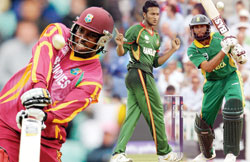
Stars to watch
To be or not to be
caption
cricket ICC: enemy number one? Pakistan’s cricket chiefs suspect that the world is against them. Is this suspicion based on real facts? Or is it just paranoia? By Khalid Hussain In the
aftermath of the 2010 spot-fixing scandal, Pakistan’s cricket bosses
directed their guns on Haroon Lorgat, the then chief executive of the
International Cricket Council (ICC). Ijaz Butt, who headed
Pakistan Cricket Board (PCB) at that time, was never really a fan of
Lorgat — a chartered accountant of Indian origin. And after what
happened following the spot-fixing scandal involving three key Pakistan
players, Butt saw Lorgat as an enemy of Pakistan cricket. Relations between Butt
and Lorgat became so tense that in September 2010, just weeks after the
Pakistani trio was caught red-handed during their tour of England, the
PCB chief demanded that ICC should sack Lorgat. The demand came soon
after Lorgat launched an investigation into the third One-day
International between Pakistan and England over suspicions of
match-fixing without first taking PCB in the loop. Those were tense days.
There were calls from various quarters for Pakistan’s suspension from
world cricket following the spot-fixing case against their players.
Things seemed bleak for Pakistan cricket even before the
morale-shattering scandal involving Salman Butt, Mohammad Asif and
Mohammad Amir as international teams had stopped visiting the country
because of security fears. With no home matches, PCB’s bank account
was depleting and its desperation was rising. A new front against the
game’s governing body was the last thing Pakistan needed. But Butt
never saw it that way. He saw Lorgat as an enemy and tried to go after
him. But his demand for the sacking of Lorgat went unheard as the South
African stayed on for two more years before stepping down earlier in
2012. History may be about
to repeat itself. Information gathered
from well-placed sources by ‘The News on Sunday’ suggest that the
current PCB top brass is moving towards a similar confrontation with
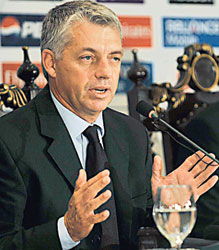
Dave Richardson, the man who succeeded Lorgat as ICC’s chief
executive. The Johannesburg-born
Richardson is a former South African Test player who has been associated
with the ICC for the last ten years. Early this summer, he was elevated
from the post of General Manager to Chief Executive after Lorgat opted
to step down. The reason why PCB
kingpins, according to reliable sources, don’t trust Richardson is
remarkably similar to the reason why Butt disliked Lorgat. “Senior PCB
officials suspect that Richardson has close ties with Indian cricket
chiefs,” said a source. “In fact they are of the view that it is an
open secret that the powerful Indian lobby was behind Richardson’s
appointment as ICC’s CEO to push its own agenda through him.” Two recent happenings
have reinforced PCB’s views that Richardson is not a friend of
Pakistan cricket and that he takes his orders from the Indians. On August 30, PCB was
left fuming when Saeed Ajmal — regarded as the world’s best spinner
— was ignored for the shortlists for ICC annual awards to be held in
Colombo on September 15. Ajmal, the dreaded Pakistani off-spinner, was
included in the initial lists of nominations and was seen by many as a
favourite to win the world player of the year award. Miffed by the snub,
PCB lodged a strong protest with the ICC but the game’s governing body
made it clear that it cannot do anything about it because the awards
process is being handled by an “independent body”. The face-off is
now threatening to snowball into a major confrontation as PCB is
planning to boycott the awards ceremony in case Ajmal is not included in
the shortlist. The other happening is
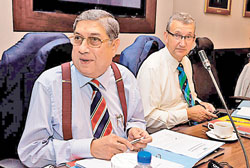
not as public but PCB bosses see it as another piece in the jigsaw. Last week, Richardson
had a meeting with Indian cricket chief N Srinavasan. The meeting that
was held in a posh Chennai hotel surprisingly went largely unnoticed by
the Indian media but sources say that Richardson and Srinavasan held a
lengthy discussion over the “roadmap for world cricket”. There is this feeling
among Pakistani cricket authorities that “the ICC chief executive went
to India to ask BCCI whether he can do anything for it”. Under Butt, PCB
officials felt just the same way about Lorgat, whom they thought played
in India’s hands. The problem with PCB
is that over the years the people running it have become obsessed with
the idea that the Indians are behind everything that is wrong with
Pakistan cricket today. Publicly, they won’t express these conspiracy
theories but privately most of them will tell you that various elements
in the Indian cricket fraternity want to destroy Pakistan cricket. “Most of the Board
officials suspect that the reason why their efforts to bring
international back to Pakistan have failed to achieve desired results
because the Indians are working secretly to spoil them,” said another
source. That’s precisely the
reason why Pakistan’s cricket authorities see Richardson as a pawn in
Indian hands. “Some of the senior
Board officials doubt that Richardson would do anything substantial to
help out PCB, especially in its bid to bring international cricket back
to Pakistan,” said a source. The feeling that
ICC’s new boss doesn’t have any soft spot for Pakistan cricket is
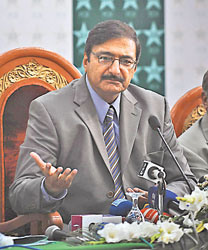
certainly not a good one for Zaka Ashraf, the PCB chairman, and his
senior officials. Unlike Butt, Ashraf enjoyed cordial relations with the
ICC when Lorgat was still around. If fact, things seemed to be moving in
the right direction with a task force appointed by the ICC taking a keen
interest in helping out Pakistan cricket. However, PCB now suspects that
things could change for the worse with Richardson at helm. So are these
suspicions based on real facts? Or is it just paranoia? It’s a bit hard to
tell. It’s an open secret
that as world cricket’s richest board, BCCI has accumulated a lot of
powers over the years. In fact, it openly calls the shots when important
cricketing matters come up for discussions. It even bullies the ICC
whenever the need arises. But can a chief
executive of a major international body like the ICC be on the beck and
call of the Indians? I don’t think so. Here, our cricket officials
sound a bit paranoid. The reason why Pakistan stand quite isolated in
world cricket could be weak diplomatic skills on their part. Ijaz Butt
certainly lacked such skills. Zaka Ashraf has fared better but is yet to
achieve anything substantial. And if under his watch, the PCB manages to
pick up an unnecessary fight with the ICC chiefs like his predecessor,
it would only add to the woes of Pakistan cricket. Richardson may not be
a friend of Pakistan cricket. But he may not be an enemy either. Let’s
not decide on the basis of suspicions alone. Pakistan cricket is already
fighting on many fronts. PCB, meanwhile, is spreading too thin in spite
of a big workforce because it doesn’t have many competent people to
run it in a professional manner. The wise thing to do
is mend fences whether it’s with the ICC or BCCI. Ashraf’s success
in lining up a brief series against India is a step in the right
direction. Let’s not spoil it. Ajmal may not be in contention for
world player of the year award. But in the eyes of his fans he already
is the world’s best cricketer. Who cares about that little trophy when
he is regularly getting us the wickets. After all, that’s what really
matters. Khalid Hussain is
Editor Sports of The News, Karachi Khalidhraj@gmail.com
Keys
to unlock the World Cup Excitement
reaches its highest level when the cricketing world experiences a T20
match between any two teams of the world. In the coming few weeks the
world will experience the T20 world cup for the fourth time as all the
Test nations along with a few associates compete for the Twenty20 crown.
It is usually thought
that this format suits the younger generation of cricketers, who are
fearless, aggressive and flamboyant. But what cannot be ignored is the
fact that the senior players who on paper would not look so ready for
the fast T20 competition can indeed be the key to glory in the upcoming
World Cup being held in Sri Lanka. Following are some key players who
can take their countries to glory with their experience and sharp
cricketing minds. SHOAIB MALIK
(PAKISTAN) Malik has been an on
and off character in the Pakistani dressing room, but has always worked
his way back into the playing eleven, be it ODIs, Tests or T20s. Dav
Whatmore, the new Pakistani coach, insisted to play him in the T20
format regularly for his ability to adjust to conditions and scenarios
in a glance. Malik’s stats are
not so great, but over the years he has proved to be a key component of
the team by being able to bat at any position, bat aggressively as well
as defensively, to pitch in 1 or 2 overs economically and set examples
in the field through his brilliant fielding abilities. Inzamam-ul-Haq is
reported to have said that Malik was the strongest and smartest
cricketing brain in the dressing room when he left the game. He was the
captain of Pakistan in the first T20 world cup in which the greens
finished in the final. His experience is surely to be a key for the
middle order of Pakistan, and also a helping hand in the strategic
decisions to be made on the field. MAHELA JAYAWARDENE
(SRI LANKA) The Sri Lankan
captain, who a few months back celebrated his 35th birthday, is quite
possibly Sri Lanka’s most dangerous weapon. Over the years he has seen
new heights. The loads of experience that he brings provides Sri Lanka
with a golden think tank. For those who did not
believe in his ability to hit the ball, the recent SLPL and the last two
IPL editions must have been convincing. The man’s strike rate in T20s
is a staggering 130 plus with and he has an average of 32. Mahela took control of
the new format with ease and since then has been an eye candy for all
the orthodox viewers. Who says you have to slog to hit sixes and fours?
Mahela is still playing international cricket! His class with the bat is
surely to be a key for Sri Lanka to open the door to world cup glory in
their hometown. JACQUES KALLIS (SOUTH
AFRICA) There is just so much
beauty in his batting that it is almost inevitable to mention his name
in such lists. His records are so great that even the word
‘brilliant’ is not sufficient for him. His ability to keep it classy
is unmatched. His bowling abilities have gone down slightly for the past
few years, but the 36-year-old all rounder is always able to bowl it
straight and get a nick here and there and keep things tight. His
exclusion from the previous T20 tournaments have proven costly for the
Proteas. Kallis is surely going
to prove a point this time around, as the backbone in the middle order
which is not only hard to break but as dangerous as any Gayle or Afridi
out there. His ability to hit the ball around in the short span of 20
overs has been tested in the IPL, and he surely passed it with flying
colours! DANIEL VETTORI (NEW
ZEALAND) The perfect example of
a left arm orthodox bowler who can turn the situation around just by
using his brain. Vettori might not have the doosra or a googly, his
ability to play with batsmen’s minds has been awe-inspiring for many
years. With all the variations under his belt, he is surely the black
cap’s strongest and most lethal weapon. Only time will tell if Dany
can still play the flute to move the batsmen like rats. Michael Hussey
(AUSTRALIA) At 37, Hussey could
very well be the oldest player to be playing the upcoming world cup. His
ability to win matches has been seen various times in the past. What the
Australians need is a combination or a player that can put fear in the
hearts of their opponents. Hussey is one of those players. A master in
tackling batting collapses through solid counter attacks. He is able to
conjure up the illusion that a crisis situation is not being tackled,
but is being ignored. Everyone remembers the last world cup semifinal
between Australia and Pakistan. Hussey is easily the Aussies key to
world cup glory. moheet@gmail.com
Stars
to watch There will be
a galaxy of stars in action at the ICC World Twenty20 which begins in
Hambantota on September 18. Although it is played more frequently than
the 50-over World Cup — that is, after every two years instead of four
years — it is more keenly awaited by cricket buffs around the world. People have begun to
place bets on who will be the star performers in the 20-day competition
in Sri Lanka. Although I have no inclination towards betting, I am too
inclined to make a guess of who will be shining in the island country.
So here are my picks for the 12-team affair. Dwayne Bravo: This man
is still young — about 29 years old — but has got loads of talent,
both with the bat and the ball. He has an excellent strike rate of over
130 runs and an equally brilliant average of over 27 runs. He has the
ability to hit sixes, which is a must for success in the shortest format
of the game. He has hit 22 sixes in 27 T20 International he has played. He is similarly
impressive in the bowling department. His wicket-taking ability will be
of a lot of advantage to the West Indian captain. Chris Gayle: Perhaps
the most fearsome batsman in the world of cricket, Gayle has recently
returned to international cricket after resolving the issues with the
West Indies’ cricket chiefs. He is among the highest priced players in
T20 leagues around the world. His attacking batting can devastate any
team in the world — he has a strike rate of over 143 runs and an
average of 36. And he is among the few century-makers of Twenty20
cricket. If he gets going, particularly while chasing a target, it will
be very difficult, if not impossible, to defeat the West Indians. Shakib al Hasan: Since
his arrival on the international cricket scene, not only have the
Bengalis begun to put up fight, they have in fact started winning
matches. He has been the main character in almost all of the Bangladeshi
successes. Though he plays for
Bangladesh, he would have represented Australia, South Africa or England
if he were born in any of these countries. Such a talent! He is a resilient
batsman and a guileful spinner. Who can forget his fighting knock
against Pakistan in the recent Asia Cup final! The rival captains and
coaches will have to think hard to tackle this young man if they are to
defeat the Bangladeshis. Tamim Iqbal: It was
Tamim Iqbal who pushed Bangladesh to the final of the recent Asia Cup.
He scored four half centuries in four matches to prove the selectors
wrong who had initially dropped him saying he was unfit. He was the
second most successful batsman in the event, much ahead of seasoned
players such as Tendulkar, Sangakkara and Jayawardene. Though his strike
rate is only 100 — somewhat low in T20 cricket — his six-hitting
skills are proven. He has 45 sixes in 113 one-day matches. It will be
very difficult for other teams to contain Bangladesh if he manages to
provide solid starts as he did in the Asia Cup. Hashim Amla: This
bearded young man is a run-scoring machine. He was unstoppable during
the recent Test and one-day series against England. If he manages to
carry on that form into T20 cricket, there is no reason why South Africa
should not go on to score over 200 runs. His is the orthodox style of
batting, but still he has got ODI and T20I strike rates of 91 and 109,
respectively, which shows that he can be very helpful to the South
African captain for setting big totals or chasing them. mushfiqahmad1000@gmail.com
To
be or not to be The issue
regarding holding of the National Games has disturbed our countryís
sports fraternity, already divided on the matter of implementation of
the national sports policy following Supreme Court’s verdict that came
on May 8. As the Punjab
government has not yet released funds to the Punjab Olympic Association
due to various factors, the provincial Olympic body’s representative
Khwaja Idrees went to the Pakistan Olympic Association’s office on
Wednesday and sought a few more days for confirmation of the Games which
are scheduled to be held in Punjab from October 16-22. Punjab Olympic
Association says the Punjab Chief Minister Shehbaz Sharif has assured
them of a grant and they will wait till the minister returns from
London. But well-placed
sources claim that the Punjab government has already prevented Sports
Board Punjab from cooperating with the Punjab Olympic Association in
holding of the event in the province which has been holding the youth
festival for the last several days and which will continue till
November. Sports Board Punjab
stated a few days back that Punjab Olympic Association was an illegal
body and therefore could not conduct the games. This statement showed
that the Punjab government has pressed the Board that the Games should
not be held until the general elections are held in the country. The motive behind this
move of the Punjab government seems to be that if the Games are held
under the current government they will be definitely opened and closed
by the country’s top dignitaries, the president and the prime
minister, as per tradition. Why should the Punjab government support an
event whose opening and closing ceremonies could be graced by its
staunchest political rivals? Punjab Olympic
Association has also decided to hold a meeting of the secretaries of the
national sports federations on September 13 in order to discuss the
modalities of the extravaganza. But the organisers’
wait for the Rs50 million grant will be fairly long. One of the stronger
stakeholders of the Games is willing to knock at the doors of the court
against the spectacle as the said person feels that the event is being
held by illegal persons. Khyber Pakhtunkhwa and
Sindh have said that they are ready to assist Punjab and if the Punjab
Olympic Association is unable to hold the event they are ready to
organize it on a short notice. But a question arises:
are the National Games really indispensable? Having covered the last few
editions of the games, I have come to the conclusion that there is no
utility of holding these Games. They are conducted only for making money
by the organizers and nothing else. On the last two
editions held in Karachi in 2007 and in Peshawar in 2010 around Rs140
millions in aggregate was spent but without any output. After the
devolution responsibility of developing sports in the country rests on
the shoulders of the provinces. Instead of spending
huge money on the useless National Games, if such a grant is used on
constructing and developing infrastructure for different sports
disciplines, it would help the country’s sports to progress in the
right direction. The country’s
sportsmen don’t have the facilities of tartan track, swimming pools
and gymnasium for indoor sports and grounds for out-door sports. There
is a dire need for more sports complexes in the country where the
competitions in majority of the disciplines could be conducted. There is
one such complex in Islamabad and Peshawar has also recently developed
one by spending a huge amount. There is no
competitive environment in the National Games and one could see that
Army, the undisputed champions, have been ruling the spectacle since
1956. No proper facilities
are given to the athletes during the week-long Games but on the other
hand the POA officials are extended VVIP treatment and are usually
boarded at the five-star hotels. These officials are
even not aware of the performance of the country’s athletes in these
competitions. It would be right to say that huge money is spent only on
the opening and closing ceremonies to show to the world that Pakistan is
doing a good job by promoting its sports. The Games are also
held without any proper planning. The provinces field their athletes
blindly, without any proper talent hunt schemes and without organizing
the Inter-School and Inter-Collegiate Games which are absolutely
necessary for picking athletes for the extravaganza. Moreover, there is no
accountability system and never have the organizers been booked for
misusing the money of the nation released for the competitions. Usually the provinces
assist their respective Olympic associations in organising the National
Games so they should also ensure the audit of the accounts of the Games
as some organizers have been suspected of making huge money in holding
the spectacle. There is a need for a
proper accountability system through which the corruption of the
organizers could be unearthed. Some provinces have also unveiled their
plans of holding camps for the National Games without knowing whether
the spectacle could really be held. In the current
scenario, the holding of the Games is not suitable as the country’s
sports officials are fighting with each other following the POA
elections and the Supreme Court’s decision regarding the
implementation of the sports policy. Ministry of the
Inter-Provincial Coordination is responsible for implementing the sports
policy, particularly the tenure restriction clause, the real bone of
contention. A former top sports
administrator has even filed a writ petition in which he complained that
the government is not acting according to the apex court’s decision. In a nutshell, it
would be better to suggest that the National Games have nothing to do
for the promotion of sports and the money spent on it should be diverted
to some projects that could help promote the sports. And if the
authorities are detrmined to hold the games, they are advised to first
resolve the other pending issues,following the Supreme Court’s
decision and then go for the Games at a suitable time. 73.alam@gmail.com
THE
CHAMPION! Fans watch as Ireland's Mark Rohan wins Men's Individual H1 -
Road Race during the 2012 Paralympic Games at Brandsds Hatch racing
track in south east Engalnd on September 7, 2012. In the H1 class
catergory athletes have limpariments to their legs and race using a
hand-cycle |
|