


|
|
|
|
 |
 |


|
Why
Pakistan can regain World T20 crown With a just couple of days left before the
2012 edition of ICC World Twenty20 gets underway in Sri Lanka, the
question on every Pakistani cricket fan’s mind is can Hafeez and Co
win back the coveted title? There is no safe answer to this question. There are
so many reasons why Pakistan can win the title on October 7 but there
are also several reasons why they might not do that.
Shahid Afridi’s critics are sharpening
their knives as Pakistan go into the ICC World Twenty20 championship in
Sri Lanka with their former captain battling a lean patch. Afridi,
regarded by many as one of the most lethal allrounders in the shortest
format of the game, has not been in his element in recent times as he
has flopped miserably with the bat while his bowling form has also taken
a dip. To make matters worse, Afridi has also been experiencing a few
fitness issues that dogged him in the recently-concluded limited-overs
series against Australia in the UAE.
Favourites
yet inconsistent Twenty20 cricket is always thrilling. Minor
mistakes on the part of any team can hugely benefit its opponents. And
it is the game of young guns, at least most of the times. The
hit-and-run type of format demands more than 100 percent strike-rate
from the batters. In this format batsmen don’t exactly have to be
technically correct, they just have to be able to hit the ball as hard
as possible and score as fast as possible and for as long as possible.
But this type of cricket reduces the gap between a good and technically
sound batsman and an ordinary player. The fourth edition of the Twenty20 World Cup is
starting from the 18th of this month. India, Pakistan and England have
lifted the previous three trophies.
Going
with the flow When Zaka Ashraf took over as Pakistan’s
cricket chief, I had my doubts about his credentials. With little or no
cricketing experience, Ashraf was installed as PCB chairman at a time
when Pakistan cricket was at its lowest ebb. He had succeeded Ijaz Butt,
the man who made a mess of PCB’s damage control campaign following the
2010 spot-fixing scandal. Under Butt’s watch, Pakistan saw one of
sport’s worst tragedies taking place on its soil when the Sri Lankan
cricketers and several Pakistanis, mostly cops, became victim to a
brazen terrorist attack in Lahore. With international teams refusing to visit Pakistan
and some experts calling for its suspension from international cricket,
the stage was set for some well-respected, able and competent sports
administrator to rescue Pakistan cricket. Zaka Ashraf just didn’t fit
the bill. In the name
of democracy The present government has been an avid
promoter of democracy and champions fairness and equality as enshrined
in the 1973 constitution of Pakistan. According to them, all their political moves are in
the interest of democracy. However, one undemocratic act which warrants
notice is the role of the Patron in the governance of the Pakistan
Cricket Board. It is no hidden fact that the cricket board, ever
since its inception, has faced several crises, not only relating to the
national team’s performances but also several administrative ones. A glaring violation of the principles of democracy
is apparent in the role of the Patron in the governance of the cricket
board. The patron is an ex officio post whereby any president of
Pakistan automatically assumes the role of the Patron with unfettered
powers to appoint the Chairman and so on and so forth, completely
against the working of a democratic setup. Squash heroes in the land of legends I happened to
brush shoulders with Qamar Zaman, Jonathan Power, Ross Norman, David
Palmer, Rami Ashour, and Geoff Hunt, all legends of Squash, at the
Second Asian Masters Championship held in Lahore from September 3 to 6. They were all content
with the security measures, as they were escorted by huge number of
police officials. It was not surprising then that they visited the Wagah
border between Pakistan and India. During a 30-minutes conversation with
Australian Geoff Hunt, I asked every thing I could ask about the game. Hunt said that Australian squash is going through the same crisis as Pakistan’s. “I see Pakistan’s juniors are good, they only have to play more international events. Low dedication is a problem. You need to develop the game. Systems have to be set right and it’s not easy in squash. Keep striving for the betterment,” he said.
Why Pakistan can regain World T20 crown Mohammad Hafeez and his boys can go all the way provided their strengths overcome the team’s minus points By Khalid Hussain With a just couple of days left before the
2012 edition of ICC World Twenty20 gets underway in Sri Lanka, the
question on every Pakistani cricket fan’s mind is can Hafeez and Co
win back the coveted title? There is no safe answer to this question. There are
so many reasons why Pakistan can win the title on October 7 but there
are also several reasons why they might not do that. Three years ago, it was Younis Khan who captained
Pakistan to a memorable title-winning triumph at the 2009 championship
in England. Before that, Shoaib Malik led the national team to the final
in South Africa in 2007 before a heart-breaking loss against India in
what was an explosive clash for the inaugural title. Shahid Afridi was
at the helm for Pakistan at the previous edition of the World Twenty20
championship in 2010 in the Caribbean where the Green-shirts fell to
Australia from a seemingly winning position in a thrilling semifinal. Pakistan have made the last four at all three of the
tournament’s previous editions. Their record as one of the most
successful teams in the shortest format of the game, earns them an
automatic place among the major title contenders this time again. The
fact that they have some of the most accomplished Twenty20 cricketers
make them look pretty good, at least on paper. These are some of the
obvious reasons why their fans expect nothing less than the title from
Hafeez and his men. But first let’s discuss the reasons that could dog
Pakistan in their quest for the crown in Sri Lanka. THE WEAK LINKS Though Pakistani selectors have tried to bolster the
team’s batting with the induction of several allrounders, there are
too many ifs and buts surrounding their selection. Players like Shoaib
Malik and Abdul Razzaq are back in the squad after being discarded as
spent force in the aftermath of Pakistan’s unsuccessful World Cup
title bid last year. There is no doubt that both Malik and Razzaq are
accomplished campaigners especially in limited-overs cricket but there
is a big question mark on whether they still have enough fire in their
belly to be able to give their best in Sri Lanka. Malik flopped on his return to national duty during
the series against Australia in the UAE. Razzaq, too, hasn’t really
justified his selection. He did give glimpses of his past brilliance by
helping Pakistan win the second Twenty20 International against the
Aussies in Dubai in the Super Over but whether Razzaq can perform
consistently in the tournament remains to be seen. Imran Nazir is also a controversial choice. The
big-hitting opener has a habit of failing when it matters most though
his fans might think otherwise. He just made 23 in three outings against
Australia in conditions that were far from being batting unfriendly. The fact that Mohammad Sami will go into the T20
World Cup without getting a single opportunity to warm up during the
series against Australia speaks volumes about the team management’s
confidence in the fast bowler’s abilities. Sami was chosen ahead of
young pacer Junaid Khan purely on the basis that he is much faster than
the left-armer. Sami’s brilliant exploits at the inaugural Bangladesh
Premier league earlier this year also helped his cause. There is little
doubt that on his day Sami can be a lethal bowler, especially in
Twenty20 games. But he needs confidence to give his best and the team
management is not helping by keeping him on the bench. The leadership skills of Mohammad Hafeez would also
come under the magnifying glass in Sri Lanka especially after the
allrounder’s inability to in spire his team in its final T20 clash
against Australia in Dubai. Hafeez came under a lot of criticism
following the big defeat as he failed to come up with a strategy that
could counter the rampaging Aussies. His inexperience as captain was
highlighted during that defeat apart from the fact that he was unable to
give his best under pressure. Pakistan’s record as one of the worst chasers in
international cricket could also haunt them in Sri Lanka. Pakistan
succeeding in chasing a challenging total is a rare sight, something
that should be a big cause for concern for their coach Dav Whatmore. Just like Hafeez, Whatmore’s coaching acumen would
also be put under the microscope. Whatmore is already under pressure
following the appointment of Javed Miandad as Pakistan’s batting
consultant in the lead up to the T20 World Cup and would need to make
his presence felt during the Sri Lankan assignment. THE STRENGTHS However, there are reasons why Pakistan would start
the tournament as one of the title favourites in spite of all their
minus points. The biggest of them is their potent spin arsenal.
Spearheaded by Saeed Ajmal, Pakistan’s spin trio, including Afridi and
Hafeez, share 145 T20 International wickets between them. Then they have
the young Raza Hasan and Shoaib Malik as two more options to exploit the
generally low and slow tracks in Sri Lanka. Umar Gul’s return to form is another big boost for
Pakistan. Gul is one of the most deadly fast bowlers in Twenty20 format
and if he fires then Pakistan could be unstoppable. One of the chief reasons why Pakistan won in 2009
was their hunger for the title. This time again, they are the one team
that really needs the title. Pakistan cricket remains in neck-deep
trouble due to one reason or the other and the one thing that can
provide a much-needed shot in the arm is a title-winning triumph in Sri
Lanka. As captain, it’s a huge test for Hafeez who can
seal his fate as Pakistan’s long-term captain in all three formats by
guiding Pakistan to the world title. As player, Hafeez has the potential
to shine with both the bat and ball and in doing so he can inspire his
team just the way Younis did three years ago. Pakistan can also draw a lot from its long list of
match-winners. Players like Afridi, Ajmal and Hafeez can win T20 matches
single-handedly. Razzaq, too, was once regarded as Pakistan’s most
valuable player and if he turns back the clock then anything is
possible. Younger players like Asad Shafiq can provide Pakistan’s
batting with much-needed stability while the hard-hitting Nasir Jamshed
is good enough to give them quickfire starts. Pakistan certainly have the firepower but the
question is whether their big guns would click in Sri Lanka. Personally,
I would like to put my money on them. Hopefully, Pakistan’s strengths
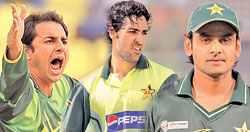
would overcome their minus points. Khalid Hussain is Editor Sports of The News, Karachi khalidhraj@gmail.com caption (From left to right) Imran Nazir, Abdul Razzaq and
Shoaib Malik caption (From left to right) Saeed Ajmal, Umar Gul and
Mohammad Hafeez
All
eyes on Afridi Shahid Afridi’s critics are sharpening
their knives as Pakistan go into the ICC World Twenty20 championship in
Sri Lanka with their former captain battling a lean patch. Afridi,
regarded by many as one of the most lethal allrounders in the shortest
format of the game, has not been in his element in recent times as he
has flopped miserably with the bat while his bowling form has also taken
a dip. To make matters worse, Afridi has also been experiencing a few
fitness issues that dogged him in the recently-concluded limited-overs
series against Australia in the UAE. His indifferent form and suspect fitness have
enabled Afridi’s critics to predict that veteran player is over the
hill and should think about quitting international cricket. They are
already predicting that Afridi would most likely fail at the World
Twenty20 which gets underway in Hambantota on September 18. So are they right in claiming that Afridi is now
more a liability than an asset for the Pakistan team? I don’t think so. It is true that Afridi has been experiencing a bad
patch in recent months. He has batted well in a few innings but such
outings are few and far between. Even his bowling exploits have been
well below the high standards he had set for himself in 2011 when he was
one of the most successful bowlers in limited-overs cricket. But when it comes to Afridi the most predictable
thing is unpredictability. Just when his critics are ready to reject him
as spent force, the flamboyant allrounder would come out with the sort
of heroics that have made him the most popular Pakistani cricketer of
his generation. Afridi is a cricketer for big occasions. Who can
forget the role that he played in Pakistan’s accent to the final of
the inaugural ICC World Twenty20 championship in South Africa in 2007.
And what about 2009, when Afridi gave match-winning performances in the
semifinal against South Africa and final against Sri Lanka to help
Pakistan lift the T20 crown at Lord’s. At last year’s World Cup,
Afridi was the single biggest factor behind Pakistan’s progress to the
World Cup last four. I think Afridi, who has recovered from a thumb
injury, is once again going to be one of the bigger success stories of
ICC World Twenty. The conditions are perfect for him as a destructive
leggie and a one good knock can help him regain his confidence as
Pakistan’s most lethal pinch-hitter. Mohammad Hafeez, Pakistan’s Twenty20 captain, is
well aware of the fact that much of Pakistan’s title hopes would
depend on how Afridi performs in Sri Lanka. “Afridi is a big match winner for us and hopefully
he will deliver for us once more,” Hafeez told reporters in Colombo
last week. Afridi, 32, is confident that he would bounce back. “I’m working hard especially on my batting
because it’s important for the tem,” he said in a recent interview. Pakistan would be playing two warm-up games against
old rivals India and defending champions England before beginning their
title campaign with a game against Pool D rivals New Zealand at
Pallekele on September 23. Bangladesh are the third team in their group.
According to the tournament format, the top two teams from each of the
four groups would progress to the last eight. Pakistan look good ahead of the much-awaited
tournament as they have a number of accomplished players, who can
exploit the conditions well. But to go all the way, Pakistan would need
some extra-ordinary performances from players like Afridi. bilalsports86@yahoo.com
Favourites
yet inconsistent Twenty20 cricket is always thrilling. Minor
mistakes on the part of any team can hugely benefit its opponents. And
it is the game of young guns, at least most of the times. The
hit-and-run type of format demands more than 100 percent strike-rate
from the batters. In this format batsmen don’t exactly have to be
technically correct, they just have to be able to hit the ball as hard
as possible and score as fast as possible and for as long as possible.
But this type of cricket reduces the gap between a good and technically
sound batsman and an ordinary player. The fourth edition of the Twenty20 World Cup is
starting from the 18th of this month. India, Pakistan and England have
lifted the previous three trophies. Pakistan lost the inaugural ICC World Twenty20
championship final to India by just five runs at the Wanderers in
Johannesburg, South Africa, in 2007 when Misbah-ul-Haq failed to control
his emotions at the end of a dramatic match-turning comeback, and chose
the wrong ball to flick over fine leg. Pakistan continued their excellent performance in
the next two editions of the T20 World Cup. Younis Khan and company held
their nerves in the 2009 final against Sri Lanka and won by eight
wickets at Lord’s, England. Bowling played a vital role for Pakistan’s win.
All bowlers performed up to the expectations. Umar Gul and Shahid Afridi
created a lot of problems for the batsmen and never allowed them to
score freely in the middle overs of the innings. After lifting the Cup the winning captain Younis
Khan announced his retirement from this format of the game, following in
the footsteps of Imran Khan who chose to leave the field after the 1992
triumph. In the third edition in West Indies in 2010,
Pakistan showed their authority in the shorter version of the game in
round matches but unfortunately failed in the semifinal against
Australia. England won the title by seven wickets. It was the first ever
World Cup win for the English. Now in the fourth tournament, once again Pakistan
are among the favourites despite their inconsistent performances. Pakistan are as good as any world-class team if they
play as a team and they have proved it so many times, but inconsistency
in their performance makes them the most unpredictable side in the
world. Bowling is the strength of Pakistan, with Shahid
Afridi, Umar Gul and Saeed Ajmal among the four top wicket-takers in
previous three Twenty20 World Cups. For their help there will be Sohail Tanvir, Mohammad
Hafeez, Mohammad Sami, Abdul Razzaq and young Raza Hasan. So the bowling
line has the capability to destroy any batting side.
The only concern for the new T20 captain Mohammad Hafeez is
inconsistent batting, especially while chasing targets. Most of the
times, batsmen get panicky and throw their wickets away. One believes it’s time for Shahid Afridi to take
responsibility of batting in middle and lower-middle order. No doubt he
is a successful bowler in limited overs cricket, but spectators also
expect something in the batting department from him. Afridi’s and
Abdul Razzaq’s batting could play a vital role in Pakistan’s
success. Fielding is the other area of concern for the
Green-shirts, particularly the catching. One dropped catch could cost
the team the match. If the top order provides good starts and the middle
order plays according to their skills Pakistan has a fair chance to lift
the cup again. khurrams87@yahoo.com
Going
with the flow When Zaka Ashraf took over as Pakistan’s
cricket chief, I had my doubts about his credentials. With little or no
cricketing experience, Ashraf was installed as PCB chairman at a time
when Pakistan cricket was at its lowest ebb. He had succeeded Ijaz Butt,
the man who made a mess of PCB’s damage control campaign following the
2010 spot-fixing scandal. Under Butt’s watch, Pakistan saw one of
sport’s worst tragedies taking place on its soil when the Sri Lankan
cricketers and several Pakistanis, mostly cops, became victim to a
brazen terrorist attack in Lahore. With international teams refusing to visit Pakistan
and some experts calling for its suspension from international cricket,
the stage was set for some well-respected, able and competent sports
administrator to rescue Pakistan cricket. Zaka Ashraf just didn’t fit
the bill. But in Pakistan such things hardly matter. Ashraf
wasn’t just appointed as PCB chief by President Asif Zardari but also
received complete authority from the Board’s chief patron. Next month, Ashraf will complete his first year at
the helm of Pakistan Cricket Board (PCB). His supporters hail him as a
saviour, who they believe is all set to put Pakistan cricket back on
track. His critics cannot help but disagree with this notion. So how has Ashraf fared during his first 11 months
as Pakistan’s cricket boss? First of all, one has to agree that on the surface
things look much better for Pakistan cricket then it did during Butt’s
tumultuous tenure. But that’s hardly a big achievement. Butt had the
tendency of shooting himself in the foot so if his successor wanted to
better than him then the only thing he needed to do was to avoid
following suit. Initially, Ashraf sent all the right signals. He
vowed to help bring international cricket to Pakistan and stressed that
PCB would work to mend fences with the world’s cricketing fraternity.
Luck, too, was on his side. Soon after Ashraf replaced Butt as PCB
chairman, Pakistan experienced an unusually long winning spree that was
capped by a stunning 3-0 series triumph against England, then the
world’s top-ranked Test team. However, a handful of Butt’s supporters argued
that the victories that fell in Ashraf’s lap were a result of the
“good decisions” made during the former chairman’s era. And they
had a point because for several months after his arrival Ashraf
refrained from taking any key decision. He opted to go with the flow.
“Sweeping actions without proper planning could be
counter-productive,” he would tell you at that time. His first major decision came soon after
Pakistan’s clean sweep against England when Ashraf decided against
retaining Mohsin Khan as Pakistan’s coach. It was a controversial
decision because under Mohsin, the Pakistanis had done exceptionally
well. But Ashraf’s close aides convinced him that Pakistan needed a
“qualified” coach in their bid to become the world’s top team. So
in came Dav Whatmore. Initially, it seemed like the move clicked as
Pakistan went on to win the Asia Cup for the first time in 12 years soon
after the former Australian Test player took over as their coach. But
the title-winning triumph was followed by a series of below-par results
that finally forced Ashraf to entrust Javed Miandad with the task of
helping Pakistan’s misfiring batters ahead of the ICC World Twenty
championship in Sri Lanka. The move has allowed Ashraf’s critics to
once again question the wisdom of roping in Whatmore. Questions are
being raised about Whatmore’s utility because of the fact that
Pakistan are relying on Julien Fountain to improve their fielding and
have Mohammad Akram as the bowling coach. “And if they need Miandad to
help remove batting weaknesses and raise the team’s morale then what
is Whatmore’s job?” asked a former Test cricketer. PCB officials, however, argue that the critics
shouldn’t read too much into Miandad’s appointment. They claim that
it’s just a small move to help out the team ahead of its biggest
assignment of the year. That may be the case but the move does underline the
fact that Ashraf and his team of senior officials are ill-equipped to
handle pressure. After putting complete faith in Whatmore’s abilities,
the Board has shown signs of impatience with the Miandad move. The biggest problem with Ashraf is that he relies
too heavily on the input given by his inner circle that includes a few
senior PCB officials, who were also a key part of Butt’s inept
administration. Instead of bolstering the Board by bringing in competent
professionals, Ashraf has so far pinned his hopes on the likes of Subhan
Ahmed, Intikhab Alam and Zakir Khan. Such officials have been around for
years without much success to their credit and to expect that they can
shepherd PCB in its bid to lift Pakistan cricket seems like a case of
false optimism. It’s not that Ashraf is not aware of the fact that the
Board lacks competent professionals both in administration and
marketing. Earlier this month, he expressed his helplessness in
launching Pakistan’s professional T20 league by admitting that there
is not a single official in the Board, who can take up this challenge.
“We would need a lot of outside help to be able to launch the
league,” he told me. So why is Ashraf unwilling to bring about
much-needed change in the Board? Surely, PCB needs competent and dynamic
professionals who can do a much better job then the tried-and-tested
officials who run Pakistan cricket and do quite a poor job most of the
times. Surely, the Board has enough money to be able to afford top
quality executives who can beef up its various wings. It’s time that
the PCB chief answers this question because Pakistan cricket deserves to
know. khalidhraj@gmail.com
In the name
of democracy The present government has been an avid
promoter of democracy and champions fairness and equality as enshrined
in the 1973 constitution of Pakistan. According to them, all their political moves are in
the interest of democracy. However, one undemocratic act which warrants
notice is the role of the Patron in the governance of the Pakistan
Cricket Board. It is no hidden fact that the cricket board, ever
since its inception, has faced several crises, not only relating to the
national team’s performances but also several administrative ones. A glaring violation of the principles of democracy
is apparent in the role of the Patron in the governance of the cricket
board. The patron is an ex officio post whereby any president of
Pakistan automatically assumes the role of the Patron with unfettered
powers to appoint the Chairman and so on and so forth, completely
against the working of a democratic setup. One would perhaps imagine that at best the role of a
patron would be more of a ceremonial nature or that of a caretaker
similar to that of the chairman of a company. However, much to the common man’s dismay, the
patron of the PCB is in essence the supreme authority as regards
appointments. He can and does make appointments without any electoral
process whatsoever. A democratic setup such as the one currently in the
country would entail an electoral process whereby the chairman and
members of the governing board were selected by way of election and not
subject to the pleasure of the patron. Since most of the major posts, including the
governing board, are filled at the behest of the patron, the general
body is only a hoax. The general body is in essence a watchdog on the
functioning of the governing board but since certain members of the
general body are unelected and unopposed, it is almost impossible for
the general body to function properly. Given the state of affairs and the hand-picked
chairmen of the board over the year, Pakistan cricket has always been
mired in controversies internationally. The most coveted power the patron has is that of
superseding the governing board and the general body and appointing an
ad hoc committee to govern the matters of the board. Thus far in the
history of the game, there have been four instances of ad hoc committees
taking over the helm of affairs and governing the board as per their
whims and fancies. For starters, the very power of the Patron to
appoint an ad hoc committee is a power which is to be exercised
sparingly and only in dire circumstances where the chairman and the
governing board fail to govern the affairs in the prescribed manner. Since the chairman and the governing board are
themselves at the mercy of the patron, the ad hoc committee is only a
furtherance of the unfettered powers of the patron. Secondly, the term ad hoc denotes temporary
existence or presence whereas in the case of the PCB, the board has been
governed by an ad hoc committee for more than a decade now. It comes as no surprise that due to the internal
mess created by the mismanagement of the board and the constant
temporariness of the unelected board wherein the management itself is
not sure of its status, the negative impact it has on the national team
and its individual players is what hurts the nation the most. Due to the temporary nature of the board the
national team’s performance has also been erratic for the last 15
years with successes few and far between. With the raw talent available at hand and stalwarts
having served the country through turbulent times, it is a pity that the
team struggles to find a place in the top ranked teams. An electoral process for the entire hierarchy of the
board is the need of the day and would fittingly lead to the board being
governed democratically as envisaged under the constitution of Pakistan. umairkazi@gmail.com
Squash
heroes in the land of legends I happened to
brush shoulders with Qamar Zaman, Jonathan Power, Ross Norman, David
Palmer, Rami Ashour, and Geoff Hunt, all legends of Squash, at the
Second Asian Masters Championship held in Lahore from September 3 to 6. They were all content
with the security measures, as they were escorted by huge number of
police officials. It was not surprising then that they visited the Wagah
border between Pakistan and India. During a 30-minutes conversation with
Australian Geoff Hunt, I asked every thing I could ask about the game. Hunt said that
Australian squash is going through the same crisis as Pakistan’s. “I
see Pakistan’s juniors are good, they only have to play more
international events. Low dedication is a problem. You need to develop
the game. Systems have to be set right and it’s not easy in squash.
Keep striving for the betterment,” he said. For Hunt the game of
squash has changed much, but he was happy that a cross section of
different nations have brought a lot of colour in today’s squash. “Glass courts have
changed every thing. Today equipment, speed, technology have changed the
squash that was there in 1980s to 90s. Yet, there is still no shortcut
in it,” Hunt said. I asked whether
sending junior players to the United States to play circuits will help
them. He said it would be a good opportunity. He said squash authorities
in Qatar with whom he is currently associated are also sending a few
players to the US. “It’s environment that matters. I do support this
initiative because you get to play against the players of different
countries,” he added. Pakistan is sending
some junior and senior players to the US this year for the first time.
Current world No 4 Egyptian Rami Ashour seconded Hunt’s opinion.
“Sending junior players to the US is a good initiative, as they will
learn a lot in that environment,” said Ashour who plays different
circuits there. Indian Lalit Agni
Hotri won a gold medal in the championship. I had conversation with him
when I greeted him for the good show of India in the World Junior Squash
Championships recently held at Doha. He said India’s
squash is limited to elite classes. “And here in Pakistan this has
never been the case. We see huge talent here in Pakistan.“You people
should heavily invest in this game you ruled the world in for 18
years.” Amjad Noon, President
Punjab Squash Association (PSA) and the man behind this commendable show
of Masters Championship, said Zarai Taraqiati Bank, National Bank,
Pakistan International Airlines, and Pakistan State Oil should come
forward to help this game. “We need financial assistance.” Pakistan Squash
Federation (PSF) did not have enough funds to organise this Masters
championship. So PSA invested about Rs7 million to make this happen in
an amazing manner. Each legendary player, including Jahangir Khan from
Pakistan, was given $5000, return ticket, and stay in special suites of
a five-star hotel. No doubt, the
championship was fruitful. Yet there were two things that disappointed
me. Our legendary player Jansher Khan did not come to the championship
despite being invited. I later found that he did not come in protest
against not given “due protocol”. I think a champion of
that stature should think beyond these petty things. He should have come
to support the sport he dominated for years. The second thing was the
refusal of president of World Squash Federation (WSF) N Ramachandran to
come to Pakistan for this championship. Perhaps he was too
busy lobbying for his re-election. It must be noted here that Pakistan
voted for Ramachandran in 2008. He should have come to show the world
that Pakistan is safe for international events. WSF’s President
coming to Pakistan would have meant a lot for the sport, for the
international community, and for the squash of Pakistan that is passing
through very bad times. Now that he has been
re-elected for a four-year term, he should do something to bring
Pakistan out of the isolation. In the end, I would say it was a good
experience to see international players from many Asian countries play
in Pakistan, even if it was for a short period. To see international
squash in Pakistan again I will have to wait till 2015 when an
international junior championship will be held in Islamabad. vaqarhumzah@gmail.com
|
|