|
|
| |
instepanalysis
Welcoming Bollywood into Pakistan
Bollywood is slowly creeping onto the big screens in Pakistan
and with it comes the hope of a better future for Pakistani cinema.
By
Saba Sartaj K |
| |
 |
| |
|
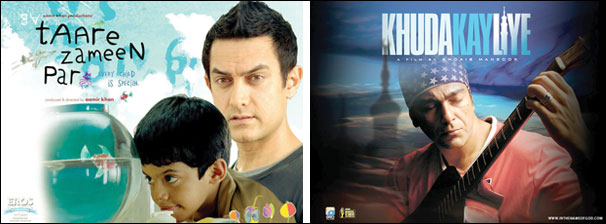
Even as you read this, Pakistanis are alternately laughing and crying
with the trial, tribulations and triumphs of Ishant Awasthi, the
dyslexic boy in Taare Zameen Par. Aamir Khan's directorial debut
had many a person who had seen the film on DVD queing up around
cinema. King size makes all the difference. Pakistanis have been
enjoying a steady flow of Indian films in cinemas for the past couple
of months.
With the release of Taare Zameen Par in Pakistan this April, the
Indian film industry has notched up its fourth release in just six
months. The Indian opening innings on Pakistan's box office was
played by the aptly named Dhan Dhana Dhan Goal , which became the
first Indian film to have a simultaneous released in both countries.
Released in November, Goal raked in two crore rupees in Pakistan,
which is emerging as the fourth largest overseas market for Indian
movies right after US, UK and UAE. The comedy flick Welcome went
on to do business of 90 lakh rupees in four weeks despite its late
release in Pakistan and the fact that a large chunk of the film
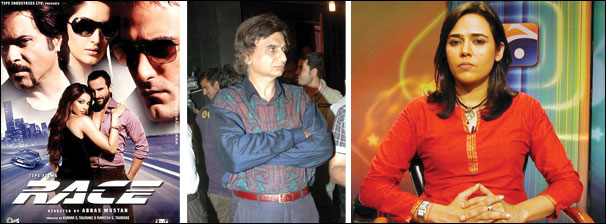
had been censored. The film Race, which released with 13 prints
in nine cities across Pakistan, is also well on its way to becoming
a blockbuster by Pakistani standards.
So
far, eight Indian films have managed to get released in Pakistan
- other than Noor Jehan and the Indo-Pak joint venture Kashish that
released in General Zia ul Haq's regime - following the ban on Bollywood
after the 1965 war.
But what sets Taare Zameen Par, apart is that it neither conforms
to the requirements for an Indian film to be cleared in Pakistan,
nor does it have any link with the country. There was news in the
papers before its release that it was running into issues and may
not be allowed to open to audiences in Pakistan. After all, according
to the Motion Picture Ordinance, 1979, Indian films produced by
Indians with Indian actors cannot be released here. But movies produced
by Indians filmed outside India can. The second clause has allowed
films like Awarapan, Gangster, The Killer and Welcome to get released
recently. Goal, shot in London, and Race, shot in South Africa,
became the first two Indian films to get same-date releases in Pakistan
as their premieres in India.
|
| |
 |
| |
Taare
Zameen Par did not conform to the ordinance but nevertheless, got
the green signal from the authorities. "The ordinance gives the
government the power to grant exemption from any provision. We found
Taare Zameen Par to be educative and informative - in short, an outstanding
movie," said Azfar Shafqat, the president of the Pakistan Censor
Board, in a landmark move that showed the new relaxed attitude towards
Indian cinema on this side of the border.
This move by the Pakistani government sparked jubilation in both India
and Pakistan.
"We laud the Pakistan authorities for the step. Such exchange
of art will lead to better relations between the countries,"
said Siddharth Roy Kapur, director of UTV Motion Pictures that is
distributing the film.
This move signifies the fact that the government is easing its stance
on the import of Indian films. They, it seems, are slowly and gradually
trying to ease in the Indian films rather then doing away with the
ban altogether at once, which might cause an uproar amongst certain
elements in our society. Keeping in mind the sensitivity of the issue,
the way the government is taking baby steps in the positive direction
is giving hopes to many cinema enthusiasts and Bollywood buffs in
the country. |
| |
However, the movement is working both ways. Pakistani film Khuda Ke
Liye opened in Indian theatres in the first week of April. It marks
a new chapter in the history of sub-continental cinema becoming the
first Pakistani film after decades to have reached Indian audiences.
It's a sign of things to come,
"I don't think banning something has ever helped any cause. If
Indian films come to Pakistan that means business for cinemas and
entertainment for the people, says film maker Mehreen Jabbar. "I
don't see any harm in it and don't think any good film maker should
feel threatened by it," she says, going on to add that "If
anything, our industry will gain |
 |
| from
the healthy competition coming into the country, it will attract investors
and our local film makers will get their act together and strive to
make better films." |
Though the film industry in Pakistan is in a shambles due to various
reasons, the box-office success of Khuda Ke Liye gave it a new lease
of life. But the problem the industry is facing at present is lack
of exhibition outlets as many of the cinemas have closed down because
of poor patronage. It was with a view to giving the industry a shot
in the arm that exhibitors and distributors in Pakistan urged the
government to lift the ban on Indian films. Bollywood movies, in particular,
have many takers in Pakistan. The movies, with their catchy songs
and glittering dance numbers, are much loved in Pakistan. Posters
of Indian actresses and actors are plastered across stores here that
sell the pirated DVDs, and over the back windows of commuter buses.
'Mauja Hi Mauja' plays full blast at mehndis and so does 'Om Shanti
Om'.
Pakistani movies were popular in Pakistan until the early 1980s. But
in the past 20 years, while Indian cinema has thrived, sending Bollywood
productions to cinemas around much of the globe, filmmaking in Pakistan
has withered because of a lack of money as well as few skilled directors,
actors and technicians. Pakistani officials say there is a gradual
move toward allowing Indian films to be routinely shown here again,
but they have not specified if the ban will be lifted altogether.
"Our government should have a film policy and take it as seriously
as to have a ministry for it. If they want to put out a soft image
of Pakistan, films are the most powerful tool and our government needs
to realize that," says Samina Peerzada, veteran actress turned
director. "We love cinema. I've seen Taare Zameen Par three times
already and will go and see it for the fourth time in the cinema."
Hira , a Lawyer from Karachi who stood with the crowd outside Nishat
Cinema for the premiere of Race, backed the cinema owners and filmmakers
in welcoming Indian films to Pakistan. Perhaps Indians, she suggested,
would now become interested in Pakistani films, too. The beginnings
of which we witnessed with the release of Khuda Kay Liye in India.
Some, however are not very hopeful with this barter of films across
the border. According to Badar Ikram, the head of GEO Entertainment,
neither country will benefit much from the opening of the gates. "Khuda
Kay Liye sold 80 prints in India and just 13 prints of Race were released
in Pakistan. That's the difference. Pakistan is not a big enough market
for Indians to take seriously. They might tap into our talent, which
is because it's good and cheap, but they will not invest in Pakistan
and Pakistani actors/musicians and technicians. That is just not feasible
enough for them," he says.
Another of the same view is the celebrated script writer Dr. Enver
Sajjad. For him, it all seems short lived and the move towards liberalizing
the exchange of cinema will only have an impact when the respective
governments in both countries take it seriously. With each changing
government comes a new policy regarding India and vice versa and till
the relations between the countries don't improve on the whole, it's
a lost cause. Also, according to him, the Pakistani audience is an
intelligent one and India is just churning out mindless films which
eventually, will not do too well in Pakistan.
"The Pakistani audience wants content. Our people might be uneducated
but they are not 'jahil' as are the Indians who are making and watching
mindless rubbish. When you have technology going up, the content comes
down, which is exactly what is happening to Indian films."
Spoken like a true idealist, but the reality is different. Race, which
is big on action and sexiness, but falls below par in terms on content
is doing rocking business in Pakistan is a case in point that proves
Dr Sajjad wrong. Ours is a market hungry for entertainment and Bollywood
glam is capable of setting the box office jangling, regardless of
the story line.
Bollywood movies have more than 90 per cent of the Pakistan market
by the jugular. DVDs are all over the place. Indeed the piracy of
Indian films and their music has kept many a stove burning in Pakistan.
The demand for them has always been here. Let's not forget, we were
watching them all throughout these years at home, way before they
came to our cinemas. Now India can make money from the Pakistan market
while Pakistani artists can make waves in India.
India has proved to be a great cultivating ground for Pakistani artists
in the recent past which include the likes of Atif Aslam, Meera, Javed
Sheikh, Jal, Roxen, Shiraz Uppal and Strings. Now with Indian films
making their way into Pakistan, Indian actors and film makers will
also benefit from the access to Pakistani market, which is ready to
lap up anything of fairly good quality from across the border.
There are, however, some elements that are resisting this transition
and change.
According to Satish Anand, CEO of Eveready Pictures, who are distributors
for Race in Pakistan, those who will thrive on monopoly and mediocrity
will be the ones resisting the change. "The influx of Hollywood
films hit Europe badly where the market for their own commercial films
shrank drastically. But now we see their local cinema emerging as
strong as ever. Following their precedent, we can welcome the change
with hopes of a better future," he says.
Eventually, Satish hopes, what will emerge strongly will be the 'made
in Pakistan' brand. "There is no point in over protecting the
industry, as we can see that has just not worked out well. To see
the growth and success of films, there have to be a lot of cinemas
around. And to see that happening we need to have a constant supply
of good quality films that will make the public want to go to cinemas
and in turn the profitability will attract investors to invest. It
is this lack of supply that has caused most cinema houses to shut
down. We need to address this shortage and import films to fill that
gap and invite peoples interest to come back to cinemas, not ignoring
our own 'backyard' in the meantime. Any film commercially desirable
is welcome. Film makers, investors will get motivated when they see
the money coming in. After all, it is mainly about the profitability
of the business," he adds.
Walking towards positive change, even if it is at snail's pace, is
giving film makers and enthusiasts hope of a better future with a
more strong, successful and fluid film industry. And if we get India's
help in getting our industry back on its feet, well, why not? After
all, what are neighbours for?
|
| |
|


