


|
|
|
|
 |
 |
   |
uk Taal
Matol governance Both
sides of the story RIPPLE EFFECT
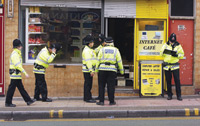
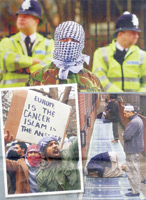
students Things will never be the same With the arrest of ten Pakistani nationals, allegedly involved in a terror plot, the chances of obtaining visas for Pakistani students will reduce By Murtaza Ali Shah The scare of a terror attack is such a phenomenon in
Britain that even a cracker on the street corner could go on to become
headlines. The April 8 arrest of 12 terror suspects, 10 of whom are Pakistani
nationals on student visas, provided fodder to the hungry media machine and
woke punditry from the slumber. Prime Minister Gordon Brown talked of the police having foiled "a very big terrorist plot". Bob Quick, the Metropolitan Police's head of specialist operations, resigned from his post after having walked into 10 Downing Street in full view of photographers, showing details of the anti-terror operations. Quick said he was resigning "in the knowledge that my action could have compromised a major counter-terrorism operation". Home Secretary Jacqui Smith hailed it as a
"successful anti-terrorism operation", and said Britain continued
to face a "severe terrorist threat". Police sources told the media
the arrested were planning a "very, very big" attack. Although police have up to 28 days to investigate the students and bring charges, several days after the operation it seems the security forces have as yet failed to find either the bomb factory or the smoking gun. Instead there is quiet talk of a blunder and a spoiled attempt much in the fashion of many such high profile raids and media and judicial trials which failed to convict the accused in the past. Before the so-called 'Easter shopping suicide bombings plot', 2002 saw a trumpeted 'Wood Green ricin plot', which found no ricin and the 'cyanide on the tube' plots, which turned out to be a hoax as it neither featured cyanide nor the tube. Then in 2006, there was the Old Trafford football stadium plot, which turned out to be the figment of someone's imagination and the 'airline bombing plot', which as it turned out didn't feature any airline. Whether the 'Easter bombing plot' leads to any convictions
or turns out to be hype has to be seen while the probe goes on, but what is
beyond any doubt is the fact that Pakistani students have been demonised like
never before and things for them will never be the same again. Not only will
they be under microscopic scrutiny in western educational institutions, their
chances of obtaining visas to study in some of the top western universities
will reduce. For many students here in the UK as elsewhere in the west, it has been a frightening experience anyway following 9/11 and 7/7. Many of them were called names, spat at, stopped and searched and attacked -- all because of their colour of skin, nationality and faith. Pakistani student societies have complained that many hijab-wearing students were attacked by racists because they thought the girls were Pakistanis. In the new climate of paranoia, many genuine students will be turned on flimsy grounds as some powerful quarters are already talking vociferously about setting up quota for Pakistani students coming to the UK. The arrest of students has led to a diplomatic row between Pakistan and Britain but it has raised many questions about the visa rules -- and loopholes -- that have allegedly allowed many quack students who are more of economic migrants than genuine students. Thanks to the mushroom growth of colleges in the last few years, thousands of students from developing countries were issued visas by the British consulates. When some British newspapers exposed some of these colleges as ghost colleges consisting of only 2-3 rooms and staffed by a lady secretary good at printing out visa letters, the UK government initially did nothing and business went on as usual. In East London alone, hundreds of these colleges were owned by Pakistan, Indian and Bangladeshi owners who linked up with consultants in South Asian countries to facilitate visas for students. After arriving in the UK, most of these students took to working full time in grocery stores, as security guards, and food and retails stores. They bothered to go to their colleges only at the time of extension of their visas. All that is past now. On March 31, the Home Secretary Jacqui Smith announced the toughest ever Australian style point-based visa regime which has changed the rules of business altogether. The new measures, under Tier 4, are aimed at students from non-EU countries, for whom Britain remains the most favoured country for higher education. Of the 1.6 million full-time undergraduates currently studying in the UK, around 99,000 are classified as international students. According to the Home Office figures of August 2008, there were 36,200 students enrolled in UK colleges and universities from the Indian subcontinent (10,600 from Pakistan, 22,100 from India and 3,490 from Bangladesh). According to new rules, all British schools and colleges taking in international students from outside the European region will need to be registered with the UK Border Agency (UKBA). There will be five visa types for students, including child student, child visitor, adult student, student visitor, and prospective student. Announcing the new Tier 4 rules, Home Office Minister Phil Woolas said fake colleges set up to help illegal foreign workers get into Britain are the biggest "loophole'' in the immigration system. The UK Border Agency has placed a greater responsibility on colleges to ensure that students meet all the requirements before applying for the visa. This means students will have to attain 40 points: 30 points for showing an unconditional offer of a recognised study place and 10 points for showing that a student has approximately £10,000 in his account for tuition fees and maintenance. It has been made essential for colleges to be accredited with Accreditation Service for International Colleges (ASIC) before they are able to recruit foreign students. The government believes through the introduction of this new system, the loopholes have been taken out and there is no need of tightening up these rules further anytime soon and the calls for the government to do more to overhaul the system, following the arrest of Pakistani students, will have no effect. James Pitman, Managing Director of Study Group UK, agrees the recent arrest of 10 Pakistani nationals on terrorism charges will likely affect other Pakistanis who are planning to study in Britain or indeed those who are here already. "While the vast majority of foreigners applying for this type of visa have genuine intentions to study, recent events will likely lead to increased pressure on the government to play a more active role in vetting applications. "The new regulations have made the admission process more stringent, and last week's events are a prime example of why the Home Office feels it necessary to tighten the rules on international students arriving on our shores. "The international education industry is estimated to be worth in the region of £13 billion to the UK economy, and perhaps more importantly, foreign students add a cultural dimension to our learning environment and, after graduating, improve trade and diplomatic relations between Britain and their own countries. This is a sector that we cannot risk alienating, especially in the current economic climate." Anatol Lieven, professor in the War Studies Department of King's College, thinks the government may have no option but to apply a stricter regime for Pakistani students. "We might have to restrict students from Pakistan… I say this with regret as a professor with valued Pakistani students. But 42,000 students from Pakistan in four years may be too many for anyone to check properly." So, has the shutter come down for Pakistani students who loved British educational institutions and always felt a close affinity with its culture and way of life? There is no clear-cut reply to this but one thing is certain that life for Pakistani students will never be the same again. Their reputation has been torn, smeared and dragged through the mud, either because of the nihilism of a handful of students or the botched operation by British security forces. The writer is an assistant editor at The News, UK edition
"Don't treat Pakistani students as pariahs" National Union of Pakistani Students and Alumni (NUPSA), which represents 21 Pakistani student societies from 21 universities in England, says it's concerned at the possibility that some individuals may have deliberately exploited the benefit of student visas with the intention of performing heinous acts. Its spokesperson Faizan Rana, a London South Bank University Accounting student, told TNS: "The present situation reflects poorly on the aspirations of the overwhelming majority of Pakistani students who are keen to integrate and immerse themselves in British society. "We are especially concerned about the premature leak of sensitive data including details of nationality to the members of the public before any trials have taken place. We are concerned that premature leaks about the police operations have led to a backlash against the Pakistani student community when no cases have yet been proven or brought to trial. "As the only national representative of Pakistani students in the UK, NUPSA reserves the right on behalf of Pakistani students in the event of inconclusive results to seek official clarification from the concerned authorities about the credibility and potential implication of this operation for Pakistani students." Rana fears the difficulties of Pakistani students from here onwards will only exacerbate. "From the prime minister, to ministers and almost all the media have already given the guilty verdict. It's very sad how the whole matter has been treated."
"Bring face-to-face interviews back" Sir Andrew Green, former British diplomat and founder of Migration Watch UK, says the scrapping of face-to-face interviews was a blunder from the security perspective of Britain. He is calling for the return to a system of full interviews by UK immigration officers. He told TNS: "Whatever the outcome of the present investigation which we do not wish to prejudge, we believe that the first priority of the immigration system should be the security of the UK. We do not believe that a largely paper-based system is sufficient to detect those who might pose a threat. "We believe, therefore, that we must revert to a system of full interviews by a UK based immigration officer. This, in turn, means that the number of applicants must be sharply reduced to make such a process manageable. An annual quota of, say, 1,000 would be a start. We could then see how that works." "We will continue to welcome legitimate students" British Home office believes that it has put in place a system that is well-suited to weed out any students whose intention is anything other than studying after arriving in the UK. A Home Office spokesperson told TNS: "Every student wishing to study in the UK undergoes scrutiny -- including fingerprint checks against a range of immigration, terrorism and crime watch-lists. "Before being allowed into the UK students must now be sponsored by a registered university or college, and show they are able to support themselves financially. These measures are part of our tough new Australian-style points system which makes it easier than ever to root our fraudulent applicants and crack down on the bogus colleges that facilitate them. "The government will continue to welcome legitimate students who wish to receive a first-rate education, and we'll do everything in our power to bar those who are up to no good."
"Those arrested are innocent until proven guilty" Faisal Hanjra, president of Federation of Student Islamic Societies (FOSIS), says media and right-wing elements have been whipping Islamophobic hysteria for a long time on defame Muslims students. "For many years now, many things have been said about Muslims students and their link with Islamic radicalism but nothing has been proven yet. There has not been a single conviction. There is no evidence to suggest campuses are recruiting grounds for radicalism. When we talk about Pakistani students in particular, there are thousands of Pakistani students who play an important role in student life in the UK, they are vibrant, dynamic and excel academically. Those who have been arrested are innocent until proven guilty. "FOSIS is concerned at the statements of Prime Minister Gordon Brown and home secretary Jacqui Smith who have said this has been a successful anti-terror operation when nobody has been charged. Just because a dozen students have been arrested on suspicion, we should not jeopardise the chances of thousands of other students. Britain should not do anything that screws the chances of Pakistani or international students from coming to the UK to get top-rated education." "It's a cock-up" Nick Cohen, the Observer and London's Evening Standard columnist and a well-known campaigner against religious militancy, suspects the operation already looks like a blunder. "Now it seems that many of the arrested men won't even be charged, but deported back to Pakistan (assuming, that is, the British can get believable assurances that they won't be tortured on return)," Cohen told TNS. "After the video of an officer launching an unprovoked assault on a passer-by at the G8 demonstrations, and Bob Quick flashing official secrets to newspaper photographers, it is easy to believe the worst. Maybe these men are innocent victims -- in which case the argument for deporting them looks very shaky. "And yet there is another possibility I don't think the public fully grasps. The threat of suicide bombings forces the police on occasion to act before they have evidence that will stand up in court. Partly it is the nature of the crimes. The 9/11, 7/7 and Iraqi atrocities were on such a scale that the authorities have a duty to snuff out the faintest chance of another crime against humanity, even if the resulting legal process ends with an embarrassing muddle. "I think that for a generation we will have to live with muddy and unsatisfying police operations. Detectives will rush in for fear that desperate men are planning a massacre and the rest of us will not be sure if they are being prescient or alarmist."
What they will write By Shoaib Hashmi It is a naughty schoolboy's dream come true. Police
departments all over the country have written letters to all schools and
colleges, saying they are too busy to provide security to the schools under
their jurisdiction, and telling the schools to arrange for their own
security. Now it is obvious that if the police cannot find enough persons
trained for security nor can the schools. So every other day my grandson gets all dressed up, gathers his books and copies and trundles off to school. He's back in fifteen minutes grinning all over his face. It appears the entire school faculty was at the gate shooing everyone back home. As there was a phone call telling the school there was a bomb planted in school, and the authorities, having no security personnel had no choice but to shut down, the school for the day. I hate to be suspicious but I cannot doubt that groups of school kids all over the country have got hold of a group of grownups who are sympathetic, and who simply call up the school and report a bomb scare. As none of the scares actually comes to anything, except in the Frontier where some schools have actually been blown up but no one bothers to warn anyone, and all the explosions have been after school hours. I wonder if anyone anywhere is keeping track of how things have changed in the recent past. For instance, apart from the last year I do not think I can remember a single instance in my seventy years when I heard of a junior school being shut down due to a bomb scare. Now there are simply too many cases to get mentioned in the papers. Or there is this other phenomenon of kidnapping for ransom. All our lives we have read about it in crime novels, or at best in American crime magazines, and suddenly it is all about us. Just today there is news of a good friend, kidnapped sometime in November, who has just been released after payment of one and a half crores. It seems a great deal of the money being used by the militants is from ransom paid by friends of people kidnapped. None of it gets reported. Mostly these are small amounts, but it adds up. My friend's story did get reported as he is a well-known man; a film producer who stayed captive for months. Ten years ago, if someone had told me we would be used to reading about dozens of killings each day, many of them suicide attacks, not merely in Iraq and Afghanistan but right on our doorstep, I would have pooh poohed and laughed in his face. But that is how it is today. And years from now, when they come to write about our times, I wonder what they will write!
Backing the boss The bureaucracy in Punjab finds Shahbaz Sharif a hard task master By Waqar Gillani Punjab Chief Minister Shahbaz Sharif together with Chief
Secretary Javed Mahmood is back in power after the Supreme Court revised its
Feb 24 decision as a result of a stay order at Sharifs' appeal. The return of
Shahbaz Sharif and his team -- famous for its tough administrative style --
was also not welcomed by the province's bureaucracy. The chief minister and
the chief secretary have been criticised by the unhappy bureaucrats who
complain of "not being properly treated" ever since he took charge
last year. With their return, the list of bureaucracy's 'grievances' is growing as expected. A grade-20 officer at the secretariat, serving in Education Department who wished not to be named, shared his views with TNS. "Are we grade-5 students that we are supposed to sign the attendance register, once we come to the civil secretariat?" he asked. Another unhappy official of the Information Department asserted that many of his colleagues do not approve of the chief minister's style of governance. He recalled an incident when a secretary was made OSD with immediate effect for not attending one of the scheduled meetings. The secretary, being interviewed for another slot, was in Karachi and informed the CM of his inability to attend the meeting because of the unavailability of flights. "The angered CM not only checked the list of available flights to prove his subordinate was lying but sent him on special duty." Such stories are certainly not new for Shahbaz and his team. Back in late 1990s, a similar attitude and reaction was witnessed. Former Chief Secretary, Pervez Masood, who served Shahbaz government in 1997 talking to TNS, accepted that Shahbaz is "a demanding boss." "But he was successful. People appreciate his style of governance." Masood sees it as a principle of working hard and seeking the colleagues' support. "If the CM can work 18 hours a day, why can't the civil servants whose job is to serve the people?" he questioned. The former secretary believes the civil servants should
not resist because the government, the civil servants or the bureaucracy is
not for one man but the whole province. "You cannot always have the boss
of your choice." But it appears the bureaucrats are not convinced that spending more time in the office guarantees efficiency. The current Chief Secretary, Javed Mahmood, who enjoys a reputation of being hard-working, was subject to similar criticism for being strict and taking actions like issuing warnings to his subordinates. An officer of Home Department admitted that many officers are not comfortable with Mahmood's style "For a Punjabi bureaucrat, demands like respect for discipline, attending emergency meetings, spending less and delivering more are synonymous with insult. They are not willing to be accountable to political or administrative structure." An official, working closely with Mahmood, believes the chief secretary foresaw the upcoming political turmoil -- disqualification and the rift with the governor. "His policy was to improve the image of Shahbaz's government. It seems this hard stance towards bureaucrats was used as a policy management tool to deliver and set some standards of services in the best interest of public and to prove Shahbaz's government was pro-people." Keeping bureaucrats on their toes was also nerve-wrecking for civil servants and provincial assembly members, including those from the ruling parties who thought the chief secretary was taking the leadership role away from them. Another official of Implementation and Coordination Department working with the chief secretary told TNS he was not vengeful. "He wants to change this impression of grouping within the bureaucracy and civil servants. That is probably why, after coming back to office, he personally called all newly-appointed bureaucrats (who were appointed by the governor) asking them to give their choice of posting." Chief Secretary Javed Mahmood was ready to defend his position. "I believe I am public-friendly. I welcome people and feel happy to resolve their issues. I am not interested in pleasing a bureaucracy that is not interested in public service," he said. Mahmood said he welcomes those "who are comfortable with this style and are willing to join the mission to serve public." Mahmood believes the bureaucracy will have to get used to serving the public with whose taxes they are receiving perks and privileges. "Should we tolerate the suited-booted baboo style of coming late to the office with someone holding their briefcases and opening doors for them while they call their friends and gossip with their colleagues and leave the office making sure no one disturbs them after that?" Mahmood questioned. Mahmood's colleagues believe this is the new "strategy" he has adopted. He has mellowed-down and smilingly tells the officers to pack their bags if they cannot deliver. A major reshuffle, in phases, is also expected, including replacement of some commissioners. The department heads have been asked to prepare a detailed policy framework and plan of action. Only those who deliver will stay, one senior bureaucrat said, adding "the CS in future will also prefer to have young bureaucrats in grade 20 instead of those interested only in ruling instead of serving." The reshuffle is expected in the wake of panel interview for as many as 30 secretary level posts. The panel comprises of chief minister, chief secretary, Secretary Services and General Administration Department (S&GAD). "I support the conducting of interviews because we want to know how committed the civil servant is to serve in that particular area," the chief secretary said. "One year has passed and the government has a right to change the beat of those who don't deliver. Besides, we need to set priorities for the next fiscal year."
The image of Pakistan as portrayed in the American media is controversial and, rather painfully, realistic By Ali Sultan "Three words to describe you." A done-to-death
question asked by a glossy magazine to some bloated self-obsessed celebrity.
Turn the question upside down; replace the magazine with America's leading
newspapers and the celebrity with Pakistan and the answer would be,
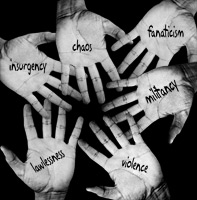
"fanatic, chaotic and highly unstable." To go through the headlines, stories and op-eds of some of America's newspapers, whether it is the 2002 Washington Post (WP) calling Pakistan "the most dangerous place on Earth" or the 2009 New York Times (NYT) dubiously asking if Pakistan can be governed, it seems that since the war on terror began eight long years ago, Pakistan, in the eyes of the American media, "feels as if it's falling apart." The common perception is that the American media paints Pakistan as a lawless state, over-run by Islamist ideals and breeding insurgents in every street. "The American press presents its internal problems pretty fairly," says Rahimullah Yusufzai, Resident Editor, The News, Peshawar. "When it comes to foreign affairs, however, especially 'the war on terror' they have no objectivity. The press sees everything through the eyes of government. The drone attacks are a case in point. When the Pentagon issues a false statement about a drone attack and claims of "no civilian casualties," the American press reports the same." When asked about if the press follows some sort of pattern, Yusufzai says, "Whenever there is a success on the part of the Pakistani government, they are supportive. It is when we suffer defeat that the press turns critical." "The American media does not seem concerned with the rest of the world. Because this war is an American war and their soldiers are dying, hence so much concern and coverage," says Yusufzai. Bertrand Pecquerie, Director, World Editors Forum, pinpointed the Gulf War as the start of biased American reporting. In a conference held by South Asian Free Media Association (SAFMA) in Lahore in 2004, Pecquerie said till the 1990s the American journalistic landscape was offering a tradition of fact-checking, the rise of opinion pages in major newspapers to present a huge range of points of view, lack of corruption, the genuine "we-report-you-decide" concept and the best journalism schools. However, it changed during the first Gulf War as the army controlled all images and prohibited in-depth and independent coverage of military operations. As a result, the American press appeared as a victim of the government and the Pentagon. At the same time, Pecquerie said, the world discovered CNN and many questions were linked to professional practices like the relationship between journalism and patriotism, criticism regarding official military sources, dictatorship of real time and virtual reality and knowledge of non-American cultures. And today, he said, patriotism was interfering with journalism as it was impossible to minimise the trauma of 9/11. "What had happened to the American press in 2002 and 2003 would remain in the journalism history as a severe blow to the profession." Pecquerie said the problem was not that the American journalists did not have enough means or ideas to investigate the pre-war claims concerning Iraq's strategic arsenal. The real issue was that American newspapers became the best agents of the Bush administration. He said the American newspapers were right to accept the principle of embedded journalism but they were wrong to rely almost exclusively on it. An American journalist currently working in Pakistan, and not wanting to be named, says: "News anywhere in the world tends to focus disproportionately on violence. Explosions make news. In Pakistan, violence is a very serious problem. But there are many other faces of the country that we don't attend to. Americans became preoccupied with Muslims after 9/11. There was a tremendous hunger for knowledge about their societies; where that anger might have come from. We knew very little. "I don't think it is because we wanted to go against these countries, or that we wanted to portray them in a bad light. In part it's because we wanted to try to understand where that anger had come from. In part it's because violence is news. But we need to make a better effort to bring voices of people doing things other than violence onto our pages. Because only focusing on one aspect of a society can lead to wrong conclusions. Americans make bad policy decisions -- Iran in the 1950s and Vietnam in the 1960s -- when they only see one side of the problem." A Lahore-based reporter who has extensively worked with his American counterparts says that as far as their reporting is concerned, it is fairly accurate. "Usually they talk to a lot of people, are well-connected and gather the facts on the ground as accurately as possible. As for the actual printed piece, it isn't written and re-written by just one person; a lot of hands are involved, who add padding and other facts, keeping in mind their newspaper's policy. The American media has its own perspective of looking at things, which most of the time might not be in sync with our own. The basic thing to understand is that when we report we see Pakistan as our nation; when the foreign media reports they see Pakistan as a country." "Frankly I am less concerned about what the Americans are doing and more concerned with what we are," says Ejaz Haider, Op-Ed Editor of Daily Times. "Read the Urdu newspapers or look at the anchors and commentators on our local channels and observe and dissect the belch they are mouthing. As far as objectivity is concerned, the American press broke the story of the torture and abuse of Muslim prisoners in Abu Ghraib prison, we didn't. We should at least credit them for that. "Take the example of the Swat flogging video. If a person born and bred in New York is going to see the video, what kind of society is he going to think Pakistan has? We need to look inwards before pointing fingers at others." RIPPLE EFFECT Swat: a sordid case of appeasement By Omar R. Quraishi Neville Chamberlain would have been happy at the antics of the ANP and the PPP were he alive today. The British prime minister is perhaps best known -- a euphemism really for infamous -- for his government's policy of not standing up to Nazi Germany, particularly from 1937 to 1939, in the run-up to the Second World War, and that's how the term 'appeasement' came to be used in the sense that it is now -- more or less equated with cowardly behaviour against an adversary. Much has been written about the so-called Swat peace deal, and most readers will know that, according to news reports, the National Assembly debated the Nizam-e-Adl regulation in the backdrop of a de facto death threat issued by the Swat militants a day prior to the issue being discussed in parliament. They warned that anyone who expressed disapproval of the regulation would be seen as a non-Muslim. The threat was obvious -- this would mean that anyone who expressed disapproval of the proposal would be deemed an apostate by the Taliban and hence would be 'wajibul qatal'. Hence, it can hardly be said that the debate was held in an atmosphere where members of parliament were free to air their opinions on the proposal. As had already been pointed out by several people critical of this caving in by the government, the 1973 Constitution already contains the Objectives Resolution which says that no laws repugnant to Islam will be passed and instituted in the country. Religion is already worn on its sleeve -- so to speak -- by the state, and citizens are never allowed to forget that the country that they live in is an Islamic Republic. Of course, these citizens do not have a complete picture of the Quaid's views on the need for a separate state for Muslims or that his views were decidedly secular and that he wanted a homeland for Muslims but where minorities had equal rights and where democracy and not theocracy would prevail. Of course, now that the Nizam-e-Adl or Sharia has been enforced in Swat, the question arises that if people living in other districts of the country want to enforce Sharia -- say for instance Okara on the outskirts of Lahore, or Gulshan Town in Karachi -- will the government permit them to set up their own system of governance and justice? The issue of course is not whether Sharia should be imposed at all but that the manner it is being imposed clearly suggests that the people of Swat, the ANP government of NWFP, the PPP government in the centre and the National Assembly have all been cowered into submission by the militants and their backers into accepting Sharia (as dictated by Mullah Fazlullah and Sufi Mohammad) as a fait accompli. I had always thought of Ayaz Amir as one of the finest writers in English in a generation -- but now after his very courageous stand in the National Assembly on this issue, one has to say that not only is he one of our best writers he is also a most valiant individual, not afraid to speak his mind, even on the pain of apparent death, or at the very least a severe admonition by the Sharif Older. The passage of the Nizam-e-Adl regulation has already opened the floodgates -- in the print media at least -- of elements sympathetic to the Taliban, all now saying that this system of Taliban-enforced Sharia should be extended to the rest of the country. Not only most women will be severely frightened at the possibility of such a thing happening, most people who want to live a life of their own choosing, without being forced to not shave, or not buy CDs or DVDs or live a life more suited for Europe's Dark Ages, will be -- or should be -- feeling very very vulnerable and can only hope and pray that the government and the state busy in appeasing the militants wake up to the reality, and stop playing their games with the future of this country and its inhabitants. One shudders to think what kind of consequences this may have for those who live in places like Karachi, Lahore or Islamabad. Only one political party so far has displayed the courage to stand up and speak against the Nizam-e-Adl regulation and not surprisingly it is the MQM. As for Chamberlain, it may be instructive to see what he did -- or rather, didn't do -- with Nazi Germany. The end of the First World War saw the creation of the League of Nations, set up on the basis of collective security by member states in the hope that it would help prevent another such war. However, the member states did nothing when Adolf Hitler occupied the Rhineland or when Mussolini's forces invaded Abyssinia or for that matter when Japan invaded and occupied the Chinese province of Manchuria in 1931. The League set up a commission of inquiry that condemned Japan, but all this resulted in was that Japan left the League and carried on with its invasion and eventual occupation. Japan's act was followed in Europe by Germany's 'remilitarization' of the Rhineland in 1936 -- a part of the French Empire till its disintegration in the early 19th century and later part of Prussia (it includes lands on both sides of the Rhine river and is situated in present-day Germany). The action was called 'remilitarization' because the region was demilitarized, as a kind of a buffer between France and Germany at the end of the First World War following the Treaty of Versailles. The reaction from the French was that France could not afford to attack the Germans because that would require a general mobilisation of the French Army and this was termed too costly for French taxpayers. As far as Britain was concerned, it did not show too much concern over this, surprising that its main opponent in the First World War was in fact Germany. The feeling among some politicians was that it was as if Germany had reoccupied what was in fact its own territory. The sentiment was similar to that expressed by the seemingly pro-Taliban elements today -- that peace be given a chance, ignoring that Hitler, like the Taliban, had gone back on his words in the past as well and clearly had sinister expansionist designs for the rest of Europe. Not only did Britain not do anything on its own, the government of that time also actively discouraged the French from doing anything against the Germans. Emboldened by this and by the very fact of human nature that no person or group gives up power on his/their own, the rest was history, and the horrors of a second world war followed. Just on a side note -- and perhaps readers should know -- the Rhineland was eventually retaken and the Germans ousted, at the fag end of the Second World War -- by a joint British-American-Canadian action. America alone lost around 24,000 soldiers in this campaign. Historians are mostly united in the belief that had the French -- perhaps supported by the British -- responded promptly to the German advance in 1936 all this could have been avoided and perhaps the Second World War would have had an entirely different shape – or perhaps none at all. Of course Chamberlain did much more than this, including his infamous trip to Munich to meet Hitler, before which he was cheered on by the House of Commons, but the appeasement of the Germans began well before. One can only wonder what the fruits of the appeasement to the Swat Taliban will be -- nine years from now. The writer is Editorial Pages Editor of The News. Email: omarq@cyber.net.pk
|
|