


|
|
|
|
 |
 |
|
exclusive review Contributor
to legacies All is not hazy
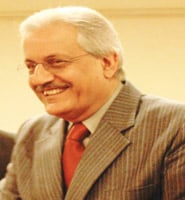
"It's a feeling of great satisfaction" "I'm terribly sorry. I may not take time out for this interview," said a visibly occupied Mian Raza Rabbani, coming out of his chamber in the parliament house, which was only a room away from the prime minister's chamber. "Dar Sahib [Ishaq Dar] and others are waiting for me." This was Tuesday, a day before the constitutional reform
package was unanimously signed by all committee members. Our frustration was
too obvious. We pleaded for a twenty minute interview. He agreed and actually
gave us ten minutes more than we'd asked for. We requested that he should
speak to us again in the next two days in case of new developments and he
agreed again. As we tried to adjust our recording machines in the small room next to his chamber, Rabbani wanted his cigar before he spoke. Dressed casually in an off-white shalwar kameez, he appeared fresh for a man who had been holding endless meetings to resolve the recently developed deadlock. As the interview progressed, we did not see any signs of frustration in him, only preoccupation, maybe, about the enormity of the task at hand. Rabbani did not want to comment on the other Mian's last-minute intervention before the document was signed or what might have led him to play the role of a spoiler. He spoke cautiously, like a chairman of the committee and not a member of the PPP team. He bore the weight of responsibility with remarkable composure, clearly a man who was on the verge of making history. Rabbani was still not ready to divulge the details of the package but gave us a good insight into what must have transpired in this nine-month long exercise that, for the most part, stayed away from media glare. The News on Sunday: Were you expecting the deadlock when it came? Mian Raza Rabbani: I would say that to an extent yes, for the simple reason that it was a complex situation that we were dealing with whereby we were looking at the entire constitution. And, obviously, bottlenecks in political negotiations are expected, more so where such complex legal and constitutional matters are involved. So, hiccups were there but the overall resolve of the committee was abundantly clear -- that it wanted to protect the hard-fought consensus it had been able to develop. TNS: The PML-N took the position that the seventeenth
amendment ought to have been scrapped separately. Why did the PPP always
insist on dealing with the entire constitutional reform package together from
day one? MRR: This question was raised at an early stage when the committee met initially. At that stage the PPP was open about it but a lot of other political parties, particularly the nationalist parties, were of the view that we should look at the entire constitution and provincial autonomy and other related issues should also be taken up. I don't blame them because they have seen a very difficult period in history where, at various points in time, they have been made promises but those promises have not been kept. Given their historical experience they were a little hesitant to bifurcate the package. TNS: Was this conveyed to PML-N then and later? MRR: Yes, the PML-N was aware of it because, as I said, this was one of the initial issues that came up for discussion and it was amicably resolved and, that is why, we went through as many as 77 meetings and came to the final conclusion. TNS: What was the extent of freedom available to you when you embarked on this course? Were there any other no-go areas apart from the Islamic provisions? Was the military establishment agreeable to the idea that there should be constitutional reform? MRR: I have been involved in this committee in two capacities. As chairman of the committee, my direct interaction was with the Leader of the House and I can say this with utmost confidence that at no stage did the prime minister interfere with the functioning of the committee or [told us] the manner or mode in which the committee should run or [ask about] the decisions being taken in the committee. There was no interference whatsoever. In my other capacity, as member of the PPP team in the committee, as far as the co-chairman of the party Mr Asif Ali Zardari is concerned, the team had an absolutely free hand. Obviously, before we went into the committee, there was a working draft which the PPP had prepared and which was made public as well, in which we had suggested constitutional amendments. But there was no interference from Mr Asif Zardari on how the committee should work or to what extent it should go or what it should or should not do. TNS: What about the military establishment? Or, you couldn't care less about what it thought? MRR: I wouldn't say that, because one has to live in the given political environment. Therefore, those broad parameters were before us. But, as such, there was no interaction with the military establishment. TNS: No directions or instructions? MRR: No, none. TNS: What about the Islamic provisions? It has been argued that if those provisions are not done away with now, they never will be. MRR: This question came up before the committee and there was a divided point of view. The committee reflects all shades of political parties including the religious parties. Given the delicate political situation in the country at the time, we did not opt to work on an agenda that would destabilise the political situation. Hence, in all these reforms we have tried to maintain a balanced position so that there is minimum rocking of the boat. Our sense was that the political situation should gain strength from these constitutional reforms rather than these becoming a source of destabilisation for the country. We also had to keep in mind the internal terrorism that is taking place in the name of religion. We did not want to take any step that would further give them [the terrorists] fuel to propel their boat any further. TNS: You've talked about the political environment. What about a political milieu where fears are being raised about this amendment being eventually struck down, even if partially, by the Supreme Court of Pakistan as being violative of the basic features of the constitution? MRR: I think the parliament has the right to amend the constitution, and while amending the constitution we were aware of the limitations that are there on a non-constituent assembly. Besides, there were a number of lawyers represented in the committee. I am myself a practising lawyer. Therefore, we have adhered to the basic structure of the constitution of 1973. We have built on the intra-party accord of the 1973 which had been unanimously agreed to during the premiership of Shaheed Zulfikar Ali Bhutto. Subsequently, even on questions of provincial autonomy and other issues, we have built on the structures that are present within the 1973 constitution. So, we are not expecting there would be petitions and, even if there are, we believe that considering the concept of trichotomy of power the parliament has done its job and it would be up to the judiciary to interpret the constitution. TNS: With regards to amendments about provincial autonomy, are we finally going to see the end of a strong centre? MRR: I would not be able to divulge the details of our proposals at this stage but, broadly speaking, the 1973 constitution itself anticipated a participatory form of federalism. But, unfortunately, because of various political factors, various dictatorial regimes that came in, it became a centralised federation. So we have tried to rekindle the flame of participatory federalism and collective sharing of resources between the federation and the provinces and, at the same time, we have built on the concepts present in the 1973 constitution to have a joint mechanism for dispute resolution. TNS: The constitutional reform exercise is indeed reminiscent of the consultations for the original 1973 constitution but we saw that in the next four to five years the consensus constitution was laid to rest by another martial law. How hopeful are you about the current exercise? Do you think the ground realities have changed between then and now? Is this exercise going to be permanent or last for the next fifty years? MRR: Well, I hope not. I hope this exercise is not done for the next fifty years because I am personally of the view that the constitution is a living document and that it needs to be revisited. Had it been revisited earlier or implemented in its true letter and spirit, perhaps the inter-provincial or the province-centre disputes or polarisation that we are seeing would not have been there. So, I hope this is not permanent and as the political environment grows and complexities erupt, future parliaments will be able to revisit this. Yes, it should be permanent in the sense that no future adventurism comes our way because a lot of water has flown under the bridges. What the federation could withstand five years ago, it can't now. And if the democratic polity is upset, if the people are once again brought under subjugation, if centralisation is further enhanced, no matter in what form, it is going to have a telling effect on the federation. It is going to strengthen separatist and extremist elements in the smaller federating units. TNS: What do you foresee as happening in the two houses of the parliament? Are you hopeful that the numbers are there for the amendment to pass comfortably? MRR: Yes, in terms of its passage in the two houses, I don't see a problem. This is the first opportunity that the parliament is getting of enacting its own amendment. Prior to that, parliaments have been meeting and ratifying amendments which were made by way of legal framework orders of military dictators. This will be the second parliament after 1973 which would be bringing in amendments by its own motion. TNS: What was the compulsion to keep this whole exercise secret? Do you think it helped? RR: Yes, the biggest reason for our success was to have kept the entire exercise secret for the simple reason that each party had a strong position on all of these issues. Those positions were stated in their manifestoes and reflected in the proposals that they gave, and obviously those are public positions. But when you sit on a negotiating table, each party has to give a little and take a little. It's never a win-win situation for everyone on the negotiating table. If the proceedings had been open, in the full glare of the media, positions within the committee would have hardened because then you are jostling and positioning yourself for the public. Once you know that what you are saying is off the record, you are in a more relaxed mood where you are looking to develop a consensus. This has been one of our greatest successes and here I am thankful to the media as well. There were certain speculative stories but, by and large, both the print and the electronic media understood the sensitivity of the situation and went along with us and I am grateful to them for having done that. One thing I can share with you is that instead of having "notes of dissent" we introduced in the committee "notes of reiteration". Notes of reiteration are that the parties agree to the consensus position which the committee has taken. But that does not mean that they have given up their original position. So they reiterate their position and say that, for the sake of consensus, we have agreed to the formulation but we will continue our struggle for what our ultimate objective is. That way we were able to maintain a balance. TNS: You did not even give a deadline? MRR: We did not want to, because then you become a captive of that timeframe. The entire committee had struggled very hard. The amount of physical and mental strain -- being away from families and totally locked up -- had been tremendous. That is perhaps one side which would never be written about. In these 77 meetings we had, on average, worked for five to six hours a day which amounts to almost 400 hours. So [having gone through all this] we did not want to be a captive of deadline. TNS: What has been the general mood like, during the meetings? MRR: Generally, the mood was relaxed. Obviously, there were moments of extreme tension or deadlock. But then all committee members rose above their party considerations and each one had a broader perspective as to what was workable for a federation given our peculiar political circumstances. In that spirit, there were meetings in which we had debates, sometimes, for more than five days, without coming to a conclusion. So, it was a mixture of relaxed mood, tense moments, sentiments running high and then coming down. But obviously after getting it through, it is a feeling of great satisfaction. TNS: How do you see your own role in the committee? MRR: This is such a historic issue that I don't think it can gravitate around personalities. It is the collective wisdom of the committee and the collective political will of all political parties. I don't think individuals really matter in this entire exercise. It is too big for any one.
-- Farah Zia, Alefia T Hussain, Waqar Gillani & Shaiq Hussain
Out of this place Risham Syed's new works are moving out of domestic space and conventional scheme of completion into a daring format and a dangerous world By Quddus Mirza "When is a painting finished? Not when it fully corresponds to something already existing – like the second shoe of a pair – but when the foreseen ideal moment of it being looked at is filled, as the painter feels or calculates it ought to be". John Berger The question of completing a work has been a persistent
problem for painters. In the studio one waits for that rare moment of
enlightenment, when it dawns that the work is finished and must be put aside.
Contrary to normal assumption, many artists miss that magic moment; so they
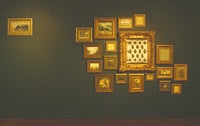
either leave their canvases unresolved or produce overworked art pieces. However in this age, like the parameter of good or bad composition, it is difficult to devise a formula to decide whether the work is sufficiently resolved or is still burdened with unnecessary additions. It is the instinct or the inner eye of the artist that determines the final state of an art work; hence the power or capability that distinguishes a mediocre from an extraordinary artist. Yet, in the case of a single creative individual, one often finds both resolved and incomplete works of art, because the oeuvre of an artist includes both good and bad (one can choose any other – politically-correct -- terms for describing the same concept!) productions. Several artists deal with the issue in their individual manner. Zahoor ul Akhlaq once explained that the instant multiple colours lose their separate identity or impact and merge into one shade he knows the painting is done. Some reach that stage by signing their names even on premature works, only to meet the deadline and pressure of the gallery. Others, like Iqbal Geoffrey, keep modifying their finished and already exhibited art works to recreate new pieces. It seems Risham Syed has derived a different method to solve the issue of resolving a work. For her, the canvas is not confined to a specific area which needs to be filled by the painter, and then the viewer is directed and forced to see it according to the maker's wish. Instead, her new body of work suggests a sense of openness with diverse elements which contribute towards making the 'final' image in the mind of a sole viewer (the image varies for each person) depending on his movement and distance from the art work. In a sense, this solution marks a new step for the painter who, in the past, was primarily engaged with fabricating single art pieces or diptych paintings. Her decision to create works in space (a continuity from her last solo exhibition and a few group shows) is matched by her choice of subjects which, compared to earlier domestic concerns, have become more politically-oriented. Thus majority of exhibits in her recent solo show 'and the rest is history' (being held from March 25 to May 15, 2010, at the Talwar Gallery in New York) address the issue of violence, power and resistance in an altered world. Here, the institution of power is the obvious concern, and forces fighting against oppression assume centre-stage. This conflict between the political power and the contingent that resists it is described in a manner that is reminiscent of the early films of Indian director Ketan Mehta. In Bhavani Bhavai and Mirch Masala, the symbol and institution of power (tyrannical raja or cruel provincial governor) are encountered, combated and finally conquered by using ordinary and familiar substances -- water and chilli powder to be precise. The human scale and humorous dimension of this conflict makes the narrative interesting and unusual. Similarly, in Syed's work, the banal, familiar and funny detail faces the signs of power and infuses an element of uncanny. For example in Marble Hearth, the painted image of space shuttle Discovery, about to take off on its voyage, is contained within a marble fireplace usually found in houses. The protruding form of flying machine, with its overt resemblance to the phallic organ, and the fire emanating from its tail are limited within a domestic setting. Association of great smokes from the spaceship and the marble construction that is designed to light fire is obvious, but the work lends other sensual and political meanings too. Another work titled The Indians Viewing the Landscape deals with the same subject but here the visual vocabulary is different in terms of its application and ambition. A gilded frame with the image of a painted landscape from the classical period is accompanied by two dwarfed (not small or kids') chairs. Both chairs, looking immaculate in their design, detail and finish, appear normal at first glance but then their size invokes a sense of unease. That feeling is conveyed and enhanced by the placement of the chair that echoes the postures of two small figures in the vast dark landscape, who – like viewers – are looking at the tiny tail of a falling aeroplane, about to hit the ground near the horizon. The political connotation of the work, with the events after 9/11, is obvious; yet by arranging a chain of spectators outside and inside the painting, Syed manages a narrative that denotes the fabric of our times. Engaging the viewer into the work is explored in another piece Cushion. Syed has created a combination of visuals that engages the visitor and transforms a spectator into a reader. The diverse images and material do not offer a direct content or easy access to meaning, yet the presence of material used for making cushions as well as references of collapsed buildings, crashing planes (hung at a distance from the framed canvases/pictures) and Western landscape and conventional still life allude to the construct of contradictions that is experienced at every level in our surroundings. Cushion's order of display -- like a salon with frames hanging closely and on top of each other -- reminds of the custom of treating art as a commodity for certain classes. However this piece in its structure and sensibility is not much dissimilar to another installation by the artist Cap made in 2008. Several of Risham Syed's new works are moving out of domestic space and conventional scheme of completion into a daring format and a dangerous world – of contradictions, just like politics and us!
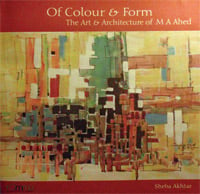
A wonderful compilation of works of one of Pakistan's foremost architects By Nafisa Rizvi Of Colour & Form The Art & Architecture of M A Ahed Writer Sheba Akhtar Publishers: FOMMA (Foundation for Museum of Modern Art), 2010 Pages: 295 Price: Rs3,500
'Of Colour and Form -- The Art and Architecture of M A Ahed', the recently published monograph of M.A Ahed written by architect Sheba Akhtar and produced by FOMMA (Foundation for the Museum of Modern Art) is a wonderful compilation of the works of one of Pakistan's foremost architects and as it turns out a remarkable artist. The unimaginative non-descript title of the book is deceptive, and even a quick browse will reveal the extraordinary abilities of Ahed -- the artist. But what truly strikes the reader is the sadness at the thought that this significant contributor to the legacies of our country has passed without a flourish or celebration of his achievements -- and that the book comes a trifle late. The book informs us that M A Ahed studied architecture at the J.J School of Arts Mumbai and received a Diploma in Architecture from the Leicester College of Arts and Technology in London. His architectural achievements are dotted across the urban landscape of Karachi. He designed the General Post Office, the factory and offices of Elite Publishers and the Abbasi Shaheed Hospital. Along with some of his peers, he set up the Institute of Architects Pakistan in 1957 and in the following year, he founded the Government School of Architecture where he was Principal from 1958-64. He was involved in the completion of Quaid-e-Azam's mausoleum in Karachi and painstakingly designed the focal point of the structure, the green chandelier that hangs in the central dome. Besides these, Ahed also designed several private residences as well as the iconic State Bank of Pakistan Building in Islamabad. For one man to have achieved so much in a lifetime indicates the immense talent, dedication and commitment of M A Ahed and coupled with his veracity in professional dealings and his moral rectitude, we learn about a man who was truly an outstanding icon of our age. We discover that M A Ahed was also a prolific artist and his oeuvre ranges from thumbnail sketches to portraiture and later to abstraction, incorporating as it were a microcosmic view of the historical development of modern art in the 20th century. On inspection, Ahed's paintings are so visually captivating that it is hard to imagine why Ahed would choose to become an architect and not an artist. Apparently pragmatic advice from an older sibling was enough to propel Ahed towards the discipline of architecture rather than art. To write about a monumental figure, and one not known for garrulity, would be a daunting task for any biographer and for an architect unused to the task of penning monographs; Sheba Akhtar's achievement must be commended. However, there are gaps in the write-up that cannot be ignored and have in fact lowered the publication to hover below the benchmark of qualitative compilation. Sheba Akhtar tells us repeatedly that M A Ahed was a reticent and introverted man as if to explain the lack of information that she has been able to glean about him. But there have been many reticent people, specifically architects like Antonio Gaudi who was known for shunning publicity, about whom volumes have been written. The literary and editorial stratagem used in such cases is to interview people who constitute the inner as well as peripheral circle of the person in question and encourage them to offer credible insight into his life and works. This, Akhtar says in her preface, she has done, although there is no visible evidence of it since she uses almost no quotes in the text, thus demolishing credibility. There is not a single quote from Ahed's wife or his siblings or even his elder son Javed -- and we are left to wonder if privacy was the issue. There are some quotes from Dr Ahmed Mirza Jamil, Ahed's trusted friend, but there must undoubtedly have been a bevy of compatriots, co-workers, contractors, engineers or craftsmen who worked with him and whose insight into his persona may have proved invaluable. The fact that the author takes it upon herself to compile the evidence and create a picture of Ahed's work and personality is testimony to self absorption since the author is only a self-proclaimed writer and has no previous experience of formal writing. This leaves us with the dilemma of whether we are required to offer concessions to the author or berate the publisher at not being more exacting about reviewing and editing the book and including input from professional editors, writers and even artists. Still, if the book on Ahed were to sit alongside say David Robson's monograph on Geoffrey Bawa, (similar to Ahed's book because it is written by an architect and professor of architecture about an architect) the differences would be significant, not because Robson is a great writer, far from it, but because his research is meticulous and far-reaching and his style of writing informed, articulate and unpretentious. The most nagging quandary of the book on Ahed is its ambiguous focus. If the publication was created to establish the legacy of M A Ahed, the architect, then there is not enough evidence of it and we are not told of specific influences of any great architect on his work nor his influence on the next generation of architects. If the primary goal of the book is to portray the glory of Ahed as artist, there is no contribution from any artist or educator to inform us of the quality of his art. Akhtar assumes the mantle of art critic, architectural jury and personal scribe to create a picture of the great man but exposes her own inadequacies. She sprinkles the book with names of famous architects and artists and endeavours to make connections that are almost ludicrous. She compares Louis Kahn and Ahed because they were both architects and passionate about music. In another instance she says; "Like the young Alvar Alto (who would later become the most preeminent Finnish Modern Architects (caps sic) at the Helsinki Polytechnic Abdul Ahed at the JJ School became involved in numerous dramatic productions…" Describing an architectural feature in a house, she says, "The use of this versatile device in M A Ahed's architectural vocabulary in terms of its climatic responsiveness and textural richness, is reminiscent of the architecture of Le Corbusier in the south of France and in India, as well as of the building of the pioneering Brazilian Modern Architect Oscar Niemeyer..." Later Akhtar says, "As with Louis Kahn, M A Ahed was occupied during most of his architectural career with the design of civic and institutional rather than residential or commercial buildings." In another reference, she writes "Like Wright and Alto, Ahed's oeuvre (body of work) encompasses the entire spectrum of design from planning and architecture to product design." There are several more such references; "Ahed's debt to Wright's design is evident…" and "Like the great Bauhaus architect Mies Van der Rohe, M A Ahed believed in the necessity of architectural form…" If these comparisons sound glib, they are still more credible than the author's assessment of the art of Ahed. She insists the chiaroscuro in Ahed's paintings is "strongly reminiscent of Rembrandt's work". There is absolutely no evidence of chiarosuro as Ahed's paintings are light and airy. She draws similarities between Ahed's paintings and Turner, Constable and Ruisdael, not to mention the homily she provides us on the Impressionists Monet, Degas and Cezanne and says, "Ahed took to heart the lessons that he had learned from the French masters." It would be best to peruse the book Of Colour and Form -- The Art and Architecture of M A Ahed by paying attention to the illustrations and skim for the basic facts of Ahed's life if we are to enjoy his life's achievements and the rich legacy of art and architecture he has left us with.
At a three-day Classical Music Concert in Lahore last week, a crop of young practitioners showed promise and consistency By Sarwat Ali A three-day Classical Music Concert was held at Lahore's Alhamra last week in which most of the major exponents of the kheyal and thumri participated. It was heartening to see and hear a crop of younger practitioners of these forms. These youngsters have been around for sometime and have made forays into other forms of singing -- but have maintained a strong bond with the classical forms as well. One such youngster is Shujaat Ali Khan, the son of Sharafat Ali Khan and the grandson of Ustad Salamat Ali Khan. It has happened that many a practitioners, younger ones in particular, have not been that keen to pursue a certain form of art but are pushed into it by peer pressure and expectation that they have to be the carrier of a certain tradition or uphold the name of a gharana. It really becomes hard for them to get out of this bind. Some, with the passage of time, accept this condition and start taking more interest and show greater involvement -- hence improvement. While some unfortunate ones just go through the motions half-heartedly, and end up being jack-of-all-trades in these forms of music -- excelling in nothing. Tahira Syed is one such example who was pushed into singing, as people also expected her to outmatch her mother. This continued as long as one has known -- and Tahira Syed's lack of total involvement may have cost her and music a lot. Shujaat Ali Khan is still young. He is in the formative period; when a classical musician really lays down the foundations of his art. In this period of extreme distraction and other lucrative offers it requires greater determination to persist with a form that does not bring instant reward. In olden days, it was the discipline the family exercised through the structure of the tradition that did not give much choice to the younger practitioners born in the family of musicians and they were coerced into becoming musicians. But these days, things are different -- and Shujaat Ali Khan despite the pressure of upholding a family honour and tradition has been seeking other openings. It is for him to decide whether he has to stick to a more insular approach or has to be inclusive -- really depending on his temperament and understanding of music and how to develop and make it into an ang. At this moment one can only keep ones fingers crossed and hope for the best. Chand Khan and Sooraj Khan are the other duo that has also shown promise and consistency in performing the classical forms. They too have to follow the path on their own without little help from the society at large and institutions in the country. One wishes them well. Nayab Ali Khan also has interest in music which goes beyond the traditional classical forms. But it appears that he is interested in pursuing the classical forms of singing as well. He too has to be careful in not letting the two cancel each other out but add and coalesce into a new style of singing, keeping the contemporary trends in view. Practitioners like Shafqat Ai Khan and Rustam Fateh Ali Khan have been singing and performing now for more than 10 to 15 years. It is for people and connoisseurs to determine their place within the pantheon of vocalist. Of course, the real comparison is with their elders, Ustad Salamat Ali Khan and Ustad Fateh Ali Khan. One has to see how far these comparatively younger practitioners have taken their art form forward. But it is encouraging to be at least talking of these two or three generations in the same breath and critically examining their work -- and building up hope that all is not hazy on the horizon of classical art forms in the country. The established ustads also took part in the festival. Credit should be given to Ustad Fateh Ali Khan who has the determination to take part in concerts that also involve plenty of travel. He keeps his appointments with great degree of regularity. It is this determination that has seen him though his life which has been a difficult one. And then Ustad Ghulam Hassan Shaggan -- who despite his age still has vigour and stamina to unleash some of his most forceful and exacting taans. Ustad Fateh Ali Khan Hyderabadi is at the prime of his career. He may be the last of the Mohicans who were brought up in the traditional style of gharana training which for want of a better expression can be called integrative. The personalised transfer of musical knowledge takes place like the learning of a mother tongue, totally unnoticed and without an effort as part of growing up. This close door integrative method is now on the wane even in the families of musicians. His singing can be described as reet ka gana, the style of singing kheyal/kaafi/thumri, which was largely based on inherited knowledge of intonation, barhat of raag, the choice of aasthai antara and the final crescendo of laikari and taans. This integrative style now is exposed to change due to the large number of influences, musical in particular, ever-looming due to an information revolution. The contemporary style, if it can be called a style is much more eclectic in nature than the integrative style of the past. Alhamra should continue with its offering of its platform for classical music with greater frequency. It is a forum and a vital one that should extent its support to the forms which though significant otherwise have few takers on the commercial circuit. It should also revive their regular concerts of the young classical musicians, for it served as a nursery. And if it continues to do so with more frequency it will become difficult to find fault with the organisation.
|
|