


|
|
|
|
 |
 |
  
|
game Sights of
wilderness
Mania in the air Air Race is to flying fanatics what F1 is to car race lovers By Usman Ghafoor Accept no hyperbole. But if you were in Abu Dhabi this
spring, you couldn't not be hit by the 'mass mania' for what happens to be
UAE's most breathtaking -- not to mention, spectacular -- sports event of the
year, called the Red Bull Air Race World Championship. Everyone in and around
town knows about it, from your hotel check-in counter to your cab driver and
so on. For somebody like me who was better acquainted with Formula 1 and
stuff, it was nothing short of a 'rediscovery'. And, trust me, being there at
the sports venue and watching the race planes pull stunts over the turquoise
waters of the Arabian Gulf is what made the experience all the more
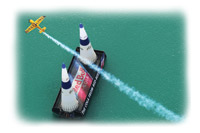
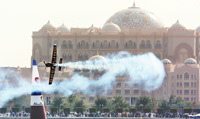
fulfilling. I was lucky enough to be a witness to the mega championship that had returned to the sparkling clean UAE capital for sixth straight year. A roster of 15-odd pilots, from different parts of the world, had descended on the Race Airport at Muncipality Harbour on the famous Corniche Road, where a customised runaway waited for them to launch their lean, mean fighting machines in the air. Through the huge glass window of the chilling Media Centre, perfectly oblivious to the soaring temperatures and gusty winds outside, we -- a whole bunch of world media folk -- had a vantage-point view of an amazing show of aerobatics, as we settled excitedly next to each other, laptops in tow, anticipating a thrilling game ahead. Though I must admit I found the game rules a bit
confusing, initially. Starting with the (approx.) 6-kilometre long race track
that needed a map for me to understand how a series of inflated Air Gates
(20-metre high pylons) had been laid out, to the fact that the pilots were
supposed to fly through the 'gates' in a particular order only and, of
course, in the fastest time possible, incurring as few penalties as possible.
The penalties, I learnt, were 'seconds' that were added to the pilots' time.
For instance, a 1-second penalty was slapped on the pilot whose plane failed
to emanate smoke (as a trail). A 2-second penalty was given for
"incorrect passing of an Air Gate". It included flying "too
high" or on an "incorrect level". Exceeding the maximum entry
speed of 370km/h through the start gate also translated into a 2-second fine.
Similarly, a 6-second penalty was due if a part of the plane touched an Air
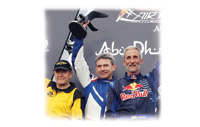
Gate. For more serious breaches of the rules, pilots could be disqualified. There were 6 flying sessions for each participant -- Training, Qualifying, Wild Card, Top 12, Super 8 and Final 4. Training consisted of two mandatory sessions, and the time of the final training session would determine the starting order for Qualifying which, again, included two mandatory sessions. Here, best time counted; 1 World Championship point was awarded to the fastest pilot. Wild Card took place on the very Race day. It had the five "slowest from the Qualifying" competing for the two available places in the Top 12 which also took place on the Race day. Now the "fastest ten from Qualifying and the fastest two from the Wild Card" competed for a place in the Super 8. Results in the Super 8 determined 5th to 8th place race positions. Finally, the fastest four from the Super 8 were to compete in the Final 4 for 1st, 2nd, 3rd and 4th places. Of course, the one with the maximum points would top. But, for a pilot to become the champion, he would have to finish with the most points at the end of the eighth race which is officially the last in the series spanning five different continents over a period of six long months. At Abu Dhabi's kick-off season, Paul Bonhomme -- defending champion from Britain -- finished 1st, ahead of fellow countryman Nigel Lamb (2nd) and Hungary's Peter Besenyei (3rd), in an action-packed battle that lasted March 26 through March 27, 2010. Austria's Hannes Arch, who had won the Abu Dhabi race last year and was considered a favourite especially after he went off with the Qualifying point on day 1, was disqualified in the Top 12 round on account of "dangerous flying". Bonhomme's winning time was 1:14.06. Lamb was 0.86 seconds
behind and Besenyei was 7.12 behind. Abu Dhabi has been a popular host for the championship's opening, ever since the event's official inception in 2005, despite tough geographical and climatic challenges it poses to the participants, what with its swiftly shifting winds, high-G turns and an ever changing skyline. But, that is what adds more zing and zap to the game, especially for the audiences. I was particularly awestruck by the way the TV cameras captured the race planes right from inside -- videoing the pilots' POVs and MCUs -- making you fancy as if you were a part of the flight. Finally, I have to quote a friend who told me prior to the event that "Air Race is to flying fanatics what F1 is to car race lovers". I believe it now wholly.
The Soan river we look at with disgust while in Rawalpindi is in fact wondrous and waiting to be explored By Saad Nawaz Qaisrani While passing over the Soan Bridge in Rawalpindi one cannot fail to notice the heaps of garbage that litter the Soan river bed. This once beautiful river is no less than a nullah. Yet a glance at the surviving vegetation on the
surrounding hills shows a remarkable growth of beautiful and priceless
phulais (acacia modesta). Sparing the steepest slopes, expanding buildings
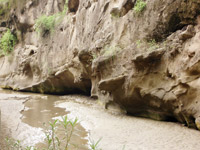
have now replaced even this vegetation. The first time my friend Iftikhar told me about the wonders of the Soan valley, I thought he was out of his senses. Is it not the same stinking flow of waste water that we see every time we pass over the Soan Bridge? How can such a thing be ever classified as beautiful? Having sensed my disbelief, Iftikhar took me to his village near Pindigheb, in the heart of the valley. The tales he told of his land were fascinating. The stories of deep canyons carved by the river and its tributaries, the teeny springs in torrent beds, the reed infested river bed where the beautiful Black Francolins hymn loudly, the ponds in the reeds swarming with all kinds of migrant waterfowls and the timeless graveyards strewn with rocks where the king of crows, the Punjab Raven would hide in their preferred reckon-like seclusion; it was all too good to be true for the Soan river I had known all along. What was the veritable truth? I had to find this out. It was one cold December afternoon when I decided to pack my bags and take a plunge into the wilderness, totally unaware of what was in store for me. I left for Iftikhar's village. It is located in village Utran, about a dozen kilometres from Dhulian Chowk. My host offered to show me hares after dinner. In knowledge of my penchant for nature and wildlife, he vowed to make every minute of this trip memorable. We set out to spot hares in the dim cloudy night. One hour of walking the wheat fields in the rainy night and we managed to spot no less than 30 hares. I was told the locals had imposed a ban on any kind of hunting in the environs of the village. Not only was their hospitality amazing but also their work for the conservation of their areas' wildlife. We couldn't go to the river to explore the rolling hills and the deep gorges the next morning. We had to be content with a walk where we had been last night, this time looking for birds and taking photographs. Much was seen, but the treat of the morning was the very rare Punjab Raven that has disappeared from Punjab. Once back from the early morning walk, we bid adieu to the friend's family and made our way back home, promising to his father that we would be back some day. Fortunately, the chance to be back in Utran came soon -- and in a month's time I was able to arrange another trip. I invited my cousin to join me this time. We meticulously planned the details for this second outing, ensuring no part of the wondrous land is left devoid of our attention. So again we made it to Utran, my friend's village, late one night. It was way too late for any kind of activity, so we took to our beds after dinner. In the morning Grey Francolins sounded the wake-up call. After a scrumptious early morning breakfast we headed straight for the river to verify the truth of all the previous boasts of the river's beauty. I did not doubt the claims; they were just too hard to believe for the same Soan river every one of us looks at with ugly disgust while in Rawalpindi. As we began the journey to the river, we were led down from atop the plateau hosting the village into the confines of a small tributary torrent. Things began to unravel, when the promised springs were spotted. Drop by drop, warm water oozed out of the ground slowly inching away from us. On both sides were precipitous heights, poked with small caves, wherein Rose-ringed Parakeets and Rock Pigeons were perched, awaiting the first rays of the morning sunshine to relieve them from their long cold night's misery. The bed of the torrent was not very wide, hardly a few dozens of meters across. Thick growth of Phulai lined the slopes and the precipice whilst the bed of the torrent housed a flora as variable as the Xerophytic date palm (Phoenix Dactylifera) to Hydrophytic reeds (Typha Augustiflora). The stream itself hardly managed to flow, though it certainly did. The torrent had, over time, cut indentations under the precipitous cliffs creating small stream pools which housed little fishes hardly any bigger than my index finger. However, much I have wanted to know which specie they were, I have not been able to find out. The torrent bed would widen at some places, at others it would cramp so strictly that there would be no path to cross other than through the reeds. After about half an hour of walking, the reeds thinned out and the precipices turned into steep grassy climbs lined with acacias. In a short while we found ourselves standing above the river bed of Soan, with the promised Reed beds and the Elephant grass visible in front of us. Very soon a flurry of noises turned even more stories into facts. The Black Francolins were certainly calling from inside the reeds. A little cackling revealed the presence of waterfowl in a pond ridden invisible by the Elephant grass (Saccharum Munja). To enjoy the sights of the wilderness, my cousin and I decided to make hideouts in the reeds abounding the lake and observe the arrival and departure of the waterfowl with greater closeness. Once we hid, in no time a flock of Gadwalls arrived at the pond. Soon other birds joined them. By the end of our sitting, we had sighted Gadwalls, Storks, Stilts, Common Teals, Northern Pintails, Common Coots and Ruddy Shelducks, all in this little pond. While coming out of the hideout, I happened to flush a female Black Francolin. My cousin later on told me that while he was hidden in the reeds, three Black Francolins playfully wandered within a meters' distance of him, and that they kept on inquisitively circling him to somehow unfold the true identity of this unwelcome guest in their domain. After spending a few hours observing nature, we left for the friend's village for a lunch. On the way back we took a new route to the village, this time climbing over the hills and then climbing down again. The scrub covered hills were not only astoundingly beautiful but also afforded excellent views of the Soan river meandering through the rolling hills. The scenery appeared to be a perfect reproduction of what the pioneer Geographer W.M Davis had called the age of maturity of a river. We had lunch before we prepared to depart Iftikhar's house. That was it for my trips to Utran. The Soan we see in Rawalpindi is a sorry manifestation of our criminal neglect towards our environment and nature's bounties, which we have always taken for granted. And the worst part is the fact that Soan river is not the only example of the same. Our land is replete with instances of such criminal neglect. And yet we are nowhere close to learning our lesson. |
|