| 
Rising
fashion stars are the most exciting resultant of any fashion week.
If Fashion Pakistan Week paved the way for talent such as Kash Hussain,
Rizwanullah and Fahd Husain, alongwith PIFD graduates Mahin Iftikhar,
Sehrish Masud to create a mark for themselves on the ramp, the PFDC
Sunsilk fashion week further cemented the ground for fashion novitiates
to prove their mettle. At both events however, it was clear that
the Pakistan Institute of Fashion Design has what it takes to create,
nurture and blossom fashion talent. Their ensembles were beautifully
constructed with impeccable finishing and finesse. What's more they
were all wearable and uniquely identifiable with inspiration culled
from different world cultures history of arts and crafts. Each piece
was a thoughtful representation of some world event or culture and
its fine craftsmanship caught the eyes of Zahir Rahimtoola and his
partner in Lahore, Swaba Shehzad who are now creating a platform
at their store Labels showcasing talent from the design school.
This is the direction that a fashion week brings to young fledglings.
So here's to fashion and its rising stars. May they keep shining
bright as we highlight the achievements of these young women that
wowed us all at Lahore…
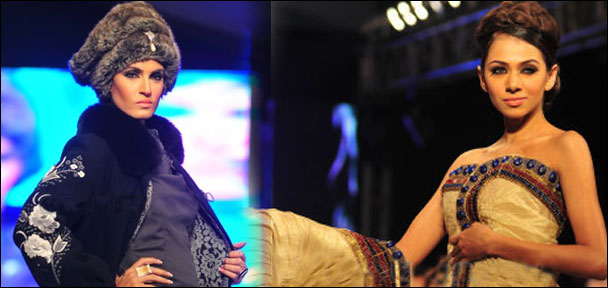
Arsh Amjad ingeniously used two large overlapping circular discs
to create a mini of the shoulder dress that was cleverly accessorised
with yet another disc used as a cape. Gleaning inspiration from
rich heritage of the Nile, her garment had a finishing of Egyptian
jewellery design called hyrogliphs with an accompaniment of metallic
plates that she got done from the famed Shahalmi workers in Lahore.
For lack of lapis lazulis that she needed to add luxury, a crucial
element of Egyptian court life, she got car painters to coat plastic
stones. Certainly where there's a will there's a way and her ensemble
was creative embodiment of how to make do with what one has with
sophistication and style.
Ayesha
Mahmood's luxurious velvet black overcoat had every woman's heart
throbbing with rich deep desire. The profound swooning could be
heard and seen dripping from women's eyes. Emblematic of the opulence
of Tsarist Russia, of Faberge eggs, dazzling gems, to scintillating
balls. Interestingly though the garment wasn't as simplistic as
just a rich wool ladies coat. The outer garment was dark albeit
with floral motifs but the inner was a lighter shade of hopeful
grey that hinted of a Russia emerging from turmoil.
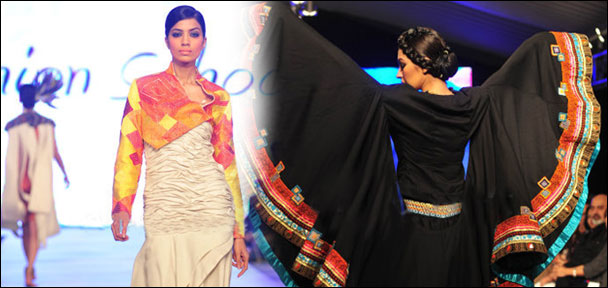
Aqsa Ilyas took a spin on the Palestine war and the abaya culture
that emerged during the war. Eventhough her garment was stark black
its multicoloured, mostly red and blue, edging lent it a certain
playfulness significant of the hope that one always seeks during
times of despondency and despair. Aqsa created a modern trendy abaya
of sorts without the long flowing top, showing instead a short top
with enormously flared sleeves connected together at the back teamed
with harem pants which surprisingly were a staple for Palestinain
women.
Anila Arooj made a simple but effective statement of how best to
modernise ancient home spun crafts like phulkari-Ahan we hope you're
listening! Anila created a bolero from a phulkari embroidered fabric
and teamed in with a cream gown. It was simple, sophisticated and
oh so chic.
Waresha Nisar did her own take on Pocahontas replete with the feathers
in the hair. Bands of fabric hung in loops to reveal a deep burnt
orange slip inside that all came together with a beaded worked shoulder.
Innovative and fun it recreated a Disney classic in effortless style
and oomph.
|