


|
|
|
|
 |
 |
|
tenancy comment Vital
forum Saving
face tenancy Whose 7,000 acres anyway? The struggle of tenants to own land they have been living on for generations shifts to Khanewal By Aoun Sahi Starting from Lahore, as one leaves the main GT road at Peerowal town, 12 kilometers from Khanewal, and starts travelling on the narrow road that leads to the villages of landless tenants, the pace of life suddenly becomes slow. Mud houses surrounded by green and gold fields of wheat,
seemingly trimmed to the same height, greet you. Big banyan, mango, and
shisham trees line the roads; herds of goats, sheep, donkey carts, and
occasional motorbikes crisscross the narrow roads. Everything seems at peace
until one talks to the residents of these mud houses about the land in
question: 6000 acres of it occupied by 25,000 people in seven villages viz.
Chak 81-81/10R, 83-85/10R, 86-75/10R and 87/10R. The land they have been
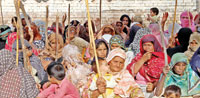
tilling since generations. The moment they start talking about the land, the contented expression on their faces gets replaced with anguish and resilience. "The establishment of Pakistan has no significance for me. First I was slave to the white gora and now the brown gora has replaced him," grumbles Barkat Ali, a 78-year old resident of Chak 81-82/10R who has seen four generations of his family tilling the agricultural land in his village, but still is unsure about the status of this land. "The government wants us to leave this land for its officers. It says we have no legal right to cultivate this land, leave alone the ownership rights," he says, sitting in the protest camp set up by Anjuman Muzareen Punjab (AMP), an indigenous organisation of tenants that was established around 2001 to organise them against state oppression. Ali, along with one of his grandsons, raises the most popular and appealing slogan of the movement: Maalki ya Maut ownership or death. "I have brought my grandson with me to make him understand that this is an issue of life and death for us. He will have to get this as his share in my inheritance." These farms in 10 district of Punjab are either owned by the Punjab government or the military. The tenants had been giving harvest shares to different government departments since they settled in the area a century ago. In 2000-2003, during the dictatorship of General Musharraf, these departments tried to impose a cash payment contract system for the tenants. This cash contract system was intended to replace the harvest shares, known as the battai system, the outlines of which are set forth in the Tenancy Act, 1887. Under the battai system, individual tenants enjoy certain rights, they do not have contracts with landowners and it is not easy to displace them from the land. While on the other hand, the new contract system was an effort to change the status of the tenants to "lessees" as it requires cash payments of rent which needs to be renewed every year making it easy for the landlords to get them displaced from the land on certain pretexts. The issue of these tenants of Khanewal is in the headlines once again because of Punjab government’s tactics to stop their planned long march on Feb 28 to Lahore, where they were to press for ownership of the land. Their route was blocked at GT Road near Peerowal by placing containers across it. "When we tried to cross these obstacles, the police resorted to unnecessary force. Hundreds of shells of tear gas were fired at the tenants. They even tortured our women and children and cases were registered against 550 tenants (41 nominated and 500 unknown) under the anti-terrorism act," said Dr Christopher John, chief executive AMP supreme council and a resident of Chak 81-81/10R Khanewal. Khanewal’s district administration on the other hand blames the tenants for attacking the police first. It is interesting that MQM is the only political party that has strongly condemned the use of force by policemen against tenants in Khanewal. "We will raise this issue in the National Assembly," said Sajid Ahmed, MNA of MQM from Karachi who has travelled from Karachi to Peerowal "on directions of Altaf Bhai" to ensure them of his party’s full support. The grandfather of Barkat Ali, like the forefathers of
many of the tenants, migrated from Jalandhar to Peerowal in search of a
better livelihood after the then government of British India introduced the
project of Lower Bari Doab canal. "Like all other tenants, our
grandparents also did free-of-cost service and labour during the digging and
construction of the canal hoping that it would result in getting some acres
of land," said Ali. Thousands of tenants in Khanewal got ownership rights to lands they had been tilling under the different schemes of Colonization Act 1912. But, for the Peerowal tenants, ownership remained a myth. A Britisher, Sir William Roberts, who was the first principal of Lyallpur Agriculture College, set up an office of the Manchester-based British Cotton Growing Association (BCGA) in Khanewal. 7,000 acres of agricultural land was leased out him for three terms of 20 years each in 1920 at the rate of Rs 1 per acre per annum. He further leased out this land to tenants on the basis of 50-50 percent share of the crop. In 1947, when Pakistan came into being, the BCGA was enjoying its second term of lease of the Peerowal farms. "Tenants again hoped that they would also be among the beneficiaries of independence, but there was nothing for them," Ali said. In 1959, under the Land Reforms introduced by Ayub Khan, the lease area of BCGA was reduced to 590 acres, while the rest of 6400 acres were given under the administrative control of Provincial Agricultural Department, ignoring the tenants’ claim for ownership rights in the land. "In 1964, ownership rights were given to us but only for six months. In 1976, the control of the farm was given to Punjab Seeds Corporation (PSC). This was the beginning of ‘neo-colonialism’ for us." Ali added that if the land had not been leased out to the BCGA, its possession rights would have been granted to them in 1921 as the same were awarded to their fellow tenants of adjoining villages, which were not under the control of BCGA. "The ownership of land was given in some of the adjacent villages, like 92/10R, where people were involved in criminal activities. Under the ‘criminal tribe scheme’ these tenants were given an opportunity to leave anti-social activities. But, we were unfortunate enough not to have a criminal record," Ali said with a smile. The situation at Peerowal became more disappointing after the PSC took over administrative control. "They used to force us to wait for hours to get our cotton weighed as we could not sell our produce anywhere but to the PSC," said Sardaran Bibi, a 75-year-old resident of Chak 83-85/10R. Sardaran Bibi was sitting among dozens of women holding sticks in their hands in a hunger strike camp set up in her village for women. She had also brought her six-year-old granddaughter with her at the hunger strike camp. "The attitude of our rulers shows that we may have to struggle for decades to get our right and I want to train my next generation to fight with these hungry land vultures," she said while pushing her granddaughter to raise slogan against the police and the government. "The thousands of acre lands in Peerowal jungle situated only a few kilometres from my village has been allotted to retired army officers in the last seven years, but we ho have been sitting here for generations are illegal occupants." Sardaran Bibi added that she was hopeful after the 2008 elections. "I thought we would finally get proprietary rights as both the PPP and the PML-N had promised to ensure this after coming into power." It is ironical that the Charter of Democracy clearly discusses the issue of land allotments to the military and suggests forming a commission to review the legality of all military urban and agricultural land allotments but both the PPP and the PML-N do not seem ready to make a commission. Government officials in Khanewal are very much clear about the status of Peerowal farms. "This land belongs to government of Punjab and all these people (do not come even legally under the definition of tenants) are illegal occupants. Both the High Court and the Supreme Court have given verdict against the tenants," said sources in the provincial government. "They have not been giving even the 50 percent share of their produce to government since 2000," they added. A few days before the proposed long march of the tenants, two provincial ministers met the tenants’ leadership at the DCO office and offered them to come to some kind of arrangement. "If the tenants wish, we are ready to negotiate a deal with them in weeks and not months," said the DCO, Rashid Mahmood. The ministers offered them 50 percent of the land, but the tenants refused it. "How can we leave 50 percent of the land? The land has already been distributed among five generations and it is impossible to identify which 50 percent land should be reverted to government. We will not consider anything less than ownership on 100 percent land under our occupancy," said Dr John. Advocate Rashid Rehman Khan, coordinator HRCP Multan taskforce, said that the decision of courts was according to the Land Reforms Regulation 1972. "The Land Reforms Act, 1977, however, has redefined a tenant as any person holding the state land in any manner and for any purpose from coming into the purview of tenant’s definition. So, they are tenants and have all the rights to own this land," he said. Email: aounsahi@gmail.com
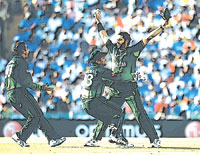
Our favourite support The way we sanctify and celebrate our heroes and artists tends to halt their ability and creative range By Quddus Mirza Long time ago, when I was a student, we were taught that hockey was the national game of Pakistan. It must still be the same in official documents as well as textbooks. But with time and change in public preference, cricket seems like the national sport now. A test of its popularity was glimpsed in the recent World Cup, which involved everyone -- from the head of the government to a small time barber working on the roadside. They discussed, analysed, argued and prayed all through the tournament. It was quite normal -- everybody liked Pakistani team,
hoping that those eleven players will win the title. So, despite the
opponents’ qualities and capabilities, the entire nation backed and
believed in the victory of the Pakistani team. Nobody -- or at least not any
known number of people -- showed support for a team playing against Pakistan.
It is only now, after the World This collective behaviour which goes unnoticed permeates areas other than the cricket field. On many occasions and forums we, as a nation, support our side without realising or recognising whether it deserves that support or not. This blind backing for our sportsmen, soldiers, singers, writers, film stars and even politicians reflects a sentiment which sometimes defies reality. People refuse to admit any negative impression associated with a figure from Pakistan, be it a musician caught with illegal money at the border or a batsman involved in illicit activity of match fixing. The immediate reaction of our public is to trace a conspiracy in every tale of infamy and insisting on a foreign plot behind all acts of human error committed by our ‘boys’. This frame of mind is evident in the way the visual art is perceived in Pakistan. Most of us respect and elevate our artists not because of their professional excellence but merely because they belong to this country. Thus, one often hears comments about our artists being the best in Asia, the greatest in South Asia or the most important in the world, and hence the titles ‘Poet of the East’ or ‘Painter of the East’. It’s not just the titles; we are convinced that some of our old masters and contemporary painters (including miniature artists) are unmatched. With the recent and growing interest in Pakistani art, a number of our artists have indeed shown abroad and their works are collected and judged for prizes and awards. But that does not mean our artists are unique in their talent and artists from other parts of the world are not as capable or prominent, or are lesser than our own. This is just one segment of how we view art in our surroundings. If a tradition of art or a craft practice is part of our history and heritage, we enthusiastically proclaim its worldwide worth. Just the fact that it emerged in our milieu is enough to sanctify that practice. One example of this attitude is our approach towards history, especially the history of civilisation. In our academic institutions, Indus Valley Civilization is taught as the most significant development in culture and civilization, without admitting the fact that its contemporary civilisations such as Mesopotamian and Egyptian surpassed it in more than one ways. Similarly, our approach towards Mughal miniature painting as one of the most sophisticated forms of expression in the ancient world is dsebateable, because miniature painting was practiced in Persia and Turkey too with distinct traits and styles, and other cultures also possess various forms of painting that can be compared with miniature painting in their sensibility and stylisation. Having known everything about the great qualities of other eras and areas, we are still content in pursuing our own historic art expressions or forms of crafts, naively believing in the supremacy of these, only because we inherited them. As Milan Kundera says "The only reason people want to be masters of the future is to change the past". This tendency has eclipsed the analytical and critical power of many here who worship past forms and adore present masters, elevating a landscape painter to the status of Cezanne, or declaring a modern miniature artist as equal -- if not better -- than Kiki Smith and so forth. All these notions can be truthful, since there is no rule that a person from this part cannot be among the very best of artists but, till that stage is reached, it is rather premature and presumptuous to celebrate our ‘accomplishments’. Actually this self-referential habit halts the creative range of our artists. So it is rare that a painter in our surroundings is seen concentrating on the art of Aztecs or being inspired from the Coptic Frescos, examples which are also distinct and loaded with meanings, symbolism and stylistic sophistications. Only when we are able to look beyond our confined view of art and art world will we be able to examine and appreciate our art in an objective and intelligent scheme. Otherwise we will keep betting on our art, as we have been doing on our cricket, only to realise later that there are other options and other achievements.
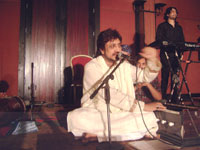
Some of the major exponents of kheyal gaiki belonging to two generations displayed their vigour at Lahore’s Alhamra last week By Sarwat Ali It has been observed that when ustads become old they still retain the ability to render taans even at the pace that they had been acclaimed for in their salad days. But the strength to hold the note in the slower tempo appears to be more exacting. The breath just does not hold long enough to sustain the vigour and stay musically relevant. But Ustad Ghulam Hassan Shaggan, despite his age, displayed at the two-day classical music concert held at Lahore’s Alhmara last week the vigour and stamina to unleash some of his most forceful and exacting taans. Ustad Ghulam Hassan Shaggan is now old and has been
advised by the doctors to be less demanding on himself. He has been a
complete vocalist with a very systematic method in his exposition of the raag.
He has also been an inheritor of a certain ang and while he elaborates on the
raag in his favoured "akwai taal", the traces of his influences and
training is easily detected. But, since he had a very fast taan that went beyond the customary three registers, there is also a popular expectation till now that his rendition would thus become a sheer display of virtuosity. Now he is much more circumspect in his performance and in shorter duration has lost nothing of the peculiarity of his style. He has a very big and authentic repertoire -- the expose of which is pure delight. One has heard many raags from him during the course of his long career that one had only read about in the books or heard from connoisseurs of music. He belongs to an age when the purity of the raag was one of the basic requirements of a good rendition and any deviation from it was considered an artistic failing. The emphasis on composition has played havoc with the idea of sustaining a particular melodic line now. Among the other major exponents of the kheyal that participated in the concert were: Shabbir Ali Khan, Muhammed Akhter Khan, Shafqat Ali Khan, Nazeer Faridi, Qamaruzzaman Badruzzaman, Ustad Mubarak Ali Khan, Muhammed Latif Khan, Hussain Buksh Gullu, Ustad Hamid Ali Khan, Ustad Fateh Ali Khan Hyderabadi and Dr Amjad Pervez. Ustad Fateh Ali Khan Hyderabadi is at the prime of his career and he may be the last of the Mohicans who was brought up in the traditional style of gharana training which, for want of a better expression, can be called integrative. The personalised transfer of musical knowledge takes place like the learning of a mother tongue, totally unnoticed and without an effort as part of growing up and this close door integrative method is now on the wane even in the families of musicians. This reet ki gaiki too is on its last legs as the media explosion exposes the performers to a vast variety of sources which become too difficult to assimilate and digest. The modern output is more eclectic. Of all the sons of Ustad Salamat Ali Khan, Shafqat Ali showed the greatest promise. Though Sharafat Ali Khan accompanied his father for many years, somehow his music was lost in comparisons to his more illustrious father. For now many years Shafqat Ali Khan has been performing solo and his singing has settled down to a more rounded form. In the beginning the rash of youth often made him to over emphasise virtuosity. In our music this has been popularly restricted to fast intricate taans and very subtle laikari, and once displayed the performer is taken seriously by the more initiated audiences. But Shafqat Ali Khan has passed that stage and is now more into a rounded and balanced performance where virtuosity has become integral to his vocalisation. He has also been more aware of the problems confronting classical music and, without diluting his singing, he has decided to create greater awareness about the finer points of classical music, lost on a mass audience yearning for a ready response. Shafqat Ai Khan and Rustam Fateh Ali Khan have been singing and performing now for more than 10 to 15 years and it is for the people and the connoisseurs to determine their place within the pantheon of vocalists. Of course the real comparison is with their elders, Ustad Salamat Ali Khan and Ustad Fateh Ali Khan -- and one has to see how far these comparatively younger practitioners have taken their art form forward. It is encouraging to be at least talking of these two or three generations in the same breath and critically examining their work and building up hope that all is not hazy on the horizon of classical art forms in the country. A number of other performers too took part in the concert like Nadeem Riaz, Mohammed Qasim Bharwana and Zara Zafarullah-Salman. A whole crop of non-professional artistes also wait in the wings for their turn and usually they are sidelined or listened to with a sympathetic ear. The standards begin to change the moment a non-professional musician occupies the stage and plenty of allowance is given. Due to this bias a non-professional musician has to be twice as good as a professional musician to be fully accepted. Alhmara should continue with its offering of its platform for classical music with greater frequency. It is a forum and a vital one which should extent its support to the forms which though significant otherwise have few takers on the commercial circuit. It should also revive its regular concerts of the young classical musicians, for it served as a nursery and if it continues to do so with more frequency it will become difficult to find fault with the organisation. Saving face Dear All, I recently lost a friend I have known for twenty-two years. No, don’t get me wrong -- he is not dead, just lost. Lost, that is, in the self-deluding, self-projecting PR world of Facebook. Here is what happened: my friend posted a comment on his page which I then commented on saying that I thought, "this had not necessarily been his view" while at the organisation we had worked together. There was no response. Which I guess in the FB world is itself a response. A few days later we met at a gathering, and I greeted him warmly but his response was frosty. Extremely polite -- but unmistakeably chilly. I feared that my sensitive (hasaas) friend had taken offence at my comment, but this seemed too ridiculous -- he would surely have chided me or been in touch if he had. Alas, my suspicions were correct: I recently noticed that he has removed me from his list of FB friends. Ooooh -- he didn’t want to be my friend any more! In my childhood such an action might have hurt me deeply but I am now almost 50 years old, and he is even older, so surely we should be past such juvenile sulks? Anyhow, the episode got me thinking about the peculiarly
self-promoting nature of FB. In this weird FB world all comments are okay as long as you agree and don’t do anything to ruin the person’s public image. You have to go along with the image thing because Facebook is now not used as a forum for friends but as a manipulative PR tool. This is evident in the numbers of ‘friends’ (yeah, right!) that people delight in adding. Hundreds of people are added as ‘friends’ so you are under pressure to maintain a certain image and persona. Which means you cannot tolerate contradictory remarks from actual friends, so anybody who does not fall into line must be ‘cut off’... I think long and hard before adding people to Facebook. My view is that just as you think long and hard before letting anybody into your house, so you should do before adding them to your personal Facebook. But really I suppose it is not Facebook but me who is the problem: I am an anachronism in this day and age. I have not really gotten into the spirit of social networking where even though you can give the thumbs-up and ‘like’ posts you do not have the option to give the thumbs down to anything at all… I belong to the 20th century-- to a group of cranky and tactless scribes who love to speak their mind and thereby end up alienating people... But if I am ever unhappy with that, no problem: I can just re-invent myself on Facebook as a witty, socially aware devastatingly beautiful, frightfully intelligent and immensely popular personality.... Best wishes, Umber Khairi |
|

 Cup’s heat is cooling off, that one can put this question: why do
individuals not have a right to favour a team which they think is better
equipped than their own. They may examine in detail the strength and
abilities of all teams but when it comes to the home team, most of our
population is unwilling to make use of any analytical faculty. Being a
Pakistani, it is pre-determined that one must defend the national team. To
cheer the Indian or the Australian teams against the Pakistani squad would be
considered unpatriotic; the national team needs unconditional and full
support from the spectators on ground and at home.
Cup’s heat is cooling off, that one can put this question: why do
individuals not have a right to favour a team which they think is better
equipped than their own. They may examine in detail the strength and
abilities of all teams but when it comes to the home team, most of our
population is unwilling to make use of any analytical faculty. Being a
Pakistani, it is pre-determined that one must defend the national team. To
cheer the Indian or the Australian teams against the Pakistani squad would be
considered unpatriotic; the national team needs unconditional and full
support from the spectators on ground and at home.