


|
|
|
|
 |
 |
  
|
journey Not
a man-eater
Back to Istanbul A city to revisit the mysteries of the Roman era, the
glories of the Ottoman times and By Awais Manzur Sumra In his epic ‘The History of the Decline and Fall of the Roman Empire’ Gibbon mentioned that Constantine founded this city at the confluence of Europe and Asia as "an eternal monument of the glories of his reign." For centuries, this city was known as Constantinople. Now it is called Istanbul -- the only city that lies on two continents, an incomparable fusion of East and West. Istanbul is the city to revisit the mysteries of the Roman
era, the glories of the Ottoman times, to gain an insight into the emergence
of a new, modern Turkey, a sleeping giant that is beginning to throw its
weight around as a major regional player. It is where a multitude of tourists
pour in, where the results of years of impressive Turkish leadership are on
increasing display, where business thrives in the shadows of elegant mosques
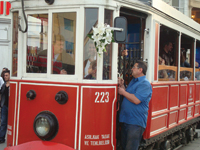
that attract the faithful five times a day. I first visited Istanbul in April 2006 for a conference on disaster management. With two full days taken up by the conference, I was left with only a few hours before my flight on the third day to see what Istanbul was all about. Those few hours allowed a quick visit to the impressive Topkapi Palace and a leisurely stroll a couple of kilometres up to Kapali Charsi -- the famous Grand Bazaar -- dodging the myriad trams, buying a couple of Istanbul pictures, savouring the unforgettable tastes of hot, mouth-watering roasted chestnuts. I returned to Istanbul at the end of 2010, this time to see the city at leisure. During Eid ul Azha holidays in mid-November, I started driving with my family and visiting parents, from Athens (where I’ve been living for the past few years), some 1100 kilometres to Istanbul to further explore its sights and sounds. Istanbul was its usual self -- welcoming, imposing, awe-inspiring, bustling. Eid festivities added to the colour. People elbowed their way through the shopping areas, serpentine queues snaked into the tourist attractions, muezzins called for prayers from mosques that dotted the city on either side of the Bosphorus. Life in Istanbul, described in such vivid detail by Nobel-prize winning Orhan Pamuk, pulsated night and day. In the heart of the old city, six imposing minarets rise
unceasingly into the late November sky. The Sultan Ahmet Mosque, better known
perhaps as the Blue Mosque for its blue tiles that adorn the interior walls,
is the signature sight of this city of endless charms. Rows of fountains,
neatly placed in elegant, lush gardens, spout frothy water. On Eid day
itself, thousands of smartly dressed worshippers, men and women, young and
old, thronged the Blue Mosque, and other mosques throughout the city, for
prayers in an impressive and inspiring show of faith, brotherhood and
harmony. Across the gardens rises the imposing facade of Hagia Sophia, the epitome of Byzantine architecture and for nearly a thousand years the largest cathedral in the world as well as the seat of the Patriarch of Constantinople. Now it is neither a church nor a mosque. Yet, Hagia Sophia retains its elegance, its vast, ornamentally-decorated main hall welcoming people of all faiths and backgrounds. As in the Blue Mosque, names of Prophet Muhammad (PBUH) and the four Caliphs prominently adorn its upper reaches, inscribed on circular-framed medallions hanging from sturdy columns. On its upper gallery, a marble plaque marks the grave of Henricus Dandolo Doge of Venice, commander of the Latin armies that invaded Constantinople in the Fourth Crusade. He is said to have died during the expedition and buried in Hagia Sophia. In its shadows, rows of restaurants serve their versions of Turkish delights as jam-packed trams trundle up and down past endless boutique shops and international fast food outlets. A couple of kilometres, beyond to the west, lies the Grand Bazaar; its maze of criss-crossing covered streets brimming with unknown secrets to be explored -- jewellery, pottery, spices, crystals, carpets, lamps and linen et al overflow from thousands of shops on to the brightly lit alleys. We spent an hour at the Grand Bazaar was too little, especially since my mother and wife had heard so much of Turkish silver jewellery and crystal pieces. East of Hagia Sophia, the road slopes down past the
entrance to the extensive complex of the Topkapi Palace, for centuries home
to the Ottoman sultans and a perfect example of Ottoman architecture. Now
converted into a museum, it is a proud repository of the "sacred
trusts" -- items belonging to Prophet Muhammad (PBUH), his companions
and other prophets, as well as thrones, porcelain, jewellery, weapons,
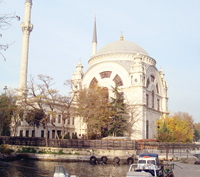
carriages and other paraphernalia from the Ottoman times. Some inner terraces afford stunning panoramic views of the Bosphorus and the Sea of Marmara, the rolling hills on the Asian side of the city beyond the choppy waters traversed by innumerable vessels. Out in the distance is the glistening Bosphorus bridge, suspended high above the water and bringing the two continents together. In the mid-19th century the Ottomans abandoned the Topkapi Palace for the modern and luxurious, European-style Dolmabahce Palace, still the largest palace in Turkey. The extravagant palace, where Mustafa Kemal Ataturk also breathed his last, lies on the banks of the Bosphorus just south of Taksim Square. The extravagant gold-plated ceilings and railings, oriental carpets, huge chandeliers, impressive paintings and beautiful crystal leave thousands of visitors awestruck on a daily basis. Modern commerce continues unabated outside, huge oil tankers chug through the Bosphorus transporting oil from the Black Sea ports to the world beyond, ubiquitous vessels of various shapes and sizes transport men and material. On the other side, high-rise buildings, home to financial institutions and multinationals, peep in from behind the tall trees -- a continuing reminder and proof of Turkey’s growing economic power. The modern funicular railway plies between the shores of
Bosphorus, close to the Dolmabahce Palace, and Taksim Square, the heart of
modern Istanbul, with its volatile and colourful mix of demonstrators,
shopkeepers, policemen, tourists and youngsters. Foreign fast food outlets,
interspersed with local eateries, line the entrance to the bustling Istiklal
Street that meanders through the centre of Istanbul for almost three
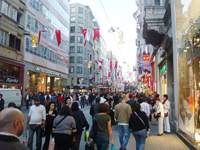
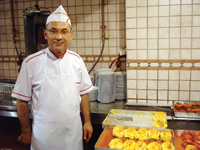
kilometres up to the Galata Tower. Throughout its length exquisite boutiques, cinemas, cafes, bookstores and theatres conveniently overshadow a sprinkling of majestic structures from the late Ottoman period. Towards the end, dark, narrow streets and alleys wind down towards the Bosphorus under overhanging balconies jutting from dark, dilapidated multi-storey houses. Before leaving Athens my father expressed his desire to visit the tomb of Hazrat Abu Ayub Ansari, the companion of Prophet Muhammad. And so I was not leaving Istanbul before locating and visiting the site. Lying in an austere setting next to the Eyup Sultan Mosque, the first mosque constructed by the Ottomans following their conquest of Constantinople in 1453, with its large shady courtyard in a non-descript part of the city, the tomb is a far cry from the Ottoman glamour and Turkish glitter. Yet, it attracts hundreds of visitors daily. Outside, on the far side of a lovely fountain, rows of shops sell copies of Holy Quran, Turkish caps and rosaries. On our last night in Istanbul, the night before Eid ul Azha, we returned to the old city. The Blue Mosque, its six minarets and myriad domes beautifully illuminated in mellow shades of blue and yellow, dazzled in all its majesty. Nearby, in the vicinity of Hagia Sophia, restaurants did brisk business. We dined on traditional Turkish food -- mousaka, stuffed vegetables, and rice with meat. Mustafa, the bespectacled chef, neatly dressed in all white, promised to serve us even better food on the Eid day. But by the same time the next day we were in Thessaloniki, hundreds of miles away, en route to Athens.
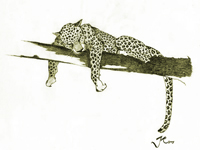
The killing of a leopard spotted in Bhakkar district, by the villagers, should get organisations working on wildlife cracking By Dr Raheal Ahmad Siddiqui Jim Corbett, the famous hunter turned conservationist,
described leopard as" the most beautiful and the most graceful of all
the animals in our jungle, and who when cornered or wounded are second to
none in courage." The leopard of Jhamat Shumali in Bhakkar district was
not a man-eater. It was an ordinary animal of average size, which fought
bravely in defense of its own life, fought effectively, mauling two persons
and killing three dogs in the process, and dying gamely at last in front of
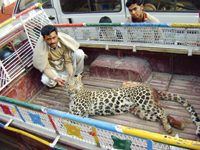
hundreds of witnesses. On February 10 this year, it was reported in the press that a leopard attacked and injured two persons in Jhamat Shumali village and disappeared in jungle. I phoned Gulzar Shah, DCO Khushab, to take immediate steps for the protection of this endangered animal. Gulzar Shah, a peerless DMG officer who cares for nature, called later in the afternoon to inform me that the game was all over. The press report was not the whole truth. While driving from Mianwali along the Mianwali-Muzaffargarh highway, you can reach Dullewala Chowk in Darya Khan tehsil. Turn right and you would be in Bhakkar city after travelling for 50 kilometers. Turn left and within 15 minutes, you would be in Jhamat Shumali village, which lies along the boundary of Khushab and Bhakkar districts. I was in this village on Feburary 15 along with Dr Sajjad Aheer, a dermatologist from Khushab, who acted as my guide. We wanted to know more about this incident. On the morning of February 10, Atta Muhammad noticed fresh pugmarks in the immediate vicinity of Jhamat Shumali village. This village is surrounded by vast tract of desert which, at this time of the year, is turned into green slopes covered with gram crop. Pugmarks on soft sand are easy picking. Being an expert tracker, he decided to follow the animal with his two dogs. These dogs called Katha, are a local cross breed of Grey Hound and Bullterrier. They were worth Rs30,000 each in local market, a crucial factor which sealed the fate of the leopard. At 11.00am, the pugmarks led Atta Muhammad to dense Jaal
tree, located in the centre of cultivated fields. His dogs attacked the
leopard which was enjoying siesta under the low thick branches of this tree.
These dogs were no match to the ferocity of the surprised leopard and within
no time one was dead and the other was gasping for last breaths. Atta
Muhammad blindly entered the fray with a view to save his costly dogs and to
catch the big cat. Leaving the dogs aside, the leopard pounced on Atta, who
protected himself from the frontal attack with his bare hands. On hearing his
screams, people from the nearby tube-well rushed to the spot. The leopard,
leaving badly mauled Atta behind, crossed the dried bed of Greater Thal link
canal and took refuge in a small thicket at a place where the village road
crosses this canal. With not much vegetation cover, the leopard was trapped. Kallu, the district wildlife officer, arrived at the scene at 2.30pm and was confronted by a hostile armed mob. The local police refused to cooperate and withdrew from the scene. Kallu was threatened by District Police Officer, Bhakkar, on phone. Meanwhile, villagers set loose hunting dogs on the frightened leopard, which after killing two, jumped over the steep slope of the canal and tried to escape, taking cover under Khagal trees planted in straight line along the edge of fields. An excited crowd chased it. Shots were fired at the animal. Adnan, a 2nd year student, ran madly to have a closer look at the beast and tripped over the injured leopard. He paid for his curiosity. Leaving him on the ground, the badly wounded leopard limped into a hole burrowed by a porcupine. Later at night Kallu pulled out the dead animal from the hole. It was a young male, 2 and a 1/2 ft high and 7ft 2inches long. Sitting in Dr Sajjad’s house in Khushab, one can see the mountains of Salt Range majestically punctuating the distant horizon. Somewhere in the north-west is Sakesar, a spot at an altitude of 6000ft which during British Raj used to serve as the summer capital of Shahpur district (presently Sargodha division). This area was full with game of all sorts. The colonial administration offered substantial reward to destroy wild animals. According to Punjab Gazettier of Shahpur District (1905) "between 1877 and 1882 reward was paid for three tigers, 11 leopards and 742 wolves. The number of animals decreased sharply. During five years ending 1895 reward was paid for 3 leopards and 152 wolves only." According to late Nawab of Kalabagh, about twelve panthers were killed in the Salt Range of Mianwalli District between 1942 and 1967. The news of a wandering leopard in the plains of Khushab-Bhakkar corridor is a good omen for animal lovers. Perhaps some wildlife is still thriving in small pockets among these mountains. The people of Jhamat Shumali had seen a leopard only once before. Ghulam Fareed, a village elder, vividly remembers that February 19, 2005 was an extremely cold day. That night this village and the surroundings received one foot of snowfall, a phenomenon not recorded in the last two centuries in Bhakkar District. The distant mountains of Sakesar in the salt range also received heavy snowfall. A male leopard was found basking in the sun near a tube well at the edge of this village. It was shot dead out of fear that it might turn into a man-eater. The same day three leopards were killed in neighbouring Khushab district. In Kartimar village, a leopard was run over by a tractor after it attacked a lad who had accidently stepped on it while cutting grass. At Shergarh Bridge in Khushab, a leopard was seen lying on the bank of river Jhelum in broad daylight. Two villagers foolishly tried to catch it in a net. Both were badly mauled and the enraged villagers killed the poor animal in retaliation. Another leopard was killed near Jauharabad sugar mill. The 19th of Feburary 2005 was thus a black day for animal rights activists. It is a clear pattern that in those years winter and snowfall in Sakesar Mountains causes the natural prey (wild boars, porcupines and rodents) hard to find, the leopards descend to the plains in search of food. With little vegetation cover in the fields and its preference to walk along the established cattle trails because of soft pads, the leopards are easily discovered and killed by the villagers who consider them a prowling enemy out to destroy their livestock. The shortage of funds force the high ups of wildlife department of Punjab to sit idle in their offices in Lahore. The local District Police Officer was only interested in illegally acquiring the pelt of this ill-fated animal. It was only the DCO of Khushab who had shown real concern in saving this endangered specie from extinction. He is planning to run an awareness campaign about leopards in his district. It is also a wakeup call for organisations like WWF and IUCN to help out Gulzar Shah in his endeavours before it is too late.
The writer is an animal rights activist and can be reached at gmlarp@gmail.com |
|