


|
|
|
|
 |
 |
|
interview The
central issue Yeh Woh security Ideals
he stood for At
home in the US
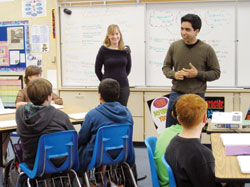
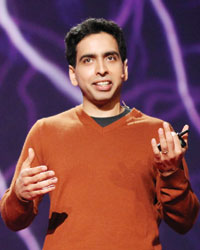
interview Mention the name Salman
Khan today and chances are people’s first thought will be of a Bollywood
actor. Perhaps, the second most popular Salman Khan around is the
Bangladeshi-American graduate of MIT (Massachusetts Institute of Technology)
and Harvard Business School who Bill Gates calls “his favourite teacher”.
Sal’s story of how he started making instructional math and science
tutorials with the most rudimentary of equipment for his cousin is legendary.
Today, he is the man behind the Khan Academy, a portal with over 3,000 videos
on all kinds of academic topics that draws over four million unique users a
month. Sal’s team includes Bilal
Musharraf who is heading up a project to translate these valuable videos into
Urdu. 500 such videos have already been translated and are accessible on the
YouTube channel “KhanAcademyUrdu”. Sal was kind enough to give
TNS an interview over Skype in which he told us about his favourite videos,
what the future holds for Khan Academy and how Pakistanis can get involved.
Since this interview was conducted, he has made it to the Time’s list of
100 most influential people in the world. The News on Sunday (TNS):
Do you know about the popularity of Khan Academy in Pakistan? Salman Khan (SK): Not much
more than a bird’s eye view. I don’t have precise numbers off hand, but
from general data and anecdotal evidence, Khan Academy is particularly
popular across the South Asian subcontinent. TNS: How successful have
you been in integrating Khan Academy into classrooms? SK: Khan Academy is in use
in about 10,000 classrooms across the planet, several outside the United
States, including a prestigious school in Mumbai. I’m not aware if it is
formally used in any particular school in Pakistan. We piloted it in a high
school in Oakland with an underserved student population and found 50 per
cent improvement across objective academic indicators. Khan Academy is easiest to
integrate in affluent English-speaking high schools with access to computing
and broadband equipment. But its real value will come through once the videos
have been translated into local languages and the infrastructure becomes more
inexpensive. TNS: Could you give us an
update on the project on translating these videos into Urdu? SK: Progress here has been
slower than we would have liked, but we expect to have a lot more done over
the next year. One factor that slowed us down was that Hindi and Urdu are
more different than we expected in an instructional setting. The ease with
which we can translate the videos is a function of how easily we can access
relevant resources. It was relatively easy in Spanish, Bengali and
Portuguese. TNS: Among which
demographics is Khan Academy most popular? SK: It appeals to a broad
range of people including parents, teachers and professionals. I would have
guessed it is most popular among the most motivated students or the
struggling students who need the boost. But I’ve been pleasantly surprised
with its popularity among disengaged students who are looking at it as a way
to return to mainstream education. TNS: Do you see the Khan
Academy as spawning several clones with the same vision? SK: I really hope so!
Pakistan would benefit from a Khan Academy clone with the content in local
languages. Egypt already has the Tahrir Academy. I just hope that the clones
choose to be non-profit like us since I feel consumers have less trust in
for-profit educational enterprises. TNS: How can people in
Pakistan volunteer for Khan Academy? SK: Contact Bilal Musharraf
to help in translating videos and adding subtitles in Urdu. More importantly,
in a country like Pakistan, there is genuine need for videos on topics in
basic literacy in the native tongue. If anyone from Pakistan sends us 5-10
good videos on this topic, we will help spread them to communities that need
them. TNS: What other
technology-based platforms do you see as being critical for education in the
future? SK: As the prices of tablet
computers fall (there’s a $30 tablet in India that I think will be as
powerful as the iPad in a year or two) and 3G/4G networks become ubiquitous,
we’ll have the infrastructure in place for something like Khan Academy to
really thrive. TNS: How do your videos
cater to the curriculum taught in schools in Pakistan? SK: Our view is that
biology is biology, physics is physics. Yes there are slight differences in
the curriculum across communities, but we’d like to think of Khan Academy
as a superset of all. We also appreciate learning about the differences since
it helps us understand the underlying themes. TNS: Do existing videos get
revised or improved? SK: Yes, on a very regular
basis. There are occasional errors in videos sometimes identified by users.
We also refine the content over time. TNS: What subject areas are
you looking to extend Khan Academy into? SK: Computer Science is
currently handled in a very superficial manner by Khan Academy, so it is a
future area of focus. Micro and Macro Economics should be up there in the
next few weeks. I’d like to see more content on accounting, finance and
particularly law which is often ignored. And most of all, I’d like to see
more content on basic literacy. We also need to make all the content as
interactive and engaging as our math videos. TNS: What are the
limitations of the Khan Academy model? SK: Some elements of
interactivity are lacking. We are trying to leverage the community to provide
more peer assessment. I’d like Khan Academy to be around in another 100
years and still be pushing the envelope on the level of group interactivity
we can achieve. TNS: What is the work
environment at Khan Academy like? SK: In some ways we are
like a typical Silicon Valley startup. But traditional for-profit setups can
be more stressful with the pressure from investors. Free from that stress, we
are able to really focus on solving the important problem of how to help
people learn. TNS: What innovations
should we expect in the coming months? SK: Expect more content
including project-based learning in computer science. Expect more
interactivity with exercises that assess your progress as you go along. TNS: Which are your
favourite videos? SK: I’ve shared a montage
of some of my favourites in my TED talk. I enjoy many of the introductory
videos especially those on algebra and the beauty of mathematics such as
those about the Golden Ratio and the odds of winning the lottery. I also
really love this video in which we simulate a collision between two galaxies.
TNS: Has the Khan Academy
received any criticism? SK: There are occasional
errors in videos that draw some criticism. Some deride us for trying to
replace teachers when the truth is we are actually trying to empower teachers
with these supplementary tools. The most valid criticism I’ve received is
that our content development platform does not welcome outsiders. And we do
that not because we think we’re the only smart people around, but because
we want to maintain careful standards. Gradually, we hope to have a more open
platform to include content from multiple sources, but quality control will
still be important.
The
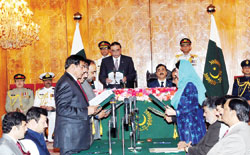
central issue The federal government has inducted 15 PPP lawmakers — five full and 10 ministers of states — in the cabinet in two phases during the last one week. It is the 17th expansion in cabinet during the four-year tenure of this government. The most significant fact in the recent expansion is that all the newly-inducted ministers, except two state ministers, belong to Punjab. All five federal ministers — Qamar Zaman Kaira, Rana Mohammad Farooq Saeed Khan, Raja Pervez Ashraf, Nazar Mohammad Gondal and Farzana Raja — belong to central Punjab, a stronghold of the PML-N. A good number of state ministers have also been taken from different districts of central Punjab. The government has 35 federal ministers, 18 state ministers and six advisors with the status of a federal minister. The total size of federal cabinet has now reached 59. The PPP insiders say the government had struggled a lot for consensus on portfolios to the newly-inducted ministers as a tug of war had started among the heavyweights to get the portfolios of their choice. The coalition partners have
also shown reservations to the expansion. The government, according to them,
will have to induct more members from the coalition partners in the coming
days. “A decision regarding inductions of new ministers from the coalition
partners will be made in the coming few days,” says one senior leader of
the PPP. When the government cut the size of cabinet in 2011 after the 18th Amendment, the prime minister had declared it an austerity move. According to the 18th Amendment, the size of cabinet cannot be more than 11 per cent of the total strength of the members of parliament which is 448 at present. It means the size of cabinet should not be more than 50 members. Analysts believe the induction of new ministers would be a huge burden on public exchequer. “One federal minister costs public exchequer Rs100,000 a day while a state minister costs around Rs75,000 a day. 15 new ministers will cost more than Rs1.2 million a day. Most of these expenses are drawn from Public Sector Development Programme (PSPD),” analyst Dr Farrukh Saleem tells TNS. Political rivals of the PPP believe that the recent expansion of cabinet is politically motivated and has nothing to do with governance. “PPP leadership has expanded the size of the cabinet to satisfy its parliamentarians so that they should not leave them,” Shafqat Mehmood, secretary information PTI, tells TNS. He claims that many of the PPP parliamentarians are in contact with the PTI. “They will join us once the tenure of this government is over. The PML-N also has similar fears. Both these parties have cut a deal to spend the next development budget on their respective constituencies to buy voters. This expansion of the cabinet is part of that programme to allure more and more voters with public money,” he says. Political analysts do not agree with Shafqat Mehmood. “It is true that the cabinet expansion is politically motivated but it has nothing to do with the PTI. It is a move focusing on the next general elections in Punjab,” political analyst Suhail Warraich tells TNS. “At present, the PPP is doing well in South Punjab with its slogan of Seraiki province. The president has already announced establishment of the Seraiki Bank. It will not be easy for politicians in South Punjab to oppose this slogan in the next election,” he elaborates. Warraich says the PML-N is the strongest political party in these areas of Punjab with the PTI making good inroads. “So, the first choice for any electable in these areas should be the PML-N. But everybody knows that the PML-N has strong candidates in all these constituencies and it would not be easy to switch over to the party with a promise to get ticket for the next election.” Warraich believes the recent expansion in cabinet is meant to re-group and strengthen the PPP in central Punjab. The PML-N leadership also criticised the move. “Finances of the country are already under immense pressure with inflation on the rise and shortage of power and gas. Instead of increasing the number of ministers, the government should have cut its expenses,” Khurram Dastagir, MNA and deputy information secretary of the PML-N, tells TNS. “Some of these ministers like Raja Pervez Ashraf have been declared corrupt by the Supreme Court. The court has ordered to put his name on the exit control list while the government has made him a minister.” He believes the PPP would not be able to dent the PML-N powerhouse (central Punjab) with such unpopular moves. “The move is aimed at political patronage to buy votes in central Punjab.” The PPP leadership admits that the expansion of cabinet is only meant to strengthen the party in central Punjab. “It is true that we were losing ground in central Punjab because there was no face in the cabinet that could properly represent the workers of central Punjab. Ch Ahmed Mukhtar is not very active while Manzoor Ahmed Wattoo does not represent the PPP workers. Samina Khalid Ghurki was trying, but she also failed to deliver as she was focused more on her constituency,” a senior PPP leader says. He says the president has given clear instructions to the newly-inducted ministers to not only focus on their constituencies, but also work for other areas of their districts. “Now we have at least one minister from all the districts of central Punjab.”
Yeh
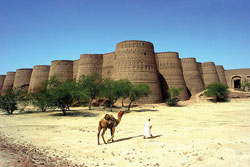
Woh The wall chalking is fairly innocuous: ‘Kashmir is ours’. Of course it is; we have always said this just like Indians have always said Kashmir is theirs. It’s the location and attribution of this territorial claim that makes it bizarre in this instance. It’s a small village deep inside Cholistan desert, nearly two and a half hours drive from Bahawalpur. The village overlooks the majestic Drawar Fort — spectacular from outside with its 30 metre high wall and 40 curved bastions covering a circumference of one and a half kilometers, but little more than a dump for historic debris from inside. The fort attracts visitors from all over the country in fair weather and is the starting point of Cholistan Desert Jeep Rally which is the largest gathering of Pakistani sardars and nawabs, and wealthy Arabs. These visitors are the only likely audience of wall chalking because the local Rohillas have little understanding of spoken Urdu and absolutely none of the written word. Ask the Rohilla if he or
she gets the message written on the wall and they just shrug and smile. They
don’t see a message there, it’s just paint on a wall. ‘And how do you
feel towards the Kashmir issue? Like all other issues. They are there,
they’ll always be there, and that’s all there is to it. Do you know where
Kashmir is? Very far from here, comes a well considered reply. Who would want to litter the walls of secular and insular Cholistan hamlets with slogans of essentially Deobandi bent? Jamaat ud Dawa of course. The name of the banned organisation appears on some of the older wall writings. But the newer ones cropping up regularly, are attributed to ‘concerned citizens’, ‘Pakistani awaam’ and such like entities. There may not be many buyers today, but sellers of bootlegged ideologies have set up shop in Cholistan. There are other shops too. Yusuf Raza Gilani of Multan is selling the Seraiki province, Mohammed Ali Durrani of Bahawalpur is selling the Bahawalpur province, and the heirs of Nawab of Bahawalpur are selling nostalgia for the lost glory in the hope of reviving the Riyasat. These peddlers of petty politics, however, ignore a simple and basic fact: they have no jurisdiction over Rohi (the desert in local parlance) and Rohilla. Like the deserts of Balochistan and Sindh, Cholistan too is the property of Arabs. They pay the governments a good price and then do with their property and the tenants that come with it, as they please. And going by local sentiments, the Arab masters are doing a much better job at governance. Bahawalpur is the seat of Dubai wallahs. They have built schools and hospitals for local population, and provide employment at generous remunerations. They have built an airport with their own money and expertise, they build roads, and they keep the provincial government in good financial health through generous injections of cash. Abu Dhabi wallahs are doing the same in Rahim Yar Khan, and Qataris, Bahrainis, and Saudis in Sindh and Balochistan. All in return for Houbara Bustard that they come here to hunt. Houbara Bustard is a large migratory bird whose number is consistently dropping due to overzealous hunting. The Pakistan government is still allowing Arabs to kill 2,500 Houbara Bustards every hunting season. Which is not to say the hunters will stop at this number when they have plenty more to kill. There is no one to stop them or to monitor their activities. There are a number of wildlife protection check points in Cholistan, but officials of the Punjab government are getting their salaries from Arabs and their job is to ensure no Pakistani is allowed into the hunting areas. As for the responsibility of conserving the endangered specie, the Arabs have set up a Houbara Foundation in the very hunting grounds that become major killing fields for the bird. The Arabs just want some bird meat in their deep freezers; meat that is considered a potent aphrodisiac and is also used to treat heart problems, liver cirrhosis, hypertension and certain kidney ailments. The rulers in Pakistan and Punjab province sell the state resources because they get money and personal favours in return. And local politicians are busy hatching plans for new provinces so they can wrest away this tray full of booty from Lahore and Islamabad. The people of Cholistan don’t figure in any scheme. They are just dumb buyers who’ll happily purchase central heating for their gopas (mud huts), if that is what’s being sold in Rohi.
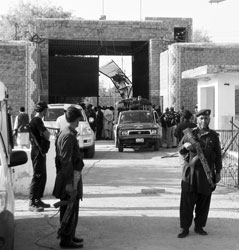
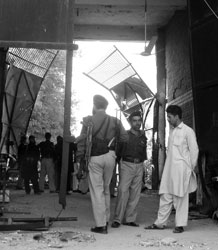
security “The militants barged into the jail, came near the death cell, asked the inmates to move to a corner of the barrack and shot the lock with AK-47 rifles. The militants, one by one, embraced a composed inmate and put a small turban on his head,” recalls a fugitive who has escaped to Waziristan along with the militants after last Sunday’s Bannu jailbreak. Adnan Rasheed, the man Taliban came for, and other inmates walked out of the jail as free men. For the first time in Pakistan’s history, around 300 armed militants travelling in two dozens vehicles came from North Waziristan tribal region and brazenly stormed the main central jail in Bannu city of Khyber-Pakhtunkhwa province and freed 384 prisoners, without facing any resistance from the law-enforcing agencies. This daring attack has put
a question mark on the performance of Pakistani security agencies and the ANP-led
Khyber-Pakhtunkhwa government that proudly owned the so-called war on terror. The Khyber-Pakhtunkhwa government has already termed it “a conspiracy and negligence of the police and other security agencies” and ordered a high-level inquiry to ascertain how 300 armed militants managed to reach Bannu city after crossing over dozens of roadside checkpoints manned by the police, FC and Pakistan army. Armed with heavy lethal arms, including AK-47 assault rifles, hand grenades and rocket-propelled grenades, the militants fired rocket at the main steel gate of the prison and blew it open. They entered the jail and broke the locks with hammers and fire shots and told the inmates they were free to go wherever they wanted. In their two-hour long pre-dawn operation on April 16, the Taliban did not face any resistance from the jail administration and other law enforcement agencies. Twenty of the prisoners were said to be high-profile terrorists and criminals, including Adnan Rasheed, allegedly involved in the assassination attempt on Gen Pervez Musharraf in Rawalpindi. Adnan Rasheed, a resident of Chota Lahore area in the Swabi district, was serving in the Pakistan Air Force (PAF) when held by the law enforcement agencies. He was given death sentence by the court and was shifted to the Bannu prison last year from Adiala Jail in Rawalpindi due to reasons best known to the authorities concerned. Rasheed married in jail a few years ago and is presently father of a daughter. His wife and daughter live in the family house in Chota Lahore with his widowed mother and a younger brother. Security officials believe that the Pakistani Taliban, led by Hakimullah Mehsud and members of al-Qaeda, conducted the entire operation to secure the release of Adnan Rasheed. An eyewitness and jail mate of Adnan Rasheed tells TNS on telephone from somewhere in North Waziristan that after entering the jail, the militants were loudly shouting Adnan Rasheed’s name. “They were desperately searching barracks for him. He was sitting quite satisfied in his death cell along with three other prisoners and loudly said ‘come here, I am here’,” the eyewitness says, who too was given death sentence by the court for killing his brother in Bannu. The eyewitness, who identified himself as Wazir, recalls Adnan Rasheed and three other inmates were taken away in the official vehicle of the jail administrator. According to Wazir, hundreds of prisoners and Taliban fighters came out of the jail. “Some were sitting in cars and pickups while many others were walking in the streets of Bannu city to reach the Bannu-Mir Ali road.” “People came out of their houses and stood in the streets while we passed through the area. Some of them even provided us water and other edibles and helped us find the nearest and safest routes for reaching the Bannu-Mir Ali road,” the fugitive recollects. After crossing the Front
Region Janikhel and Bakakhel areas on Bannu-Miramshah road, where the
military had set up checkpoints, Wazir says, the Taliban sent dozens of
pickup trucks, cars and tractor trolleys to take the remaining people to
Waziristan. “When we arrived in Mir Ali in North Waziristan, a large number of Taliban fighters were standing on the road to receive us. Adnan Rasheed, who had already reached there, was given a very warm welcome by the militants and was later taken to some unknown location in a big convoy of vehicles,” explains Wazir. He says Adnan was considered a VVIP prisoner in the jail and had three cell phones. “He was living a luxurious life in the prison. The day the jail was attacked, he was constantly speaking to some people on his cell phones,” the fugitive says. The KPK government has removed four top officials and formed a five-member inquiry committee to investigate causes of the jailbreak. Former superintendent of the jail, Zahid Khan, claims he had personally approached senior police officials and Domail and Town police stations soon after the Taliban attack, but none of them could come to their rescue. He says no government official or security agency had ever informed them about the likely attack on the jail. There are different theories about the jailbreak story. Supporters of one such theory believe the incident was the outcome of some understanding between the government and Taliban leadership. “The government had brought all those prisoners whom the Taliban demanded in exchange for the kidnapped vice-chancellor Islamia College Peshawar, Ajmal Khan, from different jails to Bannu and then gave them a chance to take their people. All the police and Khasadar personnel were removed from their checkpoints near the jail before the attack. You will see Ajmal Khan will be freed very soon,” a government official based in Peshawar says. ANP leader and KPK Information Minister Mian Iftikhar Hussain, however, rules out the government’s involvement. “The questions to ask are: how these militants crossed the security checkpoints to reach the jail premises? How can we believe our intelligence agencies and security officials did not know about the presence of Taliban who spent two hours in the jail? Why did the police and other security personnel not react in time? Why the militants and the prisoners were not stopped when they were travelling and walking on main roads of the city? These are the questions the committee is going to investigate,” the minister says. He was critical of Interior Minister Rahman Malik for terming the jailbreak a failure of the KPK government. “I would like to remind Rahman Malik that the militants came from North Waziristan and went back there which is the federally administered tribal area and is governed by a representative of the federal government,” the minister says. Meanwhile, Ihsanullah Ihsan, spokesman for Tehrik-e-Taliban Pakistan (TTP), has claimed responsibility for the jailbreak. Talking to TNS from somewhere in the tribal areas on telephone, he says, only 150 militants were involved in the operation. “Out of 150 Taliban militants, only 50 took part in active operation while the remaining 100 were wearing explosives-laden jackets and stood outside the prison. We did not face any resistance as we had already made all the arrangements,” the TTP spokesman claims. He denies having spent Rs220 million on the jailbreak operation. He says though some other important prisoners were also in the jail, they conducted the entire operation to free Adnan Rasheed. Denying any understanding with the government, he says, eight important Taliban prisoners whom they had demanded in exchange for vice-chancellor Ajmal Khan had been released from the prison. The spokesman refused to admit any cooperation from the jail administration or government officials, but says, “This is an Islamic country and there are good Muslims everywhere to help the mujahideen.”
Ideals
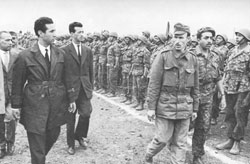
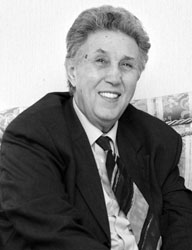
he stood for Anti-colonialism. Arab Nationalism. Third World Liberation. These are some of the ideas that come to mind immediately when one thinks of Ahmed Ben Bella and what he stood for. And these were powerful ideas: electrifying the Arab masses as one country after another threw off the shackles of colonial rule. But consider the facts on the ground today. Libya is emerging from a civil war, and the dust has still not settled on the far-from-dignified end of Muammar al-Qadhaffi. The Ba’athists employ ever more horrifying repression as Syria is engulfed by its own revolution. In Ben Bella’s own Algeria, a terrified regime offers miserly concessions to dissidents as unemployed youth threaten to rampage through the streets in righteous wrath. These were regimes which derived most of their ideological legitimacy from the ideas which Ben Bella and his comrades represented. Now the Arab Spring sweeps its way through country after country, almost like the merciless verdict of history itself: shaking to the core regime after regime. And it shatters not just autocratic, conservative pro-Western kleptocracies, but also regimes which (ostensibly) adhered to all those things which Ahmad Ben Bella stood for. One is forced to ask if Ben
Bella’s dream was nothing but the pursuit of a mirage. One is tormented by
questions such as the following: Was it, in the final analysis, an authoritarian project? Was it a chase which could only culminate in the “mukhabrat” state: where the secret police, plain-clothed thugs and brutal troops cut a bloody swathe through protesters in a futile effort to save a corrupt bureaucracy? What were the circumstances which made Ahmed Ben Bella, what was it that made him such a towering figure of his time, what was it that makes writers of obituaries venerate him as an elder, whether they admire him as a revolutionary or condemn his legacy as an authoritarian dead-end of history. Was their anti-colonial project a wrong to be set right by a multitude energised by the Arab Spring? Ahmed Ben Bella started out as an avid footballer, who followed his brother’s footsteps into the colonial French Army. In the chaos of the Second World War, he sided with the Free French forces, devoting his military skills to the victory of the French Republic over European Fascism. But like many other colonial citizens, Ben Bella ended up horrified by the hypocrisy of a Europe which fought Hitler for democracy, only to deprive people in Africa and Asia of the very same. So he became involved with the FLN (National Liberation Front) in Algeria even as the Second World War drew to a close. The FLN proclaimed: “Algerian! We invite you to think over our above Charter. Your obligation is to join with it in order to save our country and restore to it its freedom. The National Liberation Front is your front. Its victory is yours. As for us, resolved to pursue the struggle, sure of your anti-imperialist sentiments, we give the best of ourselves to the Fatherland.” Ben Bella himself became the face of the Algerian independence movement. Travelling through country after country on a passport issued by the Pakistani government, he and the FLN presented an impassioned critique of French colonialism. In a famous photo of Algerian revolutionaries apprehended by the French colonial regime, Ben Bella stands with his chin pointed up, his contempt for his captors very clear and very charismatic. It is said that he broke down in tears when he addressed a crowd as the guest of Gamal Abdel-Nasser, the towering Egyptian leader who shared his political leanings. History’s cruelty to the colonised people was not lost on Ben Bella. His proficiency in French and difficult in speaking Arabic was a living reminder of the entrapment of the colonised subject: caught between a pre-modern past which they could never fully own and a colonial capitalist modernity which could never accept them as equals of the white man. The FLN’s triumph over brutal French repression is a well-known and glorious chapter of history. It was a cause célèbre of the Third World, attracting great minds from across the globe. From Martinique came Frantz Fanon. From Pakistan came Eqbal Ahmed. Che Guevara himself considered it an honour to meet with Ben Bella and others after their triumph and the establishment of a post-colonial Algerian regime. And that is where the tragedy of Ben Bella’s project began. He was committed to a path of radical land reforms and breaking down the repressive institutions of colonialism. He identified with the radical political left but shied away from identifying himself as a Marxist. His inspiration, as he explained in later life, came from Islamism: of a “mild” and “peace-loving flavour” as he described it. This is, of course, something which is difficult to relate to for many thinkers in our times, with the rise of a harsh and backward-looking Islamism across the Muslim world since the late 1970s. Becoming the first
President of an independent Algeria, Ben Bella was unable to establish
constitutional legitimacy for the post-colonial regime. In the face of
increasing political opposition and even open rebellion from his own comrades
in the FLN, Ben Bella strengthened the military, led by Houari Boumedienne,
only to be toppled himself in a coup d’etat in 1956. As Algeria entered the
familiar path of Soviet-inspired industrialisation and rule by a military-led
bureaucracy, Ben Bella went into exile abroad. In the 1990s, as Algeria
descended into one of the Muslim world’s most brutal civil wars between a
rigid state and a massive Islamist insurgency, Ben Bella became a voice for
reconciliation and democratisation, even as he condemned the upsurge of
Jihadist violence across the Muslim world. So what did Ben Bella himself have to say about the fate of the post-colonial Algeria which he helped create? He was obviously cognizant that something had gone horribly wrong in the path followed by post-colonial revolutionary regimes such as the one he helped set up: “Everywhere that the struggle for national freedom has triumphed, once the authorities agreed, there were military coups d’etat that overthrew their leaders. That is the result time and time again.” But he also realised that for an Algeria emerging from direct colonial capitalism into a world structured around indirect neo-colonial rule, the challenges were immense: “Algeria was therefore only the beginning of something that was in development: this is why I say that it’s the global capitalist system that finally reacted against us.” Were it not for the heartfelt international solidarity offered by Ben Bella and his comrades in the Algerian FLN, it is difficult to imagine all the immense anti-colonial and anti-capitalist struggles in Africa, Latin America and Asia, whose leaders drew so much of their inspiration from these trail-blazers. Perhaps it was Ben Bella’s fate to be deprived of ultimate success during his lifetime. Perhaps the means he employed to fulfil the anti-colonial, Third-worldist, Arab nationalist dream were flawed. But let us remember that if that dream itself was an authoritarian project, we might as well give up on any hope of a discourse of liberation and social justice. Sometimes the dream itself is far more important to human history than the means employed to fulfil it. Shall we not remember Ahmed Ben Bella with that in mind? At
home in the US Just a few weeks before his resignation, Pakistan’s then-Ambassador to the United States Husain Haqqani addressed an unusual gathering at the embassy in Washington. The event was unique in that the audience included young school-goers. All of them were Pakistani-American students from almost 14 different states visiting the embassy as part of a three-day annual Youth Leadership Conference. Haqqani noted in his
remarks that while Pakistani immigrants to the US have achieved success in
the fields of medicine, engineering and information technology, they need to
diversify their expertise for productive engagement in mainstream American
intellectual and political arenas. He pitched law, media, research and
education as attractive careers to participate in the “battle of ideas”. He cited personal experiences and assured the kids that he would talk to their parents if needed, to persuade them to let the kids select an “unconventional” field. Haqqani posed a series of questions to the audiences. How many Pakistani experts appear on American television? How many have written books for the American audience or are involved in research projects? How many have joined the bureaucracy? How many are research scholars? How many have appeared on the national political scene? An attempt to answer these and other questions. How much it helped the second generation of Pakistanis in America to understand is yet to be seen, but his message underscored the importance of thinking outside the box. Pakistani immigration to the United States started in the early 1970s and surged in late 80s, says Dr Khawaja Ashraf, Chairman of the Advisory Council of the Pakistani American Council (PAC), an umbrella organisation of Pakistani associations based in North America. Dr Ashraf tells TNS that earlier Pakistani immigrants were drawn by jobs in medical, academia, or training in specific fields with the subsequent wave entering blue collar trades. Dr Ashraf emphasized that Pakistanis “do not migrate mentally”. Rather than setting down roots and blending into American society, their main objective is to make big bucks and move back. “Pakistanis create two specific self-made anchors to support themselves in the US — patriotism and religiosity,” Dr Ashraf says. “The first generation of immigrants remains interested in politics back home instead of integrating themselves in the new system, while the second generation of Pakistani Americans is mostly culturally defensive and focuses on spending their time in Islamic centres.” Dr Ashraf, a Republican and a former party central committee member in California, thinks that dual nationality is another reason most Pakistanis tend to engage themselves in politics back home instead of fully participating in the US political system. Comparing the Pakistani diaspora with its Indian counterpart, Dr Ashraf maintains that even the Indian television channels in the US show either cultural activities or local issues that Indian Americans face on a daily basis. But a clear distinction between the electoral politics and decision-making process is required here. Pakistanis do participate in the electoral process in the US. Their small groups have had influence ever since. A few claim that they have little understanding of the inner workings of the system, but they start from the local county level. Joining one party or another, attending regular meetings and making financial contributions are critical steps of this process. With election season in high gear, politicians from both parties are reaching out to voters. President Obama recently attended an event in Houston organised by the Pakistani community. One of the hosts, Muhammad Saeed Sheikh, tells TNS that almost 600 people attended the general event, while a smaller group of 70 had dinner with the president. There were eight Pakistani Americans present as against two Indian Americans. In total, the community raised 3.4 million dollars for Obama. The president’s response? “Shukriya!” Encouraged by the turnout, Saeed Sheikh, president of Houston-Karachi Sister City Association, says most of the attendees showed up to see the president, and not because they are politically active. He mentioned M.J. Khan who was elected to the city council and said that while Pakistanis participate in local politics, the community needs to get more involved at every level. Sheikh adds that internal divisions among Pakistani immigrants are hindering advancement. He points out that Pakistani community is divided into different ethnic groups including Sindhi, Balochi as well as non-Muslims Pakistani immigrants, who strive and lobby for their own narrow issues and not the community as a whole. In contrast, Sheikh says “no matter what their ethnic background is, Indians portray themselves as one.” Boston-based political activist Khalid Mahmood agrees with that perspective and adds that most Pakistani like to brand themselves as Muslims first and keep themselves away from the social fabric of the country. He also asserts that the reason for failure to engage politically remains education. “Indians, who migrate, are much more educated and skilled than Pakistanis, hence the shift from just being electoral voters to reaching a decision-making level is at least a generation apart,” he says. Mahmood’s theory about education is borne out by statistics. According to a report by the General Accounting Office, in 2009 over half of the H1B visas (the H1B visa is a non-immigrant visa, which allows a US company to employ a foreign individual for up to six years) were issued to Indians working in technology related positions. According to a fascinating report carried out jointly by the Asian American Federation (AAF) and South Asian Americans Leading Together (SAALT), the South Asian community grew 78 per cent over the past decade. The research based on Census 2010 points out that Indians comprise the largest segment of the South Asian community followed by Pakistanis and other nationals, making Indians and Pakistanis the third and seventh largest ethnic groups respectively in the US.
|
|