


|
|
|
|
|
 |
 |
  |
obituary MOOD
STREET Town
Talk Peaceful
operation clean-up Challenges
in cleaning the city In
keeping with the tradition
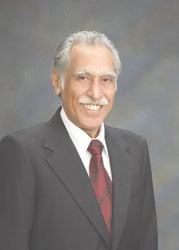
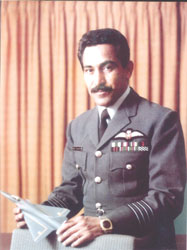
obituary The biggest religion is humanity Activist and educationist, Cecil Chaudhry was instrumental in the restoration of Pakistan’s joint electorate system in 2002 By Naila Inayat The service started with Psalm 20 “May the Lord answer you when you are in distress; may the name of the God of Jacob protect you...May He remember all your sacrifices and accept your burnt offerings...” sung hundreds of mourners packed into the Sacred Heart, Lawrence Road church last Sunday. It was on Good Friday
that Cecil Chaudhry spoke to us for the last time
— “The biggest religion is humanity and then comes your own
faith so first become a good human being and everything else will fall in
place.” This was his last message for the people of Pakistan as he lost
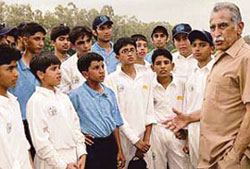
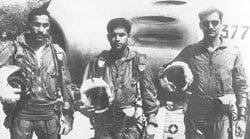
his battle against the merciless disease of cancer at age 71. And his last quote sums up the entire life of Group Captain Cecil Chaudhry who had a multifaceted personality, best known as war hero, activist, educator, visionary, fighter and a voice for the disgruntled minorities of this country. For the past and present pupils of St. Anthony’s High School he was an inspiring figure on the campus. They endlessly share with you stories of his valour, discipline and charisma. “Being an Anthonian, I would also like to become a successful and intelligent man like him in the future. There was so much to learn from Sir Cecil,” says 14-year-old Rohail Nadeem. Cecil Chaudhry’s association with St. Anthony’s started from the time his legendary father F.E. Chaudhry became a teacher at the school. FE Chaudhry’s family was the only Catholic household in Dalwal village, Chakwal. Chaudhry is a well-known photojournalist of yesteryear. Born on Aug 27, Cecil Chaudhry was schooled at St. Anthony’s; he pursued his higher education at the Forman Christian College, Lahore. He was a BSc in physics. He later graduated in aeronautics and mechanical engineering from the PAF Academy. Remembered as a war hero he was part of the famous attack formation, which led to the destruction of Halwara Airfield and Amritsar RADAR in 1965 war. “Back in Oct 1965, I
was 13, in class seven when this whisper swept the corridors of St.
Anthony’s — Cecil Chaudhry — and we were let off to go outside and
see this tall, slim, good-looking man with swept-back hair with thick
moustaches,” recalls Salman Rashid, a St. Anthony’s alumnus and a
writer. And that was beginning of an ambiguous relationship. “I didn’t meet Cecil again till 1974. I was lieutenant in the army and he was base commander Shorkot. I marched into his office dropped my salute and said Sir! I’m also from St. Anthony’s. He looked at me and after a long pause he said yaar tumahara dimagh tu nahin kharab hu gaya and he asked me to have a seat,” Salman Rashid said. Overall, Cecil Chaudhry was not satisfied with the status of minorities in the country. In an interview with TNS in April 2010 he argued over the 18th amendment clause that stopped a minority from becoming prime minister or president of the country. “It is blatantly discriminatory, against the non-Muslim citizens of the country. You cannot have democracy until you separate state from religion. Let us not forget that two leading minorities — Hindus and Christians — stood side by side with the Indian Muslim League in the creation of Pakistan. Punjab’s resolution was primarily a Christian move. Similarly, the resolution of Sindh to become a part of Pakistan was spearheaded by Jugarnath Mandal who was also responsible for getting non-Muslims reserved seats in the Senate,” he had said. In his passion for interfaith harmony, there was no rage. His equanimity always pulled the people towards him. Not many people know
that Cecil Chaudhry was a mentor to the slain Shahbaz Bhatti. “He knew
Shahbaz more than our own father. I still remember when Shahbaz was
murdered he said, ‘World has lost an activist, Pakistan lost a true
patriot. My loss goes beyond that — I have lost my son’,” said
minister in-charge for National Harmony Dr Paul Bhatti, Shahbaz Bhatti’s
elder brother. “Chaudhry was one of the founding members of the All Pakistan Minorities Alliance, who brought minorities into the mainstream,” said Paul Bhatti. Denationalisation of the missionary institutes was close to Cecil Chaudhry’s heart. He earnestly believed that these institutes could best be managed by missionaries. “I would always remember him as a great man, a faithful Christian and an energetic member of the FC College Board of Governors,” said Peter Armacost, Principal FCC. It was in 2002 when Peter came to FCC and the Mission had only recently taken the school back. “He helped me understand the situation on ground; the politics that shrouded the institutes here in Pakistan. He told me about the history of the Christian community and the vision he had for Pakistan — which was Jinnah’s vision too.” “Cecil Chaudhry was very good friend of mine, our association goes back to the time when I worked with Chacha Chaudhry in ‘Pakistan Times’. And later he voluntarily joined the education sector, our bond strengthened, we used to meet every week. His contribution to the society as a human rights activist was valuable,” said veteran journalist, Munno Bhai.
Belonging to the professional and working middle class of Pakistan it pinched me real hard when for the first time I purchased petrol for my car at Rs. 95 per litre. But this was not all. In a very short time petrol crossed the Rs. 100 per litre mark. The price hike did not only affect petrol, CNG prices had also increased simultaneously. I thought perhaps some cars might go off road as fuel was running beyond reach. I was wrong. When I next went to the petrol station to purchase gas for my car the queues for petrol as well as for CNG were as long as ever. The traffic on the roads had also not eased a bit. I asked myself how do the people of Pakistan who are employed on the basic wage of rupees 7,000 per month make both ends meet? The constant surge in inflation in prices of basic household items especially essential food products which are consumed on a daily basis by the common man made me reflect on this extremely disturbing fact. If the basic wage in Pakistan is compared to the expenses for a basic household it is certainly beyond common sense to justify the existing state of affairs. So I decided to explore further. I had the opportunity to live in the United Kingdom for sometime so I decided to do a comparison of the prices of the basic food items and the basic wage in an extremely expensive developed country Britain with Pakistan. The basic wage for workers over 20 years of age in England is around Rs. 882/hour whereas in Pakistan it is around Rs. 39/hour. European Union Labour laws restrict a working week to 40 hours at this rate as beyond this a higher rate is payable to the employee. Based on a 30 day month or 172 hours a British resident will earn roughly Rs. 155232/month before tax if the pound to rupee conversion rate is Rs. 145. In comparison an employee in Pakistan works unlimited hours for a basic wage of Rs. 7000 per month. An even more astonishing aspect is that there is very little difference in the prices of daily consumption food items between the two countries as compared to the difference in the basic wage. I went to the closest grocery store and purchased milk at Rs. 60/litre, baked bread at Rs. 50, a dozen eggs at Rs. 90, cooking oil at Rs. 170/litre, flour at Rs. 30/ kg, rice at Rs. 95/kg while earlier petrol had cost me Rs. 103/Litre. Next I went online and searched the net for comparative prices for the same items in United Kingdom. Grocery stores had these products available at Rs. 73/litre for milk, Rs. 68 for baked bread, Rs. 144 for a dozen eggs, Rs. 192/litre for cooking oil, Rs. 58/kg for rice while petrol was at Rs. 200/litre. When this data was complete my thought process was in the state of a dilemma. Are these economic hardships that Pakistan is going through a result of the trickledown effect of the global recession and global inflation, or is our present situation a result of a corrupt failed leadership? Recession primarily affected countries which were credit economies and were undergoing an artificially inflated construction boom. Pakistan is a cash economy. As a common practice house purchase is on cash payment and not on mortgage basis. Again vehicle purchase in Pakistan is principally on cash and not on credit. Did recession deplete our banks or did the gigantic amounts of overdraft being relied on to run the daily lavish expenses of reckless governments and mammoth administrations? This callous attitude has certainly hit the economy hard. Then is global recession and inflation responsible for the present economic turmoil of the Pakistani nation or the whims and wishes of the ruling few who have perhaps never purchased and paid from their pocket for the petrol or CNG which keeps the pompous fleet of their royal motorcades mobile? United Kingdom is a welfare state which provides free health care and education to all residents along with a basic infrastructure to facilitate a comfortable living for the common people. The concept of a welfare state is preached by Islam but practised in the west. We cite Pakistan as a democratic Islamic Republic and yet it is beyond my humble understanding how such a phenomenon can be justified by any sitting government. It is even more perturbing that people are living this social injustice but are not ready or prepared to do something about it. Whether it is an ‘I don’t care’ attitude, patience or indifference on the part of the people, it is certainly disturbing. This reminds of an English proverb ‘when there is too much of a silence a storm is brewing’.
* Exhibition: LSF Photography Competition 2012 on April 23-24 in Heritage Museum (old Tollinton), The Mall. Museum timings are 10am to 4pm. * Vigil: Akhuwat’s ‘Anti-Poverty Day’ is being held on April 28. By pledging our solidarity with the poor, together we must continue our efforts to eradicate poverty from our country. Venue: Canal Bank, Jail Road. * 100 Ghazals of Maulana Rumi: Hast-o-Neest Centre for Traditional Art & Culture holds sitting with Ahmed Javed (Director, Iqbal Academy Pakistan) on Maulana Rumi on last Saturday of every month. Timings: 3:30 pm to 5:00 pm
Peaceful
operation clean-up
The shops, declared
encroachments long time ago, have finally been removed under a project
launched in 2007 funded by the World Bank and Punjab government. The plan,
besides other things, envisages restoration of a selected part of the
Walled City into its original shape and making it a tourist hub. Removal
of these encroachments, which were like warts on a pretty face, is the
first major achievement of the project executors. The opposition was so
strong that it took them good five years to break inertia. What has emerged from
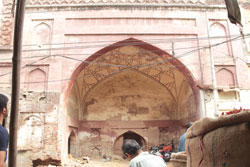
behind the removed structures is a secret well kept for ages and a sight
worth seeing. Though mired in dust and suffering from decay caused by
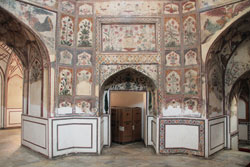
sheer neglect, these walls form the exterior of historic Shahi Hamam
(royal bath), built by Lahore Governor Sheikh Ilmuddin Ansari in 1634. He
was popularly known as Wazir Khan. The hamam lies at the
beginning of what is known as the Shahi Guzargah (Royal Trail) and
historical records tell people travelling from Delhi and Agra to the
Lahore Fort or Walled City used this facility to freshen up after a long
journey. The interior of the
hamam is enchanting for visitors as they can see the biggest fresco
painting of Mughal era there. The development is a
good sign for countless many who would writhe in pain seeing damage done
to the beautiful structures of the Walled City. The momentum has been set
and if things keep on progressing at this pace, encroachments along the
royal trail will become history. The next battle fronts
are Masjid Wazir Khan, Sonehri Masjid and Begum Shahi Masjid. This path is
the same that was followed by Mughal Emperors, when they came from Delhi
to Lahore. A salient feature of
this operation was that there was no direct conflict between shopkeepers
and the personnel who removed encroachments. The deal was struck and
execution carried out with mutual consent. Though the deal deprived
content-hungry TV channels hours of “newsworthy” live footage, it
provided some relief to the shopkeeper as well. Shopkeepers were given
Rs 10,000 per square foot to get the place vacated. A shopkeeper occupying
a shop measuring 100 square feet walked away with Rs 10,00,000 (one
million). Many of them demand alternative space to do business as well
something which the government is not willing to accommodate.
Challenges
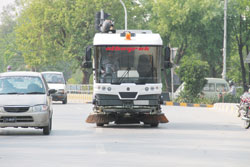
in cleaning the city The city is being cleaned with renewed zeal. After the government has signed two contracts with Turkey, new trucks to lift garbage, new mechanical road sweepers, new garbage containers on wheels, sweepers cleaning the city in new uniform round the clock – all gives the hope that the city will look sparkling clean one day soon. But there are challenges too. Did people urinate by
roadside in Turkey at anytime? Well they do that in Lahore in the absence
of enough latrines or public toilets. There are many roads along which
there is katcha area where water accumulates whenever it rains and which
takes hours on end to rid roadsides of rainwater. Apparently, abandoned
plots where people feel no hitch in dumping garbage is another problem
here. So the challenges are many but seeing the political will to clean
the city, we hope the government will also ensure integrated effort from
other departments. The city needs more public toilets to discourage the culture of urinating by roadsides. The katcha areas by the roads need to be paved with tiles to stop accumulation of rainwater and people’s mindset has to change to save plots from becoming dumping grounds of filth. The last proposition is the most difficult for attitudes can change only with education. The Lahore Waste Management Company (LWMC) staff has a request: “Please tie a knot on the shopper in which you put garbage.” Is that asking too much but people don’t. The LWMC also distributes shoppers for free. Their operations manager says, “We need some law against littering. There is only Rs. 500 fine on littering a plot to which people don’t give a damn. If caught, they pay the fine but don’t stop throwing garbage in the plot again. People behave abroad, why not here? – Because the laws are not good enough to deter people from bad practices.” The new skips or containers placed by the Lahore Waste Management Company have been reported missing at many places. Fourteen FIRs of theft of new skips have been registered so far and many lids on them have been stolen. It is baffling for the LWMC what to do in such an event. The new skips are smaller this time but there are four skips where there was one before. Meet the LWMC team, whether they are people out on the roads or the staff monitoring the work from the office, they all come across as committed, energetic people, determined to make the idea of a spick-and-span clean Lahore a success. “The government has bought 600 compactors out of which 85 have reached here,” says Memoona Arslan, Manager Communication LWMC. The ten thousand workers of LWMC work in three shifts to keep the city clean round the clock. There are more workers deputed in the first shift as compared to other two. Memoona’s team has visited 20 city district government schools by now to create awareness among children. They intend to visit many more. The LWMC staff gives bins to the schools they visit. Memoona believes the importance of keeping homes, streets and mohallas clean have to be inculcated in the masses through curriculums taught in schools which will go a long way in changing people’s attitudes. Not many people know that the city district government has a 24-hour helpline 1139 where people can register any complaint regarding cleaning. Its Earth Day today. The Solid Waste Management department that merged into the City District Government (CDGL) in June 2011 for 20 years, is now LWMC cleaning city streets, markets and bus stands day and night while 2,200 vacant plot identified by the LWMC, are being cleaned by private contractors. The News on Sunday talked to the staff on city roads and here is what they said: “Sixty trucks, big and small are lifting garbage at present.” Staff on a compactor said, “We do a round in five hours while in Turkey they probably do five rounds in five hours. We are lifting 8 -10 tonnes of garbage in a round while they lift double this in Turkey in the same time. We need more garbage lifting trucks soon or the old system was okay.” A middle-aged man sweeping a major city road with a small broom attached to a long stick with a green garbage collector on wheels by his side, looked smart in the new uniform. When asked what he had to say about the new system of cleaning, he said, “It takes three hours where it took two to sweep a place because of the new broom which is not suitable for roads. The old broom was big, with more volume, covering greater area so cleaning took less time.” The government has spent on everything, why not on broom. One of the three sweepers who were working hard to drain water from a katcha area along a main road, when asked, said, “It has been almost four hours we have been trying to drain water. Our hands and arms are sore now with effort. What if these katcha areas are tiled.” The cleaning of the green belts which was previously responsibility of the Parks and Horticulture Authority (PHA) is now a job of the LWMC. People respect the LWMC staff. So, everybody in the LWMC department is making effort to do their bit but nothing exists in isolation and other departments and the citizens have to pitch in to help them in this mission. After all, the city belong to us all. Memoona told TNS Lahore generates 56,00 tonnes of solid waste every day and the company has the capacity to lift 42,00 tonnes. Besides, the city does not have landfill sites. “Mahmood Booti site expired long ago and the ones at Babu Sabu and Saggian are not good enough. Solid Waste Management Department has purchased 160 kanal land at Lakkho Der near Sundar for this purpose where recycling plant will also be installed where the plan is to generate electricity with solid waste. In Istanbul people go for picnic at landfill sites,” says Memoona.
In
keeping with the tradition Annual plays always come with peculiar baggage. They are usually the only plays put up by an educational institution. Blood, tears and politics are shed and played, and usually everything comes full circle on the first day of the performance, after the endless days of remembering lines and practicing exits. Same was the case with
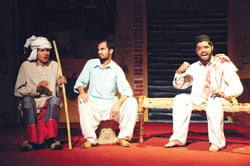
The Government College University Dramatics Club’s performance of Sazza
Yaab, an original play written by Tasawar Iqbal and directed by Sameer
Ahmed which ran for three days, from
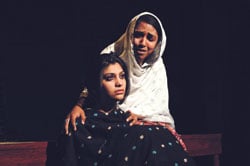
the 13th to 15th April. Sazza Yaab is a play set in a small, low-income community where a young girl Akifa played by Saba Fayyaz works in an office and supports her family that includes her old mother and an older, divorced sister. When the Nazim Sher Samand played by Zohaib Zafar Naqvi launches religious allegations against Akifa for working late and “dressing inappropriately,” things start boiling up in the community and spill over when Akifa is gang-raped by masked assailants. Instead of actually helping Akifa and her family, the community, under the guidance of the devious Nazim, blames Akifa for the incident and declares her family as outcasts. The play ends with Akifa losing a rape claim petition she files against the people of the community and a silly epilogue concerning the Nazim and divine retribution. The lighting by Saad Jamal and Maryam Darakhshan, mostly dull in the dialogue intensive scenes, showed a spark or two in the action driven ones. Sameer Ahmed’s did manage to get measured performances by most of his cast. Now, there are two
things to get out of the way. Sazza Yaab might be taught in schools as a
text that defines the stereotype to the Tee: The defiant, young woman who
thinks she can live a decent, honest life on her own rules; the community
leader who is a religious bigot, counterbalanced by the community eunuch
and the mentally ill boy, which define truth (played very well by Muzammil
Tarar and Omar Ijaz respectively); the other womenthe mother, the sister,
the neighbour who defines the accepted model, the woman who understands
that the world is run by men and lives by it. But here is the catch. A good performance and the material being stereotypical are two different things. The performances, especially by Tarar and Ijaz were carried off well, and even the performances, as a whole, playing the archetype showed that the Pakistani cliché that we have loads of talent isn’t totally off the mark. The revelation —not much of one actually— is the fact that Sazza Yaab or any play sweated over by students shouldn’t be written off that quickly. The live performance— plays or otherwise— lives and dies quickly; its dynamic, its very texture totally opposite to the recorded one. The only suggestion— and a strong one at that— is that smaller, more intimate performances are needed. Let annual plays remain as a tradition, but to mould the live performance from an event to a craft, repetition is required. The prerequisites are there: actors, playwrights in the making, scenographers, lighting designers, directors, managers, everything. The working and dynamics of an ensemble are intact. The only thing is to make the activity of play-making more regular, and if craft can only be learnt by practicing it, let old plays be revived, where playwrights in the wings can someday memorise a word, a line, a phrase and understand that a play becomes magic not by abiding to stereotypes but to imagination.
|
|
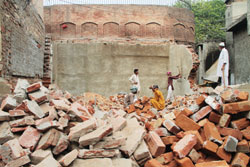
 Unpleasant
sounds of hammers hitting a bricked structure welcome visitors to the
Walled City as soon as they enter Delhi Gate. The scene has also changed
altogether. Dozens of cloth, spice and grain shops and a couple of food
outlets on the left side of the narrow road have just disappeared.
Unpleasant
sounds of hammers hitting a bricked structure welcome visitors to the
Walled City as soon as they enter Delhi Gate. The scene has also changed
altogether. Dozens of cloth, spice and grain shops and a couple of food
outlets on the left side of the narrow road have just disappeared.