


|
|
|
|
 |
 |


|
Not
too old yet Punter
bags another feat What
ails Australia’s best and brightest?
A
tactic that does not always work
Sports
and conflict resolution
Running for a cause
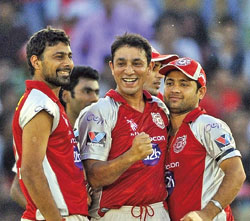
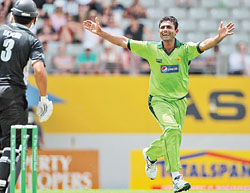
Not too old yet Pakistan should rethink their policy of discarding talented allrounders like Abdul Razzaq By Mushfiq Ahmad Good allrounders are a great asset for captains, particularly in this modern cricketing age. They give depth to a team’s batting line and increase bowling options. Pakistan have usually had one or two quality allrounders in the team — from Intikhab Alam, Mushtaq Muhammad, Asif Iqbal and Imran Khan to Abdul Razzaq and Azhar Mahmood. In the present team,
there are two very good allrounders: Mohammad Hafeez and Shahid Afridi.
This talented duo give a lot of depth to the batting line and variety to
the bowling department. But unfortunately, as the former coach Mohsin
Khan pointed out a few months ago, the team lacks a quality fast bowling
allrounder. “Personally I believe, there is a one key area where the
team is lacking and that’s the absence of a good and reliable
fast-bowling allrounder,” he said in a talk with ‘The News on
Sunday’ before the series against England earlier this year. In the 1970s and 1980s Pakistan had the services of Imran Khan, one of the four greatest allrounders ever. Then from mid-1980s to early 2000s we had Wasim Akram, who was not as good as Imran but did serve the country well enough as an allrounder. In late 1990s Abdul Razzaq and Azhar Mahmood emerged and made Pakistan a very strong side. What is the reason behind the lack of a quality fast-bowling allrounder in the present team? In my opinion it is the tendency of selectors to regard every over-30 fast or medium fast bowler as an old player and discard him. Because Pakistan have a few good fast-medium bowlers who can bat very well but they have been ignored over the past few years. Azhar Mahmood was the first such player to be victim of selectors’ preference for younger blood. He was ousted at the very beginning of his thirties despite an impressive One-day International record, which boasted quite a few match winning batting and bowling performances. Then it was Rana
Naveed-ul Hasan who is a very good allrounder for limited-overs cricket.
In fact his bowling alone should guarantee him a place in the team as he
has 110 victims from just 74 one-dayers. His batting capabilities,
especially in the death overs, are a bonus for the team. But he too has
been kept out since Pakistan’s tour of Australia in early 2010. The latest and perhaps the biggest victim is Abdul Razzaq. Throughout last year’s World Cup and a few matches which he played after the quadrennial spectacle he was given only a few overs to bowl and was sent in the lower order where he could not show his full batting potential. Then there is the case of Mohammad Sami, who was only a fast bowler in the beginning of his career but now has emerged as a very good batsman too. He scored 579 runs at an average of over 32 runs in the Quaid-e-Azam Trophy Division One besides taking 39 wickets from 11 matches. While Azhar Mahmood might no longer be interested in representing Pakistan since he has gained British citizenship, the other three have been playing domestic cricket in Pakistan. There is no reason for ignoring them. Age cannot be. Sami is only 31, Abdul Razzaq 32 and Rana Naved 34. If Imran Khan could play at the age of 39 and Wasim Akram till he was 37, why can’t these players continue when they have not even crossed 35? It is time the selectors realised their folly and considered these three allrounders for our one-day and Twenty20 teams. There is plenty of cricket left in them. We must utilise their skills, particularly because those who have been given chances in the recent past like Sohail Tanvir and Hammad Azam have failed to live up to the expectations. mushfiqahmad1000@gmail.com
Punter
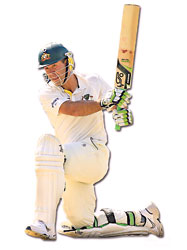
bags another feat During the first innings of the third Test against West Indies, former Australia captain Ricky Ponting (13,289) runs went past Rahul Dravid (13,288) runs to go second on the list of world’s leading run-scorers after Sachin Tendulkar’s 15,470 runs. Last year after Australia’s defeat in World Cup quarter-final against India the 37-year-old had retired from one-day cricket, saying, “I have decided to stand down as captain of the Test and one-day teams as of now.” There is a lot of debate about the retirement of Ricky Ponting and Sachin Tendulkar. But in my opinion a player can decide his future better than anyone else. Ponting especially belongs to the team where players step down by themselves when they feel that their performance or fitness is not up to the Australian standard. Steve Waugh, Shane
Warne, Glenn McGrath, Justin Langer, Damien Martyn and Adam Gilchrist
are the examples. If Tendulkar can play at the age of 39 why should Ponting quit at the age of 37? He and Sachin are the greatest modern cricketers and have set a very high standard of batting. No doubt that not much cricket is left in both classy players, but both are trying to prolong their Test careers as much as possible. Let’s see who hangs his boot first. Paying tribute to Sachin Tendulkar once Ricky said, “The number of innings of Tendulkar I have been able to sit back and watch, I think he is an amazing player. Look at his stats and records and it’s quite incredible for someone to have stayed in the game for 20 years. He has set benchmarks for guys like me to chase him and get as close as we can. If I had to last 20 years, I would probably be batting in a wheelchair!” Australian captain Michael Clarke has expressed confidence in his former skipper and confirmed his place in Australia’s next Test assignment at home against South Africa in November. After retirement from One-day Internationals the new captain Michael Clarke paid tribute to his former skipper in these words: “It was odd to think of an Australian one-day dressing room without Ponting after his 17-year career in the format. I’ll miss his guidance out on the field, his guidance off the field, his friendship, his experience around the group, his knowledge of this game. They’re things that no matter how much talent you have as a young player, the experience and knowledge of the game you need to learn.” Nicknamed Punter, Ponting may not be able to break Tendulkar’s batting records, but he has played the most vital role in dozens of Australia’s wins. Ponting took over, from Steve Waugh, the one-day captaincy in 2002 and Test captaincy in 2004 and statistically has been Australia’s most successful skipper. Under his leadership, Australia won 48 Tests out of 77, 16 of them in a row between December 2005 and January 2008. He also shared most consecutive Test victories (16) as captain with Steve Waugh. In One-day Internationals, he won 163 out of 227 matches for Australia, including the 2003 and 2007 World Cups. He led Australia to 34 consecutive wins in World Cup matches. Ponting started his career with Tasmania at the age of 17 and with Australia at 20. He was unlucky to complete a century on his debut Test against Sri Lanka in December 1995 when he got out for 96. He is an excellent player of fast bowling; his cover drive and the pull are exceptional. Only Sachin Tendulkar has more centuries in Tests and ODIs than Ponting. Ponting is the only batsman in the history of cricket to score centuries in both innings (120 and 143 not out) of his 100th Test match — this happened against South Africa in 2005. During his illustrious career, Ponting got numerous awards such as Wisden Leading Cricketer in the World (2003), Wisden Cricketer of the Year (2006), Allan Border medalist a record four times in 2004, 2006, 2007 and 2009, Australia’s best Test player (2003, 2004 and 2007), Australia’s best One-day International player (2002 and 2007). He was also selected captain for the ICC World XI for the World Cricket Tsunami Appeal charity match against the ACC Asian XI in 2004. Khurrams87@yahoo.com
What
ails Australia’s best and brightest? There have been an alarming number of Test and Sheffield Shield batting collapses of late. From Australia’s calamitous 47, to India’s frequent capitulations, New Zealand’s recent dramatic middle-order loss of 5 for 0, and Queensland almost surrendering the Sheffield Shield final — batting performances in the longer versions seem to have dropped off dramatically. Perhaps we can blame the wickets. Groundsmen have seemingly been less inclined to roll out flat, docile pitches. James Sutherland’s pleas last summer for better Shield pitches have fallen on deaf ears. Or maybe the new breed of bowling coach has stolen a march on his batting counterparts. Certainly Craig McDermott seems to have found the right ingredient for Australia’s young band of quicks. Or are batting
techniques in a downward spiral? Perhaps the T20 catch-cry, “Clear the
front foot and swing as hard as possible”, is playing havoc with the
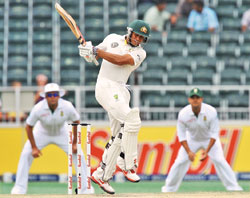
techniques of young batsmen. During another highly enjoyable summer in the Sheffield Shield, I had lots of chances to get up close and personal with several fringe Test batsmen. The struggles with technique of most were noticeable. For years as Australia ruled the cricket world, we were blessed with champions who churned out thousands of first-class runs before being selected — Mike Hussey passed 10,000 before his ascendency, and before that, Matthew Hayden must have despaired of ever getting a decent go at Test level. Now as the guard changes, opportunities arrive for the new generation sooner than they did in the past — David Warner was around the 1000-run first-class mark when he got his baggy green. It has underlined the indifferent seasons the likes of Phil Hughes, Usman Khawaja, Shaun Marsh and Callum Ferguson have had. The cricket public expects these young batsmen to have everything mentally and technically figured out when they are chosen, and that they should be the finished article, with complete understanding of their own games. Some, like Steve Smith, seem to be sorting things out, but others appear to have a fair way to go. Perhaps my most fascinating time on the cricket field this year was stationed at mid-off while Andrew McDonald went to work on each of these young batsmen with his exceptionally intelligent medium-pacers — and talked me through his tactics. Without the gift of pace, “Ronnie” has had to learn the skill of bowling inside and out, and his mastery on a helpful pitch is comparable to any I’ve seen. I’d reckon quite a few young hopefuls on Shield wickets this summer found batting against his crafty medium pace far tougher technically than fending off Brett Lee at the WACA ground. In the last round of Shield fixtures, Victoria overcame a disappointing New South Wales, with Ronnie bagging amazing match figures of 6 for 50 from 34 overs. In the process he passed the bats of Hughes and Khawaja with alarming regularity. Hughes’ shortcomings have been widely critiqued; less so Khawaja’s. I first noticed his difficulty against the away-swinging ball in county cricket last year. In overcast conditions against a Tiflex ball that seemed to go around corners, Khawaja’s open blade and front-on position had the slips cordon licking their lips — and sure enough, he obliged twice. In that game against Victoria he was twice out caught behind — a notable penchant that oppositions are sure to be pencilling into their black books. In conversation with Ronnie and coach Greg Shipperd afterwards, it was commented on how far around Khawaja was turning his back foot during shots. The textbook says the back foot should be pointing towards point, not the bowler. That’s causing his back hip and shoulder to swivel around, so that he is “squaring up”. Often he seemed to be missing Ronnie’s deliveries by six inches. It would seem to be a problem that can be solved, but the question is, does he know he is doing it? And if so, does he know how to fix it? Swivelling into a front-on position is a left-hander’s curse. Hughes also suffers from it, as Chris Martin managed to expose. The difficulty is that these two exceptionally gifted players are trying to fix things under the glare of an impatient media and public, and are feeling the pressure of expectation. The question for each is: when and how to fix it? I’ve never believed in the notion of not working on technique because a match is pending. Should we take note of the fact that the top golf pros always have swing coaches on hand? To be the best you can be, you have to keep adjusting until most avenues are exhausted and discarded - even if that means doing it on match eve. Many will argue otherwise, and they will have valid points, but to get closer to the end of the road, experimentation needs to be continual. Sometimes it will be one step forward and two steps back, but that is the nature of the beast of batting. Marsh is a southpaw with problems different from those of his NSW counterparts. His stem from his trigger movements — he doesn’t have any. That’s not to say that kind of technique hasn’t been extremely effective for others. Hayden stood still and moved just once in his strokeplay — forward to full balls and back to shorter ones; but Hayden is a monster of a man who used his height to sublime and brutish effectiveness — often employing it to lean into wide balls as his foot went straight down the wicket. Early in his innings, especially, Marsh often moves across very late, presenting his pad as a target and causing his swing to not come down in a straight line. When in form it all works like clockwork and he is imperious. When lacking form, it looks robotic and static. Ferguson is another who could perhaps think about operating more in straight lines. He is a very clean hitter of the ball, but with a backswing heading towards gully it’s almost impossible to be consistently meeting the ball with the full face of the bat. His line of swing is nice and straight when he drives half volleys, but when he has to defend he sometimes chops down on balls as his bat heads in the direction of midwicket. Ronnie picked up on it and sent one straight through a gap between bat and pad. He then nicked Ferguson out in the return fixture. It is a curious technical dilemma, which might explain why Ferguson’s one-day record is so good and his four-day one disappointing. In the shorter formats there is less defending and therefore his problem is less exposed. He is perhaps very much aware of it, but the skill is to fix it. While no doubt all four are admirers of Simon Katich’s toughness and resilience, I sometimes wonder if they have considered the merits of the somewhat ungainly Katich method of moving across and standing in the so-called corridor of uncertainty. Ugly as he might look to many, Katich is perfectly upright and balanced, his head is over the line of the ball, he knows exactly where his stumps are, and he plays in straight lines. Once he’s settled, the bowlers are forced to bowl something other than line and length in the corridor, and Katich has been able to cash in, particularly when they try to hit his exposed leg stump. Smith played McDonald best of all at the SCG. He was much more selective of the wide ones he loves to thrash through the covers, and there were fewer hoicks over cow corner, yet he didn’t lose his ability to despatch bad balls to the fence. All the five batsmen mentioned are naturally talented players and have been singled out by the national selectors. All have good records in T20 but have some difficulty adapting to the different demands of each form of the game. Just about any top-class batsman will be able to reel off the mentors who have had the most influence on him. Whether it is fathers or coaches or team-mates or even opposition players, these people are vital in spotting problems and helping fix them. But the demands of T20 have added a new dimension to batting techniques. Teams everywhere are splashing out on full-time bowling coaches, but seem less inclined to recruit batting coaches. Perhaps a new type of batting coach is needed — a coach who has played T20 and is skilled in converting players back into the techniques of the first-class game rather than the other way round. When that happens, the batting collapses that are causing such consternation in cricket circles may become a thing of the past. Victoria and Middlesex opener Chris Rogers played one Test match for Australia
A
tactic that does not always work Barcelona were heading into their Champions League semifinal second leg facing, distant as it was, the prospect of losing three matches in a row, losing as they had the first leg of the semifinal and the ‘Clasico’ match over the weekend. This is something not seen since Guardiola has taken charge, and with the defeat to Real all but guaranteeing that Barcelona will not be lifting La Liga trophy this year, an exit from the Champions League would only compound the Catalans’ misery. It is no secret that
this season, Barcelona have failed to shine the way they have in recent
years. There have been many reasons put forward for this, some of which
border on being an excuse, such as saying that this Barcelona outfit are
fatigued after four years of continuous trophy hauling. While this is
acceptable as a humble brag, it cannot seriously be considered an actual
reason for not performing well. If it really were a case of fatigue, one
would see increased rotation and a continuous, near-linear decline in
output. Yet this is not the case. Barcelona’s intermittent
disappointments have come between periods of sheer brilliance, such as
the 10 match winning streak earlier this year, which saw them slice down
the points gap with Real at the top of La Liga. Fatigue, clearly, does
not fit the bill. What has been exposed this season, however, is how well and truly Messi is the best football player on the planet. It is not only the moments of magic, mercurial and mesmerising as they are, that make his claim to greatness so strong. It is more his ability to reproduce said magic week after week, indeed year after year. The number of goals he has scored, his ability to create goals, and the consistency with which he has done both these things over the course of multiple seasons makes him peerless. However, what it has also made him is a perennial go-to guy for his side. Barcelonaís passing of the ball and their movement as individuals and as one cohesive unit — the phrase ‘wave of attackers’ is better illustrated by this Barcelona side more than any other — gives the illusion that Barcelona possess several avenues of attack in the final third. The fact, though, is that all of Barcelona’s attacks are channelled through Messi. Of course Xavi sets the rhythm of passing for this side, but his key purpose remains to be a conduit for the ball to find its way to Messi’s feet, whether it is from his own pass or a few passes further on. Messi’s talents on the pitch extend to his ability to keep himself in peak fitness without getting injured, as a result of which he is seldom absent from duty. When you add Xavi’s tirelessness and vision into the mix, you get a potent combination of passing and movement that has kept the Barcelona chugging along on a well settled rhythm. However, what has also settled in is complacency. The reason we have all found ourselves unable to write Barcelona off at any point in any match is the feeling that any moment, Messi will pull something out of his sleeve and leave, the ball will end up in the opposition net, and the rest of the world, after they have caught their breath, will marvel at what just happened. The problem for Barcelona arises when this does not happen, or when the opposition engineers a game plan to ensure this cannot happen, either by disruptive fouls, skilled marking or a mix of the two. Messi’s ability to deliver consistently has made Barcelona oddly arrogant of their own ability. The ‘Barcelona way’ of playing football, the so-called tiki-taka passing rhythm, and the many plaudits they have received as a consequence of practicing it, has led players to feel a sense of entitlement; that Barcelona deserve to win any match they play because they play ‘pure’ football. In his interview after the loss to Chelsea, Fabregas claimed that Barcelona deserved to go through, implying Chelsea were just lucky, and football is unfair like that. Harsh words, but then one ought to sympathise with the Spaniard, whose hopes of landing a major trophy have for now been thwarted by Chelsea, as they were on a few occasions while he was at Arsenal. Coming back to the subject of entitlement, Barcelona’s team have basked in glory because they have had amongst them a player who provides the end product to all their passing. The supporting cast for Messi in midfield has been constant i.e. Xavi and Iniesta, but up front, there have been regular changes. Eto’o, Ibrahimovic, Henry, Villa and Sanchez have all featured up top alongside the Argentine to play the role of alternative goal scorers. That said, the reliance on Messi has persisted. While Guardiola has been lauded for producing a style of play that is deeply rooted in Barcelona’s own academy, La Masia, not enough focus has been given to producing a plan B, for when the plan A — pass it around till Messi does something great — fails. This has been brutally exposed in the last three matches. First Chelsea, then Real Madrid, and then Chelsea again, have shown that by placing a physically strong and mobile layered defence (Chelsea often had 8 players in two lines) in front of them, you can force Barcelona to just pass the ball around in midfield ineffectually. As time wears on, Barcelona’s inherent desperation to attack means they pull more bodies forward, exposing themselves to counter attacks. Barcelona’s style of playing has been the cornerstone of their success, but an unwillingness to change from it will only harm them, as we have seen this season. Teams, and not just the best ones, have figured out that if you clamp down on Messi, Barcelona’s effectiveness is diminished significantly, and they have practiced this to great effect, as proven by the fact that Messi scored his first goal away from home in La Liga deep into the season, and even now, has scored less goals from open play in the Champions League this season than Bayern’s Mario Gomez. Barcelona need not just alternative goal scorers, but alternative routes to goal. Continuing their heavy reliance on Messi not only restricts their own chances of success, but also risks tarnishing Messi’s own legacy. zainhq@gmail.com caption BARCELONA: Barcelona’s Argentinian forward Lionel Messi holds his head in his hands after losing to Chelsea after the UEFA Champions League second leg semifinal here on April 24, 2012.
Sports
and conflict resolution Regions ravaged by war and conflicts could be brought back to normalcy with the simple but effective tool of sports. A group of researchers has assessed the condition of sports in the volatile districts of Swat, Shangla, Malakand, Lower and Upper Dir and Buner. The entire sport system is in the hands of highly-politicised, non-serious, amateur sports managers who mostly take credit for the hard work of a few selfless personalities. The fact of the matter is that we in Pakistan have never tried to understand the dynamics of sport beyond physical education and a competitive activity. With the win-at-all-cost mentality, it becomes difficult to realise the utility of ‘sport for all’ approach that makes sport a low entry and high impact point for a social change. Recently some sport evangelists started preaching sport for development and for the achievements of Millennium Development Goals (MDGs) in Pakistan including sport for conflict resolution. Realising the
importance of sport as a cost effective yet potent tool, the UNDP
Pakistan Chapter carried out a much needed sports need assessment in the
districts of Swat, Shangla, Malakand, Lower and Upper Dir and Buner. Multiple stakeholders, including provincial governments, provincial relief and rehabilitation authorities, APEX Consulting and Sports Development Foundation (SDF) played a key role in completing the task, which was carried out for the first time in the history of Pakistan sports. The multi-disciplinary team headed by Aamir Bilal who is the CEO of Sports Development Foundation (SDF), randomly picked 54 Union Councils in six districts for a detailed quantitative and qualitative data analysis. The team conducted in-depth interviews and focus group discussions (FDGs) with local administration, provincial sport bodies, coaches and players of local sport clubs, physical education experts, students, teachers and the youth effected by conflicts and terrorism in these districts. The resultant report gives detailed guidelines about using sport for conflict resolution and reaching MDGs in the districts. It describes in detail the popular competitive and indigenous games and sports played in these areas. The report spells out the condition and extent of damage to the existing sport facilities in local clubs and education institutions; the exact requirement of sport kits and equipment in the districts; the need for precise training and capacity building of coaches, sport persons and support staff; and how to mobilise the sport clubs to increase youth participation, curb extremism and promote peace. The assessment indicates the implementation partners and highlights the practical considerations of using sport in peace building and proposes necessary short, medium and long-term plans. The report defines conflict as a form of competitive behaviour between people or groups. It occurs when two or more people compete over perceived or actual incompatible goals or limited resources. The report describes in detail the best practices of sport that are applied globally for conflict resolution backed up by the United Nations. The report states that majority of governments interviewed from developing countries and countries-in-transition draw connections between their approach to Sport for Development and Peace domestically and the attainment of the Millennium Development Goals (MDGs). These countries include Angola, Azerbaijan, Benin, Burundi, Cape Verde, Ethiopia, Ghana, Lebanon, Mozambique, Palau, occupied Palestinian territory, Papua New Guinea, Peru, Samoa, Sierra Leone, South Africa, Sri Lanka, Tanzania, Thailand, Uganda, Vanuatu, and Zambia. A large number of governments have indicated that their interest and support for sport-based interventions stem from the recognition that sport can help address needs identified within their countries. Countries cited diverse needs related to integrating youth from different religious backgrounds, integrating new immigrants and persons with disabilities into their respective communities, uniting dispersed populations, and bridging gaps between groups and communities in conflict. Some countries with national sport policies have gone a step further to integrate Sport for Development and Peace approaches into additional policy streams. In these cases, the national sport policy acts as an umbrella strategy under which corresponding legislation and programs are influenced. For instance, although there is a national sport policy in place in Azerbaijan, Sport for Development and Peace has also been incorporated into the national legislation On Physical Culture and Sports in Azerbaijan, the National Program for the Development of Physical Education and Sport in Azerbaijan, and the State Program for the Development of Football. The report emphasises that sport activities should be based on local premises, situation and resources. The consultants state that reconstruction of open sport facilities where people can meet and play has been recognised as an important and early step in the normalisation process after conflicts. In brief, this unique document is the first step towards the practical implementation of sport for development and conflict resolution in the war-affected areas of Swat, Buner and adjacent districts which can be easily replicated in other parts of the country.
Running
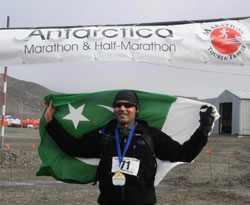
for a cause Many expatriate Pakistanis have made their motherland proud with fabulous achievements. Ziyad Tariq Rahim is one of them. Distance running is his passion: from cross country to half marathon to marathon to ultra marathon and beyond! Ziyad, the banker son of the famed cricket commentator Tariq Rahim, presently based in Qatar, recently created history when he completed the seven day 250km Marathon Des Sables (MdS) in the Sahara desert in Morocco. Having done the Antarctica marathon in March, the 38-year-old Ziyad became the first person to ever run these two extreme marathons within one month. The long journey
started long ago. At the age of seven master Ziyad was introduced to
long distance running at the elite Aitchison College in Lahore. “It
was called cross-country. The distances got longer as we moved to the
higher classes. In the senior school, it was a 12 km run (two loops of
the college). I also enjoyed sports like hockey, cricket, swimming,
etc.” he says. But the serious long distance running started quite late. “After finishing the school, I graduated from the Government College, Lahore, and went to the UK for higher studies, subsequently moving to Canada in 2000. There, for the first time, I came across the runners participating in the Toronto Marathon. The whole atmosphere was electrifying with so many people on the streets cheering the runners on. That’s when I decided to participate in such races. In 2002, a year into my marriage, I decided to take part in the Quebec City 10K event. I still remember how hard it was when I first started the race. I suffered from shin splints in the 2nd kilometer but continued running through the pain and completed the 10K race in an hour... by far the most painful hour of my life. But the feeling of crossing the finish line and been awarded a finishers medal was amazing. Since then I have never looked back. Two weeks later I entered my first half marathon in Toronto.” His next goal was the full marathon i.e. 42 km. “For the next one year, I continued to increase my distance by taking part in numerous half marathons and 30k events. My first marathon was in Nova Scotia in 2003. I finished in 3 hours 49 minutes. From there on, marathon running became a part of my life and I regularly entered races. I even moved up to ultra-distance level by taking part in 50K trail running events. I have taken part in 90 long-distance events in all the parts of the world, including USA, UK, Brazil, Egypt, Malaysia, etc.” Even a sport as grueling as a marathon, with an apparently monotonous action, provides humorous moments and interesting memories, he says. “During the Toronto Marathon in 2005 as I was approaching the 40Km mark, I saw a Sikh taxi driver standing on the footpath. Since the roads were closed for the marathon, he could not work and was very agitated. When he saw me — probably the only brown guy running — he just shook his head and shouted in Punjabi, ‘oye tu wein aay paagal goorian wongan nus riya hai...chal ghar ja kai cha pi te samosay kha’.” He says that in 2006, he waited till the last moment to register for Mississauga Marathon as his wife was nine months pregnant and the due date coincided with the marathon. “On the race morning, I got the go ahead from her to run the race provided I carried my cell phone with me. That whole race I ran in anticipation that I would get a phone call that my wife has gone into labour. Luckily, nothing happened but I did finish the race in a quick time.” Has he ever won any race or made good finishes? “No, I have never been a competitive runner — my goals have always been different. I enjoy running in different places and always carry my camera. Most of the time I take pictures along the route, interact with fellow runners and even stop at different check points to chat with the supporters.” He says he regularly does fundraising for various charities. “This year, I participated in Antarctica Marathon and the MdS while raising awareness for Noma disease in Africa.” Though Ziyad has spent most of the life outside the country of his birth, his heart lies in Pakistan. “In 2010, I ran three marathons in consecutive weeks in UK to raise funds for the Pakistan flood victims. My aim is to continue to work with different charities both in Pakistan and abroad to raise funds for a good cause. Furthermore, where ever in the world I run a marathon, I always carry my country’s flag with me or either run in the Pakistan cricket team jersey. My aim is to portray a positive image of my country and I regularly get appreciated for that. In Antarctica, at the closing ceremony, the race director announced that for the first time we have got a runner from Pakistan.” Antarctica Marathon is called the last continent marathon — one of the hardest races even to get into. The average wait-list is 4-5 years. “I applied for the race in 2009 with a guaranteed entry for 2014. Two weeks prior to the race, the management called me if I was interested in joining as a few competitors pulled out at the last moment. After some thought and clearance from work, I decided to enter and flew to Argentina to catch the ship to Antarctica,” Ziyad says. “It was a brilliant experience. We spent 10 days on the ship, ran the race on King George Island in -20 degree centigrade and then explored the cold continent for the remaining days. We kayaked in the near frozen waters, visited Penguin colonies, saw whales, leopard seals and other wildlife up close and personal — a journey of a lifetime.” Marathon Des Sables is the toughest footrace on earth — equivalent to running six marathons in six days in 50 degree centigrade over some of the most desolate landscape. “We had to carry all the personal belongings with us, sleep in makeshift tents at night, cook our meals and weather sandstorms day and night. It is a true test of human endurance. During the weeklong event, I lost 5kg, was sun burnt and sometimes went hungry at night as the storms were so severe that it was impossible to light a stove to prepare a meal. My feet were all blistered up but had to finish the race for the sake of my charity.” Ziyad wishes to complete the seven-continent club — something that no Pakistani has done yet — by taking part in a marathon in Australia or New Zealand later this year. “I also want to arrange an ultra marathon in the northern areas of Pakistan and invite foreigners to come and see our beautiful country.” ijaz62@hotmail.com
|
|