



|
|
|
|
 |
 |
  
|
heritage Tourists'
paradise lost? Confessions
of an air hostess
The reason why a Jain Temple in Tharparkar is in shambles is because the masses are becoming increasingly apathetic towards heritage, and also because of the scarce resources available with the government By Shahid Husain The Jain Temple of Pari
Nagar, situated at Virawah, some four miles from Nagarparkar in Similarly, while the road network in Tharparkar has connected the impoverished land with urban centres, including Karachi, it has also been a bad omen for heritage sites. Picnickers who frequent the desert after monsoon when it becomes lush green visit Tharparkar and feel no qualms in taking away statues from the temples just for fun. The more enterprising amongst them indulge in such acts in the hope that they will make a fortune by selling the artefacts to foreign buyers. "It is presumed that the Temple is a part of the city of Pari Nagar. If the area is properly excavated we can find a lot about the history and layout of the lost city besides precious artefacts of that unique period," Qasim Ali Qasim, Director, Department of Archaeology & Museums, government of Pakistan, told TNS. Captain Stanley Napier Raikes, author of 'Memoir on the Thurr and Parkur' traces the history of Jain temples as under: "They (the temples) clearly demonstrate that at the time of their construction -- and which, from dates engraved on some of the slabs, was probably in the middle of the eleventh century --the artisans were by no means behind those of after-times in the art of sculpture. The figures and ornamental sculpture and designs in various parts of the buildings are beautifully executed, particularly the figures, which are better proportioned and executed than almost any I have seen in the East." According to Qasim, the Ran of Kutch happened to be a sea and Pari Nagar was established as a seaport in 500B.C. It was a busy port of the area, had international significance and enjoyed trade links with Kutch Buj, Peer Bandar, Mandlay, Lanka and Sumatra. It is said that Pari Nagar
seaport was destroyed by an earthquake. According to Tarikh Initially there were six Jain temples in the area. The Verawah temple consists of two rooms having a large hall called mandapa besides a small, dark chamber called vehana. These rooms have lost their glory with the passage of time and most of the sculptures and paintings have been defaced or usurped. Despite the fact that the temple is in bad shape due to a host of factors, it is a finished example of building art. Its masonry is orderly and the architectural treatment of the parts is still in a position to show how knowledgeable its builders were. "As many as 21 sculptures of Jain period were recovered in January 2006 during the construction of Virawah-Nagarparkar road from local people and Rangers posted nearby. Initially, Rangers did not allow us to enter their camps but we were able to inspect them when their high-ups were contacted," says Qasim. "We found 35 carved architectural elements on marble. On January 24, 2006, these were staked at Veriwah temple while small items were shifted to Umerkot Museum," he adds. Today, the white marble temple looks deserted and without any guard despite the fact that it's a site of immense heritage value. Around the temple have cropped up thick bushes while a green solitary tree stands on the left side of the temple as if silently registering the plunder of precious artefacts. Pieces of red bricks are scattered everywhere. A notice at the site placed by the Department of Archeology & Museums, Pakistan, warns: "Under the provision of Section 19 of the Antiquities Act 1975 (VII of 1976), any person who destroys, damages, alters, disfigures or scribbles, writes or engages any inscription or sign on the place shall be punishable with rigorous imprisonment for a term which may extend to three years, or with fine or with both." However, the thieves and robbers of artefacts are seldom apprehended because the guard posted there is never present. In 2006, it was reported that two operators of an excavator digging the Virawah-Nagarparkar road found a very old pitcher filled with gold jewellery and simply disappeared with the bounty. But, Qasim believes, the remains of Pari Nagar not only provide an opportunity to explore history but could also become a site of religious tourism. "The pieces of iron found here are an indication of ship making industry in the old Pari Nagar dockyard," he says. Qasim also points out that the Jains in India are pretty rich and could become a major source of attraction if "religious tourism" (in his words) is promoted well. "Our department has prepared a master plan for the conservation and restoration of heritage sites and to make them a tourist attraction. With the advent of Thar Express we can attract the Jain population in India and promote religious tourism," he says. The pilgrimage would also provide job opportunities to the local people and boost relations between Pakistan and India, he says. "Two pillars of Virawah Temple have also been preserved in the Karachi National Musuem during the colonial period." He says that the government has earmarked Rs 500 million for conservation work in Sindh and an additional Rs 500 million for survey and documentation under a 10-year plan that extends up to 2011. Chacha Ali Nawaz, 81, a respected figure of Nagarparkar declares that he is a witness to the fact that the people of Jain religion lived in Tharparkar prior to Partition, but after Pakistan achieved independence in 1947 they migrated to India and took many statues with them. "There were about 800 Jain families in Pari Nagar prior to Partition but they were looted by Thakurs and they shifted to India," he says.
Tourism has taken a strong beating in the ancient and scenic valleys of Swat and Dir, because of the fear of terrorist attacks By Behroz Khan The terror wave unleashed by extremists in the restive South and North Waziristan region more than four years ago has finally traveled towards Malakand division, particularly the ancient and scenic Swat and Dir valleys where tourism has also taken a strong beating because of fear of terrorism. Though, Swat and the
surrounding valleys have long remained the cradle of ancient Al-Haaj Zahid Khan, President All Swat Hotel Association, is of the opinion that the people of Swat are not involved in the suicide bombing and the terror activities, as most of these elements have come from outside. "Mainly the government and partly the media are responsible for spreading terror," he opines, "Almost 80 per cent of the tourists have stopped coming to Swat because of this word of mouth." The peak season for tourists, Zahid Khan continued, is uptil August 15 and there is no hope that the damage done to tourism this year will be compensated in any way. "Tourism is the only and viable source of income to a lot of people. The silk industry established during the late Waali of Swat no longer exists. All the facilities enjoyed by the region through the Afghan Transit Trade have been taken back." "These are the worst times we are facing," declares Muhammad Ayub Khan, managing partner of the Rock City Hotel Mingora, talking to TNS. He said that less than two per cent of domestic tourists had visited Swat this season due to a fear of insecurity, while the fact is that there is no threat to their lives because the people live by their own values and will never harm their guests. Ayub Khan further said that hoteling was just a component of tourism, as other sectors such as transport, handicrafts, wood carving, farming, gas stations, and renting out houses by locals have suffered to a great extent. This year, he said, even the NGOs, the people from the international community, and domestic tourists chose not to come despite the fact that Pakistanis should not be afraid of their own people. "There is not a single incident in the history of Swat to say that any tourist has been harmed. We can provide protection to our guests in accordance with our traditions." Muhammad Bilal, the owner of Suvastu Gallery, a handicraft shop in Mingora, said that he used to receive about five groups of foreigners on daily basis during the three-month season, but this year not a single group had visited him. "Not only natural beauty, but Buddhist monks and followers of the ancient religion from China, Japan, and Korea enrich their spiritual experiences when they visit Swat because this is the birth place of Buddha" Khurshid Khan said. The situation in Dir Upper, another tourist spot, is not different either. "There is a sharp decrease in the number of foreign and domestic tourists this season. I am not sure if we have received one per cent of the guests this year compared to the figure of last year that we had," said Sajjad Ahmad, Manager Dir Hotel. The movement of the forces on the roads is the major cause of the growing tension and people are very much concerned about the days ahead. Same is the reply from the transporters shuttling between Dir Upper, Chitral, and Dir Lower. "We are waiting for hours at the Timergara bus stand for passengers. This was not the case two months back," says a driver Muhammad Tariq. According to Tariq, no one is traveling on the roads because of cases of explosions through remote controlled bombs. "Even our drivers and transporters are afraid of the situation. They avoid traveling through the roads in the district," says Latifur Rehman, manager Dir Bus stand. "We have beautiful places like Ushirai Dara, Dir proper, Barawal, Shringal, and on the top of it all, Kumrat Valley. But, security and peace are a must if we want to attract tourists."
A flight attendant, travelling as a regular passenger, recounts interesting experiences By Tamania Jaffri During travel, of the
various thoughts occupying our minds, flight attendants are, usually, Seated on a middle seat in economy between one fat depressed nauseated lady and one chaddar-clad almost asleep one, I decided that there was no worse way I could have lost the seat allocation gamble. A word here about these 'lady seats': While bus systems like Daewoo preserve the holy status of the lady seats with almost religious possessiveness the airlines don't recognise them officially. So, while you can miss a ride on the bus just because the one empty seat is next to a male, and you are not allowed by the rules to sit there, the airlines should be thanked if they even manage to seat two relatives together. Of course on every flight, as soon as the plane takes off some woman would ask the air hostess to change her seat, if she hasn't already used emotional/social blackmailing on the males around her to switch her seat. I used to look down upon these occurrences as inconvenient disturbances before I realized that the average Pakistani male considers your seat area as legitimate space for his elbows. No amount of 'ahem ahem', 'excuse me' or even blatant explanation can cure this misconception. The ladies at least give you the elbow space, however sometimes at the cost of your personal one. Anyway, coming back to my current disposition on the ladies seat, I was about to fall asleep, when the loud sound of a middle aged woman talking across the aisle to some girls woke me up along with half of the plane. On a late night flight all you wish for is some sleep on the plane, no hijacking drama obviously, and a car ready as soon as you land. This was an undesired deviation to the plan. Since the woman was much older to me in age, I called our airhostess and asked her if she could politely ask this lady to keep her voice down, since many around her were trying to sleep. The chaddar clad woman sitting next to me popped her head out after the air hostess left and told me that it is very nice and considerate of me to point that out. I just shrugged and admitted my sole personal interest. At which she told me, "but this happens on many flights, our passengers lack basic manners and need to be reminded time and again." I asked, if she was a frequent traveler, to which she told me that she was actually an air hostess herself. I found this quite interesting since I had never had a chance to talk to an airhostess before. Pointing towards her chaddar, I asked her if the airline allowed her to cover her head on duty. She smiled shyly and told me that she had covered her face because frequent travelers recognised air hostesses, even when they are not on duty. I realised the 'celebrity hazards' this woman faced, as she recounted tales of passionate love declarations on the plane, and stalker situations. Air staff is not as well paid as we might be lead to believe. They also have similar long shifts as doctors, with night duties and no regular weekend holidays. Then there is the added pressure of maintaining your appearance and controlling your weight unless you are 'grounded'. Before every flight they also have a 'viva' type quiz in which they are asked random questions from the Airlines Manual. They are surprisingly skilled with trainings such as emergency baby delivery, hijacker situation handling and air crash prevention/control. She told me it was always easy to recognise another air hostess, since they never eat air lines food and always ask for water in a paper cup. It was easy to understand that, when she told me that they poke their fingers under the polythene covering, into the food, to check if it is warm and the plastic cups are simply swooped through dirty water. Disgusted but still regretting saying no to the yummy smelling biryani, in the passing trolley, I asked her about the relationship between pilots and the air staff. Her stories about the pilots were hilarious, the most funny being how a pilot refused to fly the plane till he got his McDonald's meal on Jinnah International Airport. By the time his exact requirements were met, the flight was already delayed by an hour. So next time on the terminal you hear the dreaded "The flight is delayed, we apologise for the inconvenience", read between the lines: "Our pilot is waiting for his McFlurry". Of all the bizarre things I have seen in my life, on our flight a girl had boarded the plane dressed completely as a bride. She looked extremely lost, uncomfortable and nervous, and if it was not for the accompanying bride groom and an elderly woman, you would have thought she had lost her way from the wedding procession. My friend told me that this was a common sight on domestic flights. Apparently the people back home have difficulty believing the boy is married unless he brings back an actual dulhan. As we landed and got out of the plane, I realised that for me the journey had ended but this plane had to go back along with all the crew but new passengers and new stories. I said thank you to my friend, for all her interesting revelations and we said our good byes, hoping to meet on another interesting flight. Moral of the story: All that flies is not plain.
|
|
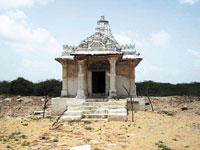 district Tharparkar is in shambles. This is because of the general apathy of
our people towards heritage and scarce resources available with the
Department of Archeology, Sindh. It has also been an eyesore to religious
bigots who reportedly disfigured two idols, which were in an intimate
embrace.
district Tharparkar is in shambles. This is because of the general apathy of
our people towards heritage and scarce resources available with the
Department of Archeology, Sindh. It has also been an eyesore to religious
bigots who reportedly disfigured two idols, which were in an intimate
embrace.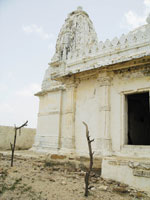 Farishta, Abn-e-Batuta also passed from here and it was destroyed by
Jalaluddin Khawariza Shah in 1223 A.D.
Farishta, Abn-e-Batuta also passed from here and it was destroyed by
Jalaluddin Khawariza Shah in 1223 A.D.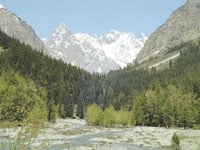 religions and civilizations of peace such as Buddhism and Hinduism, they were
never identified with extremism. Unfortunately, contrary to the true spirit
of the religion, the Islamic extremists are changing the face of these areas,
as the so-called jihadis set up military training camps, recruitment centres,
and establish links with outside militant outfits to work havoc, infest the
place with terror, and bring death and destruction to this tourist's
paradise. The land of tourists has regrettably fallen into the hands of
terrorist. The arrival of Pakistan's armed forces in such a big number in
Swat and Dir has heightened tension to a level that perhaps this will be the
first instance where certain local families in search of safety and security
have migrated to downtown district areas braving the scorching heat instead
of staying in their native villages and towns, particularly in summers.
Suicide bombing, the use of the Improvised Explosive Devices (IEDs), and
attacks on the security forces is a new phenomenon, which is a replica of the
expertise and tactics used by militants in the Waziristan tribal belt. But,
besides other aspects, the unrest caused by the mullahs and the military, has
hit the tourism sector hard in the region this season. People in general feel
uneasy in the presence of the security forces.
religions and civilizations of peace such as Buddhism and Hinduism, they were
never identified with extremism. Unfortunately, contrary to the true spirit
of the religion, the Islamic extremists are changing the face of these areas,
as the so-called jihadis set up military training camps, recruitment centres,
and establish links with outside militant outfits to work havoc, infest the
place with terror, and bring death and destruction to this tourist's
paradise. The land of tourists has regrettably fallen into the hands of
terrorist. The arrival of Pakistan's armed forces in such a big number in
Swat and Dir has heightened tension to a level that perhaps this will be the
first instance where certain local families in search of safety and security
have migrated to downtown district areas braving the scorching heat instead
of staying in their native villages and towns, particularly in summers.
Suicide bombing, the use of the Improvised Explosive Devices (IEDs), and
attacks on the security forces is a new phenomenon, which is a replica of the
expertise and tactics used by militants in the Waziristan tribal belt. But,
besides other aspects, the unrest caused by the mullahs and the military, has
hit the tourism sector hard in the region this season. People in general feel
uneasy in the presence of the security forces.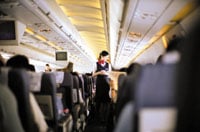 not it. Unless, of course, they do something abnormally nice, obnoxiously
rude, or posses the aisle traffic-stopping good looks. Their role as our
hosts while we are on the plane, is now a mutually sour one. Passengers are
impatient, demanding, and far too many for the reluctant hosts who are
overworked, underpaid, and have smiled way past the Fake Smile Authenticity
Guidelines. I had also done my fair share of air staff ignoring unless I was
hungry, wanted the empty dishes to be picked up or desperately wanted the
magazine that they were out of stock. Somehow as the threshold is passed from
economy to the business/upper class, the level of mannerisms between the
passengers and the air staff seems to transcend from restrained politeness to
attention, concern and courtesy. This emotion is obviously also feigned, but
the acting is far superior, just like the cost of the ticket.
not it. Unless, of course, they do something abnormally nice, obnoxiously
rude, or posses the aisle traffic-stopping good looks. Their role as our
hosts while we are on the plane, is now a mutually sour one. Passengers are
impatient, demanding, and far too many for the reluctant hosts who are
overworked, underpaid, and have smiled way past the Fake Smile Authenticity
Guidelines. I had also done my fair share of air staff ignoring unless I was
hungry, wanted the empty dishes to be picked up or desperately wanted the
magazine that they were out of stock. Somehow as the threshold is passed from
economy to the business/upper class, the level of mannerisms between the
passengers and the air staff seems to transcend from restrained politeness to
attention, concern and courtesy. This emotion is obviously also feigned, but
the acting is far superior, just like the cost of the ticket.