



|
|
|
|
 |
 |
   |
football Darts has a
bright future in Pakistan Pakistan
cricket: Relief
activities: The other side of Pakistan cricketers Set
out to be world cricket's highest ever run-getter!
football PFF recently started a global search for footballing talent so that Pakistanis living outside the country would be identified in trials and selected to participate in local (Pakistan) leagues By Muhammad Shahbaz Zahid Football, as we speak, is
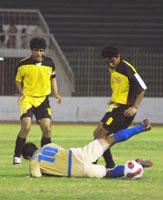
on the rise in Pakistan. And with more and more tournaments Recently a private TV channel -- Geo Super -- launched a football league in association with the Pakistan Football Federation (PFF). Trials were being organised before the tournament which received a huge response as locals participated in them in huge numbers. The tournament, which contains five teams, started off with a bang and has been a serious hit among the masses. PFF, on the other hand, has been arranging tournaments at city, departmental and club levels for a number of years now and have been trying their best to make the game reach a new height. But lack of facilities -- including play grounds and proper local administration bodies -- have been creating hindrances in proper development of football here. And it's not only football that has been facing such obstructions in its path of development. There are other sports as well which have been facing the same scenario. And because of these reasons, the talent here is not totally exploited and youngsters aren't appropriately groomed to make an impact in their playing careers. Now, a step has been taken
by the PFF which according to me won't help in promoting PFF recently started a global search for footballing talent so that Pakistanis living outside the country -- even if they haven't ever lived in Pakistan for a single day or weren't even born here -- would be identified in trials according to their footballing skills and selected to participate in local (Pakistan) leagues. The only condition required for those players in order to participate in tournaments here or even to represent Pakistan is that their parents, or one of them, should be a Pakistani in nationality. During its first-leg of global search, the PFF selected eight players after its trails which were held in Rotherham, Northern England last week. The players, who were selected, would be featuring in the Pakistan Premier Soccer League (PPSL). This tournament would commence in October this year. The two-day trials to select these footballers were held on 29 and 30 July at South Yorkshire's Millmoor Ground -- which is the official venue of Rotherham United Football Club. More than 130 players attended the tryouts. The eight winners -- chosen by Rotherham coaches -- will be training at Pakistan's national football academy in Lahore by the start of next week. Naveed Haider, a director at PFF said after the selection of youngsters from the trails that "this exercise would broaden our base and open doors to Pakistanis around the world who want to play football". I have a question to ask in this regard. "Couldn't this exercise be practised here in Pakistan? If PFF can spend so much on hosting trials in England to search out for talent, can't they hold those trials for locals and identify the budding youth who can play a role for their country?" Pakistan is ranked 176th in the present FIFA world rankings. Pakistan, who have never qualified for the World Cup or even the Asian Cup in that case (and doesn't look like doing so either in near future), wants to boost its fledgling domestic league and, above all, improve its national side. Mohammad Arif, a PFF coordinator, was assigned to bring the youngsters of various age-groups to participate in the Rotherham trials. He said: "We want to boost PPSL with foreign players and above all improve our national squad. We are seriously taking next year's 11th South Asian Games where our U-23 team will go all out to secure a hat-trick of gold medals". Excuse me mate, although I agree that the foreign people you are taking about can make a difference but what about those players who won two golds for the country in previous South Asian Games? Will they be left out? Will new players take their place and they'll be left to rue their fate why weren't they born in England or why didn't their parents migrated to UK? The PFF chief, Faisal Saleh Hayat, said after the selection of players: "Several talented players of Pakistan origin are living abroad and we are well prepared to utilise their skills for our coming assignments in the international circuit. We will continue to dig out football players of Pakistani heritage for the betterment of Pakistan football". Respected PFF chief, I have learned that you have been working hard for the betterment of the game in Pakistan and even the FIFA chief, Sepp Blatter, and Asian Football Confederation (AFC) chief, Bin Hammam, have praised your efforts for bringing the game a new life. They why aren't you carrying on with your efforts? I personally think that recruiting foreigners won't make a sudden impact on the local scene. The first and the foremost thing to do is to promote the locals. And has Pakistan ever signed up players of local origin from other countries to play for their national cricket team or the hockey team or for any other sport? The only example of a few that I can remember is of Carla Khan -- Pakistan's top squash player. Carla, who few days back suffered a slump in world rankings, was the number one player of Pakistan for a long time. She has been the highest-ranked player for Pakistan in world rankings in their entire history. Carla wasn't born in Pakistan, but in London. However, her grandfather, Azam Khan, was a squash legend here and that had inspired her to take up the game. Though Carla has won many laurels for the country, the thing here which has to be kept in mind is that Carla plays an individual sport. And she has to rely on her own abilities and talent when she is representing the country. And when we are talking about football, which is a team game, everyone needs to contribute. Now if the PFF thinks that adding one foreigner, of Pakistan origin, can make an impact in the team's performances on his own, they are wrong. Because in football, contribution of all the eleven players in needed at the same level. Some of the selected players, from Rotherham trials, would be challenging for a spot in Pakistan's starting line-up ahead of 7th South Asian Football Federation (SAFF) Championship 2007 (Sri Lanka/Maldives), 19th World Cup qualifiers and Second AFC Challenge Cup 2008 (Chinese Taipei). Four youngsters could be in the national colours even sooner when Pakistan will take on Arab nations Syria, Yemen, Oman, Qatar and Central Asian Kyrgyzstan in the AFC U-16 Championship Qualifiers (Group-A) from 17-28 October 2007. Suffean Mahmood, a 22-year-old, is one of those players who has been invited by the PFF. Mahmood, from Birmingham, plays at fullback position and has struggled to get a foothold in the professional game in England. Suffean, who had an unsuccessful trail at Premier League club Aston Villa said: "Here, in England, it just hasn't happened for me. Hopefully I can win my first cap, for Pakistan now, and become a role model to show other (Asian) kids that it is possible to break through". May be Suffean has opted to play here because he wants a breakthrough in his footballing career, which he didn't get in England, and interest in playing for Pakistan isn't his top priority. May be I am wrong, and if I am, we would certainly keep an eye on Suffean's progress. According to a report, there are almost 750,000 British Pakistanis but not one plays in the Premier League (top tier league of British football) with just three on the books of lower leagues clubs. Zesh Rehman, a 23-year-old centerback, who made a name for himself here in Pakistan and spent three seasons with Premier League club Fulham before joining Championship side Queens Park Rangers last year, is another person Pakistan certainly needs contributions of in their national side. Zesh had reached England's U-19 ranks before opting to play for Pakistan. One does hope that this development can boost the status of the game and will inspire other youngsters to follow the footsteps of those who have made a name for themselves. But on the other hand, as I speak, it might deprive the locals of a chance to fulfil their dreams on representing their country and portray their love for the game. The
writer is a staff member at 'The News' Karachi shehnu@gmail.com
While cricketers have been returning from the last two World Cup events empty handed, the Pakistan darts team could reach the quarters in the Asian Cup By Waris Ali She is the national
champion, and has represented Pakistan on the tours of India and She is Madiha Javaid, one of the most prolific players that the Pakistan Darts Federation (PDF) found during its talent hunt programme at college level. She was still a graduation student at the Ayesha Degree College in Lahore when she captured the attention ofthe federation. First recognised as a sport by the United Kingdom, darts is a game in which darts are thrown at a circular target, which is called the dart board, hung on a wall. Though various different boards and games have been used in the past, the term 'darts' usually now refers to a standardised game involving a specific board design and set of rules. While darts is a traditional pub game in the western countries, it is now recognised as a professional competitive activity across the Commonwealth countries, the Netherlands, Ireland, Palestine, the Scandinavian countries, the United States, and now in Pakistan. Madiha knows that she is still young and can achieve a number of goals in her game. Her achievements at present have become more praiseworthy in view of the fact that none of her family members had a background relating to sports. Her entrance in the game was more a matter of chance, since she was quite good at table tennis and badminton, and hoped to win success in these games. The credit goes to the Pakistan Darts Federation for hunting out such a talent in Madiha. The darts national champion, who recently passed her graduation examination, expressed her feelings that the game is gaining popularity in the country, mostly because of the events organised at school and college levels. She said that major sports channels are giving extensive coverage to the game and public awareness, for this reason, is fast developing about it. She said that she was eagerly waiting for an international event where she could perform so as to win laurels for the country. Madiha expressed her hope to perform well at the forthcoming darts world championship. She said the main factor behind the failure in the Asian Cup was that the other competing teams were experienced and were not neglected by their governments. But she must not consider their ouster at the quarter-finals stage as a failure; compared to the Pakistan cricket team's shameful performance in the previous two World Cup mega events, the darts federation team performed excellent and can hope to perform even better. At least, the media is in search of such successes so as to stir the conscience of the cricket board authorities. Pakistan has been giving an abysmal performance in the world of sports for last one decade; there was no major victory in any cricket tournament, hockey has witnessed a very bad time and squash is almost a forgotten game, while the snooker world championship has also been lost for ever. In fact, Pakistan has become a perennial loser. It is so because the standard of sports in the country has fallen drastically and games are considered an activity for some extra time; they have not been made part of our life despite the universally recognised fact that games, whether outdoor or indoor, are necessary for bodily, and hence mental, health and the physical fitness. It has since long been bad luck of the Pakistani people that an excessive craze of cricket did not let them tend to other games, particularly those which are easy but interesting to play. It is the game of darts that became a source of inspiration for this piece of writing; few people in Pakistan know about it only because it has been given little coverage in the media and that there is a serious lack of government patronage. The role being played by the Pakistan Darts Federation for promotion of this game is commendable; on the national level it is consistently making a struggle to uphold the game by conducting tournaments throughout the year and launching talent hunt programmes on school and college levels, while they have won titles for the country on international level also. The Pakistan Darts Federation General Secretary Chaudhry Shahid Javed, in a detailed discussion on the progress of darts in Pakistan, told 'The News' that the lack of facilities and government patronage is the major obstacle on the way of their efforts for popularising the game in Pakistan. Highlighting the role of the federation for promotion of the game, Shahid said that the federation conducted tournaments throughout the year in all major cities of the country and launches extensive talent hunt programmes on school and college levels. He said the federation, with its headquarter in Sports Complex, Iqbal Park, Lahore, conducts four tournaments regularly every year, including the national championship, Independence Cup event and Inter Club and Inter Provincial tournaments. Shahid deplored the attitude of the government towards the sincere efforts of the federation. He believes that extensive media coverage could better highlight the federation's activities, and for this purpose the federation is planning to conduct media workshops for developing a greater awareness about the game. The general secretary said that the federation was active in three provinces of the country, however Balochistan could not respond to its efforts, a reason why Pakistan Darts Federation could not be affiliated with Pakistan Sports Board. When asked how they managed their finances, Shahid Javed said that the federation had been successful in winning some sponsors for its events. Briefing about the victories of the federation on the international level, Shahid said that Pakistan Darts Federation has also participated in international events in India and Malaysia and showed remarkable performance in the both the events. On its tour of India, he said, Chaudhry Sohail of Pakistan won the singles league event while the federation players were runners-up in the team events. In Malaysia, seven players, including four boys and three girls, participated in the Darts Asian Cup 2006 and succeeded to reach the quarter-finals stage, Shahid said and declared it a good progress in view of their consistent struggle despite governmental negligence. About the talented national champion, the federation general secretary said he was strongly hopeful of good results from Madiha, and that she has the ability to win a big international title if government patronage was granted to the federation. Pakistan cricket:New season, new goals Regrettably, we will be compromising quality; so the same system contradicts PCB's designs of preferring quality over quantity By Dr Nauman Niaz This winter we'll have
loads of action. Razzmatazz, the Twenty20 World Cup, South The statistics will relive in books, DVDs and a million memories. Even for those not closely involved, the excitements and disappointments, crammed into a mere three months, will be savoured or forgotten for ever. For one who has written about the sequence of defeats and declining standards that preceded Pakistan's wonderfully entertaining recovery from the abject performance that followed their inspiring start in India in 2004-05, the best reward was that there wasn't any need to write another "what's wrong with Pakistan cricket" article, nor to find ways of reassuring the doubters that, actually, there was quite a lot right with it, too. To win at Abu Dhabi against half-baked Sri Lanka (without their stars) earlier than most expected was a bonus; to do it in such style (after World Cup 2007's disaster), amid classic, fast-burning single-day match tension that introduced another generation to the game's unique subtleties (as mentioned by the Chairman PCB, was like winning the jackpot). It is not the case that cricket in Pakistan has woken up bursting with health after a long fever, but to many that is what it felt like. Sri Lanka made it possible, both by setting the pattern by which Pakistan led by a naive captain Shoaib Malik played and by battling impishly or listlessly, Mahela Jayawardene heroically to the fore until he, of all people, finally allowed Shahid Afridi's bulging talent to burst like an ostrich from the egg. Because he gave so much to the Sri Lanka's cause as well as to his country's, Jayewardene was the man of the season every bit as much as Lasith Malinga, who would have played more often for his country, and with just as much passion, if injuries had allowed. Sri Lanka still had heroes in defeat and Pakistan none in success. Even Mohammad Asif looked lacklustre. Soon, Asif was aggrieved as PCB took a now so common U-turn, sacking him as vice-captain of the team. What was the point in making him Shoaib Malik's deputy if he was to be removed tersely. It is a pity Sri Lanka despite losing the three-match series picked a heavy purse while Pakistan were given lower rates. Why did PCB agree to play in Abu Dhabi in the first place? Poor marketing! (Similarly PCB first declined to field the Pakistan team for Bob Woolmer Academy's fund raiser and then agreed to do so); most of the time we are uncertain about doing things -- aren't we? Are we sure that by expecting to field our team in the tournaments like the one at Abu Dhabi we would be able to generate millions more of the American dollars we covet. Dr Nasim Ashraf wanted to turn PCB corporate and by now we have had a long list of plans, a rolling budget of US 39.6m and now we would need more money, some of them will be used for the wider spread of the game (the commercial success of pitting our team left right and centre). One was both disappointed and delighted to read through Chairman PCB's recent statements. Disappointed when in an Urdu daily it was reported that Dr Nasim's first preference was the NCHD (why couldn't NCHD and PCB both be his equal priorities?). One felt strange but at the same time skeptical thinking it could have been a gross misinterpretation of what he must have had said. Delighted to see another news item in an English daily where the Chairman PCB has vowed that in the next two years first-class cricket will be shown live on television and each player will be drawing to the tune of Rs 50,000 a month -- well that's encouraging though tamely over-ambitious. One wonders the cricketing set-up(s) or 3m each generating a collective of Rs 10.65m a month to dispense salaries or stipends to each first-class cricketer (approximately 13 regional and seven to eight department teams will be competing in domestic tournaments meaning that we would be having about 320 plus cricketers) -- wow! Here one feels completely whetted that cricket is really going to progress if it isn't at the moment. Dr Nasim also added that establishing coaching camps in 55 districts was his top priority; everything looks great; greater still. PCB also intends to extend all their help to the departments to prepare their own grounds; the rolling budget is seemingly setting things at place. Another interesting reading was Dr Nasim's statement that Geoff Lawson will be given specific targets, say to win a tournament or a series in two years (isn't that trivial, a tournament or two annexed or a series won; will it be enough for Lawson's appraisal?). One must appreciate Dr Nasim's determination to change the corroded systems. Now a bit on Pakistan's next cricket commitments; at least the Twenty20 matches in the World Cup in South Africa later this month will give Shoaib Akhtar a chance to recover some pride. A "Long Live Cricket Day" must be organised throughout Pakistan as Shoaib will return to international cricket. It is a reminder both of that essential link between the top and the bottom of the pyramid in any successful cricket player and that Shoaib will not take the bruise inflicted to his dignity lightly. The Pakistan Cricket Board is changing. One doesn't want to lend one's ears but could give PCB's hierarchy an advice that one of the reasons for Australia's long period of success has been their respect for the game. Example in 2005, David Hussey, whose brother, Michael, had helped Durham up to the first division, put himself out to attend the annual dinner of the new Cockspur club champions, Horsham, the club he had in 2003 helped to win the Sussex League. Since then he has helped Nottinghamshire to win the second and first divisions of the English County Championship in successive seasons. In Pakistan, we must stop playing tricks with our first-class cricket. There was nothing much wrong with the Silver and Gold League and things were seemingly popping up well. Ironically, we have now contemplating to bring thirteen regional teams besides inviting seven or eight departments to compete in only competition. Besides the Quaid-e-Azam Trophy we'll be having a Pentangular Cup. We must understand, there are still too many non-qualified players in first-class cricket but Rs 50,000 per player (as Dr Nasim stated in Islamabad during the concluding ceremony of a month-long Customs Cricket Academy programme on July 29) for the next couple of seasons will be distributed and by end 2008 the new criteria will begin to force the hand of first-class teams inclined to look elsewhere to buy success -- let's hope Chairman PCB's ambitions turn into dexterity and practicality. Let these not be understatements. Why should Hasan Raza appear for Karachi in first-class cricket if he has a contract with Habib Bank Limited; so we want to predict that Karachi would be without his services (that's the ugly part of both departments and regions playing together in the same competition). So Habib Bank will be buying success and Karachi left unattended. Positively, if we see Karachi without stars may well need to understand or get the message that success has to be built patiently. With the new structure at place, teams like Rawalpindi and Karachi would be wedding local talent to get the dynamic results. It remains crucial that players get proper opportunities in prime positions in first-class bowling attacks and batting orders. So this means, youthful people will get more chances, with stars already representing departments and they'll be groomed; this is the brighter side of the new concept but regrettably, we will be compromising quality; so the same system contradicts PCB's designs of preferring quality over quantity. But the key factor to be remembered is that in our teams over the last few years there has been a clear class divide, there have been three to five extraordinary players and the rest just made up the numbers and showed up to the games. That, therefore, meant that an artist had to wield the hammer instead of the brush. A case in point is when Pakistan teams of the yore are talked about, we talk about a Hanif, a Fazal, a Zaheer, a Mushtaq, an Imran Khan, a Wasim, a Waqar, a Qadir or an Inzamam, but never the playing eleven; one doesn't think barring the one time that we won the World Cup the Pakistan eleven was called anything as a sum total (Imran's cornered tigers). That one thinks is the difference in the genetic structure of cricket played in Australia and the rest of the world especially in Pakistan. In Pakistan we all know that our domestic structure is never going to be a monolithic organisation starting right from the under-16 levels and going on to the Quaid-e-Azam Trophy level and encompasses every conceivable hue and shape of purveyors of cricket skills. This structure is apparently supposed to yield a crop enough to survive a famine, flood and fire and yet have some left over for dessert. But the stark reality is that this structure is going to deliver either a half baked or under qualified product to international cricket. Some of these unleavened outputs may well have the aforementioned gene to derive success "in spite" of the system and they'll excel. The others will enjoy their 15 minutes in the sun; soak in the benefits as much as they could before retreating to their holes from where they had crawled out. Our domestic structure should form a pyramid with an extremely narrow top with only 4-5 teams competing for the top honours (maybe only 4-North, South, East and West-this concept of regions is beyond me) The Quaid-e-Azam Trophy therefore should be the path to top of this pyramid where we should allow either city level teams or region level teams The Quaid-e-Azam Trophy should therefore have an elite level and lower plate level (the Gold and Silver League concept) accommodating these teams and the end objective being that 60 individuals out of these playing teams will merit selection into the zonal sides that will have qualification rights into team Pakistan. Eligibility to play in the Quaid-e-Azam Trophy should be controlled tightly enough by way of grade cricket and also intra-state competitions like inter-district, inter-school etc. The NCA that exists should take in the exceptional talents identified at say an under-16 or under 18 levels putting them on a fast track program for Quaid-e-Azam Trophy qualification besides taking care of the fringe and international players. By clearly showing the benefits, and the corresponding net value of their plans and policies, the PCB should advocate their vision. After all, if we can all just give and take, we can live with the high-quality and the appalling. Just don't give us the repulsive. Relief activities: The other side of Pakistan cricketers One may also recall the prompt response from the Pakistan cricketers when the October 2005 earthquake ravaged the northern parts of Pakistan, resulting in the deaths of about 90,000 people By Gul Nasreen Our cricketers' 'predictable unpredictability' has been talk of the cricketing town for long. They are known to be 'volatile' while on the field, but it is not the case with them, to a certain extent, when off the field. At least, they are consistent in their approach to social welfare activities, which can be gauged from their continued support to the cause of humanity in recent years. Where there is a need for rehabilitation, relief and welfare activities, the Pakistan cricketers are there. As simple as that. Pakistan cricketing legend and the winner of 1992 World Cup Imran Khan actually heralded the chapter of social welfare activities for cricketers in our country in real sense of the word when he established the Shaukat Khanum Memorial Cancer Hospital in Lahore, followed by a number of small scale welfare activities by his fellow cricketers. King pacer Wasim Akram, who used to target the stumps with his lethal yorker, has followed suit in recent years. Being a diabetic, the record holder bowler made himself part and parcel of the campaign against diabetes through the platform of social welfare body ó DEA Foundation, which is actively working to create awareness among the masses about the disease and has also been working out strategies to make individuals aware about how to live normal lives after being afflicted with the deadly disease. Recently, Wasim's DEA Foundation also held an off-shore match in Abu Dhabi between Indian and Pakistani celebrities and cricketers to enhance education and awareness about diabetes. This match was a part of five-match series to raise funds for the said Wasim Akram's NGO. It was also a great occasion for the Abu Dhabi people to see the galaxy of stars lined up among them for a noble cause. One would definitely appreciate Wasim Akram's cause and should support Wasim in his mission will help to combat this disease. "The new generation can save themselves from this disease or at least face it bravely," Wasim Akram was quoted to have said. Looking into retrospect, here one may also recall the prompt response from the Pakistan cricketers when the October 2005 earthquake ravaged northern parts of Pakistan, resulting in deaths of about 90,000 people besides rendering millions homeless and damaging the infrastructure badly. Our cricketing legends, along with other sports greats, were at the forefront in the relief and rehabilitation activities in the post quake scenario. They put up individual as well as collective efforts to contribute to the cause of the affected people. The Pakistan Cricket Board (PCB), overwhelmed by the players overwhelming support to the cause of the quake affectees, had dedicated the first One-day International between Pakistan and England in December 2005 at Lahore for the victims of the calamity. The entire gate receipts from that match were given to the President's Relief Fund. Extending their helping hand, some Pakistan cricketers actually took part in the relief work. The entire cricket team travelled to quake-stricken areas and took part in relief operations in the post-quake scenerio. The then Pakistan team captain Inzamam-ul-Haq, along with his senior teammates, were all pressing the government to evacuate the victims and shift them to safer zones. Prominent all-rounder Shahid Afridi had visited a hospital in Islamabad where quake victim children were treated to ascertain the gravity of the situation and through repeated appeals attracted the philanthropists and volunteers to come and see for themselves what was most needed and practically take part in the relief activities. Former Pakistan captain Rashid Latif, current players Younis Khan and Mohammad Sami, had also raised 2.5 million rupees from sale of their bats and shirts for the earthquake victims in northern Pakistan. Rashid Latif and Younis Khan had auctioned their bats for one million each while Sami auctioned his 2003 World Cup shirt. Javed Miandad was part of Pakistan's sporting legends campaign in Karachi to raise funds for earthquake victims. Along with Olympian Islahuddin and squash legend Jahangir Khan, he visited parts of Karachi to fetch some precious funds from collectors and donors through a televised auction and collect money from all over Karachi. The latest on our cricketers' welfare activities is that some Pakistani cricketers, past as well as current, will be launching a programme in United States of America to raise funds for the flood affected people of Balochistan. They have already launched a relief programme in collaboration with the Islamic Relief organisation in parts of Balochistan. Former Test paceman Jalaluddin along with Test all-rounder Shahid Afridi and Haaris Khan visited Kharan and other parts of Balochistan and distributed relief goods among the affectees. According to newspapers report, former Pakistan captain Moin Khan, Shahid Afridi and other players will be visiting USA later this month to raise funds for the flood affected people of Balochistan. Cricketers Salman Butt, Imran Nazir, Muhammad Hafeez, Naved Latif, Misbah-ul-Haq, have also offered their services to support this humanitarian cause. It may be mentioned here that the said international voluntary organisation has long been engaged in various projects aimed at alleviating the poverty and suffering of the world's poorest people. Jalaluddin and Haaris Khan have remained associated with this organisation eversince its launch in Pakistan 15 years ago and now it has roped in more players into the noble cause as it has solicited support of the former Pakistan captains, Moin Khan and Rashid Latif. "We are desirous of contributing our bit for the betterment of the people in need," Salman Butt, Pakistan's newly appointed vice captain, was quoted to have said. The younger Pakistan lot Imran Nazir, Mohammad Hafeez, Naved Latif and Misbah-ul-Haq have also voiced their support to the NGO. It may be mentioned here that along with the volunteers of the Islamic Relief, Jalaluddin and the flamboyant Shahid Afridi have just undertaken a tour of the areas of Balochistan, affected by floods where they were moved by the touching scenes that they witnessed with our eyes. "I believe it's our responsibility to come to the rescue of those people who have lost their dear ones, their homes and their livelihood," Shahid Afridi was quoted to have remarked. According to Jalaluddin, Islamic Relief, with the support of the Pakistan's cricketers, plans to hold more fund raising functions in the United States as well as in England during the next few months. Jalaluddin is hopeful that cricketers from other parts of the world would be joining hands with Islamic Relief in doing service for the affected people. He believes that international matches could be organised in future to raise funds for the noble cause. Pakistan's first choice wicket-keeper/batsman Kamran Akmal and veteran batsman Younis Khan have also agreed to participate in the future events of the relief body to be organised by Islamic Relief for the fund-raising purpose. Cricketers are highly respected, revered and blindly followed in our country. People readily respond to what their 'heroes' advise them. So their welfare activities can get a rare boost which can make a difference at large. Set out to be world cricket's highest ever run-getter! Beside his extraordinary talent, courage and consistency have been the main virtues of Tendulkar who has made batting glamorous and entertaining without sacrificing solidity There can be few more
exciting sights in cricket than watching Sachin Tendulkar bat at During the second day of the second Test against England at Trent Bridge, Sachin Tendulkar when he scored his 25th run became the third batsman to score 11,000 runs in Test cricket. He has also scored a world record of 37 Test centuries and also 43 half-centuries. West Indies captain Brian Lara (11,953) and former Australian captain Allan Border (11,174) are the other two players to have reached the milestone while Steve Waugh and Sunil Gavaskar have also scored more than 10,000 Test runs. Tendulkar has a better batting average of 55.05 as compared to Border's (51.00) and Lara's (54.04). Tendulkar also holds the record of most runs in One-day Internationals, having scored 15,051. He is also the highest century-maker in limited-over internationals with 41 hundreds in 388 appearances at this level. Tendulkar 34, with no signs of retirement at the moment, must be looking to overtake Border and the world record of Brian Lara that would complete a clean sweep of batting records for Tendulkar, who is the leading century maker in Tests and One-day Internationals, as well as the leading run scorer in limited-overs internationals. He is also close to completing 100 catches in Tests. So far he has held 92 catches and could complete this 'century' in the ongoing three-match series against England. Sachin Ramesh Tendulkar made his Test debut against Pakistan at Karachi in November 1989 and became India's youngest Test player at the age of 16. He scored his maiden Test hundred at the age of 17, against England at Old Trafford. He was named among Wisden's Five Cricketers of the Year in 1997. He also made his One-day International debut at the age of 16 against Pakistan in 1989. In 1996-97 he was appointed as the captain of the Indian side, making him the second youngest captain in the history of Indian cricket after Mansur Ali Khan Pataudi who was named captain at the age of 21. Tendulkar, regarded among the premier batsmen in the world in the last decade, is ranked second in both the all-time Test and one-day lists prepared by Wisden, behind Australia's Don Bradman and West Indies' Viv Richards, respectively. In batting, he has reached a stage that others can only dream of. He has destroyed practically every bowling attack in the world. India's batting has revolved around Tendulkar for more than a decade. So much so the critics have often labelled India a one-batsman team, especially on tours. Beside his extraordinary talent, courage and consistency have been the main virtues of Tendulkar who has made batting glamorous and entertaining without sacrificing solidity. He is also generally considered to have a near-perfect balance between aggression and defense. Tendulkar took 19 Tests to get his first 1000 runs, but since then the aggregate has been increasing with a rapid rate. He took nine Tests each twice to go from 4000 to 5000 and from 5000 to 6000. But his last 1000 runs have come in 17 Tests. Sachin's overall average is 55.05 -- even against Australia his average is 53.11, but surprisingly against Pakistan and South Africa his performance is quiet below average, that is 39.91 and 36.42 respectively. Tendulkar has scored 1000 runs against every major team but against Pakistan he failed to reach the four figure marks after playing 16 Tests against the arch-rivals. Tendulkar has suffered a series of wear and tear injuries in the last few years and recovered from a long-term tennis elbow injury to play against Pakistan last year. High expectations from the millions of fans who do not accept anything less than a century from him the build-up puts a lot of pressure on the master batsman. No other player suffers so much from the pressure of expectations like that. He perhaps puts too much pressure on himself because he feels he has to win big matches and prove his critics wrong. With age on his side, this man is set out to be the highest run-getter in the history of world cricket. Sachin Tendulkar, known as 'The Little Master', has served two unsuccessful terms as India captain, the first aged 23 in 1996 before being axed 17 months later after his batting suffered. He was re-appointed in 1999, but stood down after a 0-3 Test series rout in Australia the following year. SACHIN
TENDULKAR: TEST CAREER RECORD Mat I NO Runs HS Ave 100 50 0 Overall 139 224 23 11067 248* 55.05 37 44 13 v Australia 21 39 4 1859 241* 53.11 7 7 4 v Bangladesh 5 6 2 556 248* 139.00 3 0 0 v England 21 33 3 1911 193 63.70 6 9 0 v New Zealand 16 27 5 1062 217 48.27 3 5 1 v Pakistan 16 24 1 918 194* 39.91 2 5 2 v South Africa 19 35 2 1202 169 36.42 3 5 2 v Sri Lanka 16 21 2 1313 148 69.10 7 3 0 v West Indies 16 25 2 1328 179 57.73 3 7 3 v Zimbabwe 9 14 2 918 201* 76.50 3 3 1 Home 60 99 10 4917 217 55.24 16 19 3 Away 79 125 13 6150 248* 54.91 21 25 10
|
|
 being organised here -- at all levels -- the world's favourite game is being
played and adopted like never before in this cricket-crazy country.
being organised here -- at all levels -- the world's favourite game is being
played and adopted like never before in this cricket-crazy country. our local players and would deprive them of the chance to represent their
country or even their cities or departments they want to play for.
our local players and would deprive them of the chance to represent their
country or even their cities or departments they want to play for.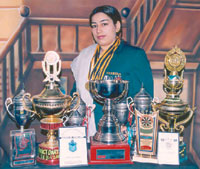 Malaysia. She is a player of darts, the current national champion, a
second-time title winner after her first victory in the national championship
in the year 2004 when she was just 18 years old.
Malaysia. She is a player of darts, the current national champion, a
second-time title winner after her first victory in the national championship
in the year 2004 when she was just 18 years old.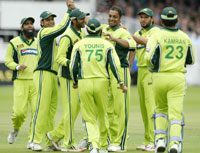 Africa's tour to Pakistan, a series in India and Australia comes home. Soon
the winter will be blown away, a new summer coming, drenching the ambience
with gold. Whatever the results, plans about giving new direction to Pakistan
cricket will continue, the results if based on success would see many fathers
and losses will be unattended, the shifting of blames theory etcetera.
Africa's tour to Pakistan, a series in India and Australia comes home. Soon
the winter will be blown away, a new summer coming, drenching the ambience
with gold. Whatever the results, plans about giving new direction to Pakistan
cricket will continue, the results if based on success would see many fathers
and losses will be unattended, the shifting of blames theory etcetera.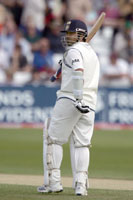 his best and, whenever he does, the spectators at the stadium specially in
India are on their feet cheering and why not Tendulkar is setting almost
impossible targets for the other batsmen. He has reached a stage that others
can only dream of.
his best and, whenever he does, the spectators at the stadium specially in
India are on their feet cheering and why not Tendulkar is setting almost
impossible targets for the other batsmen. He has reached a stage that others
can only dream of.