



|
|
|
|
 |
 |
  
|
travel In shambles onehour
Al Ain City in UAE is an interesting site for those wanting to explore lives of Emiratis in pre-oil discovery era By Shahzada Irfan Ahmed Imported luxury cars,
skyscrapers, mammoth shopping malls and a sea of tourists are the first
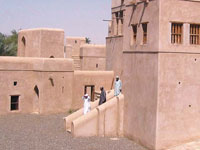
things Today these emirates have undoubtedly become the regional business and tourism hub and offer myriad attractions to visitors besides offering long-cherished jobs to workforce pouring in from everywhere. Most of the visitors find little time to explore the history of this land and stick religiously to the prime purpose of their visit to this part of the world. However, there are also those who want to turn pages of history and find out how the life of a Bedouin has transformed over time, especially after the discovery of oil in this region. Luckily for this inquisitive lot, it doesn't take long sessions of discussions or thorough research to reach a conclusion. All it takes is a visit to the historic city of Al Ain (meaning the spring) lying on the outskirts of Abu Dhabi, away from the coastal line. Recently put on Unesco's heritage list, this oasis city boasts of having been host to one of the oldest civilizations in the history of mankind. Archaeologists have found remains of Bronze Age in this area and discovered that the land had been under active occupation of settlers even before the pyramids era, around 5000 years ago. On his way to Dubai from Abu Dhabi by road, the scribe got a rare chance to visit this city of gardens offering picturesque views of unending rows of date palm, pathways flanked by low walls, hot springs at the foothill of majestic Jabl-e-Hafeez (a mountain 1,160 metres above the city level), traditional camel market and an archaeological park displaying remains from thousands of years ago. A strange revelation during
the journey was that out of the approximately 700,000 Pakista A travel companion disclosed that hidden treasures like Al Ain were exposed to the expatriate community only when it starting moving from main city centres to distant areas. This movement was imminent as rents in areas Abu Dhabi and Dubai have experienced exponential raise in the last couple of years. Besides, the ever-increasing intolerance amongst the Emirati landlords against bachelors has expedited the process to a great extent. The visitors to Al Ain Oasis are welcome from dawn to roughly an hour before dusk. Entry to the densely cultivated area is strictly prohibited after dusk. Once we were there, we were asked by the attendants of this historical site to remain closed to the marked pathways. Otherwise, we could lose track and stand stranded amongst thick foliage of not less than 60,000 palm dates planted in Al Ain Oasis. On the cultivation pattern, we were briefed by a self proclaimed guide that it was on the behest of late Sheikh Zayed bin Sultan Al Nahyan that date palm monoculture was introduced here. Prior to this, multiple crops and fruits were grown in Al Ain but the sheikh gave local farmers sufficient funds to plant date palm in the area and have a more reliable source of permanent income. Late Sheikh Zayed's unmatched love for the area was for the reason that Al Ain was his birthplace and he spent his youth here. The Al Ain Palace Museum is where the late sultan lived during his youth. We were also told that fertile soil from other parts of the region was transported here on donkey backs to boost cultivation in this area. Another thing worth noting on Abu Dhabi-Dubai road (from where we took diversion to Al Ain) was the Dubai-bound traffic carrying mostly the Pakistani passengers. A few of these cars were hoisting Pakistani flags as it was the 14th of August that day. Our driver (also a Pakistani) refused to copy this act of 'bravery' despite our repeated requests. He told us that hoisting any national flag other than UAE is disallowed here and is an act punishable with hefty fines. The UAE police does not stop cars hoisting such flags. It simply notes down the registration numbers of the cars and sends fine slips to the violators. Dubai-bound traffic has increased on this road as Dubai government has not given landing rights to the recently launched Etihad Airways owned by Abu Dhabi government. Similarly, Emirates Airline owned by Dubai government cannot land at Abu Dhabi International Airport. Pakistani passengers who travel on cheap tickets offered by Etihad (around 30 per cent less in price than PIA's) land at Abu Dhabi and travel by road to Dubai-to their final destination. Coming back to Al Ain, this garden city also has a park that is the site of several tombs dating back to the third millennium B.C. Al Ain also has a camel market where one can see the local emirates bartering for superior breed camels. The city has a long history of camel racing and the main track is located in Malagit. Al Ain also boasts of centuries-old forts of which many have been restored while others have been left in ruinous state. Besides, Al Ain zoo modelled along a desert theme is a major attraction for visitors. Spread over 850 hectares, the zoo remains open from 4 pm to 10 pm and provides respite to visitors from the scorching heat of the desert. On prior request, desert camps can be arranged for visitors. Here one can satisfy one's taste buds with mouth watering Emirati cuisine including barbecued meat, especially the lamb roasted on a moderately lit spit. The affair goes on endlessly under an open and star-studded sky with an entertaining belly dancer inviting party-goers to join her in her hip-swirling dance with traditional music being played live. In short, Al Ain is a must go for those who want a break from the hectic routine life and relate themselves with the Bedouins of pre-oil exploration days in the region.
In
shambles By Zulfiqar Ali Kalhoro Three kilometres north of
Shardi Larj, Badin, are located necropolis of Mankani Talpurs. The However, the necropolis of Mir Abdullah is in shambles and most of the tombstones are in a dilapidated condition. Previously there were four canopies in the necropolis, not a single canopy exists today; all the canopies have been reduced to debris. One can reconstruct the architecture of the canopies from the remains which is spread over the site. The principal canopy belongs to Mir Abdullah Khan Talpur after whom this cemetery is named. This canopy has also damaged the adjoining graves. It had twelve pillars built in square plane superimposed by a hemispherical dome and was erected on double plinth with both plinths carrying breathtaking designs. To the west of the canopy of Mir Abdullah is a ruined shelter of Mir Walia Khan Talpur, that is also twelve, pillared. According to Mir Haji Mohammad Khan Talpur of Tando Bagho, Mir Walia Khan alias Mir Mohammad Hassan was son of Mir Bagho Khan. Mir Bagho Khan Talpur occupies a significant role in the history of Manakani Talpurs. He was the founder of Tando Bagho, now a bustling town in Badin district, and excavator of Bagho Wah (channel) which is still an agricultural land of Tando Bago tehsil. Mir Bagho Khan, son of Mir Mirzo Faqir Talpur was General of Mian Sarfraz Khan Kalhoro (1772-1775) and was very close to him. Mir Bagho Khan was killed by Sodha Rajputs while hunting. According to Mir Mehboob, Mir Bagho Khan (traditionally known as Pir or Mir Wagha) was buried in the courtyard of Primary Girl's School in Umarkot. To the west of the canopy
of Mir Walia lay tombstones of Mohammad Khan Talpur and Fateh Khan Apart from the destroyed canopies, the cemeteries contains many gravestones of ordinary people and the servants of the Talpurs carrying inscriptions and are decorated with floral and geometric designs. Some 200 metres south of graveyard of Mir Abdullah lays a necropolis of Syed Ahmed Shah. He was the general of Mir Tharo Khan's army. This graveyard contains gravestones of the soldiers of Mir Tharo Khan's army. Mir Tharo Khan Talpur was the founder of Manakani Kingdom and established his capital at Ketyan-Jo- Kote on the left bank of Puran River in Badin. Ketyan-Jo-Kote or Ketun served as first capital of Manakani Talpurs. It was a centre of all cultural and political activities. Mir Tharo Khan and his brother Mir Allah Yar Khan II resided in this town and their palaces dominated the city. Apart from them, the palaces of Mir Bagho Khan, Mir Abdullah Khan, Mir Walia Khan, Mir Ghulam Hyder and Mir Ali Murad also dotted the landscape of Ketun town. Mir Tharo Khan Talpur was a shrewd and liberal ruler. During his rule, peace and prosperity prevailed in the territory. According to Mir Mehboob Ali, primary teacher in Tando Bagho, Mir Tharo Khan engaged in the battle with rulers of Hyderabad over a minor issue. This battle took place between Shahdadanis rulers of Hyderabad (descendents of Mir Shahdad Khan Talpur) and Mankanis rulers of Badin (descendants of Mir Manik Khan Talpur) in 1803 A.D. The battle started after scuffle between the Kardars (revenue collectors) of the Mir Tharo Khan Talpur and Mir Ghulam Ali Khan (1802-1811), a ruler of Hyderabad which resulted in some casualties. In that fight Kardar and few farmars of Mir Tharo Khan were wounded and later on succumbed to their injuries. Mir Tharo Khan vowed to take revenge of his people. Meantime, news reached to Hyderabad that Mir Tharo Khan was collecting troops and planning to attack Hyderabad. Mir Ghulam Ali Khan Talpur (1802-1812) also prepared for battle and assigned his nephew Mir Sobdar Khan Talpur, son of Mir Fateh Ali Khan Talpur, to lead the Talpur army. Mir Sobdar Khan Talpur along with his army marched towards Badin. Syed Ahmed Khan was the general of Mir Tharo Khan's army. Both armies in the battle ground near Guni fought severely for five days. Mir Tharo Khan was taken prisoner and Manakanis lost the battle Mir Tharo Khan was taken to Hyderabad where he was presented before Mir Ghulam Ali Khan. This battle was known as Wal Wari Jang (Battle of Wal) took place in 1803 A.D claiming many lives from both sides. According to the locals, 410 soldiers of Mir Ghulam Ali's army and 300 soldiers of Mir Tharo Khan's army died in this battle. Mir Tharo Khan was not put in jail, rather he was greatly honoured. He stayed in the palace of Mir Ghulam Ali. After some time he was allowed to go to his capital, Ketun. After his return from Hyderabad, Mir Tharo Khan felt dejected. After some time, he made his son Mir Ali Murad a ruler of his kingdom. Mir Ali Murad shifted his capital from Ketun to Mirpurkhas in 1806. Mir Tharo Khan also abandoned Ketun and lived in Mirpurkhas. Ketun, the first capital of Manakani Talpurs lost its grandeur. Mir Tharo Khan died in 1829 leaving behind two sons Mir Ali Murad Khan and Ghulam Hyder. He was buried in Chitori necropolis in Mirpurkhas. At present, Ketun is in ruins, with only few tombs withstanding against the vagaries of weather. Similarly, the graveyards of Mir Abdullah and Syed Ahmed Shah are also victim of neglect. Unfortunately, these escape the attention of both the descendents of buried dignitaries and concerned authorities who are responsible for preserving the crumbling heritage.
onehour It's a breezy first day of
August as we enter Lahore's "Joy Land" for our yearly pilgrimage
along with Throwing all security issues, you-can't-stay-out-too-late warnings by parents and all the rest spoil-sport cautions to the wind and drive past security barriers to enter our destination (Joy land, Fortress stadium) to find it swarming with like-minded blessed Lahoris. Dressed to the nines, women, children, girls and the accompanying males stand in queues to get their tickets for the rides. This obviously owes to the weather, which is not so punishing after the midnight and early morning rain. Ali is still surprised though. "It's the middle of the week!! Don't these people have to work tomorrow?" he cries looking around. Well, if security threats couldn't stop them, trivial things like work hardly matter. The scene is surely reassuring and I take in the bursting energy and carefree joviality of the people around and silently pray for the same for the whole country. I can't deny that there's a lurking fear at the back of my mind, of all those warnings and threats materialising any moment in this happening place full of innocent people, but I decide to push all fears out of my system and focus on the positive vibes all around. Ali decides to pass the scary 'Pirate' ride as he watches his elder brother and three other dare-devils wait for their turn near the giant swinging boat with people screaming and waving from inside. The remaining four of us head towards the small cafe to grab some hot fries sprinkled with 'chaat masala' and a cold drink. We find an empty table and sit down to enjoy our snack. As we finish our drinks and head back, it starts moving and gains speed, people start screaming but none of us makes a sound. They smile and wave while we try to take photos which don't come out good. And lo and behold! My cousin Kumail takes out his cell phone and starts talking as it's the most normal thing to do while swinging dangerously in a huge boat. Ali greets him with "Whoa! You might as well have gone to sleep Kumail!!" when they get off. Ali is pleasantly surprised to see a boy getting off the ride wearing a shirt with Eminem's face on it and asks if he is popular here? We head towards our final ride,the Ferris wheel including Qasim and Ali while Kumail and Farwa get on the scariest of them all, the 'Crazy boat'. Shaped like a hammer, you sit in its head and it takes a full vertical spin backwards in the middle of the ride. I let this one pass too, waiting for all to get down with my youngest brother as we watch a couple at the nearby shop trying to get their two toddlers to pose for a photograph to be printed on a T-shirt. It's proving to be an impossible feat and they settle for a universally recognised 'one-smiling-one-looking-away' sibling photo. Another couple holding a child hardly two years old buys a packet of Lays for their son who shall soon be having another sibling as his mother's appearance promises. Everyone off their respective rides, we're ready to leave for another favourite Pakistani activity, eating out. Our American cousins make very clear, as they always do, that it is only Pakistani food they want and absolutely no Mcdonalds, KFC or Pizza Hut. We get in our cars and head towards a famous place which is sure to take care of their food preferences to the max.
|
|
 that come to one's mind when you talk about the United Arab Emirates (UAE).
The way these emirates, mainly Abu Dhabi, Dubai and Sharjah have developed
over the last few decades is simply amazing.
that come to one's mind when you talk about the United Arab Emirates (UAE).
The way these emirates, mainly Abu Dhabi, Dubai and Sharjah have developed
over the last few decades is simply amazing.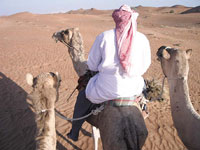 ni
workers in the UAE, a very small fraction has ever visited this heaven on the
earth. The reason quoted for their sheer lack of interest is that Al Ain
falls at a distance from the coastal line where all the development has taken
place.
ni
workers in the UAE, a very small fraction has ever visited this heaven on the
earth. The reason quoted for their sheer lack of interest is that Al Ain
falls at a distance from the coastal line where all the development has taken
place.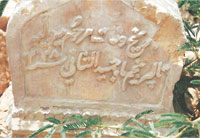 Mankanis trace their ancestry from Manik Khan Talpur. Talpurs (1783-1843)
ruled over Mirpurkhas, Badin and some parts of Mithi district. There are
three renowned graveyards of Mankanis in Sindh namely Mir Allah Yar Ja Quba
in Dadu, Chitori in Mirpurkhas and cemetery of Mir Abdullah in Badin. The
Mankani Talpurs played a significant role in socio-political record of Sindh
during Kalhora and Talpur dynasties.
Mankanis trace their ancestry from Manik Khan Talpur. Talpurs (1783-1843)
ruled over Mirpurkhas, Badin and some parts of Mithi district. There are
three renowned graveyards of Mankanis in Sindh namely Mir Allah Yar Ja Quba
in Dadu, Chitori in Mirpurkhas and cemetery of Mir Abdullah in Badin. The
Mankani Talpurs played a significant role in socio-political record of Sindh
during Kalhora and Talpur dynasties.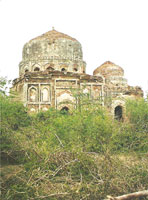 Talpur carrying inscriptions. Near these tombstones is located another canopy
which has also levelled to the ground. The decorated shafts, capitals,
brackets and lintels of the canopy have scattered over the site. Well-nigh
close to the canopy of Walia Khan Talpur lies yet another anonymous twelve
pillared destroyed 'chattri.'
Talpur carrying inscriptions. Near these tombstones is located another canopy
which has also levelled to the ground. The decorated shafts, capitals,
brackets and lintels of the canopy have scattered over the site. Well-nigh
close to the canopy of Walia Khan Talpur lies yet another anonymous twelve
pillared destroyed 'chattri.'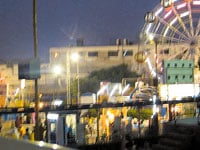 our two American cousins. This visit is taking place after two years as Qasim
16 and Ali 11, last visited their favourite city in summer 2005.
our two American cousins. This visit is taking place after two years as Qasim
16 and Ali 11, last visited their favourite city in summer 2005.