



|
|
|
|
 |
 |
   |
Shift
in strategy overview The
moving targets fallout Peshawar
and peace In
self-defense
Editorial The policy of dialogue
and use of force as a last resort is over. The government has decided to
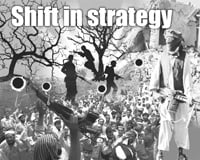
ban Clearly, the government has moved ahead from the consensus between the four coalition partners in NWFP -- PPP, ANP, JUI-F and PML-N -- to continue talking with the militants and seek a political solution. The reason for this change in strategy is the series of suicide bombings across the country, killing scores of civilians. The attacks, especially in Dera Ismail Khan and Wah, enraged the public opinion against the militants as well as the government; against the government for not doing enough to secure the law and order situation and ensuring peace. The military operation did not make things easy. Hundreds of thousands of people were displaced from Bajaur as the clashes between the military and the militants began. The government was required to accommodate them somehow and engage militarily as well in a province which saw seething sectarian clashes at the same time. Politically, the consensus broke. ANP did not categorically say or believe that the time for peace talks it began in Swat was over. A permanent player in the province and under some real threat at the hands of militants, the liberal secular ANP was almost forced into taking this position. JUI-F, being ideologically close to the Taliban, did not for a moment believe in the other view -- the one that espouses military solution. And yet, for the time being, seems the policy of force is holding sway. But, as Rahimullah Yusufzai suggest in his analysis, that position may change any time. Now that the PPP-led federal government has decided to ban the Tehrik-i-Taliban Pakistan (TTP) and refused dialogue with militants unless they surrender, the only other option is to carry out sustained military action By Rahimullah Yusufzai The government has given
up, at least for the time-being, the policy of dialogue that it had
initiated after the Feb 18 general elections to resolve the conflict in
the North-West Frontier Province (NWFP) and Federally Administered Tribal
Areas (FATA). In its place, a sustained military campaign But Bajaur, South Waziristan and Swat aren't the only troublespots where the security forces were asked to act. Kurram Agency, suffering from a debilitating sectarian conflict, is calling for attention of the security forces to disengage the heavily-armed combatants, open the blocked roads that have paralysed life and return the most beautiful and greenest tribal region in FATA to normalcy. That the security forces cannot fight in every tribal agency became evident when Rahman Malik, adviser to Prime Minister Syed Yousuf Raza Gilani for interior affairs, gave a 72-hour ultimatum to the warring sides in Kurram to stop fighting but was unable to provide troops to start punitive action against the combatants. Days after the expiry of that deadline, fighting continued in Kurram and there was no evidence that enough troops could be spared to fight on a new frontline. Another tribal agency, Mohmand, too, is restive in view of growing activities of the militants. Taliban are back in Darra Adamkhel, the gun-manufacturing town in which a military operation temporarily drove away the militants. Government officials are being abducted and those defying the Taliban are under attack in the Darra Adamkhel valley and its surroundings both on the Kohat and Peshawar sides. And nearer Peshawar, the Mangal Bagh-led Lashkar-i-Islam has regained control of Bara in Khyber Agency because it didn't suffer any real damage at the hands of the paramilitary Frontier Corps, which had moved against the non-Taliban militant groups there to strengthen Peshawar's defences and reassure the worried residents of the capital of NWFP. The other militant group in Bara named Amr bil Maruf wa Nahi Anil Munkar (Promotion of Virtue and Prevention of Vice) is angry and in a revengeful mood after the recent murder of its head, Haji Namdar Khan. Tribal areas aren't the only places that are causing concern to the military, government and the people. Several districts in the Frontier are suffering from violence following inroads by militants. Hangu in southern NWFP is still recovering from the violent events triggered by Taliban fighters who ambushed and killed 16 Frontier Constabulary personnel and provoked the security forces to act against them. Tank due to its location as the gateway to South Waziristan is vulnerable to militants' activities. Lakki Marwat, too, would have become a dangerous place if the Marwat tribesmen had not joined hands to flush out the non-local Taliban operating in the district and warn the local Taliban to behave. Bannu has experienced a number of terrorist attacks, the latest one killing around 10 policemen and civilians and injuring many others on August 28 car bombing. Its proximity to North Waziristan and the Frontier Region Bannu, also known as Frontier Region Bakkakhel, has made it an insecure and uncertain place. Kohat has also been affected and a number of suicide bombings, rocketing on the city and the garrison and attacks on the cops have taken place in its urban and rural areas. Another southern district that is bleeding from violence is Dera Ismail Khan. It has also been infiltrated by militants but its biggest problem is the sectarian nature of the conflict. Such is the intensity of the conflict that even a public hospital in the city wasn't spared and 32 people were killed when a suicide bomber struck on August 19 after placing himself in the hospital's emergency ward among mourners who had brought the body of a Shiite man assassinated earlier in the day. Karak is the only southern district that is relatively peaceful and has until now been spared of the effects of militancy. But it cannot remain peaceful forever owing to the likely fallout from the violence raging in its neighbourhood. Malakand region in general and Swat in particular have suffered the consequences of Taliban militancy. With the breakdown of the peace accord that the ANP-PPP provincial government and the Maulana Fazlullah-led militants signed on May 21, violence has returned to Swat and a full-fledged military action is now underway. Though the NWFP government is insisting that the peace agreement is intact, it would be unrealistic to expect that the two sides would be able to trust each other again and cooperate to make Swat peaceful and stable. In the Peshawar valley, which forms the central NWFP and is the most agriculturally fertile and developed part of the province, the security situation has been deteriorating. Peshawar, Charsadda, Nowshera, Mardan and Swabi have been affected by militancy to varying degrees. Like in Lakki Marwat, Hangu and Buner, village elders and political and social figures in some districts in Peshawar valley are realising the need to form defence committees, jirgas and even local lashkars (force) to evict militants from their areas. They know that the presence of militants would prompt the security forces to take action against them and the result would be displacement of people as witnessed in Bajaur Agency, loss of livelihoods and damage to the fragile economies of their areas. Even in the tribal areas in Bajaur, tribesmen in the Salarzai area picked up courage to fight the Taliban after blaming them for their sufferings. Only Hazara region in NWFP is immune from the Taliban phenomenon. But people constantly worry that the militants could infiltrate parts of Hazara, particularly Mansehra, Battagram and Kohistan and destabilize their peaceful districts. Now that the PPP-led federal government has decided to ban the Tehrik-i-Taliban Pakistan (TTP) and refuse dialogue with militants unless they surrender, the only other option is to carry out sustained military action against them. This is reversal of the policy that was firmed up when the four-party ruling alliance of PPP, PML-N, ANP and JUI-F and the military leadership interacted at security briefings arranged by the Army Chief General Ashfaq Parvez Kayani for the heads of these parties. It was decided that peaceful means would be used to resolve the conflict in the NWFP and FATA and military action would be taken as a last resort. The government had to change its policy not only due to outside pressure applied by the US and its allies but also on account of the devastating suicide bombings carried out by the TTP in Dera Ismail Khan, Wah, Lahore, Islamabad and other places. Though the TTP justified these bombings as its reaction to the military operations in Bajaur and Swat, the high number of civilian casualties in the suicide attacks outraged the people and caused a turning of the tide against the militants. The ban on TTP won't have any impact as it was never a legal organisation and had neither an office in any city nor bank account. The move was largely symbolic and was apparently meant to send the message that the TTP would no longer be a partner in any future efforts to peacefully resolve the conflict in NWFP and FATA. Further hardening of the government stance became evident when Rahman Malik's announcement that the government was considering placing head-money on top Taliban commanders in Pakistan and his insistence that militants must surrender before peace talks could be held with them. The Taliban would not lay down arms and it means that the fighting would continue. The steps announced by Rahman Malik, who isn't a politician and had served all his life in law-enforcement agencies, are administrative measures aimed at treating the militants as criminals and terrorists and attempting to liquidate them. It remains to be seen if the government and security forces possess the power and stamina to pursue this tough course. In the past also, the government went all out in ordering military action against the militants, but its inability to defeat them prompted it to sue for peace by involving tribal elders and even Afghan Taliban as mediators. Right now the focus is on punishing the militants but who knows if this is going to be the final strategy or the process of dialogue would be resumed at some state in the future. The
moving targets First the soldiers
risked harm if they moved around in uniform in parts of NWFP and FATA, Such was the high level of threat to the men in uniform that they were advised not to venture into the towns and cities in the Frontier while wearing their distinctive khaki uniforms. Some removed their nameplates from official residences and travelled in private vehicles instead of the official ones. Army troops moving in convoys were and still are a major target of suicide bombers and improvised explosive devices (IEDs) planted on roadsides. Some innocent civilians got killed while driving close to military convoys as soldiers mistook them for suicide bombers. One had heard about this kind of 'collateral damage' in Iraq and Afghanistan but not what is happening right here in Pakistan. The paramilitary soldiers from Frontier Corps, which operates in FATA and on the border with Afghanistan, and Frontier Constabulary that is deployed on the boundary between settled and tribal areas and in the districts, have also suffered significant casualties. They are marked men whenever operating in Taliban-infested areas. A large number of soldiers from both FCs have deserted their jobs. Some policemen, too, in violence-hit districts have left their jobs. Demoralisation has set in among the paramilitary troops and cops serving in dangerous areas and those posted there are all the time making efforts to cancel their transfer orders. Militants began targetting top politicians some years ago after accusing them of supporting the pro-US General Pervez Musharraf and justifying the 'war on terror'. In the NWFP, PPP-S head Aftab Sherpao was attacked twice by suicide bombers in his native Charsadda district when he was the federal interior minister. He survived both times in the bombings that killed a total of 85 people. PML-Q provincial president Amir Muqam, who was also a federal minister, also survived one suicide bombing in Peshawar. Now the country's new rulers are under threat from the militants. The government has taken steps by upgrading security for the most threatened ruling politicians at the centre and in NWFP and providing them bullet-proof vehicles and extra guards. But suicide bombers are difficult to stop once they make up their mind to strike. In the NWFP, ANP leaders have become a target after the collapse of the Swat peace accord. Taliban militants in Swat have publicly threatened all the politicians belonging to ANP and PPP who signed the peace accord with them or were elected from Swat and the rest of the Malakand region because they consider them responsible for the breakdown of their agreement and the resumption of the military operation in the valley. Those under threat have curtailed their movement and public appearances. Survival is the name of the game in these troubled times. Politics as we knew it has undergone a complete change. --
Rahimullah Yusufzai
There is no doubt that the government is ill-prepared to handle the huge mass of dislocated rural people By Mushtaq Yusufzai Violence continues
unabated in Bajaur Agency, despite a military campaign that involves
aerial Up to 300,000 people have already left their homes in Bajaur and put up at makeshift camps. Still a number of families have been forced to risk their lives and return to their villages because the conditions of living in these camps are next to miserable. According to Owais Ahmad Ghani, Governor NWFP, 263,000 people have been displaced (from Bajaur) and 16,000 forced to go back -- till date. Other figures are also quoted, but there is no doubt that the government is ill-prepared to handle the huge mass of dislocated rural population. The long-awaited military operation was finally launched on Aug 6 against the unbridled, Maulvi-Faqir-Mohammad-led tribal militants, when dozens of armed Taliban fighters ambushed the paramilitary Frontier Corps (FC) convoy near Loisam, killing 22 soldiers. The convoy was on its way -- for the reinforcement of the soldiers -- to Nawagai town besieged by the Taliban fighters. Besides inflicting heavy human losses on the troops, the militants affiliated with the defunct, Baitullah Mahsud-led Tehrik-i-Taliban Pakistan (TTP) also took away ten vehicles of the force including jeeps, pick-up trucks and even a tank and an artillery. It prompted the government to launch a full-scale military operation against the militants in which Pakistan Air Force (PAF) jetfighters and military gunship helicopters heavily pounded the militants' positions in their strongholds - Mamond, Salarzai, Charmang and Nawagai tehsils - of Bajaur Agency, bordering Afghanistan's restive Kunar province. Already terrified by the gruesome acts of Taliban fighters and fed up with their self-styled harsh Islamic policies, including beheading of their opponents in the name of spying for the US and Pakistani security forces, torching of girls' schools and capturing and destroying security posts and government installations, hundreds of thousands of tribespeople left their homes after the military campaign was started against the militants. Majority of these displaced families were lodged in the various so-called relief camps established by the NWFP government, days after the military operation was started, in Munda, Timergara, Talash and Chakdara in Dir Lower and Mardan, Charsadda, Nowshera and Peshawar. It was hard for the generally extended tribal families to accommodate themselves in these relief camp where each family was provided a tent to put up at, with no basic amenities of life. Many of these displaced families had been anxiously waiting for the military operation to end so that they could return to their homes before the holy month of Ramzan. Some of these people started returning, despite heavy bombing, and preferred death over what they noted humiliation of their women and children in the camps. "The government would have reduced us to the size of beggars and we'd forever be left asking for food (distributed in camps)," complains Khanzada of Seway village in Mamond, currently living at a makeshift Munda relief camp. Like him, every tribesman in these camps is against Taliban but harbours doubts as to the ongoing military operation. Senior government officials are calling it the biggest ever displacement of people in the history of Pakistan. They argue that leaving homes in such large numbers is proof of the fact that there is very little support for the extremist elements and terrorists among the tribal locals of Bajaur. According to the military officials conducting the ongoing operation against militants, dozens of Taliban fighters have been killed and their hideouts destroyed. They insist that the operation will continue till all their hideouts are destroyed and the government writ is restored in the whole region. However, the military has so far resorted to aerial bombings only, using jetfighters and gunship choppers to pound suspected positions of the militants. Many innocent people have also become victims of these indiscriminate aerial strikes by planes in various places of the troubled region. Local tribespeople fear more of fierce clashes between the militants and the law-enforcement agencies once the ground operation is launched against Taliban fighters. Apart from the mainstream local Taliban, led by Faqir Mohammad, the deputy head of TTP (recently banned by the Rahman Malik-run interior ministry), there are four other major militant groups in Bajaur: Jaishul Islami run by the militant commander Wali Rahman; Karwan-e-Naimatullah, headed by Maulvi Naimatullah operating from Salarzai tehsil; Qari Ziaur Rahman group headed by an Afghan Taliban commander Qari Ziaur Rahman, based in Charmang; and Dr Ismail group, led by Dr Ismail, leader of defunct Tanzim Nifaz Shariat-i-Mohammadi (TNSM), based in Damadola, Mamond subdivision. One of them, Qari Ziaur Rahman, as mentioned earlier, is an Afghan Taliban commander fighting US-led NATO forces in Afghanistan's Kunar and Nuristan provinces. He was caught in Peshawar by the law-enforcement agencies a few months back, but like several other dreaded militants, he too was released in exchange for Pakistan's former ambassador to Afghanistan, Tariq Azizuddin. Interestingly, after his release, Qari Ziaur Rahman set up a separate militant group in Bajaur with (reportedly) support from Arab fighters and is now giving tough time to the Pakistani security forces engaged in fight against the Taliban militants. He even claimed responsibility for ambushing the FC convoy in Loisam and causing heavy losses to the soldiers. It was four years ago that militants surfaced in Bajaur and started challenging the writ of the government by kidnapping and killing paramilitary security personnel, government servants, attacking government and NGO offices and capturing and torching of girls' schools and hospitals and blowing up music and barber shops. But consistent ignorance on the part of the concerned government authorities, particularly the political administration and paramilitary Bajaur Scouts officials based in Khar, gave enough time to militants to strengthen their positions in the fertile and once peaceful Bajaur region. Like the other two militant-controlled tribal regions -- South and North Waziristan tribal agencies -- militants in Bajaur ruthlessly killed a number of pro-government tribal elders who did not want their peaceful region to turn into a battlefield. The tribespeople of Bajaur think it would be better if the government had taken notice of the unlawful activities of the militants earlier. "It was time to crush them when they established a parallel administrative set-up by imposing a ban on music, shaving beards and sending girls to schools," reveals a Peshawar-based doctor who belongs to Bajaur Agency's Salarzai subdivision. He wishes not to be named fearing that the Taliban fighters would kill his relatives in the town. According to the government officials based in Khar, Taliban captured a dozen girls' schools and a basic health unit (BHU) in Salarzai, Mamond, Nawagai, Charmang and even Khar tehsil. Some of these schools were destroyed by the militants through explosive devices while in others they set up their Islamic courts and police stations and jails. The residents add that the Taliban have been using these schools as their training centres during the night. However, fed up with their harsh policies, the tribespeople of the Salarzai tehsil have finally raised a 'Lashkar' (tribal force) against Taliban in the area. They have set up checkpoints and announced a general war against militants, both local and foreigners. In their first-ever action against Taliban, the tribal Lashkar Tuesday opened fire on a group of militants in the Batmalley village of Salarzai and shot down one militant from Mansehra. It seems before launching its ground operation, the government wanted the tribespeople to come up with such tribal 'Lashkars' and help purge the villages of the militants. Military authorities are saying that the operation will continue till all the basic objectives (of the operation) are achieved. Some of these basic objectives are: restoring the writ of the government, recapturing the security posts vacated by the FC personnel along the border, and destroying the militants' hideouts. A clear-cut policy on the part of the government is imperative to dealing with the menace of militancy By Javed Aziz Khan The law and order
situation in Peshawar has worsened to a point where the only option left
for the Last week, in Badaber, a town located ten kilometres off the provincial metropolis, the only girls' high school was razed to the ground when three high-intensity explosives hit the place. Later, a local police station was also attacked with five rockets. The aggreived public believes the law-enforcing agencies are to blame for the entire situation. Some of the elected representatives from the Frontier even accused the authorities of criminal negligence, in a recent press briefing. Those belonging to the richer classes have already began to move abroad while the middle class is looking towards shifting base in Punjab and Sindh. "I never thought I'd have to leave my country and my folks one day. But the situation here is getting worse by the day; I must try and save the lives of my parents and my children," says Mohammad Imran, a well-off resident of the city. Imran comes from a village that is ten minutes' drive from Matani -- considered to be the militants' stronghold till last month (they operate from the nearby tribal areas now). Over the past one year, about 25 schools and a number of police stations in Matani and Badaber have been attacked with explosives, rockets, mortar shells and automatic guns. The police, apprehending the situation, requested the concerned authorities to deploy Frontier Corps in Matani and Mathra. Their requests were answered -- months later -- only for Matani, after scores of policemen and civilians had been killed, schools blown up and police posts attacked. For the first time in the recent history of the metropolis, two cobra helicopters took off from the Peshawar airbase and hit the hideouts of 'criminals in the guise of militants' following an attack in Adezai on the flag-march of the police force that was led by capital city police chief and SSP operations. Today, the Frontier Corps has taken over the Matani police station but there is no end to the incidents of blasts and attacks on police stations and security posts. "The main centre of such incidents (in Peshawar) is Darra Adamkhel," a senior police official told TNS. "Whenever an attack is carried out, the terrorists flee to Darra which is their stronghold. A decisive operation in that town is, therefore, imperative. The battle of Peshawar will be won or lost in Darra." Explaining the role of the police, the officer said they had held jirgas with the nazims and other elected representatives of Badaber and Matani and constituted peace committees and provided security passes and weapons to the volunteers after involving the public. The nazim of Adezai, along with 15 other villagers, was also arrested last month for his involvement with the miscreants. Matani and Badaber are not the only towns where militants are active. The situation is the same in Mathra, Daudzai, Khazana, Nasir Bagh, Regi, Shiekhan, Sarband and other villages that share boundaries either with Mohmand or Khyber Agency. Majority of girls in these towns have been forced to remain indoors after their schools were blown up. Barbers have stopped trimming beards while those running CD shops, internet clubs or gaming centres have had to switch businesses. Kidnapping for ransom is another crime that has seen a sharp rise in the region. Different groups have emerged in the rural and suburban Peshawar and their asking 'price' ranges between Rs 5 million and Rs 40 million. In June last year, when the forces moved to Bara to 'save Peshawar', it was expected that the operation would be launched in all the troubled towns but nothing of that sort happened. This encouraged the groups operating in the areas and also disappointed the general public. "I don't know why the government is silent and letting the criminals do whatever they want to. The federal government shouldn't think twice before moving its forces unless the situation is actually part of some 'conspiracy' against us," says an obviously perturbed Ashfaq Ahmad, a resident of the Landi Arbab village. Many believe that the groups operating in the name of militancy would not have been encouraged if the law-enforcers had taken the situation seriously after the first bomb of the series rocked Peshawar on Sep 18, 2006. Later, a few smaller bombs hit different parts of the provincial capital but the investigators produced an 'all ok' report for the press. This resulted in a bigger blast outside Jinnah Park in Oct 2006 in which eight people were killed and scores injured. As the series continues, it creates more and more casualties. Peshawar is not an easy target for those operating from Darra Adamkhel in south, Khyber Agency in west and Mohmand Agency in north. It has a full-fledged cantonment hosting the 11th Corps of Pakistan Army. The city has headquarters of paramilitary Frontier Corps and Frontier Constabulary with a Pakistan Air Force base. Besides, around 6000 cops, with more facilities and weapons, are there to protect the life and property of the public. The only problem is coming up with a clear-cut policy regarding the groups in Peshawar, the remaining Frontier and FATA. The day the federal and provincial governments have determined to resolve the issue, the law-enforcing agencies will take little time to clear the region of the different militant groups. Government functionaries are said to be assisting 'lashkars' -- the volunteers' squads against Taliban -- as all efforts to bring about peace in the troubled areas come to a naught By Yousaf Ali The killing of six
militants in the Buner district of NWFP by the locals encouraged the
common people As the Taliban claimed responsibility for suicide attacks, demolishing of girls schools and CD shops, issuance of threatening letters and holding people for ransom, the common man was obviously turned against them. Prior to Taliban's 'confession', majority of people in the militancy-hit areas -- such as the Swat Valley, Bajaur Agency and others -- were supportive of them and would even make generous donations. The women in Swat also contributed with cash, jewellery and other costly items to the rebel cleric, Maulana Fazlullah, who has led the Taliban movement in the district initially through his illegal FM radio station. Taliban were not so violent inside Pakistan in their initial days, but the frequent US drone attacks on the tribal areas, particularly the one on a religious seminary in Bajaur in 2006 that killed some 80 people -- most of them young students -- made them refashion their policy. The Lal Masjid operation and the government intensifying its search for suspected militants only aggravated the situation. Deputy Chief, Tehreek-i-Taliban Pakistan, Maulvi Faqir Mohammad recently told this correspondent that they were not in favour of activities inside Pakistan, but "we are doing this in self-defense. If the government lets us live in peace, we'll focus our attention on fighting against US forces in Afghanistan." However, the activities of Taliban in Pakistan failed to win the support of the general public of the areas under their control. The people in these areas did not approve of their activities, but they could not express their views in public. They feared serious consequences. "How could we support the Taliban? They are responsible for all our miseries today. It is due to them that the military operation was started in our agency which used to be a peaceful region. Hundreds of thousands of our proud tribesmen have been rendered homeless. Scores of others have been killed by the jetfighters and gunship helicopter shelling. But I cannot say a word against them in public, as I am more concerned about myself and my family," says Noor Sher, a young man from Sewai, a village next to Damadola in the turbulent Mamoond sub-division of Bajaur Agency which houses the main camp of Taliban. Noor Sher's house was close to the Taliban main camp. His family was forced to move to other districts when the military operation took place, but he was left behind to take care of his house, crops and cattle. At the time when he was talking to this correspondent, gunship helicopters were hovering over our head. We ducked behind a tree to avoid being hit. It was the daring locals of Buner who inspired valour among people in the settled districts and tribal areas to rise against the Taliban and discourage their activities in the region. On Aug 13, the people of Buner who, according to the officials, were 1200 in number, hounded six Taliban operatives and killed them in Shalbandi area of the district. The militants had attacked a police station at Kingargali locality of the same district and killed some eight policemen a few days before they faced the wrath of the people. The people of Buner have formed an anti-Taliban squad with the aim to protect their district from militant activities. "We are the trendsetters. Others should follow us," announced Rauf Khan, District Nazim Buner, after the killing of militants. Soon after the Buner incident, jirgas were held in other districts of the Frontier province in which the local elders vowed to resist Taliban intrusion in their areas. In Maidan town of district Dir Lower where the militants had reportedly fled to from Bajaur Agency, a jirga held talks with the militants on Aug 15 and managed to expel them from the area. The locals also formed a force of volunteers and set up checkpoints on the roads. Similar jirgas were held in Mardan, Swabi and other districts of the Frontier in which 'lashkars' were formed to resist the Taliban. The most recent Lashkar was raised in the Salarzai sub-division of the restive Bajaur Agency that attacked a group of militants and killed one of them on Aug 26. Salarzai is considered one of the most volatile sub-divisions of Bajaur where the Taliban are led by Haji Naimatullah under the banner of Karwan-e-Naimatullah. There are reports that the anti-Taliban lashkar was formed when the Taliban ambushed three tribal elders namely Malik Bakhtawar Khan, Malik Shah Zarin and religious scholar Maulvi Sher Wali while they were on their way home from a meeting with government officials in Khar where they had pledged to raise a lashkar and sought support for the purpose. The local tribesmen held the Taliban responsible for the killings. Some 200-300 volunteers have so far been enlisted in the tribal lashkar. It has been observed that the government functionaries are assisting the volunteers' squads against Taliban everywhere as if the government considers that it could combat the increasing militancy by mobilising the general masses against them, as all efforts -- use of force, talks and agreements -- to bring about peace in the troubled areas and elsewhere in the country have so far failed to bear desired results.
|
|
 Tehrik-e-Taliban and ignore the calls for a ceasefire by the TTP before
Ramzan. The ban itself has only a symbolic value since TTP is not a
registered organisation but it is significant. Of course, the government
has no moral basis to continue holding a dialogue with the Taliban after
this ban.
Tehrik-e-Taliban and ignore the calls for a ceasefire by the TTP before
Ramzan. The ban itself has only a symbolic value since TTP is not a
registered organisation but it is significant. Of course, the government
has no moral basis to continue holding a dialogue with the Taliban after
this ban.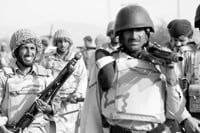 has been launched in Bajaur and South Waziristan tribal agencies and Swat
district in yet another bid to defeat the Taliban militants and reassert
the government's writ.
has been launched in Bajaur and South Waziristan tribal agencies and Swat
district in yet another bid to defeat the Taliban militants and reassert
the government's writ.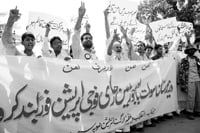 particularly in urban centres. Then the members of the law-enforcement
agencies, particularly the police, became a target for the militants. And
now politicians from the ruling parties, whether it was the PML-Q or PPP-Sherpao
prior to the Feb 18 general elections or the ANP and PPP after the polls,
are at the receiving end of the growing threat from Pakistani Taliban and
assorted extremist groups.
particularly in urban centres. Then the members of the law-enforcement
agencies, particularly the police, became a target for the militants. And
now politicians from the ruling parties, whether it was the PML-Q or PPP-Sherpao
prior to the Feb 18 general elections or the ANP and PPP after the polls,
are at the receiving end of the growing threat from Pakistani Taliban and
assorted extremist groups.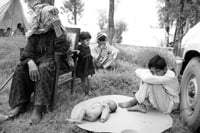 bombing and artillery shelling and also after the biggest displacement of
people has taken place in the history of Pakistan.
bombing and artillery shelling and also after the biggest displacement of
people has taken place in the history of Pakistan.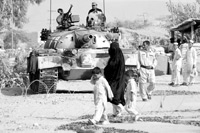 common public is to join the cops patroling the city streets to pre-empt
any terrorist attacks on their lives and properties.
common public is to join the cops patroling the city streets to pre-empt
any terrorist attacks on their lives and properties.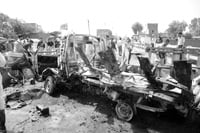 in other parts of the province as well as the bordering tribal belt to
rise against the militants, form volunteer squads (lashkars) and hold
jirgas. This was something which the common people couldn't think of
before -- out of fear of the Taliban.
in other parts of the province as well as the bordering tribal belt to
rise against the militants, form volunteer squads (lashkars) and hold
jirgas. This was something which the common people couldn't think of
before -- out of fear of the Taliban.