


|
|
|
|
|
 |
 |
   |
comment Voice
of the workers diplomacy Faulty
perception life Quest
for a more equal world crisis Pakistan's
missed opportunity By Dr Noman Ahmed The cold-blooded murder of politician, activist, and intellectual, Habib Jalib Baloch last month sent shockwaves in Balochistan and the rest of the country. Noted for his principles and viewpoints on issues of public interest, the political scene is shaky after Habib Jalib Baloch.
Need to dig deeper One of the major problems that we in Pakistan have to confront is the lack of incisive analysis of our social structures and conflicts By Aasim Sajjad Akhtar The banter about Pakistan being a failed state refuses to go away. The country's biggest city is once again up in flames, large parts of all four provinces are submerged in floodwater, and political stability remains as elusive as ever. It is hardly surprising that pundits all over the globe continue to insist that our now 63-year old experiment with Muslim nationalism has failed. The failed state thesis suits the establishment. It
allows hawks to spew out incessant rhetoric about the evil designs of
'Pakistan-haters' and thereby call for consolidation of the coercive
apparatus of the state in the name of saving the country. The perverse
result is a complete refusal to address the real social, political,
economic and cultural crises that afflict us and the reinforcement of the
ideology of national security and the power of those who claim to defend
us. In truth, the existence of Pakistan has only ever been threatened by our own rulers. The secession of East Pakistan was not a grand conspiracy hatched by foreign powers but the culmination of the west Pakistani establishment's refusal to share power and economic resources and accept that Pakistan is a multi-national state with diverse cultural inheritances. Karachi's descent into ethnic strife, the spread of jihadi militancy, and the rapid unraveling of the state's service delivery apparatus, all phenomena aided and abetted by international powers, are nevertheless first and foremost the doing of our establishment. In this way, Pakistan shares a great deal with the other post-colonial countries that have been branded 'failed states'. Most of our fellow travelers are African, but there are also others closer to home, including Burma. The people that inhabit these societies, including ours, are not dysfunctional by nature, but parochial conflicts of various kinds have increased exponentially over time in large part because of the machinations of the ruling class and imperialist patrons. I have written on these pages many times in the past that this imposed dysfunction can be traced in the first instance to the technologies of colonial rule, and specifically to the colonial state's politicisation of identities such as ethnicity, religion, clan, caste and the like. Crucially, most so-called 'failed' post-colonial states have not attempted to -- and perhaps are not even capable of -- undoing this legacy and moving beyond it. Imperialism is, of course, hardly blameless. Much of the internecine conflict in Africa, for example, is explained in part by the ruthless profiteering of multinational mineral and bullion mining companies. In the 19th century, Africa was steamrolled by European conquerors competing with one another for access to the continent's riches; formal colonialism may now be in the past but capital's insatiable appetite to expand its horizons regardless of the social and ecological costs remains unchanged. It is not simply a case of business as usual. There is a new imperialist economic power in Africa. Its name is China. The Chinese government's investment arms have put more money into Africa than any other international power in recent years, not for the benefit of ordinary Africans, but to augment its own economic agenda. China's particular focus is oil, but China will soon be the biggest trader in the continent and the biggest investor in infrastructure projects. The change in imperialist patron notwithstanding, most African countries will not shed the 'failed state' label anytime soon. Thankfully, there is a silver lining. Contemporary Venezuela and Bolivia prove that destructive colonial legacies can be addressed -- in these two Latin American countries race has been the major political faultline -- whilst imperialist conspiracies can also be repelled, if the requisite political will exists. This is not to suggest that social conflict is a thing of the past; there is arguably more conflict along class lines in Venezuela and Bolivia today than ever before. But in contrast to the parochial conflict that is widespread in contexts such as ours, the struggles taking place in at least some Latin American countries are progressive and productive. Closer to home in Nepal a thunderous revolutionary upheaval produced hope that a new democratic order could be fashioned after the fall of an obsolete kingship. High hopes have been dampened by the machinations of foreign powers and ruling class reaction but there is nevertheless here is another example of people's will defying the odds and avoiding the fate of the proverbial 'failed state'. The fact of the matter is that so-called 'failed states' do not disappear. With time their dysfunction becomes more pronounced and the manipulation of external powers becomes more suffocating. In principle institutional structures of modern states can disintegrate in the face of various crises but societies are much more complex and both precede the modern state and will persist even when any particular state is no longer on the map. One of the major problems that we in Pakistan have to confront is the lack of incisive analysis of our social structures, conflicts and how structures and agencies have been transformed over time. Next door in India much more dynamic analysis and theorising has helped to make the political process robust, even if the Indian state is, in most matters, as draconian as its Pakistani counterpart. Too much writing on Pakistan and other so-called 'failed states' remains mired within this tired narrative thus reinforcing structural violence and exacerbating parochial conflict. At times like these it is understandable that attention is being called to the state's absolute failure to deal with the floods, or with Karachi's complete breakdown. But these are symptoms of deeper phenomena which need much more serious investigation than we have attempted to undertake to date. It is instructive that many Pakistanis think of Africa in superficial terms like others think of us. We know nothing about Africa (which is partly why we talk of a whole continent rather than referring to constituent parts) yet we venture explanations about its problems, many of them ahistorical and some downright racist. And then we complain about the David Camerons of the world (racist and uninformed he may be)?
Voice of the workers It is encouraging to see Faisalabad workers moving away from the paralysis of the system and attempting to carve out their own politics By Ammar Ali Jan On the 20th of July, the industrial city of Faisalabad
came to a halt as a result of clashes between workers from the power loom
industry and security forces. What can arguably be termed as the largest
and most militant strike in a Pakistani city in recent times, this
confrontation between the state apparatus and workers not only raises
questions on the indiscriminate use of force by the government, but the
details of this episode also demonstrate the huge gap that exists between
the country's official labour policy and its proper implementation. For the past two years, the power loom workers in Faisalabad have organised themselves under the banner of the Labour Qaumi Movement (LQM) and have often protested for an increase in minimum wage and for its implementation. This year, the LQM had been in touch with the Labour Department for a package for workers in the private sector similar to the one delivered to public sector employees. The June budget brought disappointment as it failed to offer any substantial wage increase to these workers which prompted the LQM to announce a strike on the 6th of July. "When we threatened a strike, the DCO and the labour department assured us that the government is about to announce a 17 percent increase for the power loom workers," says Mian Qayyum, Chairman of the LQM and chief negotiator on behalf of power loom workers. "We called off the strike and gave them a deadline till the 19th, but we knew that we must prepare for a struggle as they will never accept our demands that easily." On the 17th of July, the LQM was informed that all secretaries had signed the package for a wage increase, but that the Chief Minister is yet to sign it. This was enough to convince the LQM leadership that the government was using delaying tactics and that they should go ahead with their planned strike on the 20th. Rana Tahir, district president of LQM, is of the opinion that it was almost impossible to ensure that government policy is implemented and it is this recognition that forced the LQM to call off the negotiations. "There is no other way to enforce government policy regarding the working class, except through agitation" observes Rana Tahir. "It is frustrating that we must first strive for policy change, and then must also be vigilant to ensure its implementation. But then we always knew there was no easy way out," he adds. The LQM announced a complete strike for the 20th of July and the response was overwhelming as almost 200,000 workers went on strike. The context for this massive success is important to mention. The workforce for the power loom industry now compromises mostly of the youth that is particularly disgruntled at the existing state of affairs. Many belong to an agrarian background and are dealing with the classic process of industrialisation and the consequent catastrophic uprooting of rural life. Further, the price hike and general discontent against the political elite has added more fuel to the fire. Last, the presence of an effective organisation such as the LQM has helped to channel this anger towards the construction of a movement. The plan of the striking workers was to take out rallies from all over the city and converge at the district council. The government, however, had a different view of the situation as it was ready to match the power of the street with the power of the state. It is important to keep in mind that two Christians had been killed in Faisalabad on charges of blasphemy and the government cited that issue to impose Section 144 in the city. Also, the government called police re-enforcements from all over Punjab to quell any protests on the day and warned the LQM leadership of dire consequences if they took out a rally. Farooq Tariq, a noted social activist and spokesperson for the Labour Party Pakistan, believes that the government was using the deaths of two Christians to place pressure on the power loom workers to call off their strike. "The police failed to provide any protection to the two accused Christians when they were being threatened by religious extremists but when the workers decided to strike, the Punjab government was able to mobilise over hundreds of policemen from across the province in order to prevent the march," claims Farooq. On the first day of the strike, as rallies started moving towards the district council, the police resorted to the only language it knows: that of brute force. After making some initial arrests, the police started firing tear-gas shells at the protestors. The workers retaliated by pelting stones at the police and on occasions, threw back the tear-gas shells. Soon, the whole city became a site of an epic battle, with over a thousand tear-gas shells fired against a hundred thousand protestors who were now beginning to turn violent. Eventually, the rangers had to be called in to maintain law and order. As the government refused to submit to the demands of the protestors, the LQM announced an indefinite strike until their demands were met. "We realised that the workers were united and that we must maintain our unity and continue to push the government against all odds," says Rana Tahir, who was badly injured by the police and goons belonging to the factory owners. For the next eight days, the organisation took out rallies within different localities to demonstrate their strength to the authorities. Finally, on the 29th of July, workers staged a sit-in in front of the District Commissioner's officer and after a five hour wait in monsoon rains, they were given the good news that all their demands had been met. Since then, jubilation and a sense of victory are visible amongst those who took part in this historic struggle. This episode demonstrates that there is a grave crisis of credibility for the Pakistani state as assurances by the government were outrightly dismissed by the protesting workers. Second, it is unfortunate that the state has failed to give the feeling of citizenship to the common man as even complete legit tasks can only overcome the bureaucracy either through influential contacts or through mass agitation. Last, it is encouraging to see a self-organisation of workers who have been able to move away from the paralysis of the system and are attempting to carve out their own politics for the future. Activists from the LQM are particularly disappointed at the PPP, the traditional party of the working class, for failing to even raise its voice in solidarity with the workers engaged in this battle. The victory of the LQM has already inspired similar strikes amongst power loom workers in Jhang, Gojra, and Toba Tek Singh who are now demanding a similar package. One hopes that this uprising in Faisalabad will help to bring back the notions of an emancipatory politics that was once able to move millions of people around the world as the LQM now plans to take their struggle into elections. Another hope is, of course, that the Pakistani state will give up its obsession with maintaining "order" and will try to be more creative in dealing with political and socio-economic issues that it faces. But maybe that is asking for a little too much
diplomacy Options for Pakistan President Zardari did the right thing by deciding to visit the UK as planned By Hussain H. Zaidi Ours is an era of economic diplomacy in which a country's position in the comity of nations is primarily determined by its economic and commercial strength and by and large economics takes precedence over politics in shaping inter-state relations. Hence, developing and sustaining a sound economy and securing and protecting economic interests abroad are the priority of governments' internal and external policies respectively. This explains why there is so much emphasis on forming blocs and concluding agreements for economic integration and promoting trade and investment. It is in this context that the recent visit of British
Prime Minister David Cameron to India, which has drawn attention more for
what he said than what he did, should be seen. The avowed purpose of the
visit was to boost bilateral trade and create jobs in the United Kingdom
(UK). Hence, Mr Cameron was accompanied by what has been officially
described as "the largest UK trade delegation in living memory".
The visit, however, was overshadowed by the manner in which Mr Cameron
flattered Indian leadership, which also prompted him to make some
indiscreet remarks about Pakistan's alleged involvement in cross-border
terrorism. At the beginning of his tour, the British premier declared that he wanted to make his country the "partner of choice" for India. Referring to Pakistan, he said, "We cannot tolerate in any sense the idea that this country (Pakistan) is allowed to look both ways and is able, in any way, to promote the export of terror whether to India, whether to Afghanistan, or to anywhere else in the world." These remarks, which were made in the wake of leaking of official US documents accusing Pakistan's spy agencies of abetting the Taliban, drew sharp criticism both inside and outside the UK. David Miliband, British shadow foreign secretary and a leader of the Labour Party, advised his prime minister to be more circumspect in what he says about foreign countries. Pakistan's high commissioner in London maintained that Mr Cameron was unfair in his remarks for his failure to consider Pakistan's role in the war against terror and the immense sacrifices that its government and people have rendered. The remarks of the British prime minister, which hardly befit his high office, cannot be termed simply a slip of the tongue as subsequently he has defended them on more than one occasion, which means that he actually meant what he said. Coming back to economics, the UK is an important trading and investment partner of both India and Pakistan. Based on data for the year 2008, the UK-India bilateral trade is $15.43 billion, including $7.85 billion exports from India and $7.58 billion exports from the UK. While the share of India in the UK's global exports is 1.67 percent that of the UK in India's global exports is 4.31 percent. The UK accounts for 2.40 percent of India's global imports, while India accounts for 1.24 percent of the UK's global imports. The UK, a member of the European Union, is negotiating a free trade agreement (FTA) with India. The India-EU FTA when it is finalised and comes into effect will result in duty-free trade between the UK and India covering most of the traded products and thus significantly push up the bilateral trade. The UK is also an important source of foreign financing for India. It is the fourth largest foreign direct investor in India. During last one decade, British firms have made $6 billion investment in India. Pakistan-UK trade reached $1.94 billion in 2008, including $1.09 billion exports from Pakistan and $853 million exports from the UK. The share of Pakistan in the UK's global exports is only 0.19 percent, while that of the UK in Pakistan's global exports is 5.44 percent. The UK accounts for 2.01 percent of Pakistan's global imports, while Pakistan accounts for 0.17 percent of the UK's global imports. The UK is the second largest investor in Pakistan. During 2009-10, UK firms made $297 million investment in Pakistan, about 14 percent of the total $2.20 billion FDI inflows into the country. The above figures show that for the UK, India is a much more important trade and investment partner than Pakistan. Moreover, India is the world's second largest market and one of the fastest-growing economies on which investors across the globe are eying. With the UK, like most other developed countries, facing economic crunch and having to significantly reduce fiscal deficit, the conservative-liberal democrat coalition is desperately looking to countries like India to create jobs through greater market access for their exporters and businesses. India has a rather restrictive foreign trade and investment regime and during his visit Mr Cameron requested Indian leadership to open up their financial, defence manufacturing and legal services to British businesses. It was announced that the UK would export civil nuclear technology to India despite previous opposition to such a move for the reason that India is not yet a signatory to the Non Proliferation Treaty (NPT). The British government believes that the decision would contribute to enhanced economic cooperation with New Delhi as well as sharing of technical know-how. A 700 pounds agreement between British Defence Group BAE Systems and engine manufacturers Rolls-Royce and India's Hindustan Aeronautics provides for supply of fifty-seven Hawk jets to the latter, which will be used to train Indian air force. The agreement is expected to create some two hundred jobs in the UK. Annoyed at 'anti-Pakistan' remarks of Mr Cameron, a section of Pakistan society, including some key politicians and analysts advised President Zardari to cancel his visit to the UK. However, Mr Zardari did the right thing by deciding to visit the UK as planned. For one thing, the cancellation of the visit would not have served any purpose. Instead, the visit can provide an opportunity for Pakistan to counter allegations regarding its role in the war against terror. In addition, Pakistan needs greater market access for its exports in the EU -- which accounts for more than a quarter of the country's total exports -- and the UK being an important member of the EU can play an important role in this regard. Email: hussainhzaidi@gmail.com
A comparison between the domain of the Khudai Khidmatgari and the compass of the present generation of Pakhtuns By Rafi Ullah Pakhtuns have been variously perceived by the world
outside according to its respective interaction and worldview. On their
part, Pakhtuns have their own perceptions about themselves, in effect,
changing with the turn of every epoch. Some fundamental developments of
Pakhtuns' history reflect the power of their perceptions; while at certain
times faults in their perceptions seem to have put them on wrong way. In
this perspective, Pakhtuns have either made progress or fallen behind in
development and maturity. I will build my argument around a comparison between the domain of the Khudai Khidmatgari and the compass of the present/new generation of Pakhtuns. Let me make it clear that by the domain of the Khudai Khidmatgari I mean an "Age" rather than political affiliation with Abdul Ghaffar Khan, his Khudai Khidmatgar movement or his political successors. This age represents advancement in social, political and intellectual spheres of life of Pakhtun society. The present generation is to be categorised into two parts -- those who have seen the twilight of the age of the Khudai Khidmatgari and those who have grown up in a totally different social and cultural context. The domain of the Khudai Khidmatgari is rich enough, as compared to the compass of the present generation, in the field of creativity, innovation, idealism in politics, culture and literature. And this was due largely to the power of perception, empiricism, and rationality that this age has acquired so unique a position in Pakhtun history. The great perception of the cohort of this age was based on its wisdom which in turn was structured by seeing everything "in perspective and in relation to everything else." The people of this age were not driven by mere emotions and sensationalism. Their great perception gave them great thinking and this thinking introduced great ideas and concepts into Pakhtun politics, culture and literature. The greatest development in Pakhtun politics of this age was the success of Abdul Ghaffar Khan's philosophy of non-violence. The phenomenon of non-violence nullified the stereotypes about Pakhtun as being wild, barbarian, bigot and war-monger. Similarly, this age ushered in a new era in Pakhto language and literature. The monthly Pakhtun magazine, launched by Abdul Ghaffar Khan in 1928, contributed much to the social, political and moral consciousness of the people. Women writers also contributed their writings to the magazine and highlighted the rights of and issues faced by Pakhtun women folk. Pakhtuns of the domain of the Khudai Khidmatgari came out of tribal and geographical shell which had kept them so far unaware and indifferent to the world beyond their own universe. Now Pakhtuns, especially Pakhtun writers, found themselves connected to their fellow human beings who were equally subjected to imperialist exploitation and aggression. Pakhto language and literature reached its zenith during this age by internalising new trends. If Amir Hamza Shinwari's sufic poetry was perfection itself, Ghani Khan's poetical works were steeped in eclecticism. Progressive ideas were welcomed and people like Ajmal Khattak, Mian Akbar Shah and Rahmat Shah Sail are considered as real paragons in this regard. Pakhto music and film industry got maturity during this age. Kishwar Sultan, Ahmad Khan, Khyal Muhammad, Sardar Ali Takkar made great services to Pakhto music. High quality Pakhto films were produced and presented which covered rich themes such as social issues and Pakhtun history. Films such as Yusuf Khan Sher Bano, Ajab Khan, Darra Khyber, Khana Badosh and Adam Khan Durkhanai can be equated with Indian classic films both in performance and content. In the field of Pakhto drama the legendary figures of Pakhto literature i.e. Amir Hamza Shinwari, Abdul Akbar Khan Akbar, Dr. M. Azam Azam, Prof. Afzal Raza, Nurul Bashar Navid and likes proved their extraordinary creativity, ingenuity and power of imagination, reflecting their deep familiarity with Pakhtun culture, history and society. This was a brief portrayal of a bygone era. A change rather too off-putting has occurred now in Pakhtun land. Since the representatives of the domain of the Khudai Khidmatgari could not withstand the perpetrators and legacies of Cold War, brand new patterns in religious, social, cultural and political spheres of life have cropped up. Faulty perceptions and ideas, thus, began to penetrate and override the new generation of Pakhtuns. And all this resulted in multiple deficiencies -- arrogance, unscrupulousness, emotions, illusory ideas and concepts, superficial viewpoint and abysmal contentment -- in our new generation. All these have crept up on the perception of the present Pakhtun generation. Defective perception is causing flaws in the thinking of our new generation and it is "seeing only part of the situation, bringing along an inadequate frame and using emotional selection of information, etc", as Edward de Bono would observe about faulty perception. This has virtually impinged on its creative potentials. The result is the extreme inability of Pakhtuns to have a prudent response to the crisis they have been facing. In contrast, when Abdul Ghaffar Khan and the Khudai Khidmatgars took a "helicopter-view" of the prevailing situation they responded to the challenge in a sensible and cautious way. The super-patterns set up by the Khudai Khidmatgars -- social consciousness, non-violence, services to language and literature and culture -- were the ethos of the age of the Khudai Khidmatgari. All the reactions and responses of Pakhtuns of this age to the pre- and post 1947 developments were in accord with such a schema. And hence progress in social, cultural, political and religious spheres of life. Things changed for the worse due to many reasons. The stigma of Communism attached to the Khudai Khidmatgars, curricula of educational institutions in Pakistan, the Saur (April) Revolution (1978) in Afghanistan and the Soviet forces' entry into that country, propaganda and counter-propaganda during the Afghan jihad and the subsequent unfortunate happenings gradually put an end to the domain of the Khudai Khidmatgari. With the demise of this age, Pakhtuns lost creativity and ingenuity, power of imagination, artistic and cultural sensibility and their super-patterns. To put it in another way, they lost the great perception of the domain of the Khudai Khidmatgari. Pakhtuns seem no more receptive to new trends and ideas. There are palpable stases in their politics, culture, art and literature and society. All this is caused by the abysmal contentment of the new generation which lulls it into a false sense of progress and maturity. The present mayhem and anarchic situation in Pakhtun land will last unless and until a corrective, by reviving the spirit of the bygone age, is put to the faulty perception and defective thinking. Email: rafi_ula@yahoo.com
Economy of Swat tourism Most of the 900 hotels in Swat were either looted or destroyed and various tourism-dependent sectors heavily suffered. By Tahir Ali With Swat, the Switzerland of Pakistan, gradually
returning to normalcy, can one hope that the badly-damaged tourism
industry there will reach its pinnacle? Though officials assert that the
peace festival coordinated by the provincial reconstruction,
rehabilitation and settlement authority, Pakistan army and the local
tourism industry has somehow revived the industry, much still needs to be
done. The revival of tourism in Swat is vital to defeat terrorism and extremism but it requires several steps on part of the government. "Increased budgetary allocation, enough share in foreign funds meant for the area and a full-pledged continuous advertisement campaign on print and electronic media are urgently needed besides tourist information centres at several places," argues Zahid Khan, President all Swat Hotel Association (ASHA). "For the revival of tourism, community involvement in the security of tourists and development of communication infrastructure will have to be ensured. Malamjabba ski resort has got to be re-opened. Road to the beautiful Gabinajabba near Kabal should also be developed. Archaeological sites should be protected and developed, and Buddhist and Hindu festivals can be arranged," says Khan. "There is no communication and no mobile service and no TV transmission in some upper parts of Swat. Roads are difficult to travel on. Paithom, KP's only tourism training institute, and the PTDC hotel in Kalam is still used by security forces. How can one hope of a hundred percent revival of tourism industry in this backdrop," Khan adds. The landscape of Swat is suitable for adventure tourism, eco-tourism, culture/heritage tourism, spiritual tourism, sports tourism, commercial tourism, etc, but the potential needs to be utilised. "Swat has over 400 Buddhist sites in Swat Valley only. There are 14 beautiful mostly unknown lakes in the valley. It's both ideal for summer and winter tourism. There is much to enjoy now but we need official patronage," Khan says, adding, "We want the world to know that the people of Swat are friendly and good-natured people. They have nothing to do with militancy and terrorism. They are supporting the government against militants. Swat is now even more secure for travelers than it has been," he says. According to Adnan Khan, media coordinator for Provincial Disaster Management Authority (PDMA), the festival was a big step towards the revival of tourism sector. Latif Bhatti, a Gujrat-based tourist, says the mela at the grassy ground bore symbolic significance. "It was the same ground where militants in April 2009 had challenged the state. Thanks to Pak Army, it is now a place where youngsters dance to the beat of drums. The flocking local females, youngsters, elders and children send positive signals about Swat and Khyber Pakhtunkhwa." Around three million tourists came to Swat during the festival. "Though the number was much less than that of the good old days, it was anyhow encouraging. We are happy over the massive response. There was so much jubilation that even the suicide attack in Mingora amidst the festival could not deter or frighten tourists," Khan says, adding, "The middle class was conspicuous by its absence. Perhaps they were either unaware of the festival for lack of sufficient advertisements about it and did not turn up due to financial crunch. " He accuses the provincial and federal governments as well as Pakistan Tourism Development Corporation (PTDC) and Sarhad Tourism Corporation (STC) for being disinterested in the revival of tourism in the region. "Neither of them had funded special advertisement campaign for the festival. Only the PaRRSA issued advertisement for us. Nothing was done by anyone else. Provincial ministers did come here but they only attended and addressed functions with no practical help," he complains. A thorough study of the Malakand related plans reveals that the sector has been altogether neglected and no allocations have been made for it. The sector has been allocated Rs0.67b or 0.9 percent of Annual Development Programme in the Khyber Pakhtunkhwa's budget this year. As far as the federal sector development programme (PSDP) this year, the sector has been allocated just Rs0.125bn (or 0.018 percent) in the total PSDP of Rs663bn. There is no mega Swat-specific project in the local and foreign components of both the ADP and PSDP either. Syed Aaqil Shah, provincial minister for culture and tourism, says the KP government under is fully committed to development and revival of tourism in the region, "The Chief Minister visited Kalam last month and announced a hefty package for the area. In coming months, you will see concerted efforts to revive tourism in Swat and other areas." "Swat and KP have vast Buddhist archeological sites and the government is mulling a special package for the people of Japan, Thailand, Sri Lanka to visit these sites," adds Shah. Tourism in Pakistan has been badly affected by instability, indifference of government, militancy, poverty and price-hike. The number of foreign tourists reached upto 0.9 million in 2006 but their number came down to 0.84mn in 2007 and to 0.82mn in 2008. Most of the 900 hotels in Swat were either looted or destroyed and various tourism-dependent sectors heavily suffered. The tourism industry lost over U$400 million in Swat alone and around Rs8bn of it, according to Zahid Khan, was directly lost by the hoteliers. "But no compensation has been given as yet. If the government can't compensate us for the entire losses, it should provide us fifty percent compensation and interest free loans so that we can repair and redecorate hotels," adds Khan. Shah says losses would duly be compensated soon if funds promised by the federal government and foreign countries become available. Rehmat Din Siddiqui, general secretary of Kalam Hotel Association, says the government should develop a ski resort at Bishay Kalam and should arrange a chairlift facility there. "Also, the government can construct an international sports stadium and an international wildlife park near Kalam Bazar," he says. Secretary tourism KP and Managing Director STC were not available for comment. The proposed new National Tourism Policy intends to provide compensation to the Swat hotel industry for the losses they suffered between the year 2007 and 2009. Saleem Abbas, a private tour operator, says the public and private sectors must join hands to revive the Swat tourism industry.
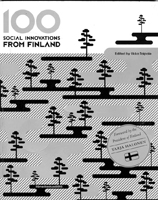
By Naila Hussain 100 Social Innovations from Finland Publication: Hakapaino, Helsinki 2007 Edited by Ilkka Taipale Pages: 192 The foreword of a "100 Social Innovations from Finland" has been written by the President of Finland, Tarja Halonin and is edited by IIkka Taipale. The book covers a range of issues from the provision of basic necessities to practical and efficient measures for improvements in the way society works and intellectual pursuits. Primarily, these are relevant to Finnish Society but many have the potential to significantly improve the quality of life in any society. With most of these innovations a certain pattern appears to be the norm: people at the helm of affairs observe a problem and with the help of experts, members of civil society, academics, doctors, scientists and others -- resolve the issues. This practice has been in effect since the 60's and has since been enhanced and become much more efficient. For Pakistan, there are definitely lessons to be learnt here. Especially, in the current scenario when repercussions are felt throughout the country due to a weak governance, militancy and a difficult economic situation. These innovations lay huge emphasis on the youth, education, recreational activities, libraries, and music. Had we taken just a few of these seriously and spent some part of GDP a little creatively, perhaps this void which has encouraged militancy both out of desperation and ignorance would not have been created. The sections in the book comprise administration, social policy, health, culture, regional issues, civil society, recreation and hi-tech. It's not easy to talk about a few of these innovations given such a large number but there are a few which have more relevance for Pakistan. The country has found that a major route to empowering women is by getting them politically engaged and in positions of decision-making. In its "single chamber parliament" Finnish women have achieved top positions in politics. The first female president and speaker of Parliament was elected in 2000 and the Prime Minister was elected in 2003. There's no dearth of women in business either. Through "Municipal self governance", Finland manages to collect municipal tax amounting to 13 billion euros. Corporate income tax amounts to over 1 billion euros. This becomes possible as municipalities have a very wide tax base. Furthermore, the state is mindful of any disparities in municipal incomes and seeks to even out any disparities if they exist. It also ensures equal access to proper basic facilities regardless of the size or locality of the municipality. A number of factors contribute towards "No corruption" and these include transparent government and an effective judicial system. The police force has a well defined structure and the media is extremely vigilant and keeps a check on how power is exercised and is also protective towards freedom of speech. Under "Social housing" the system enables middle class and also lower income workers to buy a home and as a result the proportion of owner-occupied houses has risen to 70 percent. The absence of slums has to do with general economic development including small income differences compared to other countries. A highly developed Nordic welfare state and a relatively small proportion of immigrants are also an important factor. "Student grants" guarantees every one's right to study and get a profession. It takes up 2 percent of the gross national product and in turn ensures a high quality education, an equal educational system and an educated labour force. Student accommodation is well organized and so not surprisingly, Finland is considered the most popular student exchange country in Europe. A lot of credit goes to the student housing organizations who arrange visitors' accommodation. "Child home care allowance" was at its highest in the beginning o f the 1990's when it was granted to 150,000 families but due to economic depression it was cut back by 20 percent. A pre requisite for the "Maternity pack" is that the mother should visit the clinic before the fourth month of pregnancy. This has worked out really well as almost all pregnant women register with health care services. Consequently, there has been a dramatic decrease in infant and maternal mortality rates since 1950s -- bringing Finland to the top three countries in the world in this regard. The idea of "A free warm school meal" is considered crucial to learning and well being. These were initiated as early as 1896 and the state subsidized them since 1913. It started as an incentive to learn Latin and the government also understood the importance of school meals assisting in enhancing the learning capacity. In the present time some 900,000 children enjoy these meals. The Finnish people have been very successful in combating poverty by maintaining a high level of employment and have also managed to prevent the risk of people left with inadequate resources. This, along with the taxation policies, have successfully reduced the income differentials among the people. "Halving the number of road deaths" has come about by taking a number of measures: General speed limits were introduced. It became compulsory to wear a seat belt, 600 km of cycle paths were constructed in urban areas. And an effort was made to break up different kind of traffic into separate lanes. The government's attitude has become focused on reforming the traffic environment rather than focusing on just the attitude of the people and the condition of the vehicle. The following innovations are in a creative vein and also very important. "The Finnish Literature Society" has over time changed from being a nation builder to a scholarly repository of memories. During 175 years of existence it has enhanced Finnish self understanding, promoted literature and has a significant number of publications to its credit. Finnish Libraries serve a multifaceted purpose and their functions range from lending books, music, videos, offering access to computers to analyzing information. Furthermore, they organise story telling circles, art exhibitions and film presentations. Given that each municipality has a library, a huge number of people benefit from this facility. "Music Schools" not only produce professionals but more importantly. "The ability to participate in art education and artistic life is seen as a fundamental right and a way to promote creativity and boost self esteem." At present over 60,000 children and adolescents study music which is subsidized by the state to the tune of 47 million euros. The storycrafting method "was developed by a Finnish psychologist Monika Riihela while working with school children in 1980's. Riihela tried to channel children's interest to something specific such as questions and tasks and concentrated on what kind of issues they brought up during discussions. It entails writing, reading the written story and the narrator having the opportunity for corrections. This method is based on the premise that regardless of age, gender, cultural background, or the degree of education, we all have something to say. And therefore, people end up establishing new levels of bonding by using this method. The advantage also being that it "halts the rush and assists in concentrating on the essential" which includes words and silent messages. The effectiveness of the method relates to the fact that for some time the narrator and the recorder engage in an encounter on the same "wave length" like the ancient oral history narrators. The stream of narration freely floats "in the borders of dreams and realities". The process is free of judgements and therefore, this method gives an opportunity for the narrator to reflect on his or her experiences and thoughts with their own words. Not surprisingly, this method has had a huge impact internationally as well. A good example being an on going exchange between children in Finland, Palestinian children in Lebanon, children in Kirkuk and Sri Lanka. Within Finland it benefits hospitals, old peoples' homes, children, maternity clinics and so on. "Unionisation" figures quite conspicuously in society. Labour market relations have a strong position within the European Union. And further more, the position of labour market organisations is also recognized in the draft of the EU constitution. The "Common responsibility campaign" raises funds for aid and assists those in distress and also seeks to help those beyond Finland. Since 1963 the aid has gone to widows, refugees, abandoned children, mothers with alcohol and drug problems, intellectually disabled, deeply indebted, those with mental health issues and so on. Apart from this ethical education, the campaign also tries to influence politicians and policies.
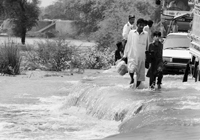
From zero again The economic revival of Khyber Pakhtunkhwa is going to be painstakingly slow By Raza Khan While the number of lives claimed by recent floods has set new records in Khyber-Pakhtunhwa the economic losses in the province are simply unprecedented. It is primarily the economic losses which made Chief Minister Haider Hoti say, "Floods have pushed Khyber-Pakhtunkhwa 50 years back". Although there cannot be exact figures regarding the
destruction in Khyber Pakhtunkhwa at this point in time but empirical
evidence shows the losses are definitely in the range of 12-15 billion
dollars. According to the figures of National Disaster Management
Authority (NDMA) and Khyber-Pakhtunkhwa government, the number of damaged
houses is 155293. Obviously, this is not a final figure as is admitted by the KP Information Minister, Mian Iftikhar, and as time progresses thousands of other damaged or vanished houses would be discovered. The damage of each house cannot be less then Rs100000 if it is a modestly constructed house. Whereas, on average, the loss of each household is definitely Rs0.5 million, thus the total loss in terms of damage to houses is Rs77 billion. It is expected that this figure would have a substantial increase and would definitely reach Rs120 billion amounting to almost one and a half billion dollars. Apart from losses to houses infrastructural damages due to floods in Khyber-Pakhtunkhwa are huge. According to the provincial information minister, 200 roads, 92 bridges, 85 educational institutions, 32 health facilities, 257 water schemes and 11 important government buildings have also been destroyed by recent floods. Communication experts are of the view that, on average, one kilometer road, depending on the quality and conditions of construction, costs between Rs8 million to Rs12 million. Keeping this in view, even if 200 destroyed roads mean roughly 1500 kilometers of total length the loss is gigantic. Calculating this one would come to the figure of Rs15 billion. Building bridges requires more money than constructing roads. So, one can easily estimate the destruction of 92 bridges in terms of finance. It may be remembered that these bridges include the critically important and costly bridges of Chakdarra-Batkhela, Peshawar-Islamabad Motorway, and Khialay Bridge on Peshawar-Charsadda route. The average cost of a government school could be worked out as Rs10 million which means a total of Rs850 million. For a poor province like KP it is a colossal loss. The destruction of Munda Dam by recent floods in KP would cost the province dearly in economic terms. As the dam is no more, the 150000 acre of land which it used to irrigate would go out of cultivation. Although it is very difficult to exactly calculate the loss statistically but again it is a huge loss not only for the province but also for the country, particularly in times of food scarcity and security issues. Moreover, this would be a recurring loss until water for irrigation is provided to this land from some alternative source. According to the KP government figures, floods have washed away crops on 1,048 acres of land and as its spokesman has stated losses would ultimately be unbearable for the province. Official figures also show that 4582 domestic animals were also swept away by floodwater. This is indeed a very low figure because people in different affected districts tell a completely different story. Therefore, the loss of livestock cannot be quantified at this stage but keeping the accounts of local people and government figures the loss is unprecedented. The loss of crop and livestock means that thousands of families have also lost their source of income. The biggest damage is in the shape of destroyed shops in various districts of the province. No figure of the number of shops and marketplaces destroyed in floods has so far come to the fore. However, according to rough estimates, the number of shops destroyed or damaged is not less than 10,000. Only in Nowshera district, the number exceeds one thousand. More than the shops themselves, the material they had was of real worth. Talking to the owner of an average-sized shop reveals that he carries commodities between Rs5 to Rs10 lakhs at his shop. "I have lost around Rs0.8 million due to rainwater and flood as everything in my shop that mostly included grocery items has been destroyed," says Fazal Khan, a shopkeeper in Sardaryab area of Charsadda. Jan Muhammad, President Fish Market at Sardaryab, says around 300 fish-selling hotels and huts have been swept away by floods, inflicting losses of millions of rupees on the owners. Remember this is one small area of Charsadda district. Merchants have lost billions of rupees in Nowshera's two cloth markets -- the Rung Mahal Plaza and Mian Muzaffar Shah Market -- where 400 to 500 cloth shops were located. "There were some big shops in the market having around Rs15 million of clothes whereas medium and small outlets on average had five to eight million worth of clothes at their shops. There are cloth merchants who have lost their entire business," says Baacha a cloth dealer, who himself lost four million of rupees. Nowshera cloth markets are famous for quality cloth. Everyday, thousands of people from across the country, particularly from Punjab, would throng the markets to purchase cloth. That would include wholesale dealers. The destruction of shops in Nowshera is not only limited to cloth shops. Janat Gul, a co-owner of Akas Digital Lab, says he and his family have lost Rs10 million worth of digital photo printing machines as floodwater has left it irreparable. The economic rehabilitation process, if and when there is one, is going to be painstakingly slow because most of the people cannot construct their property and cultivate their lands anew in a short time. If the provincial and federal governments do not take quick action the situation would go from bad to worst. The damage caused by floods in KP will have far-reaching consequences as the province is one of the poorest parts of Pakistan and the region where official poverty incidence is more than 70 percent. In other words, seven out of ten persons in KP earns less than two US dollars or Rs170 per day. The writer is a political-economy analyst: razapkhan@yahoo.com
Pakistan's missed opportunity World's biggest expo, a stall next to the popular host but a lack-luster performance By Syed Waqas Ali Kausar The most dynamic city in the world's fastest changing nation, Shanghai is an exhilarating, ever-morphing metropolis that isn't just living China's dream, but is setting the pace for the rest of the world. The writer was honoured to be part of a 40-member delegation sponsored by Confucius Institute NUML. They traveled China extensively, including the most impressive World Expo held in Shanghai under the banner "Better city Better life". The goal of World expo 2010 Shanghai was to attract the
participation of 200 countries, international organizations and 70 million
visitors. Sub themes of expo included numerous aspects such as, exploring
the prospect of urban life in the future, centered on innovation and
interactions, opportunities for cross-cultural dialogues and cultural
diversities, display of urban civilization to the full extent, probing new
approaches to human habitat, lifestyle and working conditions in the new
century, eco-friendly, sustainable development, scientific and
technological innovation. When I managed to enter into the premises of expo, I could not take my eyes away from the USA pavilion whose design and execution was not only impressive but inspiring as well. Although, I wished to visit USA pavilion first, but I was moved by patriotic feelings, therefore I sat on a bus and with the help of a map reached the Pakistani pavilion. It was situated right next to an all weather friend, China. Its design inspiration came from the Lahore Fort, a UNESCO World heritage site under the banner of "Unity in Diversity". It gave me immense pleasure on seeing a huge influx of visitors covering the zig zag designed gates of the Pak Pavilion, like others, with uniform movement which seemed unending. A huge pair of portraits of our Prime Minister and President, along with a much smaller portrait of the Founder of the Nation and the National poet welcomed us. The inside story was quite different from the outside. Though the culture, tradition, habitat, landscape of Pakistan was displayed up to some extent, there was a constant feeling of paucity and dearth of true, in-depth display and depiction of Pakistan. Pasting huge sceneries and portraits merely suffices the need of such a humongous and the most expensive fair of the world. Though the queue of Pakistan pavilion never ended until I stayed there, but I surely can say it was not due to the splendor of Pak pavilion. Cultural demonstration of the four provinces was hardly given any limelight. It merely included the snaps of old people making glasses from sand, a depiction of an old PTV video of 80s and 90s. I hardly found out the national sport of Pakistan in Pak pavilion. Pakistan is blessed with the sky high Himalayan mountains, salty ranges, sandy deserts, gushing rivers, Arabian Sea and the hub of many civilisations, like Indus Valley Civilisation, Mohenjodharo (along with Harappa) is one of the world's earliest and greatest, flourished contemporaneously with the Egyptian and Mesopotamian empires. Pak Pavilion hardly has an exclusive and in-depth display of its natural blessings. I managed to visit 15 pavilions of the expo, including India, where I found out exemplary display of the culture progress and future of India. I was moved by the 3D presentation of the Indian culture translated in Chinese, where a huge bevy of visitors were keenly and actively watching the manifestations of their diverse culture, economy, technology with pin-drop silence. I was amazed further when I went up stairs and just found out a huge pictorial exhibition of Pak China relation from Ayub Khan to present. This for me was a square peg in a round hole as it was the only Pak Pavilion who had exclusively done this. There is no denial of Pak-China relations and even I may be the greatest admirer of and well-wisher of this friendship but this hardly fits into the expo as it was the demonstration of culture, progress technology, habitat, eco-friendship, tourism and so on. We depicted upstairs as a museum of Sino-Pak relations along with a huge list of Pak women who contributed at the top level, which may be understandable to an extent. Science and technology was also given least importance. I hardly remember any display of scientific progress. On the ground floor there were many stalls displaying and selling traditional woman wears, onyx items, block printed sheets and spreads, carpets, jewelry and many traditional items. Display was hardly impressive to attract the visitors. Moreover the sky-high prices were even quite surprising for the local buyers. Though the business community always hovers around profit and loss, prices should be minimal, to attract people and acquaint them with the culture and traditions of Pakistan on such events. Contrary to Pak pavilion I could see a number of stalls of Indians, selling their local brands under spacious stalls where the unending lines of customers were in queue just to visit and buy typical Indian stuff. Even Bangladeshis, Lankans, and Nepalis were quite at home in marketing their brands whose quality and diversity of stuff was not at par with us. I managed to visit more than 15 pavilions and one of the heartening elements was the warm response of the administrations of the respective countries towards us. It will be unfair to name Sri Lanka, Turkey, Iran, Oman, Qatar, and India as well who has granted VIP permission to us to visit their pavilions. The love of Turkish people towards Pakistan was worth seeing. China the ever-green friend of Pakistan was unbelievable in hospitality, regard and the generous treatment towards all Pakistanis was exemplary and hilarious. Most of the nations projected a futuristic vision through innovative designs and concepts, Pakistan pavilion, a replica of the Lahore Fort under the theme; 'unity in diversity' needs many measures to convey the essence of its theme. I will term it as the golden chance for Pakistan to project its positive image. The expo was held in China, the ever green friend of Pakistan and Pak pavilion received flocks of people as it is situated near the Chinese, the most popular pavilion of World Expo. We needed to highlight the positive image of Pakistan, by displaying culture of Four Provinces, Gilgit Baltistan, and AJK along with promoting civilization and tourism. A big question mark arose when we analyzed the Pak Pavilion with the theme of World expo Shanghai 2010. The writer is a PhD Scholar of Governance and visited China as part of a delegation sponsored by Confucius Institute NUML. He can be reached at waqasalikausar@gmail.com
Till the time Balochistan becomes a home for its inhabitants, it will continue to be a nightmare for those who run the federation By Dr Noman Ahmed The cold-blooded murder of politician, activist, and intellectual, Habib Jalib Baloch last month sent shockwaves in Balochistan and the rest of the country. Noted for his principles and viewpoints on issues of public interest, the political scene is shaky after Habib Jalib Baloch. The spate of recent killings in Balochistan has
targeted noted men. Faiz Mohammad Sasoli, a journalist, was gunned down in
Khuzdar a few weeks ago. Before that, a senior faculty member of
Balochistan University was gunned down in broad daylight. While these
incidents were most tragic, they cannot be termed isolated events. Acts of violence and sabotage have marred Balochistan for more than five years. Use of sophisticated devices and weapons and the continuity of such acts without any break clearly suggest that the situation is more complicated than a conventional law and order problem. The complex links of these events with the Baloch communities and the power structure render the course of events worthy of immediate attention. In some recently published research works, scholars and affiliates of Carnegie Endowment of Peace have raised concerns which are very important and require detailed and objective assessment. They have outlined several core reasons behind the seething unrest and resistance offered by the various factions of the nationalists. The ongoing expropriation of land and resources by other communities and state agencies; marginalisation of mega development projects and plans for the construction of military garrisons in Sui, Kohlu, Awaran, and Gawader are the key concerns. Federal government's intervention and control on the routine developments and administrative affairs of the province; communal and ethnic strife in the prevailing social composition, low status of social and economic development, and use of brute force by the regime are some factors that led to further compounding the situation. The Balochistan imbroglio is now largely internationalised. Events such as the previously imposed ban on Balochistan Liberation Army (BLA), abduction and killing of foreign workers, and targeted assassination have brought greater focus of international community on the Balochistan scenario. Popular perception is that the current handling of Balochistan crises by the establishment is not likely to yield concrete results. The promised autonomy in the form of 18th Amendment and NFC award has to be made a reality without further delay. It is very important that a congruent approach is adopted to develop a sustainable and acceptable solution for this grave saga in the making. Aghaz-e-Huqooq-e-Balochistan seems to have dimmed in the prevailing mayhem. It has been historically observed that whenever the law and order situation intensifies, the government announces vague financial incentives for the development of province. Political circles and other stakeholders normally view such moves of the regime as an attempt to divert public attention from core matters. It is sad to note that provincial government representatives are seldom found on the occasion of a catastrophe. What one finds are only personnel of law enforcement agencies. In order to change perceptions, the regime must display magnanimity by announcing amnesty and ceasefire. Top leaders of all factions, including Balochistan National Movement, Jamhoori Watan Party, Baloch Students Organization, and other groups may also be invited to hold dialogue. All the tribal chiefs and representatives should also be invited in the talks. The objectives of dialogue should be on striking a working relationship between the government, political parties, and tribal chiefs thereby developing a roadmap to stop violence and sabotage through acts of confidence building. This is vital because there are many matters where the provincial government does not possess jurisdiction and authority. This attempt may become ineffective if the establishment does not come forward with an open approach. Release of political detainees and help in locating the missing individuals can be the starting move by the establishment to convince the other side about their sincerity. A climate conducive to development and progress shall have to be fostered without delay. There is a need to appraise various development projects that are announced by the federal government in Balochistan. Be it the extension of highways and railways or the construction of new cantonments, the entire portfolio of development initiatives need a careful examination. While the negotiating parties may hold on to their respective viewpoints, the benefit to the people of Balochistan should be paramount consideration while deciding on the final course of action. Genuine grievances must be addressed on a priority basis. Limited or no accesses to military jobs, few options of employment in the province, and high number of non-residents are serious issues. One must take a cue from the pre partition British regime which gave participatory role to Baloch influentials in administration and developmental works. Unless the Baloch share a sense of ownership in development projects, little cooperation can be expected on their part. The government has been accusing sardars for supporting Balochistan Liberation Army (BLA) and other outfits. It also charges sardars for running ferari camps in different parts of the province. There is no denying the existence of these entities but they are the results of simmering socio-political suffocation in Balochistan. The formation of militants outfits are clear indicators of the fact that certain groups have found themselves alienated from the mainstream political process. Therefore, in order to assert their position, they use respective clout and capacity to pressurise the administration. In the case of the BLA, the approach of pushing it to the wall shall prove enormously dangerous. The past instances of dealing with the National Awami Party by Bhutto regime and liberal dissenters by the Ziaul Haq regime in a high-handed manner turned out to be damaging exercises. The need of the hour is to broker peace and stability by enhancing the mandate of the current provincial government. Members of the ruling coalition must be authorised to strike peace deal with the agitators. Space and time must be allotted without interference for this process to take root. The agenda can be all-encompassing. Most controversial and delicate issues should also be brought up for discussion. The rising number of non-Baloch in the service and property acquisitions, abduction and illegal confinement of notable citizens, and re-visiting constitutional provisions and a process of socio-political reforms may be a starting point. The maintenance of law and order must be evolved through a consultation process. Till the time Balochistan becomes a home for its inhabitants, it will continue to be a nightmare for those who manage the federation. |
|