


|
|
|
|
 |
 |
   |
Editorial khyber pakhtunkhwa By Shahzada Irfan Ahmed Muhammad Mushtaq, 26, a farmer owning 2.5 acres of land in Layyah, is desperate to dispose off his stock of desi (organic) hen at the best possible rates he is offered. The setting is the area adjacent to Kukrwala Bund where he is surrounded by men of different ages and attires. The crowd constitutes onlookers and bidders who are trying to outdo each other and clinch the deal. balochistan sindh "We have spent the past several days on the bund, without sleep or sustenance," Arbab tells TNS. "We need to be on the alert!" punjab By Shahzada Irfan Ahmed In district Layyah, the flood-affected people are reluctant to move. Though the same reluctance was exhibited by people in other flooded parts of the country, the residents of the low-lying areas of Layyah have their reason to hold on to their ground. Being owners of one of the most fertile lands in the country and huge livestock, most of them are not willing to leave their animals and stockpiles of crops lying in barns. "The scale of disaster is much more than
the scale of arrangements" By Shaiq Hussain The News on Sunday: Apart from your organisation, we have other agencies for disaster management such as Federal Flood Commission, Emergency Relief Cell and National Crisis Management Cell etc. However, we don't see any coordination among them on ground? Nadeem Ahmed: All the agencies mentioned by you have a clear mandate and functions to perform. For achieving them, all the organisations have always coordinated with each other before, during and after the floods. During the recent 'Phet' cyclone in Pakistan, the emergency situation on ground was effectively handled through well-coordinated efforts by Pakistan Meteorological Department and civil and military organisations. Identifying the proven methods of flood control By Aziz Omar Floods have been deemed as the deadliest and costliest of all natural disasters. Yet the flood management, prevention and control measures that have been conventionally adopted in many countries have been marked by murkiness and have often proved to be counterproductive. Pakistan is no exception. The area suffers yet another blow. This by the raging flood waters By Essa Khan Khel Even before Swat could be freed by the monster of terrorism, the area is facing yet another disaster in the shape of floods. The recent torrential rains have played havoc in Mingora, Babuzai, Barikot, Kalam, Charbagh, Bahrain, Khwazakhela and Matta. According to estimates, these are the worst floods the area has seen since 1929. About 400,000 residents of the area are desperately waiting for relief to come their way. Around 8,000 houses and 2,000 shops have been completely washed away and 15,000 houses and 4,500 shops severely damaged. Some 100 hotel have been damaged in the popular tourist towns of Kalam, Bahrain and Madian.
With the death toll crossing the 1500 mark, this is decidedly the worst flood in the country's history. To be fair we have had our share of disasters. The earthquake of 2005 ought to have been a learning experience in managing disaster. But the scale of loss this time is an indicator that we learnt nothing. The loss of lives is compounded by the loss of livelihoods and a huge damage to the country's agriculture and infrastructure. After the relief and rescue phase is over, the long-term rehabilitation of the estimated three million displaced people, their food and health needs is the last thing we seem prepared for. The disaster management authorities, the civil administration, the provincial and federal governments, the military, each one of our institutions has failed the people in this hour of need. A country run on aid, it was no surprise when we started looking around for helicopters and boats donations. Fortunately, we got them well in time but these too proved insufficient. And that was not all. We did not have the desired flood warning system. And once the warning came, we had no way to evacuate lands and move people because the mistrust in state institutions is so deep-rooted. Still there are things the people of this country would like to know. They want to know if it was a natural disaster or there were ways to prevent the floods. They want to know the role of timber mafia in causing the flash floods on mountains. They want to know the extent of corruption that led to poor quality dykes and embankments that got washed away so easily. The questions are too many. We have only tried to capture the depth of this disaster in Khyber Pakhtunkhwa, Balochistan and Punjab on these pages today and get a sense of what awaits us in Sindh. We will focus on the private relief and rehabilitation efforts in our next issue.
Floods in focus The losses are colossal and compensating the affectees would be an impossible task. The government, lacking both imagination and resources, has failed to deliver By Rahimullah Yusufzai Man-made and natural disasters continue to take a heavy toll of life and property in Khyber Pakhtunkhwa. It seems there is no end to the sufferings of the people in the province as it lurches from one crisis to another. Several days after the recent flooding, the province is
still struggling to cope with the situation. Though a full picture of the
devastation caused by the torrential rains and huge floods has yet to
emerge, the overwhelmed ANP-PPP coalition government ruling Khyber-Pakhtunkhwa
has already described the losses as unprecedented. Chief Minister Ameer
Haider Khan Hoti remarked that the natural calamity had pushed back his
under-developed province by 50 years. Shakeel Qadir, head of the Provincial
Reconstruction, Rehabilitation & Settlement Authority (PaRRSA), said
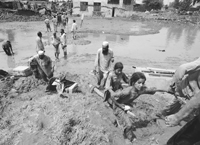
infrastructure built over the past 15 to 20 years had been destroyed. Mohammad Afzal Khan, veteran nationalist politician and former federal minister who earned fame and a government gallantry award for standing up to the Taliban in his native Swat despite life attempts and attacks on his house, said the damage caused by the floods was much larger than that inflicted by the militants. The 82-year leader of the ruling Awami National Party (ANP) said he couldn't imagine that Swat would suffer so much destruction as every bridge was dismantled, roads were rendered unusable, entire villages vanished and agricultural land and orchards, roadside bazaars and houses on the banks of river Swat right from Kalam to Barikot were washed away. Swat along with Shangla, Nowshera and Charsadda was one of the four worst-affected districts by the floods. However, 11 out of the 25 districts in the province suffered severe damage and the rest were also affected by the rainfall. It would take years to rebuild lives, revive livelihoods and reconstruct homes and infrastructure damaged by militancy and military operations. This was a task beyond Pakistan's capacity and the sad part was that enough outside help wasn't coming. Nature too has not been kind to this part of Pakistan. The earthquake of October 2005 that had struck part of the province along with Azad Kashmir destroyed much of the infrastructure and wiped out villages in the mountainous Hazara division. Reconstruction is still not complete in Mansehra, Battagram and Kohistan districts that suffered the most in Hazara and livelihoods haven't been fully restored. Death and destruction revisited parts of Hazara, particularly the remote Kohistan district, following torrential rains and floods. Battagram and Mansehra also suffered losses, but the overall death toll and property damages in Hazara this time were far less compared to the destruction experienced by Malakand and Peshawar divisions. The last major floods to hit the region were in 1929 when the North-West Frontier Province (NWFP) was part of undivided India. Old records show and elderly people recall that those floods devastated the land and swept away everything, particularly in the vulnerable plains of Peshawar Valley. However, all including the very old people agree that the recent floods were the most severe in living memory. In fact, the flooding in Nowshera gave an opportunity to the ANP politicians and all those opposed to Kalabagh Dam to argue that the project must not be built as it would block the natural flow of water and its reservoir in case of floods would submerge populated areas in Peshawar Valley. It is another matter that those in favour of Kalabagh Dam believe it would facilitate better management of water of the Indus and other rivers flowing into it and reduce the risk of flooding. The provincial government's capacity to rescue people and provide them relief was quickly exposed. The day the floods peaked, the province reportedly had five boats and no helicopter. There were no life jackets at the disposal of the government. Subsequently, boats and helicopters were procured from the military, federal government and foreign donors, including the US which sent several Chinook and Black Hawk choppers to join the rescue effort. Information minister Mian Iftikhar Hussain, who despite losing his only son in the terrorist attack did a commendable job to brief the media and give a thrust to the government's inadequate relief and rescue operations, said on August 4 that 30 helicopters and 168 boats were in operation. The demand for helicopters came from every affected place, but not many were available in the initial days and in some cases couldn't land due to floods. Lives could have been saved if more helicopters had been put into service quickly as survivors taking refuge on roof-tops or high ground in some cases waited for days to be picked up and moved to safety. Foreign and domestic tourists were finally airlifted to safety and Chinese engineers and workers executing hydel-power projects in Kohistan and Shangla were also evacuated. However, tourists stranded in Kalam accused the military authorities of airlifting their own families and friends ahead of other deserving people. People unable to get timely help were bitter and angry. One of the biggest complaints was the government's failure to forewarn them about the enormity of the danger of floods. There is no early warning system in the province. The government argued that the cloudburst caused flash floods and that this was unpredictable. But this couldn't satisfy the affectees, who were enraged that the government failed to come to their rescue when their villages were flooded and even getting safe drinking water and food became a challenge. Chief Minister Hoti saw first-hand the bitterness of the affectees in Nowshera and Charsadda where he visited on the fifth day of the floods and not earlier. He had to concede that he and his government functionaries should have come earlier. So frustrated were the survivors that many remarked that the rulers flew overhead in helicopters to watch their misery. A lawmaker from the ANP, Fazal Shakoor Khan, in the party's stronghold Charsadda, which was submerged to a large extent, wondered publicly how they would seek votes from the angry electorate in the next elections. There was also bitterness among the stalwarts of the provincial government against the federal government and international donors. Mian Iftikhar angrily remarked that the provincial government could refuse help if it wasn't provided in time. Some help eventually started coming from the US, Canada, Japan, Australia, Japan and other countries, but Islamic states were still to open their coffers. Apart from rendering rescue and relief services through its troops already deployed in most of the flood-ravaged areas, the army also mobilised its engineers to start building temporary bridges on the rivers, particularly on the river Swat at Chakdarra where the collapsed bridge served the districts of Lower Dir, Upper Dir and Chitral as well as Bajaur Agency. Peshawar too had been cut off from downcountry as both the Motorway and the Grand Trunk road were blocked due to the destruction of bridges. Both have now been reopened but major repairs would have to be undertaken to bring the two roads to previous standards. The rains and floods have destroyed houses, crops and properties. The losses are colossal and compensating the affectees would be an impossible task. The government, lacking both imagination and resources, failed to deliver at the time of the floods and expecting it to rehabilitate the affected people and rebuild their damaged homes would be like asking for the moon.
Victims face exploitation at the hands of swindlers By Shahzada Irfan Ahmed Muhammad Mushtaq, 26, a farmer owning 2.5 acres of land in Layyah, is desperate to dispose off his stock of desi (organic) hen at the best possible rates he is offered. The setting is the area adjacent to Kukrwala Bund where he is surrounded by men of different ages and attires. The crowd constitutes onlookers and bidders who are trying to outdo each other and clinch the deal. The best offer made so far is Rs1,000 for the stock that can easily get around Rs7,000 to Rs8,000 in normal circumstances. But Mushtaq, who has just descended the boat that rescued him along with his belongings, has very little choice. The moment he approached the road leading to the city, he was intercepted by this lot that advised him to get rid of his baggage. "It will be hard for you to find food for yourself and you are expecting to feed your hens," was the first remark that Mushtaq heard. He tells TNS that he could only bring the hens as his house was inundated in water and he was sitting on the top of his roof when the rescue boat arrived. Mushtaq says there were few other people in the boat who wanted to bring their cattle with them but the rescue workers refused to accede to their request. Their point was that their first priority was to evacuate humans as the resources at their disposal were scant. He says he might withhold the stock for a day or two and fears he would have to sell it off to avoid death of the birds due to starvation. Hardly a few kilometres away from the site, similar bargains are being made, says Muhammad Ibrahim, a supervisor at 5-marla scheme, Jinnah Colony, Layyah. According to Ibrahim, the farmers who had evacuated the low-lying areas a few days ago with their cattle are selling their animals at lower-than-half their market prices. He says it's a pity that the government has taken no measures to provide fodder to these animals and all announcements made in this regard are only on paper. Had there been any temporary settlements and availability of fodder, the people would not have been deprived of their livelihood. If this was not possible, the government could have offered reasonable prices for these animals just as it announces for crops like wheat, Ibrahim adds. While this exploitation goes on unchecked, Punjab Livestock and Dairy Development Department claims it has set up 580 flood relief centres where it is providing free vaccination for cattle and hens and ensuring free supply of their feed. TNS team that visited a couple of flood relief sites could not find livestock officials at the camps set up for the purpose cited above. What welcomed it everywhere was the site of baffled farmers, treading along the marshy paths with their cattle or hen, and greedy eyes affixed on them.
Flash of havoc People in flood-hit areas in Balochistan are still awaiting relief goods under the open sky By Muhammad Ejaz Khan In Balochistan, floods came after heavy torrential rains in Zhob, Naseerabad and Sibi divisions on July 22. Amid claims by the government that rescue and relief operations were in full swing in calamity-stricken areas, the flash flood claimed many lives, affecting over 0.2 millions people. Unfortunately, the exact figures of the death toll in these parts of Balochistan could not be ascertained as the officials of the provincial government have no reliable data about the exact number of deaths or damages caused by the flood. Previously, officials of the government and its Crisis Management Centre (CMC) confirmed the deaths of over 50 people and on the very next day, it reduced the figure to 24. Now, the officials of the Balochistan government say that 42 people have lost their lives in the flood so far while PDMA gives the figure of 24. The Kohlu, Barkhan, Sibi and Naseerabad districts are the worst hit areas where flood has caused colossal human and material losses. A total of 50 people had been missing in Barkhan district and thousands of people have been shifted to safer places by rescue teams subsequently. The fate of the 50 people who are described missing or feared dead is still an enigma for all in the Zhob division. According to PDMA, in Balochistan a total of 24 deaths were reported while some 22,740 families have been affected in the stormy rains and flashfloods in the province. The maximum number of casualties is from Barkhan where 50 persons are still missing. The fresh spell of monsoon rains and flash floods also wreaked havoc in Harnai district. The road link of Harnai with Quetta and Sanjavi and thus with Punjab and the rest of the country was suspended following the flood where it swept away parts of roads. The flood water also caused breaches on the Harnai-Sibi section and affected railway bridges there. Dozens of mud houses in the Harnai town including Killi Zarmana, Muhallah Islamabad, Muhalla Gharibabad, Muhallah Jalalabad, Muhalla Akhtarabad, Syedabad, Degree College Colony were damaged. Nakas, Shahrag, Khost, Spin Tangi and other areas were completely or partially damaged by flood water. People in flood hit areas are still awaiting relief goods under the open sky. A victim of the flood from Kohlu, Khuda Bukhsh, says "We have been saved from the flood, but we may die of starvation. Flood affected people, cows and goats are stranded on rooftops without water or food in Kohlu." The flood affected people remarked that the district administration had failed miserably to facilitate the people by providing them relief goods. However, the Baloch government is of the view that previously the inclement weather hampered the relief operation. But now there is in progress in all parts of the province. The government has released Rs. 1.5 million for each district where floods played havoc, said an official of the government.
Same sad story Sindh has had enough time to make necessary preparations but… By Zulfiqar Shah Ghulam Ali Arbab, a resident of Old Hala, a small town on the right bank of Indus River in district Matyari in Sindh, has formed a small self-help group, along with other villagers, to monitor the water flow in Indus and provide necessary information to the residents of the town from any possible danger of a breach of the bund (dyke) in the current state of flood in the river. "We have spent the past several days on the bund, without sleep or sustenance," Arbab tells TNS. "We need to be on the alert!" The bund adjacent to Old Hala has been declared vulnerable along with several other such spots in the province where local irrigation authorities expect a possible breach may occur in the embankment. Although the government officials are said to have made frequent visits to the region, locals like Arbab say the thought of a breach is too horrifying, which is why they have taken upon themselves the task to monitor the flow of the flood. The huge area, known as 'Katcha' on both sides of the Indus River which turned dry over the last two decades due to decline in water flow, was taken over by the influential locals. The Katcha land is cultivated with water from tube wells and at many places the people have built villages. The entire Katcha area has been declared a danger zone and a report prepared by the provincial government in 11 districts suggests that about one million people need to be evacuated. The government has already imposed Section 144 (of Pakistan Penal Code) to force people to leave. Lack of trust between the state and the locals is apparent from the fact that the people are not willing to pay heed to the officials. "We are begging them [the people] to vacate their homes for their own safety but they refuse to listen to us," complains Karim Sangrasi, Assistant Mukhtiarkar in Noshero Feroz, one of the danger-prone districts in Sindh. "They think we are giving them lies." A similar situation came up when a two-member ministerial committee visited the dangerous parts of Katcha last week in Matyari and Hyderabad districts. During their visit, they had to face tough resistance from angered villagers who said they would prefer to stay indoors than move; their main grouse being inadequate arrangements at government-run relief camps set up in schools. Besides, they said there was no guarantee that the land they leave would not be grabbed by the influential and the corrupt. Regardless, the provincial government continues to press on the people from all Katcha areas in Kashmore to move down to Thatta district. "Evacuation [of the people] is our first priority," says Saleh Farooqui, Director General, SDMA, "because we want to minimise human loss." He says that the Sindh government has already acquired the services of Army, Rangers and other law enforcement agencies for evacuation, emergency relief and rescue. "District governments are working round the clock to bring the situation under control." The devastation caused in Khyber-Pakhtunkhwa and Punjab together with the incisive media criticism on both the provincial governments for delayed action, which resulted in huge human and property losses, have put Sindh on the alert. Government officials claim that except for the Katcha area where around one million people are likely to be displaced and suffer huge financial losses -- considering the cotton crop is ripe already -- it is unlikely that flood will cause any major damage elsewhere. "Repair work in sensitive areas of different embankments is being done on a war footing. We've already moved in cranes and tractors," reveals Manzoor Memon, an irrigation officer at Kotri Barrage. Organisations working in the lower districts of Sindh such as Thatta and Badin suggest the government should chalk out a comprehensive rehabilitation and compensation package for the flood victims. "It is obvious that the people in Katcha areas, particularly the fishermen communities downstream Kotri, would be affected in the main," says Sami Memon, a spokesman for Pakistan Fisherfolk Forum (PFF). "They are losing homes, livelihood and whatever they have. They need immediate attention." Sindh, being lower-riparian region, has had enough time to make the necessary preparations to face the wrath of the flood but, like other provinces, it also lacks any coordinated mechanism to manage natural disasters and calamities.
Threat from the South Mianwali and Khushab districts offer a classic case of how we mismanage disaster By Waqar Gillani Allah Wasaya, 60, a labourer by profession, was sleeping with his two young daughters in his two-room brick-house in the old Mari Indus, a small but historic village situated at the bank of the mighty Indus, when the river started overflowing about ten days back. The old city is located at the border of Khyber Pakhtunkhwa, miles away from the city of Mianwali in Punjab. The villagers cross the Indus on boat to enter into Shakkar Darra in Kohat District in KP. "We were sleeping on the roof when we woke up to the
noise of water. It was terrible and everyone was trying to evacuate the
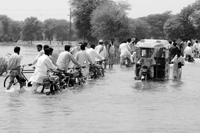
place by 2am." As he says this, a wave of fear runs over his face. "I rushed out of home quickly with my family towards the top of a mountain in this valley-shaped old city," he says, adding, "There were some announcements made in the mosque earlier but the water flow was much more horrific than what we had anticipated. "I saw death very closely. I left all my valuables and tried to save my family," he says, sitting atop a mountain outside the city. A number of relief camps and huts have been arranged by the government and some non-government organisations including National Rural Support Programme (NRSP) and Mapal Leaf Cement factory etc. The salt range has been badly affected by the flood, wreaking disaster in dozens of villages in tehsil Essa Khel and the small town of Kala Bagh, a site specified for the controversial proposed dam to save the water of the Indus and to generate cheap electricity. Though the government relief has not reached all the affected places, it has somehow put cautionary signboards indicating people that their lives can be at risk while passing through these roads and bridges. "There are many villages in Mianwali which are hit by flood and no rescue team has reached there yet," says Khalid Khan, a relief activist who has been visiting these places for more than a week. "Many people are badly stuck at the top of their houses in remote areas and are waiting for help. The problem with settlers is that they are not ready to leave their places." Politicians are hardly seen in these areas and mostly people are faring through the disaster on self-help basis. "The politicians have not come to the flood victims, though their own housing schemes have drowned," Khan says, pointing to a large piece of land along the Indus near Kala Bagh city, all submerged in water. "This was the Dubai City housing scheme of one of the family members of Nawab of Kala Bagh but now it is nowhere to be found." Till Wednesday last, the compiled data of the Relief and Crisis Management Department of the Punjab government showed more than 1,343 villages of eight southern Punjab districts affected by high floods. About 1.37 million people are affected while the affected area is 2.07 million acres including the 1.36m-acre cropped area. The number of partially damaged houses is 48,513 while as many as 25,323 houses have totally collapsed. As many as 65 people have been killed including 16 who drowned in water. The number of cattle head loss is more than 712. "The government has set up 170 relief camps in the districts which include Mianwali, Khushab, Bhakkar, Layyah, Muzaffargarh, Dera Ghazi Khan, Rajan Pur and Rahim Yar Khan," Mian Muhammad Akram, Director Operations, Relief Cell, tells TNS. Muzaffargarh, Rajan Pur, Mianwali and Dera Ghazi Khan are the most affected districts. Muzaffargarh tops the list with as many as 422 villages badly hit in the recent flood in River Indus and River Jhelum. Many urban parts of Khushab, Mianwali, Sargodha and Muzaffargarh are also affected by flood, leaving people to suffer. They are indecisive whether to leave their places or not. "We have received no government help," complains Muhammad Altaf, 28, a labourer in district Sargodha's Shah Pur area which has been drowned. "Elected politicians come to us only for votes. We find ourselves alone," he says, sadly looking back towards his drowned village and with the flood passing over the main road and speedily entering into another area. The floods have also affected areas with important installations -- like power plants and barrages in southern Punjab, dozens of villages and the city of Kot Addu at Taunsa Barrage in Muzaffargarh, adjacent to Dera Ghazi Khan, from where water moves to Sindh. "We are trying to reach maximum number of people and manage their evacuation," says Muhammad Irfan, who heads the control room of Rescue 1122, the official rescue network in district Khushab. "Our staff is working round the clock and we need more equipment for operations." Sharing the problems of the people who refused to leave their places, he says that even a week later, there are a few families in Syed Sakhi Maroof in district Khushab who refuse to budge. "We go there daily. "The government is catering to more than 22,277 flood victims in these camps. We are trying our best to rescue people and provide them medical aid and food," says Akram. On the other side, the flood-hit are continually a picture of protest. In violent protests in district Khushab where there was no government help to save an endangered bridge, protesters started beating and attacking local administration, police and rescue teams and blocked the main road connecting Khushab and Sargodha last Monday. Allah Wasaya, who has taken shelter in the relief camps, is disinterested in getting food and water from the overcrowded and undisciplined relief camp of the government. "The chief minister also came and promised help a few moments ago. The aid will come, I am sure from Lahore and Islamabad but not for us," he says, indicating middle tier (district and local level) corruption in the aid distribution system. Loyal to the ground Affectees in Layyah are not ready to leave their livestock and grains behind By Shahzada Irfan Ahmed In district Layyah, the flood-affected people are reluctant to move. Though the same reluctance was exhibited by people in other flooded parts of the country, the residents of the low-lying areas of Layyah have their reason to hold on to their ground. Being owners of one of the most fertile lands in the country and huge livestock, most of them are not willing to leave their animals and stockpiles of crops lying in barns. The main city of Layyah was saved by employing army personnel who erected an embankment there overnight. Right now more than 1,200 square kilometres of land (in Layyah) is inundated in water and around 300,000 people have been displaced from their homes. The width of Indus River has gone up from 3 kilometres to somewhere between 18 to 20 kilometres and led to the complete drowning of 12 union councils of Layyah. Crops and cattle worth millions face destruction as the scale of disaster is too high for the authorities to manage, says Asghar Ali, a relief worker operating in the area. He tells TNS that the land is so fertile that its theka (contract) goes for Rs 60,000 per acre -- one of the highest price tags in the country. Besides, Layyah is one of the biggest sources of livestock in the country, he says, adding that perhaps it is for this reason that the provincial minister for agriculture and livestock, Ahmed Ali Aulakh, hails from the district. He was a farmer from Layyah who had won an award last year for producing best wheat crop, he says, adding "one can well imagine the scale of loss caused by floods in this area." Asghar's statement is also endorsed by Inayat Baloch, Community Safety Officer, Rescue 1122, Layyah. He says it was a Herculean task to convince people of the affected parts of Layyah to leave their houses before flood water had arrived. Asghar tells TNS that warnings were issued well in advance and Rescue 1122 ambulances visited the areas three days before flood water reached the district. He says they told people this time flood would be the worst in the country's history but people did not take it seriously. Announcements were also made from mosques but to no avail. Asghar says the people were not willing to leave their cattle and grains behind. The average size of cattle-head an extended family owns is around 60 to 70. They have stocks of fodder available with them. They are perched on their rooftops whereas they have kept cattle in pens built at a height, he says. "They think they are safe but it's not so. The foundations can collapse anytime once water seeps into them." Asghar says Rescue 1122 has repeatedly approached such families but they are not cooperating. The demand they put is that their cattle should first be evacuated. The demand that seemed hard to honour initially has been met recently with the private sector stepping in. It was Layyah Sugar Mills which offered its fleet of big boats to move the stranded livestock to a safe place. The mills have maintained a fleet of boats to ship sugarcane across the Indus to their site, Asghar says. The boats are large enough to carry cattle, bags of grain, household belongings as well as their owners. The Punjab government has declared the city a calamity-hit area and waived off agricultural taxes like abiyana but the situation demands for much more. "They must establish temporary settlements and prepare us to stand on our feet once flood water recedes," says Muhammad Mushtaq, a farmer from the drowned Zangaiza Basti located in one of the riverine belts of Indus.
"The scale of disaster is much more than the scale of arrangements" -- Lt Gen (retd) Nadeem Ahmed, Chairman, National Disaster Management Authority (NDMA) By Shaiq Hussain The News on Sunday: Apart from your organisation, we have other agencies for disaster management such as Federal Flood Commission, Emergency Relief Cell and National Crisis Management Cell etc. However, we don't see any coordination among them on ground? Nadeem Ahmed: All the agencies mentioned by you have a clear mandate and functions to perform. For achieving them, all the organisations have always coordinated with each other before, during and after the floods. During the recent 'Phet' cyclone in Pakistan, the emergency situation on ground was effectively handled through well-coordinated efforts by Pakistan Meteorological Department and civil and military organisations. Historically, this is an unprecedented flood event in Pakistan since 1929 that has straightaway impacted the entire country in one stretch. Despite the fact that federal, provincial and district level organisations have made full arrangements, the scale of the disaster is much more than the scale of arrangements put in place. TNS: In the wake of the deadly earthquake of 2005, much was said about building of new infrastructure to deal with disasters, but the current floods have shown we still have a long way to go. Why is it that every time there is a disaster we have to seek aid from other countries, especially of helicopters and boats? NA: It depends upon the scale and magnitude of the disaster. Presently, all available resources, including the material and the rescue equipment are being used to provide relief to flood victims. TNS: Floods have wreaked havoc in Khyber-Pakhtunkhwa where the government and the security forces have been fighting militancy. Don't you think the inability of the government to provide the much needed relief to the people will help the Taliban-led militants in that part of the country? NA: Both federal and provincial governments, with the participation of the armed forces, are ensuring all necessary rescue and relief measures. The situation, we hope, will improve soon. TNS: According to the Federal Flood Commission, the danger is far from over and the situation in KP and Sindh will worsen in the coming days. What is your contingency plan to tackle the disaster in Punjab? NA: Punjab has taken the major brunt of super floods from upstream KP. There has been a lot of damage to private and public property. Irrigation and flood control embankments have been destroyed to a large scale. Further going downstream to Sindh, Indus River belt between Guddu and Sukkur Barrage is seriously threatened and discharge to the tune of 900,000 cusecs to 1,000,000 cusecs is anticipated in this belt. However, all flood-fighting arrangements have been completed by the provincial field formations. The threatened communities in the low-lying areas are being evacuated to safer places. Reserve stocks of food, medicines, tents, blankets and water purification plants have been provided on site. Besides, services of Pak army with boats and helicopters have been made available. To avert such a disaster in future, we need to acquire flash flood monitoring and warning system, which at present does not exist.
Identifying the proven methods of flood control By Aziz Omar Floods have been deemed as the deadliest and costliest of all natural disasters. Yet the flood management, prevention and control measures that have been conventionally adopted in many countries have been marked by murkiness and have often proved to be counterproductive. Pakistan is no exception. Patrick McCully, the Executive Director of International Rivers, a California based organisation that works all across the world in protecting rivers and the rights of the dependent communities, attempts to promote activities that foster better ways of meeting people's needs for water, energy and protection from damaging floods. "Dams at best have had mixed results as flood management tools and though they can certainly minimise some floods. I believe they are one of the reasons for ever-increasing flood damages worldwide," he says. Indeed, large or small dams in a number of regions across the world have seemingly served their purpose for a certain period but due to design flaws and torrential rains resulting from global warming they have wreaked havoc by collapsing. One such gruesome instance is the domino-effect collapse of a large dam in China in 1975, the Banqiao Dam on the Huai River. The typhoon resulting from its failure caused the collapse of 65 smaller dams downstream and taking a toll of 230,000 lives in the ensuing flood waves, epidemics and famine. According to a report, titled Dams, Rivers and People: Coping with Floods in a Changing Climate, prepared by International Rivers in 2007, flood control tools entailing infrastructural aspects are typically designed on the basis of the assumption of a static climate. However, in an ever so wildly unpredictable climate that exacerbates the natural calamities such as floods, flexible and adaptive flood risk management measures have to be explored. Some successful measures include moving embankments back and restoring wetlands, floodplains and meanders along the rivers that serve as natural water reservoirs and curtail urban flooding. Such natural structures also play an integral role in extracting the ecological benefits of normal flooding such as nutrients and alluvial mud that is vital in supporting the indigenous flora and fauna. Of course, emergency measures, flood forecasting and evacuation procedures have to be significantly improved and streamlined as well as advance planning for communities to cope with the impacts of floods. Pakistan has already experienced similar circumstances in the past. One was the completely avoidable 1992 incident where the operators of the Mangla dam opened the spillway without warning and measure, flooding the villages and army garrisons below the dam causing 500 deaths. The other was the one in 2005 involving five dams which burst after heavy rains swelled the local rivers in Balochistan. The biggest of the five dams, the Shadikor dam had only a 35-metre wall but killed at least 80 people and left 4,000 families injured in the aftermath of its failure. This dam had been constructed at a little less than a million dollars only two years prior. Even if the dams don't burst themselves, the levees which are generally built up along the river as a gut response to containing rising river water, give way and flood waters swiftly inundate the surrounding cities, towns and villages. This is exactly what has happened in the case of countless human settlements all along the River Indus such as those in Nowshera and D G Khan. Mr Patrick McCully, who has authored the book Silenced Rivers: The Ecology and Politics of Large Dams and was also the member of the Steering Committee of the UN Environment Programme's Dams and Development Project and oversaw the establishment of the World Commission on Dams paints a stark assessment of Pakistan's approach towards water management, floods and otherwise. "The knee-jerk reaction of Pakistani politicians saying that the flood disaster shows the need for more dams is typical of most countries after a major disaster like this. Politicians want to be seen as calling for a solution, and "sophisticated flood-management approaches" does not have the populist appeal of "more dams". Politicians also of course tend to be ignorant of water management, and they know that dams can bring money into their districts.
The area suffers yet another blow. This by the raging flood waters By Essa Khan Khel Even before Swat could be freed by the monster of terrorism, the area is facing yet another disaster in the shape of floods. The recent torrential rains have played havoc in Mingora, Babuzai, Barikot, Kalam, Charbagh, Bahrain, Khwazakhela and Matta. According to estimates, these are the worst floods the area has seen since 1929. About 400,000 residents of the area are desperately waiting for relief to come their way. Around 8,000 houses and 2,000 shops have been completely washed away and 15,000 houses and 4,500 shops severely damaged. Some 100 hotel have been damaged in the popular tourist towns of Kalam, Bahrain and Madian. More than 100 small and medium-sized bridges and roads have swept away, thus isolating it from the surrounding areas. The 40-km-long patch between Madian and Kalam has eroded. Acres and acres of agriculture land have been flooded. People are starving, prices of food and other basic items are sky-rocketing --with opportunists hoarding food items, petrol, LPG etc. The electricity supply has severely been affected as two main lines in Chakdara have broken down. Wapda had not restored the service in the area (till the filing of this report). The district administration is almost non-existent in the flood-affected areas of Swat. Neither has it set up any relief camps nor proposed a price control mechanism. Resultantly, the scarcity of petrol and LPG has hugely affected the transport system. The ex-Nazim Matta says, "This calamity has stranded not just the locals but also the overseas workers who were visiting their homes for a vacation. Many of them fear losing jobs as their visas are nearing expiry. They must be evacuated immediately." Swat-Malakand Operation Incharge, Maj Gen Ashfaq Nadeem says, "Pakistan Army has set up relief centres in every army unit. Doctors, medicines and food items are available." He urges people to contact the nearest unit for relief purposes. According to Human Resource Development Officer, Naeem Akhtar, 86 people have been killed and 93 injured and about 1,500 houses destroyed (till Aug 4 when this report was filed). Helicopters have distributed 2,000 food packets and 1,000 tents in the area. The transport facility -- from Khwazakhela to Mardan -- has been provided to the stranded tourists. He adds fuel has been provided to 38 tubewells to avoid water shortage, and to levis have been deputed in the area to keep a check on the relief operation. Some 600,000 people in the Mingora city are facing severe water shorage as 9 Union Council tubewells are not functioning. Locals say the area's influentials have taken control of a large number of generator provided to them by the Tehsil Municipal Administration. They allege that high-ups are using them for personal use. Sui Gas was restored in the Mingora city after five days. Educational institutions have extended summer holidays until August 15, and MA and M.Sc exams have been postponed from August 3 to August 17. In the absence of relief offered by government and civil society, the local people are working on the self-help basis. But sources claim Pakistan Army has dispatched 30 truck-loads of construction material to Swat to reconstruct bridges and roads, restore communication links and evacuate the stranded people from the devastated area. |
|