


|
|
|
|
 |
 |
|
travel
travel Over the next seven days my stay in North Korea were spent running from one tourist attraction to another — a very busy schedule set by the travel agent in conjunction with the official Korean International travel company. Tourism in DPRK does not mean you get to pick the places you want to see; “they” decide what things you should really see. During this stay a storm of thoughts related to nations, peoples, leaders, economies, human rights, and freedom besieged me. All my life most of my information has come from western sources. With information come biases, deeply and insidiously layered in. Seeing North Korea without the bias of western propaganda was a challenge. The first change I welcomed
in Pyongyang was its clean air. Compared to Beijing or cities of western
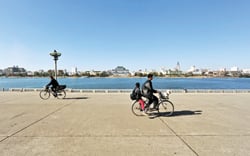
countries, Pyongyang air was much healthier to breath. In Pyongyang I stayed at the Yanggakdo International Hotel, which sits on an island in the middle of River Taedong that flows through the city. It is a beautiful setting for a hotel and from the revolving restaurant on top you can see Pyongyang stretching out in every direction. But westerners believe the island location of the hotel is to make sure that the foreigners don’t go anywhere in the city on their own. Yanggakdo is nicknamed Hotel Alcatraz by the tourists. After the Second World War when the Japanese colonisers were thrown out by the Koreans the peninsula got divided between the areas of Russian and American influences — a political landscape similar to that of post-war Berlin, but on a much bigger scale. The two Koreas sought unification, but there was disagreement on the political and economic system the united Korea would run on. A war broke out to settle matters. At the end of the Korean war in 1953 the peninsula got divided between North and South Korea with the current boundaries. The line that slices the peninsula cuts at 38-degree north latitude (or at 38th parallel). The area around that border is known as the demilitarised zone or DMZ — in fact, it is one of the most militarised borders in the world. Most tourists approach DMZ from the south, so reaching that border from the north was an obvious thrill for me. In the eyes of North
Koreans (or at least the North Korean establishment), the communist regime of
DPRK represents the true aspirations of all Koreans. The only obstacle in the
way of the Korean unification is the presence of the American military in the
South. The North refers to the American bases in South Korea as the American
occupation of the southern part of the Korean peninsula. The day the
occupying forces would leave, South Korea would be free and would gladly join
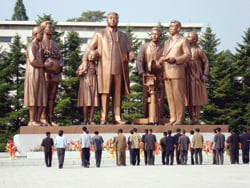
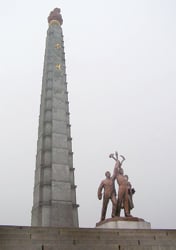
the North under North’s communist government, the logic follows. As I travelled on the road from Pyongyang to DMZ, I wondered what it would have been like to drive on that highway before the Korean division. This main artery connecting Pyongyang with Seoul must have been a very busy thoroughfare at that time. But not now. We drove on a deserted road and came across vehicles we could count on our fingertips. The guides assigned to our group were really translators. Every “tourist attraction” we would be taken to, would have its own guides. Those site-specific guides would explain things in Korean, that speech would then be translated by our guides. It was a non-stop flow of information coming our way, leaving us little time to think on our own. At the 38th parallel, DPRK seemed well-prepared to stop a road advancement by the occupying forces in the South. Huge stones held by ropes sat on platforms along the road. At the appropriate time the ropes would be cut to make the stones roll down and create large barriers in the way of the advancing forces. After spending the night in Kasesong we returned to Pyongyang in the morning. Our arrival was followed by a trip to the Pyongyang Film Studios. That visit would have been of more interest to me had I seen any movies made in North Korea. When the comity of socialist countries had a large membership, films made in those countries went to sister countries and their film festivals. Where do they go now? I wonder if South Koreans watch movies made in DPRK with the same interest as North Indians watch films made in Pakistan. The word you would hear most in DPRK is ‘Juche’, or more specifically the Juche ideology. It is a Korean version of how Kim iL Sung thought the economic system of his native land should look like. Juche ideology is about the country being an industrial power and be self-reliant on most of its needs. Pyongyang has a monument, Juche Tower, made specifically to celebrate the Juche ideology. Our climb of the Juche Tower took us over 550 feet above the city, telling us that following the Juche ideals we can reach the skies. Climbing down I had an interesting conversation with a fellow tourist. She had recently visited Albania where she saw litter everywhere. “They are not proud of their land. All of them seem to be looking for an opportunity to move to the western countries,” she said of the Albanians. I told her the US has a lot of Swiss people — she was from Switzerland. Movement of people, especially in today’s well-connected world, is a complex phenomenon — feeling proud of the land is just one aspect of the issue. A lot of other things — how the historical baggage impacts societies, when and why do people feel powerless, how do leaders emerge, how certain ideas prevail in a society, what classifies as fashionable, and how do people follow each other in quick pursuit of happiness — need to be considered in understanding why certain societies are the way they are and why people want to move out from certain areas. Speaking of cleanliness, I found DPRK cities and towns to be very clean. North Koreans might not be rich, but they looked tidy and were properly dressed. It is interesting to observe poverty’s relationship with basic hygiene and maintenance of oneself. In South Asia, poor often means dirty and unkempt. Whereas the western propaganda is untrue about many things North Korean, it is right on the mark on the personality cult going on in DPRK. Showing reverence to Kim iL Sung (known as the eternal president, after his death in 1994) is not only expected from the locals, tourists too are asked to be very respectful of the Sung statues. Before I entered DPRK I was told I would be expected to bow at Kim iL Sung statues. I did not take those instructions seriously until the opportunity to prove my commitment finally came. I was asked to bow in front of a large Kim iL Sung statue. I mumbled something about having already bowed. “No, not like that,” I was told, “All tourists would stand in a straight line and would bow together.” We went to the huge Kim iL Sung mausoleum where the ‘Great Leader’ lies mummified. Per our guide’s instructions we had our best clothes on — men wore ties. I was surprised to experience first-hand how little heat pollution free air retains. Even though Beijing is almost at the same north latitude as Pyongyang, the latter is a lot colder than the Chinese capital. I was shivering standing in the long line of visitors outside the mausoleum and felt relieved on entering the building. We passed through air showers where streams of air blasted away any dust that might be present on our clothes, and then automatic-rolling brushes cleaned our shoe soles. Going through these cleansing processes I met a delegate from Bangladesh. The three men were members of the Workers Party of Bangladesh and were invited on the occasion of Kim iL Sung’s birth anniversary. I asked them if communist party workers from other countries were visiting too. They replied in affirmation. “Anyone from Pakistan?” I asked. No, there was no one from Pakistan. I asked them their professions. One of them was a contractor. Learning that, I was not sure if I should smile on the irony of seeing a contractor as a leader of a workers’ party, or feel sad about a contractor exploiting labour to gather enough money to visit DPRK. Going through a number of long corridors we finally reached the big hall where Kim iL Sung lay behind a glass case. It was time for the grandest bow of our DPRK visit. We bowed at the ‘Great Leader’ from all four sides and then proceeded to listen to the wails of a woman describing how losing the ‘Great Leader’ was the greatest irreparable loss DPRK had ever suffered. Tourists were given tape recorders and headsets to listen to the eulogy in their own language. This drama was not much unlike what we see during Moharram majalis. One of the highlights of my DPRK visit was seeing the opening ceremony of the Mass Games, an annual athletic event in which men and women from all over North Korea compete. I can casually tell you that the athletes did a synchronised dance as the games opening ceremony, but it would be hard to describe the magic they created. Imagine thousands of young athletes holding little cards in their hands, shuffling and displaying cards in unison, the effect of which is to create a mammoth painting of a peculiar theme. Then imagine hundreds of athletic dancers using their bodies to make amazing shapes and flower bouquets in front of the large painting. You have to see it to understand why awed foreign tourists see this spectacle with pin drop silence. My eyes brimmed with tears while I saluted the hard work of the athletes and the wonderful training skills of their coaches. Birthday celebrations of
the eternal president continued for the full week. We went to see a flower
show named after Kim iL Sung, the Kimilsungia flower show. Along with
bouquets added by embassies in Pyongyang, the flower show featured flowers
from all over the world. Later in the evening we saw a dance in a local park. After the dancers did their expert show, the spectators — they were all foreigners — were invited to get down from the bleachers and dance with the Koreans. We all went down and paired up with Korean girls. The girl I danced with was way too agile than me, but was charitable enough to not laugh at my clumsy steps. During the dance I came across a man with a Sikh turban. I briefly spoke to him in Punjabi. He said he was with the UN and was there in DPRK on a short assignment. A day earlier we had eaten at a place that was across the street from foreign missions in Pyongyang. Knowing that I was sitting just a few hundred yards from the Pakistani Embassy in Pyongyang I had the urge to slip out of the eatery and visit the embassy staff. But our guides were keeping an eye on us and it was quite impossible to dodge them. The way DRPK had restricted my interaction with people, I had the burning desire to talk to people, just anyone outside the small group I was confined to. The opportunity for such an interaction came quickly. It was when our guides took us to Pyongyang Public Library that I became aware of a Russian film crew shooting us besides making video of other things. Later that night I ran into Irina, the director of the crew. She wanted to interview the foreigners and wanted to know, of all the places in the world, what made these tourists come to North Korea. We said yes to the interview, but logistics had to be worked out. It was next to impossible to get permission from our guides. We decided to meet much later at night when the guides would not be there to watch us. As planned, the Russians came later in the night, after most people had gone to bed. They came with vodka and nuts. They recorded our interviews. I told them about the most remarkable experience I had in DPRK. I did not fathom the divine status accorded to Kim iL Sung till I visited Mt. Paekdu. At Kim iL Sung’s anti-Japanese guerrilla camp near Jong-iL Peak, the guides showed me the room where Sung used to meet with other guerrillas, the room where he would sleep, the room where he would eat, etc. I asked the guide where was the toilet that the Great Leader used to go to. The guide did not understand my question. I was asked to go out of the camp, turn right, go straight, and then turn left to find the toilets on my right. I could use the toilet there. “No, toilet not for me, but for Kim iL Sung,” I insisted, “Where is the toilet that Kim iL Sung used at this guerrilla camp?” At this point several other guides came together and conferred in Korean. Then one of them asked me to explain my concern again, very slowly, one word at a time. I did just that; I told them my concern that they had showed me all different rooms at the camp, except for the toilet and I was curious to know where Kim iL Sun relieved himself. They all smiled and shook their heads in disbelief on “my joke.” Kim iL Sung did not need to use a toilet. He was beyond such human needs. By the end of the tour we
had become very comfortable with our guides. They had an opportunity most
North Koreans did not have: to interact with the foreigners. I can imagine
what the propaganda I repeatedly heard in a week would do to someone’s
thinking faculty when fed over a lifetime. You would believe in everything
being told to you, wholeheartedly, because you have not seen anything else.
But if you happen to take the profession of a guide, you can come across
other people who think very differently than you. You may encounter a
different opinion. And that might open a window of thought for you. That
night you may go home and wonder if whatever you have been told is indeed
correct. So we asked our guides if they knew who would succeed Kim Jong iL. They had no clue — they never even thought about Kim Jong iL being not there, ever. Does Kim have sons and daughters? They didn’t know. What a strange thing to say? Don’t you think you should know more about the most important person of your country? Even when our guides did not have any answers to our probing questions such conversations must be very provocative. And that brings me to the real deal. Irrespective of who rules a country and in what fashion, people, fundamentally, are same all over the world. Even when we don’t agree with certain governments we must extend our hand of friendship to the people these governments rule. Calling a country evil, is in itself very evil. DPRK cannot be changed by sanctions; it can be changed with more interactions. DPRK is so fresh and unadulterated, it is fascinating. In this world swept by capitalism where else would you find streets not defiled by signs of McDonalds, Sony, Philips, Benton, and other multi-national brands. I wish that even when there is a regime change in Pyongyang, the country would adhere to the Juche ideology and not allow multinational corporations run them over. I also wish that even when, one day, North Koreans throw out the Kim dynasty they would not destroy the statutes of the dynasty members. That the North Koreans would be wiser than the Germans who almost completely demolished a wall that could be a priceless historical monument and a great tourist attraction. (Concluded)
|
|