



|
|
|
|
 |
 |
  
|
issue comment Honouring the
master Real
man’s story issue Nobody has witnessed anything Lack of protection to eye-witnesses in terrorism cases helps the accused go free. It is imperative to provide physical security to witnesses, prosecutors and judges By Aoun Sahi On August 18, 1996,
terrorists attacked a Shia religious gathering in village Chaudhry Shabbir
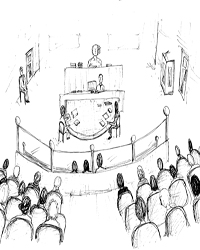
Ahmed Ghalvi in district Vehari, “We were happy that finally the murderers were behind bars and soon we would get justice,” he recollects. But, the decision resulted in the killing of eight more members of the family, including the elder brother of Ghalvi. “Five witnesses and our three close relatives were killed in two different incidents,” says Ghalvi who lives under constant threat to his life. “It seems as if we have done some crime by testifying against the killers. We have been living under constant threat while he has been released and received like a hero.” Witness protection is a serious problem in Pakistan, especially in cases related to terrorism. “In such cases, witnesses hardly stand by their initial testimonies as terrorist organisations intimidate them. They also threaten judges who do not give punishments even if they have sufficient evidence to do so,” says a senior police official in Punjab. “In the past, judges, police officials and prosecutors involved in such cases have been killed by terrorists. Even many of the police officials refused to investigate the cases of high profile terrorists out of fear. The conviction rate in terrorism cases is less than 10 per cent as our justice system heavily relies on oral/direct evidence instead of forensic evidence which actually help terrorists.” According to the police official, the recent acquittal of Malik Ishaq, a Lashkar-i-Jhangvi activist, is an example of these legal lacunae. Arrested in 1997 from Faisalabad, Ishaq had boasted that he had been responsible for the death of 102 people. He had 45 cases registered against him, including murder and terrorism. Last month he was acquitted in 35 of these cases while in the rest he was granted bail. It is believed that Ishaq maintained his network while in jail and masterminded the attack on the Sri Lankan cricket team in March 2009 in which six people were killed. “The failure of witnesses to stand by their initial testimony was the second most significant factor in his acquittals,” according to a confidential internal analysis by the Punjab police in the case, especially acquired by TNS. A recent research study by
the Counter Terrorism Department of Punjab “Why Do Terrorism Cases Fail in
Courts?” looks into the Interior Minister Rehman Malik told the Senate in April this year that 606 people were arrested in Pakistan between 2008 to 2010 on terrorism charges. “352 of them have been released by the courts due to unavailability of witnesses or lack of evidence,” he informed the parliamentarians. According to an official report of the Punjab Public Prosecution Department, the department initiated proceedings against hardened criminals and activists of banned outfits in 1,324 cases registered under the Anti-Terrorism Act from January 1 to September 30 in 2010. “In 306 high profile cases, the accused were freed after the witnesses resiled, while those under trial in 372 other cases of terrorism were acquitted on the basis of compromises or on merit,” the report reads. Muhammed Jahangir, Punjab’s chief prosecutor, says more than half of witnesses in terrorist cases turn hostile. “Even those injured in terrorist attacks resile as under the present circumstances and laws, it is not easy to protect witnesses in Pakistan.” He says witnesses in developed countries are protected through the Witnesses Protection System, but police and other law enforcement agencies have no such system in Pakistan. “We have sent proposals to the government on witness protection programme. We will have to provide security to witnesses to decide the terrorism cases,” Jahangir says. “Pakistan’s restrictive laws on admissible evidence are another significant factor behind the failure of so many terrorism cases. We need telephone [intercept] evidence. How else are we going to connect the mastermind to the attack when he is miles away? We need to amend the evidence laws and rely more on physical evidence instead of oral evidence. It will automatically protect the witnesses.” Amjad Cheema, advocate High Court and ex-public prosecutor for anti-terrorism courts in Punjab, says that during his tenure the acquittal rate in terrorism and kidnapping for ransom cases was over 95 per cent. He adds the present legal framework does not protect witnesses at all. “According to section 173 of the Code of Criminal Procedure (CrPC), the police is bound to write down complete names and addresses of the accused and witnesses in the investigation report. So, the accused can easily have access to the names and addresses of witnesses.” Cheema thinks that reforms in the CrPC should also address the lack of protection to witnesses, judges and prosecutors. “A strong witness protection programme is urgently needed. Given the widespread and unchecked proliferation of arms, and the reach of criminal and terrorist networks, witnesses are understandably reluctant to risk their lives by testifying in major terrorism cases — the only reliable source of evidence in our legal justice system.” “Police officials reject the proposal to set up a witness protection scheme as impractical. They think, in a country like ours, it is impossible to provide physical security to witnesses, prosecutors and judges. It is not easy to relocate people or introduce faceless judges as people can’t just disappear in our society, and even if they do, the terrorists will just go after their families. We have also asked the government to provide financial security to witnesses. Police should be given access to phone tapping as electronic intelligence can help nab terrorists without involving the eye-witnesses,” Cheema says. Constraints of an age where the art works are dispensed with and their copies held dear Quddus Mirza If you get a chance to drive on the newly completed flyover at Ferozepur Road Lahore on either side, you’ll see a large form in glossy finish installed between the two roads. It is the small scale model of the monument which was erected here several years ago that gave this busy crossing its name Kalma Chowk. The original monument was removed with the construction of the flyover, yet its memory (mostly because the name is still used) persists. Without judging its aesthetic value or artistic merit, one laments the destruction of this sculpture that was installed in a public place and added a creative element into an urban location. It was a work made by an artist (designer or architect), that is now disintegrated and only survives in two small reproductions, which do not serve the same purpose or have the same impact associated with the initial art work. One could carry on crying over the loss of this work in the name of Art, if one was totally detached from the reality. The new flyover is designed to facilitate the flow of traffic for the commuters to commute quickly and conveniently: hence no one is protesting the removal of a prominent artwork from the public arena. Considered deeply, its demolition is as or perhaps more crucial than the cutting of a few trees on the Canal Road, Lahore. Actually both felling of trees and dispensing with an artwork are connected to a single phenomenon: public convenience versus Art or environment (ideally environment must concern everyone, but unfortunately it has become as exclusive and elitist as art in our midst!). So it is intriguing that the art community did not show any reaction on the elimination of an artwork. To an extent this is understandable. To start with, most people, including the art community, did not recognise the structure at Kalma Chowk as art object (at the most it was a landmark). Being a part of public domain and consumption was perhaps one cause to distance this piece of sculpture from art. In a strange way art in the public domain, unless it is a painting in the form of a mural (at Mangla Dam, Lahore Museum or Frere Hall in Karachi, all by Sadequain), fails to attain the desired status. So nobody showed any displeasure on dismantling this artwork at one of the prime places of Lahore. As no one was aware of its creator, so it was seen more like a product that — in the tradition of industrial outputs — is produced without the name or mark of its maker. It was easily erased and now it exists in its two small scale models at the two edges of the new flyover. However, the difference between the original and its versions is not of scale but of surface too. The actual monument was built in a rough texture giving it a human touch because an uneven exteriority always reminds a man’s effort and tools in forming an object; whereas in contrast, the glossy, smooth and shiny layer recalls the mechanically fabricated product. These two small-scale models of the monument also signify how art is perceived and used in our societies these days. Actually we live in the age of deception, in which we are constantly trying to convince others and ourselves with copies that are substitutes for authentic entities. This sort of transformation has a lot to do with our involvement with the virtual domain in which images have superseded actual individuals, incidents and experiences. This, a late twentieth century phenomenon, is extended in the way reproductions of great works of art have occupied the public space. This amounts to the invention of photography which facilitated a large population to own duplications of art works; and the creation of plastic that offered to have replicas of world monuments, easily, cheaply and quickly manufactured and owned (Taj Mahal in plastic remains a favourite item for decorating living rooms in most households here). Normally a person who owns a plastic Taj Mahal does not have much chance of visiting Agra to see the mausoleum built by Shahjehan. But once he is there, he is comparing the huge structure with the object that adorns his mantlepiece. As it happens with numerous tourists around the world, who are marking historic sites and famous paintings on their guidebooks, the encounter is no more than matching its replica (from its long history of reproductions in souvenirs and picture post cards) to the original. It is not unusual that often a visitor is disappointed to find the real thing not fitting or fulfilling the expectations built by the period of knowing and cherishing the reproductions. A similar process takes place during art exhibition, too, in which the display of art pieces lasts a week or ten days, but the catalogue of these works remains relevant for a longer duration (an aspect that has inspired some artists to prepare just the catalogue without any art works or exhibition!). So, despite the fact that we still have many genuine art and artefacts around us, we are happier to settle for copies because we know that in the end these will last and shared widely than the original art work, hidden at someone’s expensive living room or stored in a closet at a safe deposit. Thus, looking at the two replicas of actual monument of Kalma Chowk, one recognises the constraints of our age that are rooted in the image or a reproduction which can be multiplied more and more till the original disappears.
Sitara-e-Imtiaz award to Ijaz Hussain Hazravi acknowledges his true contribution to music By Sarwat Ali One of the names mentioned in the awards list announced on Independence Day was that of Ijaz Hussain Hazravi. This comes as a pleasant surprise to many music lovers. He died many years ago in 1989, and his name, unexpectedly propping up as if from nowhere, can be seen as some compensation for this ghazal and thumri gaik that has largely been forgotten. The connoisseurs of music respected him for his masterly rendition from the 1950s onwards. It has happened with many an artiste that the fame has not resonated in accordance with their true contribution to the art. The reasons may be many but one cited in the case of Ijaz Hussain Hazravi can be that he lived all his life in Rawalpindi and did not move out as suggested by many of his well-wishers to a bigger centre of music and art like Lahore. Just by being in the centre or the capital of art, the exposure increases manifold and the opportunities multiply. The various forums like stage radio, television, recording companies are available while the print media too is at hand to write and carry photographs — which in the end help in consolidating the profile of a vocalist or a musician. Ijaz Hussain Hazravi, being in Rawalpindi, was averse to these overtly contemporary devices of promotion. He was not known to the common people who make or break an artiste but only to a selected few who had the acumen to separate grain from the chaff. All his life he lived in a rented house, small and dingy in Bhabhra Bazaar in Rawalpindi. And all his life he wanted to get out of there to live in a house and locality where he could do his riyaz without any hindrance and invite musicians over for sessions. But like so many other musicians he never had the financial means to move to a place where he could be more comfortably placed. The places where he could sing were away from his house and usually the haunts of musicians of Rawalpindi — most of whom were his friends like Qazi Zahoorul Haq who would be with him in his tiny baithak in Taj Hotel in Rawalpindi where he did his riyaz and held music sessions. Ijaz Hussain Hazravi hailed from a family of musicians. He was born around 1930 in Hazro and learnt the art of music from his father Nabi Buksh, elder brother Allah Buksh and his cousin Inayat Hussain Hazravi, a sarangi player. It is also said that he gained considerable musical knowledge from two doyens of the Patiala Gharana — Ustads Ashiq Ali Khan and Bare Ghulam Ali Khan. Though he could render the thumri with great feeling he switched to singing the ghazal. He became a recognized voice of Rawalpindi Radio and was generally regarded as a ‘sahib-e-tarz gawaiya’. He evolved an ang of his own in singing the ghazal, always based on the melodic structure of a raag. Some of the ghazals that became famous were ‘Aah ko chahiye ik umar asar hone tak, ‘Ishq mujh ko nahi wahshat he sahi’, ‘Asar us ko zara nahi hota’, ‘Mere kheyal sey lao day uthi hai tanhaai’. Ghazal in the earlier phase was sung more like a geet. Its rhythmic pattern was uniform and the singer had the freedom to add and subtract from the text. Many of the early singers felt obliged to weave the metrical pattern of the ghazal into the rhythmic scheme of the composition. Both these were very limiting factors where music was concerned. Then, since ghazal was popular in the salons of dancing girls, the musical form too developed as subservient to the complexities of dance. Many of the ghazals of the middle phase were mere adjuncts to the entire ethos of dance. This mujrai ang was again an inhibiting variable in the growth of ghazal as an autonomous form of music. Ustad Barkat Ali Khan was successful in liberating the musical form from the metrical design of the poetry and infused it with the freedom of a thumri gaik without losing the thread of the poetic content altogether. In the last 50 years ghazal emerged as a very popular form of singing in Pakistan and some of the most outstanding exponents reached the apex of this scale; making in the process significant contributions in the evolution of this particular style. The imperatives of identity helped in promoting the ghazal in the new state of Pakistan. It was thought that the ghazal represented a cultural continuum that was closer to the Muslim identity. In poetry, since ghazal had grown from the interaction between the Persian and local traditions, and since most of the practitioners were Muslims, it was owned by the establishment of the new state as the foremost musical expression of Pakistan. Ghazal was patronised and it basked in its appeal to the middle-class urban audience. Ijaz Hussain Hazravi used to sing with the surmandal in the beginning but with the passage of time switched to the harmonium because he was a very adroit harmonium player as well. According to many experts, there were few in the country who could play the harmonium with the evocation that he did. Some of the recordings of his solo harmonium playing were also recorded and then broadcast which is rare because harmonium is considered an accompanying instrument and not mellifluous enough to be played solo. His father was a good vocalist and a harmonium player and it is said that he was the ustad of Madan Mohan, the Indian film music director who spent his formative years in Rawalpindi. We venerate the dead rather than the living. Whatever the posthumous award given to Ijaz Hussain Hazravi may mean, it is clear that someone up there in the corridors of power still remembered him and was able to convince others on the veracity of the dictum — better late than never.
By Adeel Pathan Rahul Roy is an Indian short filmmaker and his work has been widely acknowledged both at home and abroad. Many of his films have travelled across the globe to various documentary film festivals and have won several prestigious awards. His major work has focused primarily on masculinities. Roy’s graphic book on masculinities, ‘A Little Book on Men’ was published this year. His films, ‘Dharmayuddha’, ‘Nasoor’, ‘Invisible Hands Unheard Voices’, ‘Khel’, and ‘The City Beautiful’ focus on issues related to communalism, gender and marginalisation. The News on Sunday met with Rahul Roy at a study programme on masculinities organised by South Asian Network to Address Masculinities (SANAM) held in Nepal. Following are the excerpts of the interview. The News on Sunday: Talk us through your film making journey Rahul Roy: After finishing my graduation, I didn’t have many options other than becoming a lawyer or a doctor. I had been working with a small group of coalminers and landless peasants in the interior part of Madhya Pradesh (MP). So the idea to do something emerged from looking at these very marginalised people... but the question was how to start encouraging ideas for research. TNS: So what were the factors that supported or encouraged your ideas? RR: In 1985 the Mass Communication Research Centre of Jamia Millia Islamia in Delhi started a film production course and this spurred up the idea of utilising technology to narrow down the communication gap. I did my Masters in film and television production and that was the first step. TNS: Why did you choose short film making instead of more lucrative Bollywood? RR: Well, I had two options either to go to Bombay and work for the fiction industry and second one was to be connected with people or in simple words to work on reality. I clearly chose the latter. My first documentary was about those violent communal riots of Delhi where local paramilitary forces shot dead a group of young people and their bodies in the canal. After that me and Saba Dewan (who later became my wife) started making documentaries and series of short films on gender — essentially women as lots of women groups were coming in the late 1980s in rural areas of India and video technology also came in so it was imperative to make films on health, wages and lands. TNS: How many short films have you made so far and what are your future ventures? RR: I have made several short films that include ‘Red Earth’, ‘Four Friends Meet, ‘Majma’ and City Beautiful. I have discussed the lives of common peoples in these films and other than ‘City beautiful’, the rest of the three documentaries have highlighted the discourse of masculinities especially in South Asian context along with communalism and gender. Presently, I am working on a documentary on the lives of musicians and discussing with them issues in the last two years something that will bring depth to the documentary. TNS: You have worked for NGOs or human rights groups. What forced you to work independently? RR: Around 1994-95 I started thinking differently and there was discomfort. My films were focusing on women but not questioning the men — that is how I discovered the concept of masculinities. TNS: Tell us about your work regarding masculinities? RR: Much of my earlier work was not issue-based but what I’m doing now is not agenda driven. I am working closely with the people, look at their lives and also how common man deals with the issues of power. TNS: How are documentary or short films different from fiction or commercial cinema? RR: Everyone claims to work on reality, whether it is documentary film making or commercial cinema and there are different ways to explain the difference between the two mediums. But I have understood that for documentary or short films you are not working with professional actors, otherwise both the mediums are about story telling. TNS: Is documentary film or short film restricted in its scope? RR: Documentary films are not looked at as profit making ventures therefore different segments of the society such as NGOs, cultural bodies, art lovers should support this form of telling the story but frankly speaking this exists in a very small chunk. Therefore documentary film making is becoming difficult to do. But young film makers are coming in and narrating the stories of lives of common men. TNS: Being a documentary film maker, would you like to say something for easing the relation between India and Pakistan? RR: Yes, certainly a lot needs to be done on this front but we should also acknowledge that something is already happening to ease the tense relations between the two countries. More effective collaborations in different ventures could also be one of the ways of bringing the countries more closely to each other. The
writer is freelance journalist. adeelahyd@yahoo.com |
|
 killing 12 close relatives and friends of Fida Hussain Ghalvi. A few months
after the incident the police arrested Malik Ishaq from Faisalabad and sent
him to Central Jail Multan. Ghalvi, along with other witnesses, was summoned
for identification of the accused. “We identified him as the ring leader of
terrorists who attacked us. Instead, he warned us in front of the jail
authorities, saying ‘dead men do not walk’,” Ghalvi tells TNS.
killing 12 close relatives and friends of Fida Hussain Ghalvi. A few months
after the incident the police arrested Malik Ishaq from Faisalabad and sent
him to Central Jail Multan. Ghalvi, along with other witnesses, was summoned
for identification of the accused. “We identified him as the ring leader of
terrorists who attacked us. Instead, he warned us in front of the jail
authorities, saying ‘dead men do not walk’,” Ghalvi tells TNS. judgments of courts in 311 cases of terrorism decided between 1992 to 2009 to
find out the main reason behind the acquittal of accused terrorists.
According to the report, culprits in 231 cases (74 per cent) were released.
The courts released culprits on the basis of three broad categories —
defects in registration of cases, defects in investigation and defects in
prosecution. The main reason behind the acquittal of accused cited by courts
at all stages was the unavailability of witnesses.
judgments of courts in 311 cases of terrorism decided between 1992 to 2009 to
find out the main reason behind the acquittal of accused terrorists.
According to the report, culprits in 231 cases (74 per cent) were released.
The courts released culprits on the basis of three broad categories —
defects in registration of cases, defects in investigation and defects in
prosecution. The main reason behind the acquittal of accused cited by courts
at all stages was the unavailability of witnesses.