



|
|
|
|
 |
 |
   |
Keeping
donations alive
By Saad
Hasan At a time when rising
inflation has shrunk disposable incomes, news of violence and kidnappings are
splashed on TV screens every The race for raising donations and having a slice of Zakat has never been tougher. Edhi, Chhipa, the Saylani Welfare Trust and hundreds of other charity organisations are vying for scarce funds. Then there are hospitals and schools that need to be run throughout the year on public contributions. Managing the day-to-day operations of Shaukat Khanum Memorial Hospital is not an easy task. Over 130,000 patients visit the specialised cancer hospital annually. More than 70,000 people get chemotherapy and radiation treatment. Most of them are supported by philanthropists. “We don’t know what is pushing up the donations but what I can tell you is that for us it has gone up to Rs526 million this Ramazan from last year’s Rs330 million,” said Director Finance Faridul Qureshi. That’s a 59 per cent increase! There are no official statistics available on the amount people donate to different private organisations, making it difficult to ascertain the cause for such an increase. It also remains hard to figure out the exact background of people who donate the most. But the Pakistan Center for Philanthropy (PCP), which accredits and audits some NGOs, estimates the country ranks amongst the top nations in terms of philanthropy. Qureshi said that one
factor that has contributed to the rise over the previous year is the floods,
which devastated large parts of the country in 2010. “Some of our large
donors had diverted their funds towards relief activity then. Now, they are
again sending us Religion plays a crucial role in making people donate, defying the general economic principle of being thrifty in a slowdown. “When conditions get tough, people start to save and being Muslims we do pay Zakat on our savings,” said Qureshi. In a survey conducted by PCP in 1999, it emerged Pakistanis were donating Rs72 billion every year then. This amount could have easily swelled to over Rs170 billion, experts say. Among all the parts of the country, Karachi being the financial capital, has historically remained on top of philanthropic activities. However, that might be changing now. Dr Buksh Ali of the Sindh Institute of Urology and Transplantation (SIUT) says most of the donations come from Karachi and he was not hopeful about meeting the target this year. “There is so much uncertainty these days with violence and all the bad news. It seems natural for our regular donors to reduce their giving,” he said. “The increase has come from random contributors.” People involved with welfare organisations say that regular donors are mostly the high net worth individuals who have become cautious in giving charity. On the other hand, the general public has started to donate more. “The only explanation which I can think of is that people are inclined to put aside more Zakat in bad times. And these are really uncertain times,” says Ali. But if Karachi has seen a
reduction in donations, have they increased elsewhere? Dr Shela Tariq of the
Lahore-based Pakistan The treatment of hemophilic patients is very expensive, she says. “The cost of smallest dose of injection ranges between Rs6,000 and Rs10,000. We have to import all the injections. So you can imagine that it’s a continuous struggle to increase number of donors.” President of Pakistan Kidney Patients Association Zaheer ud Din also affirms that donations have actually increased. “People have a lot of money and if per capita income is held constant, Pakistanis give more than US citizens.” He said that his organisation cannot afford advertisements in newspapers and relies solely on word-of-mouth for increasing the net of donators. “The most we could do is raise awareness and seek funds at seminars, medical conferences and lectures.” Economists point out that in the last three years, while urbanites have felt the pinch of their incomes being squeezed, the farm income has shot up. This might be one reason that the agriculture-driven economy of Punjab has seen more donors coming forward. Dr Kaiser Bengali, a prominent economist, said that both agricultural output and price of crops has increased. “There has been a general improvement in farm income. But it can’t be said with surety if farmers have started to give more donations. We don’t have any data to substantiate that.” Edhi feels the pinch By Rabia
Ali As tradition goes, every year in the holy month of Ramazan, a majority of devout Muslims deduct Zakat from their income, and donate money to charity organisations that serve the poor. However, this year, the
country’s largest social services providing organization, Edhi Foundation,
claims that people have not been At their office near Merewether Tower, Edhi’s long-associated spokesperson, Anwar Kazmi, is making calls to all their centres situated across the country, asking for the total amount of donations received so far. And as figures come in, Kazmi realises that all is not well this year. Last year, the organisation collected a whopping Rs 280 million during Ramazan, but this year, donations have dropped by at least 35 per cent, and the final tally is likely to be worse. “With just two or three
days left for the holy month to end, I think there will be a total of 45 per
cent decrease in this year’s donation collected by the organisation, which
gets the highest number of funds across the country.” With a concerned look, Kazmi cites several reasons as to why people are not helping the poor this time. “A majority of our donors belongs to the middle class, and today even they are not able to meet ends meet. The surge in prices of basic commodities and sky-rocketing inflation, along with unemployment, has made the lives of these people difficult. How will they be able to give donations when they can’t afford to feed their own families?” he asks.
“These organisations which are already receiving funds from international organisations are demanding donations from locals to mint more money. They are fooling the masses,” said the bearded man, while adding that there is a lot of competition now, and every other person is asking for charity. Another reason Kazmi gives is that last year’s floods motivated the masses to come forward and help the affected people, hence the donations, be they in the form of food stuff, clothes or money, came in great number. However, with people forgetting the disaster and the plight of the victims, this year, they don’t feel obliged to help others.
“Almost all of the emails we are getting from overseas Pakistanis about payment are from women. They seem to be more concerned about helping the needy this time than the men,” he chuckles. In Pakistan, most of the funds come from Punjab, especially from Central Punjab. But this time, even from there, not too many donations have been received. “This
is not the first time that we are witnessing a decline in our donations. I
remember that in the 90s our graph fell when a In Karachi alone, the organisation shelters 7,000 homeless people, including orphans, the destitute and the physically and mentally handicapped in its seven homes. According to Kazmi, a hefty amount of around Rs 350 to 400 million is required every month to run these centers, along with the vast network of ambulances, the mortuary and other institutions. Sadly, the organisation was unable to meet a single month’s expenditure in the holy month. Kazmi feels that there should be an authority which keeps a check and balance on organisations which are not genuine and are misusing the donations. “Our accounts are audited, and plus we pay income tax. Our records are clear and transparent,” he says. How does the humanitarian Abdul Sattar Edhi feel about the lack of funds? Kazmi says that the social activist is not worried as Edhi, like always, finds his way to collect money. “Edhi has planned that he will beg on the streets, and collect ‘chanda’ for the thousands of poor people which the organisation is sheltering.” And as phone calls continuously interrupt the conversation, Kazmi concludes by assuring that, “Despite the drop in funds, our organisation will never be shut down, and will continue to run.”
|
|
 other day and a sense of despondency is in the air, one would expect that
people must have cut back on donations this Ramazan. But this is not always
the case. In fact, people are giving even more, much more, to those in
need in certain instances.
other day and a sense of despondency is in the air, one would expect that
people must have cut back on donations this Ramazan. But this is not always
the case. In fact, people are giving even more, much more, to those in
need in certain instances. money.”
 Hemophilia Patients Welfare Society says that charities reach out to the same
donors who have been on their records. “Our organisation has fairly
consistent contributors. We will easily meet the target for this Ramazan.”
Hemophilia Patients Welfare Society says that charities reach out to the same
donors who have been on their records. “Our organisation has fairly
consistent contributors. We will easily meet the target for this Ramazan.” very generous, and donations which once came easily to the organisation have
witnessed a great plunge.
very generous, and donations which once came easily to the organisation have
witnessed a great plunge.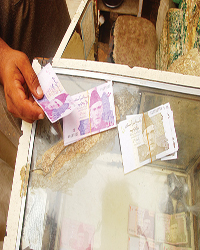
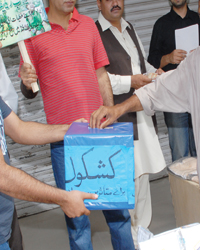 But
it is not only inflation which is hindering the donation process. Kazmi
admits that the appearance of several ‘fake’ NGOs has hit the
organisation’s charity work during this month.
But
it is not only inflation which is hindering the donation process. Kazmi
admits that the appearance of several ‘fake’ NGOs has hit the
organisation’s charity work during this month. However,
Kazmi points out a new trend which the Edhi Foundation has witnessed this
year. Most of the international contributors, who constitute 40 per cent of
their total donors, are women.
However,
Kazmi points out a new trend which the Edhi Foundation has witnessed this
year. Most of the international contributors, who constitute 40 per cent of
their total donors, are women. political party started gathering animal hides and people were so fearful
that they would not give donations to anyone else.”
political party started gathering animal hides and people were so fearful
that they would not give donations to anyone else.”