


|
|
|
|
 |
 |
 
|
essay comment Compositions
from the core
essay We, as a nation,
are acquiring new habits: we are getting used to violence, mayhem, gang
rapes, mass murder, suicide bombings as everyday events. And what we are
becoming too familiar with is against the very raison d’être of the
state. The idea of the state emerged in the world, as theorised by Thomas
Hobbes, as a reaction against the natural condition. Human beings created
the institution of the state so that the institution will help them overcome
the condition described as bellum omnium contra omnes, the war of all
against all. The idea was that the
state would acquire an absolute monopoly over all forms of violence whether
tribal, clannish or familial. A father could no longer beat his child nor a
husband could thrash his wife. All forms of violence were going to be
administered through the institutions of the state. The ownership of your
body, private property, and your ideas could not be violated without the due
process. This monopoly over violence exercised by the state was to bring
peace to the entire collective of citizens. This was the contract between
the citizen and the state. The citizens would pay the taxes and the state
was to expend those taxes to distribute justice. Slowly the idea of justice
transformed into something even grander: some states started programmes to
distribute economic as well as structural justice. Even hunger and illness
were considered as violent phenomenon for the citizen. The state became the
greatest equalising force in some societies. It protected the citizen from
the cradle to the grave. It brought the indigent to the level of the elite
by making the elite pay greater taxes. The accident of birth, in a poor
family, was no longer supposed to inflict lifelong misery on any citizen. Over the years, through
the successful implementation of the basic ideas of the state, some entire
populations became free of random violence. Monaco, Palau, Hong Kong,
Singapore, Iceland, Japan, French Polynesia, Brunei, Bahrain, and Norway all
have been able to reduce non-formal violence to the level that they all have
less than one murder victim in every 100,000 citizens. This produces a
social situation where the citizen owes the state safe or ethical. The
citizen has grown up to be a fully unharmed adult because of the social
contract and now he/she owes the same safety to the entire public sphere.
This credit of safety gives the state the right to demand moral acts of its
citizens. The state can claim that
it has been a good creditor of morality and safety and has kept its side of
the bargain. The lender of safety can now levy taxes and demand safety of
the public sphere. This is the reason why the state does not punish juvenile
offenders. They have not received enough credit of safety yet and they are
not fully enfranchised citizens. The same is the case with those adult
citizens whom the state has not been able to protect from harm. If a citizen who has led a
precarious life commits a crime, the social contract is less binding because
he/she has not received enough credit of safety. This was the reason Julian
Assange was not imprisoned by the Australian justice system when he was
arrested for the first time as a teenage hacker. The Judge showed leniency
because of the “unstable personal background”, “the nomadic
existence”, and “personal disruption that occurred” in the household
in which Assange grew up. The Judge, a representative of the state was
acknowledging the fact that the state had not been a good lender of safety
to Assange. What all this means for
the social contract in Pakistan and how binding the social contract is for
Pakistani citizens is quite obvious. The very basic principle that the
citizen has to feel safe first as a child, then as a teenager, and then as a
fully enfranchised citizen so that the state can later demand safety of the
public sphere is not being followed by the state in Pakistan. In fact, the
state of Pakistan has broken this contract many times and may have lost its
right to demand moral behaviour from the citizenry already. The state broke the social
contract for the first time when it accepted bribes from the newly arrived
citizens to assign them the evacuated properties of the fleeing Hindu
population. The state also broke the social contract when it did not allow
the majority of East Pakistanis to assert their democratic will. The state
broke the social contract when the institution mandated for external
security repeatedly conquered the parliament. The state also broke the
social contract when it declared some citizens to be inferior citizens
because of their beliefs without asking them to pay half of the taxes. The
state also eroded the trust of its citizens when it started producing
informal militias for guerrilla warfare and started selling ordinary
citizens’ capacity of violence to other states and became a client or a
vassal state engaged in proxy warfare in the region. How can the state demand
moral behaviour without giving any credit of safety to its citizens? We the
citizens are right when we display a nihilistic ennui and anomie at the news
of every attack as a habit. We are getting used to broken promises. The
state has violated the social contract so often that we have stopped
expecting anything other than more broken promises. We are not surprised
when we hear that the Taliban are attacking the jails, marketplaces,
shrines, and schools. These enemies of the state were trained by the state. In political theory, there
is no difference between a criminal who arises from within the boundaries of
the state and the soldier of the enemy state who attacks on the orders of
another sovereign. What the Taliban signify for the social contact is this:
any person who does not recognize the state of Pakistan as the sole arbiter
of violence and the sole distributor is the enemy of the state. The irony is
that some of these enemies of the state were originally trained by the state
itself. That is why nobody can think or feel coherently anymore about the
political institutions. The political and juridical ramifications are
unnerving. The state used its own resources to undermine its own sovereignty
and even marketed this shattered sovereignty as a capacity among the
international bidders, other sovereigns. Now the collective body of
all the citizens is under threat. The policemen are involved in gang rape
and they record their violence on video and show it to the parents of the
victim and the judges are afraid of the perpetrators of non-formal violence.
When the police arrest a car thief they pray that he is not a foot soldier
of the Taliban because then the arresting officers are at risk. When the
judge expects a jihadi to appear in the court, he usually directs a
policeman to dress like a jihadi and appear in the court with a black or
brown cotton sack covering the face. The judge is afraid of speaking in
front of a blindfolded jihadi in case the jihadi recognises and remembers
the voice of the judge and later on seeks revenge. If the fully armed
institutions of the state, the police, the judiciary, the army, are
threatened by the non-formal sources of violence, the social contract is no
longer binding for anyone. If the police and the army is not for the
protection of the citizen, what right does the state have to levy any taxes?
The state exercises its writ through its absolute monopoly over violence.
That is what defines the modern state as the sovereign. In Pakistan,
however, the sovereign state has many competitors and challengers to this
monopoly over violence. Hence, Pakistan has become
a bazaar where competing sovereigns display their capacity to inflict
violence. It can mean that there is in fact no moral responsibility and no
accountability and nothing that is binding. If a citizen is still behaving
morally, it just means he or she is being generous or magnanimous towards
others around him. All this leads to only one
logical conclusion: we display nihilistic ennui so that we do not have to
deal with the fact that there is no valid social contract operating between
the state and the citizenry anymore. It is already a free for all. The
citizens are just making do with a make-believe moral system in a
make-believe state. Nobody knows when the charade will come to its logical
conclusions. The writer is concerned
with all forms of freedom. His work is available at www.saeedurrehman.com
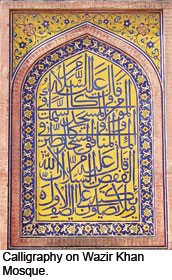
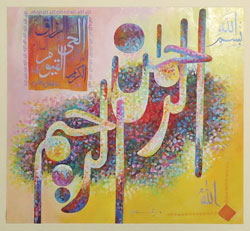
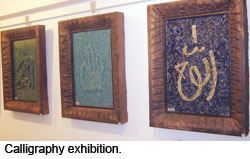
comment A number of
invitation cards of calligraphy exhibitions start arriving as soon as the
month of Ramzan begins. Although calligraphy is practiced throughout the
year, actually for centuries in Muslim societies, the increase of this
genre’s public viewing in Ramzan has become a norm. This is precisely what
discourages me from going to calligraphy shows at this time of the year. You could call it a
baseless bias against the form due to its political (ab)use during Ziaul
Haq’s period. The truth is that long after the military dictatorship has
ended and when there are no supporters and promoters of calligraphy as the
only kosher art form, the reaction to calligraphy remains. This is mainly because we
may have moved away from the doctrine, but we are still caught up in the
complexities imposed by a government that sought religion for its
justification to rule. And even in this age of global exposure made possible
through internet, tv channels and expanding means and opportunities of
travel, we still adhere to the same attitudes and behaviours that were set
in place in the late 1970s and early ’80s. To observe religion is not
an unusual practice, and human cultures have thrived on their connection
with and interpretation of faith. In the past, art has been associated with
religion, whether it was Christian iconography, Hindu deities, Buddhist
imagery, or archaic and primitive faiths of African tribes. In fact, in the
earliest human history, one could not differentiate between religion and
art, since both blended into each other, especially in the cave paintings
from 30,000 years ago. In the later periods, too,
art was meant to be a vehicle to serve religious rituals, and was not
created for other motives like optical experience, aesthetic necessity or
sensuous pleasure. From the caves of
prehistory to the glorious canvases of Renaissance, the history of art is
infused with sacred content. Today, the believers of some faiths are not
active the way they were in the past, especially after the Enlightenment in
Christianity and the Marxist ideology adopted by Buddhist China. Societies which are still
considered to be Jewish, Christian or Buddhist — despite the extraordinary
traditions of art based upon religious themes, narratives and stories —
are now dominated by a certain kind of atheism, suspicion and alienation
with religion. Yet, in those cultures which now have a largely disinterested
public that does not consider religious value as important, these works are
still appreciated. The works, beginning from cave painting to Egyptian art
to Mesopotamian sculptures to Greek art to Christian paintings and
sculptures, are now enjoyed not for their religious content or historical
significance but for their formal, pictorial and aesthetic aspects. Therefore, people from
across civilizations and cultures are able to appreciate these works, only
because the makers of these pieces were able to infuse elements which
surpassed their immediate narratives, to liberate their creations from the
narrowness of one interpretation, and convey other concepts and aspects of
art making. But when all that
pictorial contribution is compared to calligraphy, the question arises:
whether the art of writing can still be enjoyed without its sacred content.
Actually the history of writing precedes the Islamic era, since Chinese
calligraphy tradition dates back to thousands of years. But it was Muslim
societies which concentrated on the art of writing (along with geometry and
architecture) and made it into a sophisticated form of personal and
collective expression. In our society, for years children were taught how to
write beautifully in school by practicing on takhti with reed pen and ink. It would be interesting to
link the decline in that training of calligraphy from our educational system
and the rise of calligraphy as art in our culture; particularly with its
religious significance. Because when a considerably large number of people
was able to write perfectly, calligraphy was not perceived an ‘exotic’
skill neither did it have a specific sacred connotation. But as soon as
calligraphic writing ceased to be a shared cultural practice and experience
in schools, the religious side of calligraphy emerged strong and was
promoted to propagate a ‘pious’ version of Pakistani art and society. It
has been marketed for the purpose of bringing good luck and blessing to
houses where pieces of holy text are hung on the walls. Thus, over time, the
secular content was overshadowed and obliterated by the sacred script. Now
when we think about calligraphy, we can not detach the religious text from
the art of writing beautifully (although in our recent past, great
calligraphers like late Perveen Raqm and Hafiz Yousuf Sadidi wrote poetry
and other lines which were not religious with immense skill and mastery).
This is the reason that whether scribed on paper or painted on canvas,
calligraphy as an art form has become limited to religion. Not in its
content alone but also in the approach of its makers and supporters who
believe that by including verses from the Holy Quran or sacred names of God,
their output would be valued, praised (and purchased) immensely and easily.
This is especially true for the holy month of Ramzan when the religious
sentiments are high. This tendency of confining
calligraphy to one dimension makes one reluctant to visit shows of
calligraphy across Pakistan. Does that sound ununderstandable?
Compositions
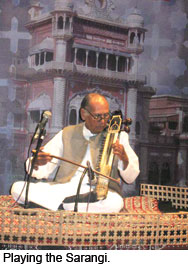
from the core Ustad Buland Iqbal
who died recently in Karachi was a good film composer and an even better
sarangi player. He composed music with a
colleague Lal Muhammed; the duo was known as Lal Muhammed Iqbal. Lal
Muhammed too was an instrumentalist for he played the bansari and the two
teamed up to compose some very good songs which became very popular for
their melodic intensity. Lal Muhammed died about four years ago. Buland Iqbal belonged to
the Delhi Gharana which meant that he hailed from almost the aristocracy of
musicians. He was the son of Ustad Bundu Khan who was the most noted sarangi
player in the country around the time of partition. His son Umrao Bundu
Khan, the brother of Buland Iqbal, also played the sarangi and also sang
during the 1960s and 70s mostly for Radio Pakistan, Karachi and in private
mehfils. In the presence of such
great sarangi players, it must not have been easy for Buland Iqbal to make a
real breakthrough and prove himself to be the greatest of them all. Instead
he chose the field of composition that must have provided more of a
challenge to him in comparison to merely playing the sarangi. The first film that the
duo composed music for was ‘Bara Bajeh’ probably released in 1961. In
all, they did thirty five films
some of them being ‘Samundar’, ‘Aazadi
Ya Maut’, ‘Jaag Utha Insaan’, ‘ Akele Na Jaana’, ‘Mere Laal’,
‘Doosri Maa’, ‘Laadla’, ‘Nasseb Apna Apna’, ‘Hanste Aanso’,
‘Paazeb’, ‘Anhon’i, ‘Siyasat’, ‘Jahan Barf Girti Hai’, ‘Janwar’,
‘Akhri Hamla’. They also composed music
for ‘Ma Tey Maa’ in Gujrati, ‘Hakim Khan’, ‘Meraan Jamali’,
‘Himmat’ in Sindhi and ‘Yousaf Khan Sher Bano’ in Pashto. Besides Noor Jehan and
Mehdi Hassan, they also brought out the best in Runa Laila, Ahmed Rushdi,
Mala, Shahnaz Begum, Alam Lohar, Masood Rana, Irene Parveen, Mujeeb Alam and
Habib Wali Muhammad. He was also a good teacher
and imparted training with a great deal of generosity to many wanting to get
familiar with the esoteric world of music.
Since the entire system of the traditional ustad shagird nexus had
broken down the alternative system of tuitions hardly worked to the
satisfaction of both teacher and student. The students have thought that the
ustads are not teaching with sincerity while the teachers have disapproved
this part time activity. Still Buland Iqbal transcended these limitations
and taught with dedication to all that came his way. Usually instrumentalists
were hard put to earn for themselves, so they preferred to join an
organisation which provided for them on a regular basis. The most preferred
organisation was the radio set up in the 1930s which after some policy ups
and downs decided to employ musicians on a regular basis. Known as “staff
artists”, these musicians were on the monthly payroll of the organisation,
irrespective of their hours of engagement. Musicians also preferred to join
the radio since it was perceived that this organisation employed the very
best musicians and was a sort of a certification of their having arrived. Film was more paying but
it was erratic. If the film did well at the box office the people who worked
for it got compensated otherwise the terms agreed upon in the contract were
hardly honoured. The other options were live performances where an
instrumentalist was supposed to accompany vocalists. It was rare that an
instrumentalist was invited to perform solo for people who were not
initiated were keen to remove the abstraction of the pure sound by stuffing
it with words. Delhi Gharana spawned many
forms and types of music. It was also the mother gharana of khayal gaiki
with Mian Achpal and Tan Rus Khan as its pioneers. It also gave rise to the
Delhi baaj in tabla and also an ang in the playing of the sarangi. All this happened at a
time when Delhi as the capital of the empire was under great strain of
centrifugal pressures. The artistes, poets, painters, architects and
musicians were leaving it for more secure and affluent centres like the
various princely states and many of the gharanas thus became famous after
the princely states in the following decades rather than the founding ustads
who had originally migrated from Delhi. The label stuck more in
sarangi and tabla than it did in khayal and
since Ustad Bundu Khan was considered to be a very well established
sarangi Nawaz, at the time of partition he moved to Karachi and set up his
abode where music and the sarangi were elevated to the level of an
institution. Buland Iqbal may have
suffered in terms of opportunities since he was Karachi-based, while the
centre of filmmaking was in Lahore. Some of the more successful artistes,
producers and directors shifted from Karachi to Lahore but some did not or
could not and thus narrowed their range of opportunities. Buland Iqbal
proved his ability within that narrow range of opportunities.
Some famous numbers
‘Bansi bajai koi
nadya key par re’, ‘dunya
kisi key pyar main jannat sey kam nahin’, ‘bhawain tani hain khanjer
hath main hai’,‘aye abre karam aaj itna baras’,‘dil main basaya
piyaar se hum ney’,‘tera mera saathi hai lehrata samundar’, ‘dil tum
ko dey dia hai’,‘aaj nahin to kal is ghar main’, ‘saiyaan anari
merey dil ko jalaya’,‘o dunya jane merey watan ki shaan’,‘ik uran
khtola aye gaa’, ‘teri jabeen yeh chaudeween ka chaand’, ‘socha tha piyaar na
karen gey’,‘aap sey phir pyaar hua’,‘manzil door nahin’ , ‘in
mardoon sey allah bachae’, ‘kis key qadmon ki aahat hai yeh’, ‘mera
chan mahi kaptaan’,‘mori ghaghar ka paani chalak chalk kyoon jai’,
‘ankhoan main kajal hatoon mai mehandi’,‘subhaan allah yeh chehrey’,
‘mili gul ko khushbo’ , ‘chor key anchal na ja’,‘sharmaa key jaani
wali’,‘mujh ko mila aisa mehboob’,‘arosi parosi chahe jo bhi
kahain’,‘kahan chali rey gori bun than key’,‘sainyaan anari sey
naina mila baithe’,‘dil ki dharkan pukare tera naam’,‘kuch dey dey
ya kuch ley ley’,‘patta jo kharke’.
|
|