


|
|
|
|
 |
 |
|
|
Editorial tussle Tough
fight From
the inside encounter “They are
misleading the IOC” The
case of two national games
We in Pakistan are
adept at transforming our weaknesses into advantages; albeit in a convoluted
way. Those reaping the advantages are fewer in number and the scale of
profit-making is huge. One may have often
wondered what stops our talented sportsmen and women from excelling on the
international scene; from winning awards and medals. And one would not have
to look too far to understand the cause. The very fact that at the
moment there are two Pakistan Olypmic Associations, headed by two retired
generals who are busy holding and winning independent elections, each
claiming to be the most authentic body, and even conducting two separate
national games, is proof of
what’s wrong with the sports scene in this country. Each side states with
a straight face that if the situation persists, the International Olympic
association would suspend Pakistan’s membership, as if to blackmail the
other side into accepting its point of view. This is a petty war of
egos. This is not the stuff the people managing the field of sports would
allow anywhere else in the world. No wonder, the state of sports in this
country is so abysmally low. The decision of the
Supreme Court in favour of one of the two parties has not helped matters
either because the legality of something like a national Olympic association
which is linked in more ways than one with the International Olympic
Association cannot be established by the apex court. It cannot decide it in
favour of one party which is not accepted as the legitimate body
internationally. In all this infighting, it
is sportsmen and sportswomen who suffer the most. The organisations that are
supposed to promote their cause are busy promoting their own offices and
positions, depending upon how close they are to the corridors of power.
Interestingly, in our case, the corridor of power remains the same because
both groups are headed by retired generals of the Pakistan army. Perhaps it is time to
civilianise the sports and let this be a level playing field in the true
sportsman spirit of sports
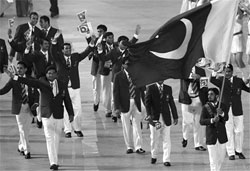
tussle Pakistan has not won an
Olympic medal in more than 20 years — since the bronze medal won by the
hockey team in Barcelona 1992. That means the national contingent has
returned home empty-handed from the last five editions of the Olympic Games
held in Atlanta, Sydney, Athens, Beijing and London. Things look even worse
in the lead up to Rio 2016 as not many Pakistani athletes are likely to even
qualify for the next games. That’s
a long list of failures. So, what would you do if you are at the helms of
sports in a country at a time like this? You
fight, if you happen to be in Pakistan! And
I’m not talking about the tough fight for a positive change. I’m talking
about a power struggle that has brought the Pakistan Olympic Association (POA)
on the brink of an international ban. The
main rivals in this tussle are two former army generals, both unwilling to
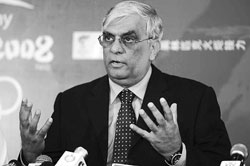
budge. General
(retd) Arif Hasan, as president of the Pakistan Olympic Association (POA),
says he is struggling to shield the very spirit of the Olympic Movement in
this country. But as the head of a parallel POA, General (retd) Akram Sahi
— Hasan’s bitter rival — claims he is fighting in the greater interest
of Pakistan sports. Both
of them have powerful allies backing them. Hasan
has the complete support of the International Olympic Committee (IOC), a
body that has the final say in matters related to Olympic sports. Sahi is
backed by the Pakistan Sports Board (PSB) and to a great extent by the
Ministry of Inter Provincial Coordination (IPC). Both
PSB and the IPC ministries are important players in this power struggle
which is threatening to push Pakistan sports towards further destruction. The
story is both complicated and simple. It is complicated if you allow
yourself to get buried in the loads of paperwork that include court rulings,
countless emails shot by either party, stinkers written by the IOC, the
government responses, etc. But it is simple if you take a look at the bigger
picture. If you do that then it becomes obvious that the main issue here is
the so-called minus-one formula. The big objective here is to get rid of
Hasan as POA chief. If that happens, then it is likely that other issues of
lesser magnitude would be resolved without much fuss. Hasan’s
adversaries believe that they have enough ammunition against the POA chief.
Their biggest contention is that according to the national sports policy,
Hasan cannot be allowed a third term as POA president. They have a point. In
February 2012, Hasan was elected as POA chief for a third four-year term
that ends in 2016. The sports policy, however, dictates clearly that a third
such term is illegal. The
anti-Hasan group also put forward multiple court rulings which they claim
are against the results of last February elections. “We
believe that Arif Hasan doesn’t have any justification to be POA
president. We would make sure that he is forced to quit and once that
happens this crisis would be over,” claims a source in the anti-Hasan
camp. But
it is not as easy as it sounds. In
spite of a powerful opposition which has the backing of the government,
Hasan remains in a commanding position. He is like a batsman standing on the
crease while the opposition is on the bowling end. A bowler can come down
the pitch, stare at the batsman and even say a word or two. But in the end,
it is the bowler who has to go back to hurl his next delivery. In such
cases, a batsman always wins whatever the scenario. As
long as Hasan has IOC’s support, he cannot be dislodged. That is something
that the government authorities will have to understand. But that means
there won’t be an easy way out of what is a neck-deep crisis. However,
Hasan and his supporters believe that an amicable solution can be reached. They
are calling for a review of the national sports policy. They also want the
relevant government departments to take a neutral stance over the issue. But
first of all, they want all stakeholders to agree that Arif Hasan is the
legitimate head of the National Olympic Committee (NOC). They are of the
view that once that’s done, then the war would be over. But
the problem is that a war isn’t war till the time both parties say it is. Hasan
and his supporters will stick to their guns because they know that with
IOC’s support they would win eventually. His
adversaries don’t think so. They are of the view that with an all-out
backing by the government authorities, who fund Pakistan sports, they would
succeed in ousting the POA president sooner rather than later. Unfortunately,
this standoff is already hitting Pakistan sports where it really hurts. Recently,
Pakistan scrambled to send a depleted contingent to the Asian Youth Games to
be hosted by China because the government decided against providing any
funds for it. The POA which doesn’t have the sort of funds enjoyed by the
PSB managed to foot the bill. A
controversy is unfolding over next year’s Commonwealth Games in Glasgow
and there are fears that the POA infighting might result in Pakistan’s
ouster from the quadrennial spectacle. That is because, the Pakistan Hockey
Federation (PHF) decided to overlook the POA reminders about showing its
intent to participate in the Glasgow Games. Instead, it opted to put the
ball in the PSB’s court and sought government permission to take part in
the event. The issue has to be decided before August 16 — the deadline to
accept a formal invitation from the Commonwealth Games Federation (CWGF). It
is feared that unless an amicable solution is reached, a similar story would
be repeated over Pakistan’s participation in Asian Games 2014. That’s
not all. If
the issue is allowed to drag on, there is this clear and present danger that
the IOC would suspend Pakistan’s membership. Such an eventuality would be
catastrophic for Pakistan sports. In the past, IOC has banned countries like
India, Iraq and Ghana and the body is unlikely to hesitate if such an action
is needed to be taken against Pakistan at some point in time. It
is time that instead of inching towards an international suspension, all
stakeholders should sit down and talk out their differences. In fact, the
tussle can even prove to be a blessing in disguise because it provides an
opportunity to right the various wrongs in the system. It
is important that various important issues like the controversial national
sports policy are discussed thoroughly before being reviewed. The policy is,
indeed, an incomplete one and there is this desperate need to refresh, or
even rewrite it with an emphasis on sports promotion and development
starting from the grassroots level. The PSB, too, should review its various
clauses, especially 4iia and 4xi that are seemingly in direct conflict with
the IOC charter. The Board and other relevant government departments should
not involve themselves in any move that is perceived as a power struggle.
They are there to support and facilitate Pakistan sports and not to seize
absolute control of it. Hasan
and his supporters will also have to show their keenness to resolve this
issue. They will have to be flexible. By winning last February’s election,
Hasan emerged as the legitimate chief of the POA. But he should make it
public that he won’t even think about looking for a fourth term in 2016.
As POA president, he will have to give more to Pakistan sports during his
last few years in office than he has given in his first two terms. In
the meantime, Pakistan’s sports fraternity will have to devise ways and
means to come out with a transparent process to elect office bearers of
bodies like the POA. The main criterion to elect an official should be what
he or she knows about sports and its development rather that whom, he or she
knows in the corridors of power. Otherwise, Pakistan sports will continue to
suffer.
Tough
fight Everywhere in the
world, whenever Olympics are concluded, sports authorities start preparing
for the next edition — they announce training plans for their athletes and
commence their work, eyeing more medals than before. But, in Pakistan, things
are different. Here, the sports authorities remain busy, not for the benefit
of sportsmen or promotion of the game, but for their personal survival in
respective sports bodies, including the Pakistan Olympic Association. No wonder, Pakistan
hasn’t been able to win a single medal in Olympics since winning a bronze
medal in men’s hockey in Barcelona, 1992. Pakistan, that was already
struggling in international sports arena, and virtually isolated due to
security situation in the country, is facing a suspension from the
membership of the International Olympic Committee (IOC). The IOC reiterates it only
recognises the POA headed by Lt Gen (retd) Arif Hasan. It also warned
Pakistan authorities against holding any “illegal” elections, however,
authorities remained unfazed and organised the elections on July 5, 2013. Things are getting worse.
The IOC has already advised all the affiliated sports bodies to not
entertain athletes nominated by the “parallel” and “illegal” POA
headed by Major General (retd) Akram Sahi. Jérôme Poivey, head of
the Institutional Relations and Governance in the IOC sent an email to all
international bodies on May 31, clarifying that the IOC recognises POA
headed by Gen. Arif Hasan. What is more worrisome is
the fact that the new POA, which is termed “illegal” and “parallel”
by the International Olympic Committee, is run by the head of the Athletics
Federation of Pakistan, who apparently believes the present scenario isn’t
harmful for sportsmen. “Sportsmen are not at
loss, only Arif Hasan is on the losing side,” Akram Sahi told the media
when he visited Karachi in June. The News on Sunday
understands that at least two international sports bodies have told their
representatives in Pakistan to refrain from supporting the parallel body,
else face the ban. Pakistan’s Basketball
Federation is already suspended by the international governing body of
basketball, but Asif Bajwa, the man in-charge of the game in the country,
seems unruffled by the events. Sportsmen in the country
are suffering due to this tug-of-war between the two groups. While the
international authorities listen to the Gen Arif Hasan’s POA on nomination
and participation of athletes, these athletes will need an NOC and funding
from the government which comes from the government, and the government is
backing Maj Gen Akram Sahi as the POA’s head. Recently, Pakistan’s
contingent for the 4th Asian Indoor and Martial Arts Games in Incheon, Korea
was cut-short to 13 from 40. The country missed out participation in
disciplines of kabaddi and snooker, both sports were a medal prospect for
Pakistan. It is understood that
sports authorities that support Arif Hasan are scared of announcing the
squad for any particular event, as the government may block their departure
from the country. Pakistan Swimming
Federation was forced to send the players to the World Championship in
Barcelona last week on self-funding basis, to avoid any possible problem,
they also avoided to publicise the squad. The Pakistan Swimming
Federation was probably aware of what was being done with the table tennis
players and how attempts were made to stop their participation in the World
Championship in France. “We thought they tried to stop the table tennis
players and that they could do the same to other athletes; that’s why most
of the federations have decided to not make their participation public
unless the athletes have joined the start-list,” says a source, who
prefers to remain anonymous. Arif Hasan, who is also
backed by the International Olympic Committee, says the situation is not
healthy for the future of Pakistan sports. “It is unfortunate that sports
and sportsmen in Pakistan are suffering due to this unwanted situation,”
says Arif Hasan. Gen. Hasan says he is
backed by the IOC, but the problem is that the PSB has stopped all funding
and camps for athletes “who are nominated by us. We are trying to ensure
Pakistan’s participation at the international level and we are not getting
funds from the government due to obvious reasons. We are doing it on our
own,” says Arif Hasan. Participation of the
Pakistan Hockey (PHF) team in next year’s Commonwealth Games (CWG) in
Glasgow is also uncertain as the PHF has openly supported government
interference in the Olympics movement in Pakistan, which is also a violation
of the IOC charter. Although, Arif Hasan is
making attempts to ensure Pakistan’s participation in the CWG hockey, the
PHF sought advice from the PSB which directed them to Akram Sahi’s POA,
which is not recognised by the International Olympic Committee, Commonwealth
Games Federation and Olympic Council of Asia. “I’m trying my best to
use my contacts and relations to avoid Pakistan’s suspension. But for how
long will the IOC and OCA wait? We can’t ignore the Olympic charter,”
says Arif Hasan. Ironically, this tussle
for power in POA has also led to the creation of parallel bodies in
different sports federations in Pakistan, leaving sportsmen in a catch-22
situation on where to go. Parallel Federations of
boxing, athletics, cycling and table tennis are already in place, probably
not for the benefit of the games but perhaps to control the power corridors
of sports. Not only this, the
government-backed interim committee, that also organised the “illegal”
POA elections, imposed a ban on officials who were supporting Arif Hasan. It
also endorsed the officials of parallel bodies. More than a dozen sports
bodies supporting Arif Hasan as POA’s president were declared
“disaffiliate” by the interim committee. To further worsen the
situation, the interim committee organised the national games in the country
last month and declared the results of the 32nd National Games conducted in
December 2012 as null and void. Athletes who participated
in the national games held in December are skeptical — they protested
against the games held last month but the interim committee remained
unfazed. On the other hand, the
athletes who participated in the recent “controversial” national games
fear they may face un-announced ban by Arif Hasan’s POA. “I don’t know
what to do. I participated in the national games as I’m contracted to
represent the army that stands with Gen. Sahi,” says national swimmer
Kiran Khan, who won 16 gold medals in the national games. “It is highly
demotivating for us to hear that Pakistan can be banned by the IOC soon,”
adds Kiran. After witnessing the
sports authorities in Pakistan in such disarray, one wonders what if the
same level of energy was used by them to promote sports. Would Pakistan have
been in a better winning position in international sports arena? All said and done, whoever
stays and whoever goes, but sportsmen are the ultimate sufferers in this war
for power in the POA. The writer is sports
correspondent for Geo News and tweets at @faizanlakhani
From
the inside Established in
1948, Pakistan Olympic Association (POA) started working with Ahmad E H
Jaffer as its first president. Quaid-i-Azam Muhammad Ali
Jinnah, the first Governor-General of Pakistan was nominated as the
patron-in-chief of the POA. Today, it composes of four provincial and two
federally administered tribal areas (FATA and Islamabad capital territory)
associations; 34 national federations of sports, and six services
organisations which include Pakistan army; Pakistan railways; Pakistan navy;
Pakistan police; Pakistan air force; Water And Power Development Authority;
and Higher Education Commission. The association has 20
aims and objective to perform its role. Some of them are: to foster and
develop olympism, the olympic movement along with its high ideals and ensure
the observance of the olympic charter; to encourage, promote, control and
assist in the development of sports in Pakistan, etc. The objectives also
include to hold and supervise the national games at least once in two years
or whenever necessary; and to affiliate national federations of games or
sports recognised in the olympic movement, associations, and to arrange and
encourage systematic training of sportsmen, coaches and sports
administrators in Pakistan. In its Constitution
revised in 2011, the mission of the POA — also recognised as National
Olympics Committee, connected to International Olympics Association — is
“to develop and protect the olympic movement in Pakistan in accordance
with the olympic charter”. In order to fulfill its
mission, the Pakistan Olympic Association may cooperate with governmental or
non-governmental bodies. However, it will never associate itself with an
activity which would be in contradiction with the Olympic Charter. “The POA is known as
National Olympic Committee (NOC) of Pakistan. Within the country, the POA
remains the oldest sport body,” says Shaukat Javed, one of the vice
presidents of the association.” The IOC fully recognises it as the main
body in the promotion of sports in Pakistan, he adds. The POA was the premier
regulator of sports activities in Pakistan from 1948 until the establishment
of the Pakistan Sports Board (PSB) in 1962, which is an official body of the
government of Pakistan. The POA was recognised by the International Olympic
Committee (IOC) in 1948. Subsequently, it also became member of the
Association of National Olympic Committees (ANOC) and the Olympic Council of
Asia (OCA) respectively. Fundamentally, the POA is
considered as the only representative of the IOC in Pakistan and operating
exclusively under the Olympic Charter, independent of political, public or
private organisations whatsoever. s “As an NOC, the POA is
the first contact point between the IOC and Pakistan. The POA is responsible
to bring athletes to regional, Asian, Commonwealth and olympic games and
continues to develop programmes in coordination with its affiliated member
units to promote sports at various tiers. It is also responsible for
organising the national games every two years,” says Javed. The Constitution of the
Pakistan Olympic Association (POA) was previously modified and updated in
2007 in accordance with Guidelines of the International Olympic Committee
(IOC) after completion of all Constitutional formalities of POA so as to
bring it in line with the Olympic Charter. The IOC, while conveying
the approval of the Constitution of the Pakistan Olympic Association vide
its letter dated 6 September, 2007 had directed that any subsequent change
made to this text upon POA’s own initiative or upon the IOC’s request
shall require the approval of the IOC. Office-bearers of the POA
are supposed to be elected every four years in an elective meeting of the
General Council. The elected office-bearers include the office of the
President, 10 Vice Presidents out of which three shall be one lady Vice
President; Secretary General, and Treasurer. There will be seven Associate
Secretaries Generals. All the Office Bearers, except the President and
Secretary General shall be elected from amongst the persons eligible to
attend the elective meeting of the General Council. The office bearers shall
continue to hold office for a term of four years or till next election. The executive committee of
the POA shall consist of all office bearers; IOC member(s) in Pakistan;
twenty representatives of the member units to be elected at an elective
meeting of the General Council; Lady members as per directive of IOC
nominated by President POA duly approved by the General Council; one
representative from the Athletes Commission nominated by the President. Meetings of the executive
committee shall be held at least twice every year or as frequently as
necessary. The sitting president of
the POA, Lieutenant General (retd) Syed Arif Hasan is the 11th president of
the POA and the second longest serving top office-bearer after his
predecessor Syed Wajid Ali who held this post for almost 26 consecutive
years. The IOC recognises Arif
Hasan as the POA’s president and asked the former general to establish
fruitful dialogue with the government of Pakistan to find solutions. The IOC in its at last two
letters clearly issued by the heads of two separate divisions — the NOC
Relations and International Relations and Governance — has most
resoundingly endorsed the Pakistan Olympic Association’s (POA’s) stance
with regard to unlawful interim committee of the POA and its sham elections.
A former military athlete
Major Gen (retd) Akram Sahi emerged as a candidate for the post of POA
president and after losing the election he moved court against the elections
and has made a parallel POA. vaqargillani@gmail.com
encounter The News on
Sunday: What is the issue with the POA and why has it not been resolved yet? Lt General (retd)
Arif Hasan: Those who lost the elections to me in July joined hands with the
Pakistan Sports Board (PSB) to remove a legally elected President, totally
misinterpreting the Supreme Court’s decision. The POA is a
non-governmental organisation and is a creation of the International
Olympics Association and, as per rules of the IOC, it should be free of any
political or government influence. It’s quite strange that Pakistan is one
of the few countries, out of the 204 members, which defies this rule. The
so-called POA headed by Akram Sahi has full support of the government which
wants to control the federations through funds which it gives to these
sports bodies through PSB. There have been repeated
warnings of Pakistan’s suspension as an IOC member if the problem persists
but this group is not deterred at all. TNS: Your opponents claim
your election for the third time is against rules and there were
irregularities in the election process. AH: The three tenure
clause was included in the Sports Policy which has been contested by the
federations since its inception on the plea that there is no such clause in
their constitution, which for them is the supreme document. The PSB, to off
set this argument, amended their rules in 2009. The board wants to
centralise everything. They gave itself the powers to annul or amend any
constitution of any federation and suspend any of its officer-bearers
whenever it wanted. The IOC objected to this and asked federations to simply
follow their constitutions and requested the PSB to respect the constitution
of the federations and also to remove these clauses from the rules. As far as the POA is
concerned, it does not get any grant from the PSB and is also not affiliated
with it. It is a body of the IOC. The Supreme Court order is very clear.
They have in para 10 of their judgement stated that their decision does not
affect POA. In para 6 of the same decision they have also categorically
stated that the Sports Policy is only applicable to those affiliated to the
PSB. On the elections, I would say I was elected through secret ballot and I
had a clear lead over both the other candidates — Akram Sahi and Qasim Zia.
The matter is in the
Supreme Court and I cannot comment any more on this. Meanwhile, they have
set up an interim committee and despite warnings from the IOC established a
parallel association through bogus and fraudulent elections which have no
legal value. Even the PSB observers in their report confirmed
irregularities. It should not even be called POA in the first place. I would request the media
not to call it POA as it has got nothing to do with the international
olympic movement. Saying there are two POAs creates confusion. TNS: What can be the
implications if this deadlock persists? AH: IOC would simply
suspend Pakistan’s membership which would disgrace the country and deprive
its players from competing in international sports events. We (POA) have
managed to ward off this threat till now but for how long I don’t know.
Today, there are several parallel sports federations established on the
behest of the government to qualify as an electoral college for selection of
a so-called POA. As all the funds come from
the government, PSB blackmails players and genuine sports federations with
suspension of financial support if they go with the genuine POA. There are
no funds to pay for training for players and sending them to international
destinations for participation in events. Sportsmen have recently travelled
on self-help basis as the federations and POA has facilitated them. I hope
this stalemate would end and the POA and the government work hand-in-hand on
the promotion of sports. TNS: How can the POA you
represent work when it is financially dependant on the government,
especially when it is opposed to it? AH: POA gets no grant from
the PSB. It primarily has an advisory role and the promotion of sports falls
purely in the government’s domain. Besides, it assumes the role of forming
linkages of players and government with international bodies for the
promotion of sports. Whenever it has arranged events or wanted to send
players in international events, the finances have come mostly from the
government. Only the government has resources to promote sports from top to
the union council level and in educational institutions, etc, to produce
sportsmen. TNS: Your opponents allege
the POA in the recent past has not performed well, used government funds and
not honoured court decision, especially the one regarding your elections.
How do you defend yourself? AH: How can POA be held
responsible for non-performance in hockey or athletics, etc? These
federations get direct funding from the PSB and POA has no role in training,
etc. All these allegations are wrong. POA, while remaining within its
mandate, has performed very well. For example, it successfully held SAF
exams in Islamabad which are known as one of the best in history. It raised
over Rs200 million funds under the banner of Pakistan Sports Trust, each and
every penny of which has been accounted for and audited. The association holds
lectures in schools, colleges, etc, to raise awareness about sports and the
olympic movement. We organised the Beijing Olympic Torch Relay which was
commended by the President of China. We gave presentations to the president,
prime minister, sports ministers on sports development. It was the first
time the seven members of POA were elected on the committees of the Olympic
Council of Asia (OCA). Besides, it has introduced a large number of
Pakistani athletes at national and international level. Coming to the second
allegation, this group organised the so-called and illegal national games
recently and reportedly spent Rs130 million on it. The PSB happily released
the amount. On the other hand, we organised the 32nd national games last
year which cost Rs15 million only. There were 3,000 officials and players
and all of them got transportation, hotels, and T.A.D.A. Now, who spends
government money at will and without justification? And finally, this illegal
group deliberately misinterprets clear-worded court judgements and tries to
manipulate them for its own benefit and took it as a justification to form
an interim committee and later on elect an illegal association. Their key
member, Asif Bajwa, was fined Rs 50,000 by a civil court in Islamabad for
misguiding it on this matter, though the fine amount was reduced by half
later on.
“They are
misleading the IOC” The News on
Sunday: We have two parallel POAs in Pakistan. General (retd) Arif Hasan
group still has the IOC backing. Why do you term it illegal? Khawaja Farooq Saeed: The
issue over two POAs has already been settled legally in the wake of
decisions of the Lahore High Court in 2010 and lately by the Supreme Court
on February 8, 2013. Arif Hasan’s election for the third term on February
4, 2013 was subject to the outcome of SC decision as an appeal was pending
in the court on the issue. Once the court decided that no office-bearer can
be allowed to keep office for more than two terms, he was no more head of
POA and, legally speaking, his POA did not exist after February 8. Pakistan Sports Board (PSB)
and ministry of inter-provincial coordination have written letters to all
federations that General (retd) Akram Sahi and Khawaja Farooq Saeed-led POA
is the legal POA. We need to obey the orders
of the Supreme Court and the law of the land. We also ensure compliance to
the IOC Charter and Olympic Movement in Pakistan. If one does not respect
laws of one’s own country how is he expected to respect laws of any other
body? TNS: What is role of PSB
in POA affairs? PSB is a government department while POA is an independent
body. KFS: It is true that PSB
is a government department and its job is to expand and look after the
sports infrastructure and not to make or break associations. POA and other
associations are independent bodies like NGOs. But, it the is job of the
government to facilitate these associations and to provide them funds to
hold games. The government gives grants to POA and only that association
would be considered legal that is endorsed by the government. The PSB also owns sports
infrastructure and without its support POA cannot hold national games in a
good manner. So, PSB and POA need to have a good working relationship to
promote sports and infrastructure in Pakistan. TNS: What is the mandate
of POA? KFS: The mission of the
National Olympic Committees like the POA according to the IOC charter is to
develop, promote and protect the Olympic Movement. Its role is to promote
the fundamental principles and values of Olympism in their countries, in
particular, in the fields of sport and education, by promoting Olympic
educational programmes at all levels in schools, sports and physical
education institutions and universities, as well as by encouraging the
creation of institutions dedicated to Olympic education. Pakistani sports
federations cannot participate in big games without POA’s approval. POA is
not even a member of IOC; it is a member of Association National Olympic
Committees (ANOC) which is a member of IOC and deals with IOC through ANOC. TNS: Is your POA a member
of ANOC? KFS: Most of the
international bodies outside Pakistan are not aware of the situation in
Pakistan. We were elected on July 5, 2013 and now have started communicating
with international sports bodies, including the IOC. The POA led by General
(retd) Arif Hasan is misleading the IOC through misrepresentation of facts.
After our communication, the IOC has called Syed Shahid Ali, member IOC in
Pakistan and minister for inter-provincial coordination, for a meeting. We
have been demanding that General (retd) Akram Sahi should also be invited. Pakistan may face a ban by
the IOC only because of one person — Arif Hasan. He has ‘served’
Pakistani sports for 10 years and I think it is time for him to leave the
POA with dignity. He still holds several international positions, including
vice president of the Asian Olympic Association and would get a lot of
chance to make international trips. We request him to leave POA to a new
elected body. TNS: What are your
differences with General (retd) Arif Hasan? KSF: We have nothing
personal against him. He came to the POA ten years ago with a lot of
promises. He is the person who involved the then dictator Pervez Musharraf
in the affairs of POA. Musharraf ‘convinced’ Syed Shahid Ali in a
meeting at his office to withdraw in favour of Arif Hasan. Hasan set up
Pakistan Sports Trust and collected funds of millions of rupees but nobody
knows what he has done with that money. Has he managed to increase the
number of medals for Pakistan? He has not been able to bring any mentionable
change. TNS: What would be an IOC
ban mean for Pakistan? KSF: That would put a ban
on Pakistani officials to take part in Olympics and other big events but
Pakistani athletes still could participate in these games under the flag of
IOC. Hasan has a kitchen cabinet of 6-7 men and they were the only ones to
participate in international meetings and events at the expense of POA. We are more worried about
the fact that the ban would result in ban on carrying the Pakistan flag in
Olympics. That would be a great blow to Pakistan’s already tarnished
image.
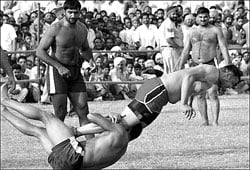
Pakistan Olympic
Association (POA) has been holding national games every two years since
1948. But this year was unique with two games being held in a year — one
in Lahore in December 2012 and the other in Islamabad in July 2013. The 31st National games
were held in Peshawar in 2010 and, in 2011, it was decided that the 32nd
national games would be held in Lahore in 2012. Besides the four provinces,
Islamabad, Fata, three services (army, navy and air force) and four
departments (Wapda, HEC, Railways and Police) take part in the games. The
winner gets the Quaid-i-Azam trophy. In the first week of
December 2012, when all arrangements had been made by Major General (retd)
Arif Hasan-led POA to hold the 32nd national games at Lahore, the three
services: army, navy, air force, and Islamabad opted out of the games. The reason they gave for
not participating was that the Punjab Olympic Association (PbOA) had
violated Pakistan Sports Board’s policy that strictly prohibits its
office-bearers from remaining in charge for more than two terms. “The army
even did not return the Quaid-i-Azam trophy to the organising committee,”
says Muhammad Khalid Mahmood, general secretary POA, led by Arif Hasan. “Despite the
controversy, the 32nd national games at Lahore featured 27 male and 14
female participants. Wapda won most gold medals and points and stood first
but, for the first time in history, did not get the Quaid-i-Azam trophy,”
he adds. Mahmood says only Rs10.5
million were spent on holding games in Lahore. “We collected most of the
funds from our own resources. But at least Rs80 million were spent on the
games held in July 2013 under the interim committee. Even the Lahore High
Court (LHC) stopped them from using the title of 32nd national games,” he
says. Khawaja Farooq Saeed,
general secretary POA, led by Major General (retd) Akram Sahi, says they
have been contesting the issue in the courts — “The LHC did not stop us
from holding the games and the case is still pending in the court over the
issue of title of the games”. According to Saeed, around 2000 athletes
took part in the games held in Islamabad last month. “Only police and
Wapda did not participate in these games.” Saeed says the Supreme Court of
Pakistan also declared on February 8, 2013 that sports policy should be
implemented. “ Experts say holding of
parallel national games is a clear reflection on our sports where no new SAF,
Asian or Olympic record has been equalised or broken. They think the sorry
state of affairs in POA can lead to a ban from IOC. “National Games are
supposed to be the prime sports activity in a country which shows an image
of our national sports system,” says Aamir Bilal, sports writer and chief
of Sports Development Foundation (SDF), the first ever sports NGO and think
tank of Pakistan. He says that in order to resolve the issue and to put
sports on the right track, it is necessary to understand the working of IOC,
its mandate and role and how respective National Olympic Associations like
POA should conduct its business. — Aoun Sahi
|
|