


|
|
|
|
 |
 |
  
|
wildlife
wildlife Travelling from
Abbottabad to Mansehra, you pass through the busy town of Qalandarabad which
is famous in the area for its delicious Chapli Kebabs. On the evening of June
28, 2005, nobody knew the town was soon going to earn a different kind of
fame — by becoming the starting point of a ferocious string of killings
which would grip the Galliat range of Hazara for well over three weeks. It was on this day that an
exceptionally large male leopard, later dubbed the “Ghost of Thandiani”,
took its first human victim. The same leopard, in a span of only 11 days and
without any provocation, killed 6 humans — all women — thereby surpassing
the record of legendary man-eating tigers and leopards in the last century
from Kumaon in terms of speed of killing. A little short of
Qalandarabad, two nullahs both starting from Thandiani watershed meet in a
thickly wooded ravine which carries a mixture of broadleaved and young Chir
pine trees. The forest floor in this ravine, extending on both sides of
Abbottabad-Mansehra road, is consequently full of shrubs and grass, making it
impossible to detect an impending danger. On a fateful evening, a
poor girl from Tarnawai who left home in search of grass for her cattle could
never have figured that the thick jungle hid death in shape of a wily
leopard. Later investigation showed that she had been in the area for nearly
half an hour when the leopard pounced upon her from behind, burying its
canine teeth in the vicinity of her throat and killing her in no time. After accomplishing this
fearful act, the leopard left for the ridge which ultimately rises in height
and ends in the southern part of Thandiani forest range. The body of the girl was
retrieved with some difficulty and the matter was brought to the notice of
the district administration as well as the wildlife department. The second kill followed in
quick succession — as another innocent girl became the next victim of the
blood-thirsty leopard on June 30, near Kala Pani on Katha ridge. Those of you who may have
travelled to the picturesque hill resort of Thandiani would recall this area
being famous for its fresh water springs and a crystal clear stream, from
where the hair-raising ascent to Thandiani top begins. The leopard selected early
morning for his kill as a young girl had the misfortune of entering a thick
blue pine jungle for grass cutting, hardly half a kilometre from her house.
Death in this case was also instantaneous as was discovered by the
panic-stricken relatives who entered the jungle shortly after noticing the
girl’s failure to return. After these two deaths in a
span of less than two days, the entire population of the area was up against
the wildlife department for having established a safe haven for leopards in
their close vicinity. There were also speculations, especially in the local
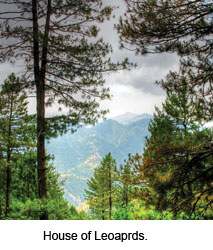
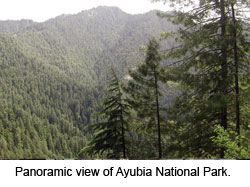
media, that the leopard might have been a resident of the Ayubia National
Park, representing the last stronghold for the species in the wild. The fury of the local
population was so high that some of the wildlife officials who turned up for
funeral prayers of the second victim were nearly lynched and had to run away
for their lives. On their part, the wildlife
department did what its limited capacity allowed during 2005 — from placing
iron cages in likely spots in jungles to informing people to exercise utmost
caution at early morning and dusk. Obviously, this failed to satisfy the
local population, politicians and an increasingly hostile media who clamoured
for solid action in the wake of these gruesome killings. Situation changed from bad
to worse as the next week saw three more killings by the leopard — all
women — and once again without any provocation. The first was made at
Aliabad near Moolia village in a thickly forested area that formed the
boundary between Nathiagalli and Azad Kashmir. My old friend Sajjad, the
game watcher, was in the area during that fateful time and later described
the circumstances leading to the third killing in great detail. The beautiful area is home
to mixed coniferous forest, including towering trees of blue pine and silver
fir. Being distant from the early scenes of killings, the residents of the
area hardly expected the marauder to be lurking in such close vicinity of
their village. The hapless girl, becoming
the third victim of the leopard, had gone out collecting firewood and was on
her way back near dusk when she came across a narrow ledge which linked the
jungle and the sparsely cultivated wasteland. As her footprints later showed,
she appeared concerned and was passing through this narrow area at a quick
pace when the leopard had pounced upon her from right side of the narrow
lane. It is not difficult to
visualise the predicament of the poor girl who must have looked into the eyes
of the charging leopard while all avenues of retreat were sealed on that
gloomy evening under the towering fir trees. Once again, the leopard
made its killing by strangulating his victim by holding her between the
shoulders and throat, causing fatal wounds. The badly lacerated body was
recovered after hectic efforts, owing to thickness of the surrounding jungle
while the disdain of the populace kept mounting to alarming limits. Although these deaths were
enough to lead to a media pandemonium, it was the fourth one which took
matters to their worst. The fourth kill was made in
Khan Kalan, an area adjoining Nathiagalli and Bakot-Kohala. Once again, the
attack came early morning and the victim was a woman who had gone out
collecting fuel-wood. However, what made it most
gruesome was the fact that this time the leopard had eaten some parts before
leaving. As described by Sajjad, the game watcher, it was now realised by the
wildlife department that what they were dealing with was not an ordinary
leopard but a man-eater. One more woman was killed
in the next couple of days (mercifully, the leopard just left after killing
her) bringing the tally of victims to five in a span of eight days. Realising that the killings
were done by a man-eater, the wildlife department had no option than going
all out after the killer. Local as well as national level Shikaris (hunters)
were requested to come to the rescue of the people. One such shikari, who
bravely reached the area, was successful in bagging a suspect leopard in Khan
Kalan area which had also mauled a woman. However, it was not the fearful
“Ghost of Thandiani” as was proved by another killing made by this
gruesome leopard hardly two days after the killing of the suspect leopard. July 7, 2005, is an
important date for the residents of the Galliat region in Hazara, as it was
the day when the awe-inspiring leopard of Thandiani claimed its last —
sixth — victim which was once again a woman. By that time iron cages had
been established across the length and breadth of the area to capture the
leopard. Local wildlife staff led by my friend Sajjad was on its feet for
almost 72 hours after the kill. On July 7, they visited countless spots in
the hope of finding the cunning leopard caught in any of the iron cages. But much to their dismay
there was none. Around this time, the
wildlife highups decided to use the live bait in the hope that the hungry
leopard (the killer had not made any human or animal kill for the last three
days) could be attracted to it and in the process, be caged or killed. Two
points needed meticulous handling. These pertained to the composition of the
party that would sit over live bait and the location where this could be
tried. The experience of my friend
Sajjad came in handy as he proposed a likely place where rounded pug marks of
the wanted leopard had been seen quite recently. After heated discussions, a
large iron cage was placed at the edge of an exceptionally thick Fir (Partal)
and Quercus (Oak) jungle near Diarseri along Bakot-Kohala road with a large
goat, firmly tethered inside. To sit over the live bait, a team of
experienced staff was hurriedly cobbled, including one Abdul Rehman (from the
wildlife department), Constable Aslam (police commando) and of course, Sajjad,
the veteran game-watcher. Three of the team selected
an isolated depression some 50 yards from the cage, with live bait inside,
and started their tense vigil on the night of July 11. The team was in place by
early evening as dusk started changing to pitch-dark night, rather too soon.
The jungle was silent except, of course, the pitiful bleating of the goat
which rang through the jungle. In the words of Sajjad, the
piercing bleating of goat gave the party both hope as well as fear — it was
sure to attract the attention of the hungry leopard but it could also raise
the suspicion of leopard that could notice the presence of the party. The party was glued to the
ground, intently listening for sounds but for almost three hours nothing
happened. Then, all of a sudden, the
jungle was blasted with a crescendo as the heavy fall of the iron gate
announced that the fearsome leopard — the Ghost of Thandiani — the savage
killer of six innocent women was finally inside the cage. As described by Sajjad, the
next few minutes almost drenched their bodies of any blood or life as they
listened to earth-shattering and blood-curdling growls of the leopard, mixed
with the miserable bleating of the goat and heavy thuds coming from the
violent shaking of the iron cage. With a lot of difficulty,
the party of three reached the cage and flashed their torches to witness a
spectacle that, according to Sajjad, still wakes them perspiring from their
slumbers. The powerful leopard was in total fury and was shaking the iron
cage (and the poor goat inside) so violently that it appeared to be on the
point of being broken. What induced maximum fear in the party was the scary
spectacle of the leopard, biting the iron rods of the cage with its teeth,
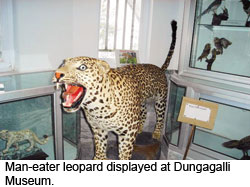
bent upon chewing it apart (I later looked at the molar teeth of the stuffed
Ghost of Thandiani to find several of these broken, testifying to the truth
of this assertion). Around that time, the party
suddenly realised it needed to come out of its fearful trance and use its
weapons before it was too late. Four shots were fired in quick succession by
Abdul Rehman and Aslam that grounded the leopard who was still growling
ferociously. Sajjad then moved forward and, coming very close to the cage,
put a lethal shot inside the chest of the leopard upon which its body
underwent a lengthy tremor before finally coming to rest. The dreadful ruthless
killer of six innocent women was finally dispatched to happy hunting grounds. One question that has
always perturbed me and that I have posed to my old friend Sajjad many a time
is yet unanswered despite a lapse of several years. Why would a stout and
perfectly healthy leopard, at the prime of his age, start killing women
without any reason? Killing for no reason, and
those too only women, 6 in a span of only 11 days, is a mystery that still
remains unanswered. The last time, I posed this question to my friend Sajjad,
as we sat near the stuffed body of the ghost of Thandiani in Dungagalli
wildlife museum, I could see consternation writ large over his face. “Many
things happen in jungle Sahib, day and night, for which no explanation can be
offered; it is best not to refer to these unless you want to invite wrath of
unseen inhabitants of the wild”. I took a deep gaze at the
wildlife watcher’s face who, as part of a small team of around 10 wildlife
staffers, is looking after 8182 acres of thickly-forested Ayubia National
Park on foot, with an estimated wild leopard population of 40. As he took me
to yet another location inside thick Dungagalli jungles to show me two goats,
slain last night by a leopard, I earnestly wished him never to earn the wrath
of jungle spirits — or whatever that rules the virgin wildernesses. rizwanmehboob@yahoo.com
|
|