


|
|
|
|
 |
 |
   |
profile comment The way we
were karachicharacter
profile What makes Munir A. Malik a force most reckon with? Kolachi follows Munir Malik's journey through the eyes of his near and dear ones, and his own. "My greatest fear right now is that I will wake up one morning to find my dad gone," tears roll down Sheherezade's face as she talks about her father, Munir A. Malik. Named by Munir himself, 18-year-old Sheherezade's face doesn't light up too often anymore as her father's detention, his chronic illness and an armed-attack on their home has made her uncertain that she will ever have a normal family life with her father again. "I always had fun with dad. We would spend hours talking, watching movies, hanging out, and sometimes even cooking," Sheherezad smiles a little as she discloses that Munir is not a very good cook but whenever he makes chicken karahi or shrimp, they taste good. Her smile disappears as she recalls the Munir she has come to know this year, a father with no time for her as he struggles for the restoration of democracy. The worst part of that struggle for Sheherezad was the one month when Munir had no contact with his family while he was detained by the government. "The last time I heard from him was a telephone call that he made from Islamabad immediately after his detention. He told me not to panic, and assured me that everything will be alright soon. But I couldn't stop my self crying since I didn't want to lose the best dad in the world." Munir, always known as a man of principles among colleagues and family, is an ideal father for his children Sheherezad and Ehsaan as he is never authoritative. "He is very friendly with us. He always listens to our future plans, but never tells us that he wants us to be lawyers," says Sheherezad. What Munir does tell his children is that no matter what career they choose, they must be honest and committed to it and always "fight for what is right." Fighting for the right, they say, is what Munir A. Malik's life is all about. Born in 1950 to G.M. Malik, a businessman who migrated from Punjab to Karachi and later became President of Karachi Stock Exchange, Munir was the first baby boy after four girls and enjoyed special attention from his parents. However, all the love and affection did not turn him into a spoilt brat, instead, Munir proved to be a child possessing extra-ordinary manners and intelligence. "He was very studious and was always found busy with books instead of wasting time," recalls Dr. Saeeda Malik, former Minister for Women 's Development and one of Munir's elder sisters. Saeeda, known as apa among the eight siblings, tells Kolachi that Munir was sent to Lawrence College, Ghora Gali at the age of six and would visit home during summer vacations only to impress his family as "a, selfless and upright child." During one such vacation, Saeeda recalls, Munir along with his three brothers and some kids from the neighbourhood rented a bicycle that fell in a ditch. When the owner and a policeman interrogated the kids about the cycle all the kids ran away except Munir who not only accepted the charge, but paid for the damages instead of squealing on the other children. "He was always very honest and never turned his back on odds, he faced them instead." Munir was forever full of ambition and wanted to "fly sky high." He was an exceptional student who always made good grades. Saeeda tells Kolachi that Munir was extremely eloquent and had excellent debating skills, however he was equally obedient to their parents and despite his aversion for living at boarding school, he never argued with their father about it. "He never told us that he disliked living away from home," says Saeeda, "but he would be extremely glad if he missed the train to Lahore. At such moments I would realize he doesn't want to live away from us." However, given his brilliance and his parents' commitment to the education of their children, in 1967, Munir was sent to the United States for to pursue higher education. Munir, a man of great intellect, polished his skills at American institutes where he studied Accountancy and Law, graduating as a certified public accountant and a Jurist Doctor in 1974. Munir worked hard to fund his studies. He did everything from plucking berries in a field to working summers as a technician and part time at an accountancy firm as well. Munir would impress colleagues when he accomplished tasks that took other seven to eight hours in a mere three. "It is called superior mentality," Munir, with his exceptional ability to focus, told awed colleagues. Despite doing extremely well, Munir returned to Pakistan in 1976 to be with his parents who lived alone after all their sons had settled abroad. Those were the days when Pakistan was under martial law and all human rights were dissolved in the country. This served as a turning point in his career, as he decided to opt for law as his profession. "I was offered to practice law with Khalid Ishaq & Company when I lost my case against the Institute of Chartered Accountants of Pakistan," says Munir. The said institute had refused to let Munir become a member or allow him to practice accountancy with them as he was an American graduate and in America, accountancy institutes rejecting Pakistani graduates was common practice. "I fought them in Supreme Court as this discrimination was restricted to American graduates." However Munir lost the case due to fundamental rights being dissolved in the country at that time, "It was then that I decided to become a lawyer instead," he says. From there began the journey of Munir's success. He became very active in bar politics, became President of different bar councils with the honour of being the youngest president almost every time. He also achieved various literary awards and being an advocate of human rights, he became one of the founding members of the Human Rights Commission of Pakistan as well. "He has observed a tremendous rise in his profession life," comments Rasheed Rizvi, President Sindh High Court Bar Association and a colleague of Munir's for 28 years. "He is a very impressive lawyer who fights his case with precision." Rasheed Rizvi believes Munir values his principles and stands by them like a rock, "he was arrested for protesting against dictatorship during the Zia regime and was made to sleep on floor for more than a month, but he didn't give up. We all respect him for that" Munir enjoys a very good reputation among members of the bar since "he never accepts temptations." He is a very effective endorser of candidates and is therefore famous as a 'Kingmaker.' "The word impossible doesn't exist in Munir's dictionary as he can practically snatch victory form the jaws of defeat," says Victoria Cariano, Munir's wife. Filipino by birth, Victoria was a student at S.M. Law College and foresaw a bright career for herself until she met Munir in 1978. "There was something about Munir that I decided to quit my career and tend to his children instead. I had a number of handsome proposals but I was struck by his brilliance." Victoria has not regretted her decision over the years as Munir is not an ordinary man. But she admits that it is not easy to live with an extra-ordinary man. "He is very honest and is not interested in money at all," says Victoria. Munir sometimes even fights cases for his friends without any fee which is, "obviously not very commendable from a wife's point of view," she says. However this has made her believe that her husband can never be corrupt, "he who said that Munir took 80 million rupees to fight against Musharraf is wrong. If this were true we would be very rich." Victoria says that since Munir has not been practicing for almost a year now, it is costing the family in financial terms, "it is not that we are starving but it does matter if you do not earn for a year." Despite the hardships he has suffered, Munir is dedicated to his cause, "I am more committed to my campaign after my detention," says Munir, who is extremely ill these days. Munir is a man of logic and high determination. He regards Nelson Mandela as his role model who had said of his own fight, "the struggle is my life." Saeeda reveals that it is very difficult to influence Munir over something he believes is right and he can only be convinced with logic. "I dare to dream the impossible dream and to run where the brave dare not go. This is our quest - no matter how hopeless, no matter how far. Remember that every long journey begins with a single step. It does not take rocket science to understand the no army, no matter of which breed, can stop the march of an idea the time for which has come." ( At the "Separation of powers and Judicial Independence" seminar- Munir Malik. May 26, 2007) Munir
Malik's milestones at a glance 8th April 1950 Date of Birth 1966: O' level 1971-74: B.S San Jose State University, CA., 1974: U.S.A. J.D. (Magna Cum Laude) Santa Clara University, Santa Clara, CA., U.S.A. 1974: California Bar examination 1976: Return to Pakistan 1977: Partner to Justice Sabihuddin Ahmed 1980: Elected General Secretary Karachi Bar Association 1980: Jailed for forty days for protesting dictatorship 1986: Elected President Karachi Bar Association 1990-95: Elected member Pakistan Bar Council 2002: Elected President Sindh High Court Bar Association 2002: Legal Frame Work Order Movement 2006: Elected President Supreme Court Bar comment The politics of influence: Sindh gears up for Elections 2008 As the elections draw closer, Sindh seems unable to break out of the voting rut it has been stuck in for decades. In most interior areas, it is not the best man that people will vote for, but one mostly pre-chosen by their elders, or someone the voters have been familiar with for years. By Adeel Pathan The long-awaited elections
are fast approaching, and the air is wrought with promises and Opposition parties are currently making it obvious that the 'free, fair and transparent' elections will be anything but. These parties have voiced their doubts regarding the credibility of the caretaker government and election commission to hold polls that will be unrigged. According to the assertions of these parties, elections in Pakistan have always been an engineered affair and voters are often influenced into voting for certain individuals. Clans and communities play very important roles in the voting process especially when one talks about interior Sindh, or the interior areas of any province. The elders of clans and communities decide whom their respective people will vote for or oppose. The election process has gained momentum in Hyderabad and its neighbouring districts including Matiari, Tando Mohammed Khan and Tando Allahyar, where political parties have dominance. However there are other districts like Ghotki, Thatta, Larkana, Badin, Mirpurkhas, Thaparkar and Jacobabad where clans and communities have a stronger say. The coalition parties
include Pakistan Muslim League (Q), Muttahida Qaumi Movement (MQM) and Kanwar Naveed Jameel, District Nazim of Hyderabad is backed by MQM, which won three Provincial Assembly seats in Hyderabad during the last general elections in 2002 and one National Assembly seat while two reserve seats were given to women. Pakistan People's Party (PPP) had won two Provincial Assembly seats and one in the National Assembly, while two were given to women of which one later deserted the party and joined PML-Q. Muttahida Majlis-e- Amal (MMA) was successful in getting one seat each in the National as well as Provincial Assembly from Hyderabad in 2002, but one of its Provincial Assembly members recently joined PML (Q) and has received a ticket to contest polls. Though political parties have not yet fully geared up their activities ahead of the upcoming general elections, PPP, going by it's policy has allocated tickets to outgoing National and Provincial Assembly members. MQM is currently interviewing candidates before finalizing their names but there are rumours that some members from the local government will be given party tickets. Therefore, a tough contest is expected between the outgoing coalition parties in Sindh and PPP. Other parties including PML (N), MMA and its allied parties have yet to organize meetings regarding elections despite the fact that November 26 has been fixed as the last date of filing nomination papers. In Matiari district, Mohammed Ali Shah Jamote, a PML (F) backed candidate is District Nazim where a tough contest is likely between PPP and PML (F), as senior PPP leader and lawmaker Makhdoom Amin Faheem belonged to same district. Mir Inayat Ali Talpur is District Nazim of Tando Mohammed Khan and won the local bodies elections under the support of the outgoing PML-Q. Dr Raheela Magsi is District Nazim of Tando Allahyar and is supported by PML (Q), she won the elections under the banner of Magsi Alliance. The influence of local bodies is not restricted to Hyderabad and its neighbouring districts. Individuals and small but powerful sectors of districts throughout Sindh play vital roles in the direction votes will go in during elections. In Thatta, for instance, the Shirazi group is described as influential for various reasons. A member of the family is District Nazim, another member is a minister in the caretaker government while a third has just finished his tenure as adviser to a chief minister. The only competition this family expects to face is for one Provincial Assembly seat from Sassui Palejo. A large number of Soomros are contesting elections from Jacobabad, the district administrated by Saeeda Soomro, mother of Mohammedmian Soomro, the caretaker Premier. Larkana remains the stronghold of the Bhuttos - Benazir Bhutto and Ghinwa Bhutto are the main contestants on the district constituencies. Another important factor of politics of Sindh besides the influence of clans and communities is the repetition of individuals for several election runs. The only party that has introduced fresh candidates thus far is MQM. The politics of influence has been a large part of the way things are done in Sindh for decades. People mostly depend on tribal elders or party leadership to decide which direction their votes will go in, mostly because of a lack of awareness and low literacy. In a lot of areas, where feudalism still has a monopoly, voters are made to vote for the party or individual of their feudal lord's choice. This is not a proclivity common to interior Sindh alone. Educated people in urban centers like Hyderabad, Mirpurkhas, Sukkur, Larkana and Nawabshah vote on the behest of their elders. They miight even vote for a face they are familiar with on an individual level, which represents a party whose agenda the voter might not be completely comfortable with. If the people of Sindh, or indeed the entire country want to see changes they have been longing for, they should make an effort to vote during the upcoming elections. The youth especially should be encouraged to vote and become more proactive about the direction the country is taking. The elections should not be merely reduced to something to watch on television at home, but a process to actually be a part of. The way we were The future revisited By Kaleem Omar Paul Valery said, "The trouble with our times is that the future is not what it used to be." He was right. Even 1984 has come and gone, and we have found nothing to replace George Orwell's nightmarish vision of the future. To say that 2084 is coming just doesn't have the same ring to it. Also, 2084 is too far off to be effective as a date to scare the living daylights out of people. In the world of business, however, time is measured on a very narrow portion of the total spectrum. Few major corporations can be counted by centuries, though there is a privately-owned iron ore mine in Sweden that has been in continuous operation under the same firm's name for more than nine hundred years. Such exceptions, however, prove the rule. Careers are measured in decades and products in years. Accounts are generally payable monthly, people often work nine to five, coffee breaks are fifteen minutes, push-button phones save you seven seconds dialing time, and lasers work in nanoseconds (one billionth of a second). It could be argued, then, that time is a way to measure and hence define existence. And these definitions are culturally imposed. The calendar is an arbitrary system for reckoning the beginning, length, and divisions of a year. There are the Chinese, Gregorian, Julian, Revolutionary, Roman and many other such calendars. The Gregorian calendar, which is now used in most parts of the world, was adopted for use in the United States as recently as 1752. In his study "Future Perfect," Boston-based scholar Stan Davis notes that isolation experiments in deep caves have shown that man's periodicity is closer to 24.5 hours than the 24 hours into which a day is divided. The question is: What would one do with this extra half hour if it were to suddenly become available to us? Members of today's Internet generation, who think computers that don't respond to commands in microseconds belong to the stone age and ought to be scrapped, would say that a half hour is an eternity. But I belong to a much older generation (make that MUCH OLDER). To members of my generation, the best thing about the future is that it only comes one day at a time. Albert Camus took a more cynical view. He said, "The future is the only kind of commodity the masters willingly concede to slaves." Paul Chamson, a Frenchman, like Camus, took an even more cynical view. He said, "One should never place confidence in the future – it doesn't deserve it." The danger of the past was that people became slaves. The danger of the future is that they may become robots. British scientist J. B. S. Haldane's prediction for the future was that "whatever hasn't happened will happen and no one will be safe from it." Perhaps the last word on the subject comes from the late great physicist Albert Einstein, the inventor of the concept of the space-time continuum and many other equally perplexing things. He said, "I never think of the future – it comes soon enough." Davis says, "If man did not adjust his natural circadian rhythm to his culturally determined yearly calendar, then daily life would get messed up pretty quickly. In other words, the things that we chose to measure and the way that we measure them tell us lots about what we value and how we see the world." In the early 1900s, roughly halfway through the industrial era in the West, US efficiency expert Frederick W. Taylor invented time management. In the industrial model of the time, a worker doing endless drudgery, where one day is just like the next and nothing changes, takes the point of view that time is cyclical, an endless repetition of events. The clock-watcher who celebrates TGIF (thank God, it's Friday), and the harassed manager who has only two hours to get the report out, see themselves as stationary "in" time, with the future moving toward them rather than vice versa. Alvin Toffler, the author of the 1970s best-selling book "Future Shock," humourously expresses this perspective: "Future shock is the dizzying disorientation brought on by the premature arrival of the future." According to Toffler, future shock is the consequence of having to make too many decisions about too many new and unfamiliar problems in too short a time. "Future shock is more than a metaphor," says Toffler. "It is a form of personal and social breakdown. We are in collision with tomorrow. Future shock has arrived." The managers who prepare for next week's conference, who launch next season's product line, and who chart their career development take the approach that time is a one-way street that we move along; we advance toward the future, not it toward us. As Davis notes, the business model of time in the industrial world was very much from the corporation's perspective. The focus was on internal reorientation and actions. Even nine-to-five time, defining as it does a regularly recurring event, is from the industrial perspective of the producer, rather than the postindustrial perspective of the consumer. When the corporation focuses externally, on the customer, it transforms its sense of time. People living in the beautiful mountainous region of Chitral, however, have a very different concept of time. They think of time as a commodity that is never in short supply. That's why Chitralis are never in a hurry and can while away months performing tasks that would otherwise take only a week or two, or sometimes not even that. On a trek in Chitral back in 1942, a visitor from the lowlands – a flatlander, so to speak – once sent his Chitrali guide to buy five rupees worth of apples from a nearby village. Since the village was only a few hundred yards away, the visitor thought the guide would be back with the apples in half an hour or so at most. In the event, he didn't return until eight hours later, by which time the visitor had given him up for lost. "Where were you?" asked the visitor with some heat when the guide finally reappeared, ambling along the track as if he hadn't a care in the world. "Buying apples for you," replied the guide. "Does it take eight hours to buy a few apples?" the visitor asked. "Yes, it does – if you want the best apples," said the guide nonchalantly. The new economy, however, is not like that. A new economy manager once told Davis, "Customers use our time up until their decision to buy, after that we are using their time. Therefore, we must deliver immediately." The key, then, is the shortening of the elapsed interval between the customer's identified need, on the one hand, and its fulfillment on the other. In the late 1970s, a Japanese car manufacturer found that more costs and more time were expended by a car in the distribution system than in the factory. The manufacturing company absorbed the sales company. Today, it's working to deliver cars to customers within a day of receiving a dealer's order. "The ability to do this seems to have more to do with technology than tangibility," says Davis. In Silicon Valley, for example, companies are toiling to bring out their next-generation workstation practically from the time they are shipping the prior-generation model. It's hard to imagine that with a toaster, though. In most hotels, checkout time is about 1.00 pm, and check-in time is about 3.00 pm. The logic is that the hotel needs two hours to clean and prepare the rooms for the next guests. Obviously, however, they do not clean all the rooms within that two-hour stretch; they begin as soon as guests start leaving in the morning, and finish late in the afternoon. In other words, room preparation is going on most of the day. The time between checkout and check in is the lag time the hotel needs because it thinks it cannot operate in real time. Less than a century ago, "bankers' hours" generally meant from nine to two. In Pakistan, that was still the case until only a couple of years ago, when banks extended their banking hours from 9 A.M. to 5 P.M. That's great for a night-bird like me, because now I don't have to wake up at the crack of dawn or some equally unearthly hour in order to get to the bank before it closes. So the future can't be all bad. karachicharacter Living the simple life By Amina Baig "I didn't want my
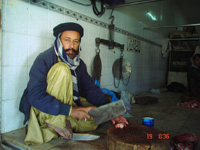
children to become butchers because it is a dirty job," says Mohammad
Mobeen Mobeen owns a meat shop in Clifton and though he doesn't want his children to follow in his footsteps, he does feel that his profession is an honourable one. Having lived in Karachi all his life, he has seen all the city has gone through but his faith in the people of Karachi remains unwavering. Kolachi: Do you enjoy your job? Mobeen: It is not a bad job, but it is not what I would want my children to do. Kolachi: Are you educated? Mobeen: I have studied up
to the third grade, which is why I want my children to be educated. Kolachi: How many children do you have? Mobeen: I have five children, aged between 18 and 20. Kolachi: That sounds almost impossible! Mobeen: It isn't really; I have two sets of twins. Kolachi: What are your children studying? Mobeen: One of my sons is studying Pharmacy, and he will go into the pharmaceutical industry. Kolachi: Do you have any daughters? Are you educating them as well? Mobeen: Yes, my daughter is studying in Inter right now; she wants to become a doctor. Kolachi: What are your work hours like? Mobeen: They are pretty good; I come to my shop at eight in the morning, and leave around four in the evening. Kolachi: Do you get time off at all? Mobeen: Yes, I get Tuesdays and Wednesdays off like all butchers. Kolachi: So what do you do on your day off? Mobeen: There is so much to do! I hang out with my family and spend time with my wife and kids or take them out. Kolachi: Where do you like going for recreation? Mobeen: There are a lot of recreational spots in Karachi, Sea View and Hawke's Bay are my favourite. Kolachi: What do you really enjoy about Karachi? Mobeen: The people! They are the best thing about Karachi. Karachiites are very friendly, loving and sincere by nature. Even when there are riots in the city, Karachiites stay as affectionate and kind as ever. Kolachi: Riots involve people; don't you think if Karachiites were that kind there wouldn't be any? Mobeen: It is not the common man who is igniting these differences, it is politics. There are political organizations which are creating divides between people. The people of Karachi are very united otherwise. Kolachi: Does your business get affected when there is unrest in the city? Mobeen: Of course. Whenever there is a riot or strike, people expect the worst and want to stay locked up in their houses; I lose business as a result. Kolachi: A lot of cattle died in Bhains Colony recently; did that affect you in any way? Mobeen: Not really, as far as I can guess, the cattle were fed something poisonous, but they were buried immediately and not supplied to shops. Kolachi: What is the best selling item at your shop? Mobeen: Mutton and beef sells the most. Kolachi: Do you pay attention to the quality of the meat you sell at your shop? Mobeen: Everything I sell here is first class! I have never received any complaints about the quality of what I sell. Kolachi: Eid-ul-Azha is an occasion one would associate with your profession; does it impact you in any way at all? Mobeen: Yes it does, though not in the way you imagine. People usually want to empty their freezers of meat around 15 days before Eid to make room for all the qurbani meat. This means less business for me, as they are dispensing of the meat they already have, and not buying any. Kolachi: You have lived in Karachi all your life; do you feel it has changed in any way? Mobeen: The only changes that have been brought about in the city have been because of the increase in population. As the population has risen, the need to accommodate it has too. This has resulted in construction over coastal areas and beaches. Now one can see apartments and high-rises by the sea which weren't there before. Mobeen is proud of what he does even though he has made sure his children are educated and never have to fall back on their father's profession. Someone like him gets affected by all the ups and downs Karachi faces, yet when he speaks of the metropolis, it is quite clear that he would not change it one bit. And though it is the people of his city who are often instrumental in all the upheavals in it, he cannot seem to shake the belief that there is good at the core of every person. He has not let any bad experiences jade him or make him lose his faith in people, as is Karachi's character. – Photos by the writer |
|
 anticipation. However, this time round, there is another emotion at play as
far as voters are concerned, or perhaps a lack of it. Most voters seem
disenchanted with the whole process of electing a new government, as once
the results are in, the promised manifestoes more often than not lay
forgotten and efforts by leaders of changing the status quo and political
methods are almost negligible.
anticipation. However, this time round, there is another emotion at play as
far as voters are concerned, or perhaps a lack of it. Most voters seem
disenchanted with the whole process of electing a new government, as once
the results are in, the promised manifestoes more often than not lay
forgotten and efforts by leaders of changing the status quo and political
methods are almost negligible. Pakistan Muslim League (Functional). These coalition parties also have an
added advantage of district governments supported by them in Hyderabad and
three other districts carved out of the city.
Pakistan Muslim League (Functional). These coalition parties also have an
added advantage of district governments supported by them in Hyderabad and
three other districts carved out of the city.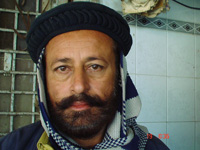 Qureshi, "it involves handling blood and innards, and I often can't
shake hands with guests because my hands are bloody."
Qureshi, "it involves handling blood and innards, and I often can't
shake hands with guests because my hands are bloody."