|
|
| |
instep
analysis
Do or die?
Pakistani pop needs to rethink its dependence on the India platform
The long exodus of talent from Pakistan to India is - at least for
the present time - over. But does the breakdown in relations between
Pakistan and India have its own message for entertainers at home?
Instep takes a look.
By
Saba Imtiaz
|
| |
 |
| |
As
the dust begins to settle on the Mumbai terror attacks, one of the
chips to fall has been the musical bridge between Pakistan and India.
With several in the Indian entertainment industry calling for a halt
to Pakistani entertainers performing and working in India, the impact
of the 26/11 attacks is set to become a wake up call to Pakistan's
music industry, as our biggest stars have become reliant on India
as their career playground.
Relations between Pakistan and India are at an all time low. Headlines
are still bursting with the news of Indian jets violating Pakistani
airspace, prompting a flurry of panic and a flood of nationalistic
text messages to news channels. To many, the situation may seem unreal,
or straight out of the recollections by our parents about the1965
and 1971 wars. The reality is that the shadow of war is very much
looming upon Pakistanis that had come to believe that relations between
the two countries could finally be normalized.
And
the biggest indicators of that dream were Pakistan's music industry
exports to India. Over the past few years, one has witnessed a mass
exodus between borders like never before. From playback deals resulting
in chartbusters for Bollywood, to concert tours and a fan following,
our musicians were the darlings of music directors. 'Chalo India'
had replaced the proverbial '80s dream of 'Chalo Dubai' as the slogan
of the moment |
| |
 |
| |
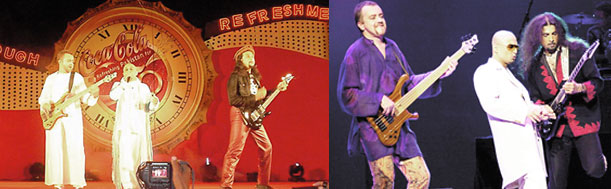
There
were the musicians that became superstars in Pakistan, like Atif Aslam
and Ali Zafar, and then went across the border. Then there were those
like Azal and Call that released their albums in Pakistan and then
instantly hopped across to India to garner fame (and do a Bollywood
single or two along the way), without achieving mass appeal at home.
There was no escaping it. Bollywood's playback singing was firmly
grasped by the best of Pakistani musicians - Rahat Fateh Ali, Shafqat
Amanat Ali, Atif Aslam - you name the hottest soundtrack of the month,
and there was a Pakistani singer on it.
But
in the midst of this, the music scene at home suffered. And the gateway
to India being opened is not the sole reason for this: it is also
the steadily worsening security situation that played a huge factor.
After all, Pakistani musicians have been releasing albums steadily
but what is missing is the one huge element that makes or breaks a
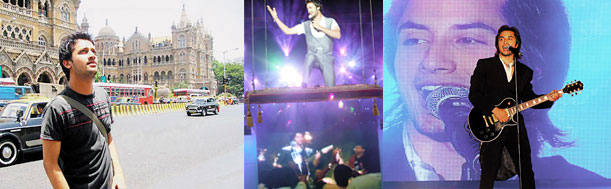
singer/band, or helps their album sell: concerts. There are no large,
open concerts in Pakistan as well; and a rarity of the private ones
as well. And this decline has happened surprisingly fast, given how
just five years ago bands like Noori performed all over the country,
in every galli mohalla, simply promoting their brand of music.
|
| |
 |
| |
Concerts
were just not a much-needed source of entertainment for a starved
nation, they were also a source of income for musicians. Moreover,
they served the purpose of getting your music out there, that would
actually drive people to buy albums.
But given that Pakistani corporations were shouldering concerts for
so long, once the security and economic situation worsened, one saw
their support wane away.
With frequent bomb blasts, no company wanted to bear the risk that
came with organizing a concert and bringing hundreds of people together
in a public space.
So
our musicians looked to India – the land that had given fame
and fortune to so many: Nazia and Zoheb Hasan, Nusrat Fateh Ali Khan,
Junoon and most notably: Strings and Atif Aslam. With the foray into
India came the options to sing playback and release music videos accompanying
the film score that was guaranteed heavy airplay because of the star
quotient. Then came album deals with record labels there and and the
vast concert circuit in colleges and arenas across India opened up
to Pakistani talent.
At home, the situation is quite different. There are no avenues left
to perform or promote music live. The quality of the music has suffered
as well – and hidden in our music seems to be a subliminal message:
"This is made for the hope that Bollywood picks it up."
|
| |
 |
| |
But after the Mumbai attacks, the gateway to India appears to have
been firmly shut or at least blockaded for the time being. With the
finger being squarely pointed at Pakistan for the attacks, it will
be very hard for any Pakistani to get a crack at India's burgeoning
entertainment industry right now. And while many in India's music
industry are saying that there shouldn't be a ban on Pakistani artists
performing in India; the reality is that this is an issue that has
transcended the bridges of art and culture. According to a recent
CNN/IBN poll, 53 percent of respondents believe that India should
cut off cultural ties until Pakistan hands over suspects in the Mumbai
terror attacks.
But as morbid as the events in Mumbai are, are they a wake up call
to our musicians? If they have no option but to reestablish Pakistan
as their home base, this would be the ideal time to set our own house
in order.
Given
the current mood in the country, it is important that the music industry
realise that this is not a time to pack one's bags and leave. It is
more important, as Pakistan's ace drummer Gumby recently said, to
"grow where your roots are." We may be a country addicted
to Bollywood, but we are also a country that has produced some of
the best music acts in the subcontinent. It is important for music
channels and musicians alike, that primary importance is given to
promoting Pakistani music. As with any other addiction, our sensibilities
must be weaned off the jhankar beats of Bollywood to the genres of
music that thrived so well in Pakistan in the past. India returnee
musicians weave many tales of the infrastructure that exists next
door to support musical acts. Isn't it time that someone takes the
lead and builds that same infrastructure in Pakistan?
|
| |
 |
| |
Moreover,
it is important that those who promote music realize that this is
precisely the kick-start needed to revive the music industry. If one
looks further back, it was in times of turmoil and war that music
flourished. One doesn't hope that it comes to the point where musicians
take a cue from the late Madam Noorjahan and produce morale-boosting
songs ala 'Aye Watan Kay Sajeelay Jawanon' (To the country's brave
young men) and 'Ae Puttar Hattan Te Nahi Vikday' (These men are not
for sale in markets) to inspire our forces on the border. Musicians
must bring back their music to the masses of Pakistan. The ways to
do this are live concerts and tours, creating those same spaces that
allowed music to transcend from the music stores to the people.
And if the door to India has been closed for now, musicians should
use this time to strengthen the fan base at home. Album sales for
most upcoming bands have been dismal at best, relying on word-of-mouth,
because they have not been able to promote their music. The only time
they're seen is in their videos, and unless one is parked in front
of the TV all day, there's no way one can find out about every new
act or song.
Obviously,
one would ask the question: who should take on the mantle? There are
many answers in mind. Firstly, the record labels, which must start
organizing concerts if they are ever to recover the money spent on
signing artists and distributing albums. And since the premier record
labels in the country are owned by media organizations, the musicians
they sign are utilized for made-for-TV concerts. Record labels should
take that a step further and organize ticketed shows, which will serve
to introduce those acts to a wider (and often, far more appreciative)
audience. |
| |
 |
| |
|
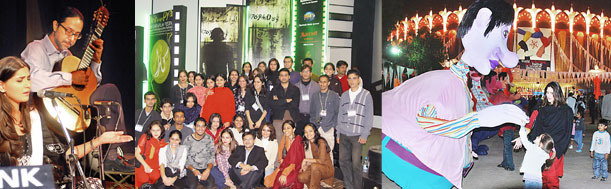
The second are the musicians themselves. We need
to build those platforms again for performing live - (Farhad Humayun
has already started in Lahore with The System) - and we need to
bring the music to the people (much like Coke Studio did this year).
And if there is anything that the Obama presidential campaign has
taught us, it is that the power of mobilizing youth is still very
much a force to be reckoned with. The Rafi Peer Theatre Workshop
festivals and the Karafilm Festival are both examples of large-scale
events that were born out of a passion to bring art, film and music
to the masses.
The spaces that did exist in Pakistan for live music need to be
revived. Lahore has Peeru's Café; Karachi had Café
Blue and M Live. Even in the absence of those venues in Karachi,
musicians like Gumby put on fantastic shows at venues such as PACC,
with the annual Munchkins concert and the recent Kolachi Quartet
show being examples. The Second Floor routinely hosts small events
that bring together aficionados of film and music. These can be
multiplied: it just needs the support of more musicians willing
to do the same. And to go ahead with events needs the same defiant
courage shown by the Peerzadas, who went on with this year's World
Performing Arts Festival in the face of bomb blasts. After all,
India continued to hold concerts and fashion weeks even as all their
major cities were rocked by multiple bomb blasts this year.
India's concert circuit model can be replicated here. We have so
many schools and universities whose students are starved for entertainment.
If corporations are not lending their support, musicians must take
the lead and take on the role of becoming concert promoters! At
the same time, they must broaden their horizons within Pakistan
and not just restrict themselves to performing in Karachi, Lahore
and Islamabad but also Quetta, Hyderabad, Faisalabad, Multan, Abbotabad
and more. If Strings or Atif Aslam can perform in Chennai, Bangalore
and Pune, why can they not do the same in Pakistan's smaller cities?
|
| |
|


