|
|
| |
must
read
Books and movies: Comrades in arms
Filmmakers rely heavily on the written word for content, but
the more delightful relationship between books and cinema is when
writers decide to comment on the film business.
By Aysha Raja
|
| |
The
relationship between books and films is akin to that of kissing
cousins. Invariably, an award winning book will find itself
adapted for the screen, enabling lesser mortals lacking the
patience and acumen to take on the written word and to marvel
at the human imagination.
Cormac McCarthy's No Country for Old Men, Michael Ondaatje's
English Patient, Ian McEwan's Atonement, Zoe Heller's Notes
on a Scandal and, more recently, Jose Saramago's Blindness exemplify
the bankability of a movie based on a novel. Each draws on critical
praise and a loyal readership curious to see Hollywood's execution
of an above-average storyline. Actors too are fully aware of
the impact a good story can have on their career: to this day
I hold steadfast to my claim of seeing Orlando Bloom skulking
about the London Book Fair looking for movie rights to a good
story. |
 |
|
| |
I, however, am a fan of the more unconventional relationship; when
writers turn their scathing attention to Hollywood and pick at the
insecurities, petty rivalries and moral bankruptcy rife within the
industry. Having said that, the terrain requires some skilful navigation;
in the current atmosphere of bitchy TMZ gossip it's easy to get bogged
down with a litany of celebrity crimes ranging from fashion faux pas
to adultery, whilst never really grasping the context or the cultural
wave.
Peter
Biskind is perhaps the only writer to have captured the talent and
the cost at which it came through his works; most notable of which
are Down and Dirty Pictures: Miramax, Sundance and the Rise of the
Independent Film; and Easy Riders, Raging Bulls which I shall be reviewing
today along with one of this year's most successful books on cinema
Me Cheeta – The Autobiography a wry look at the Golden Era of
Hollywood through the eyes of a chimp!
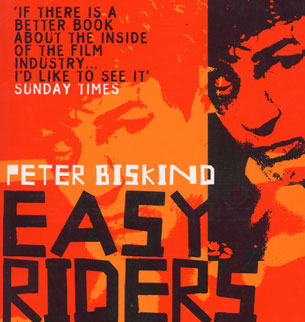
Easy
Riders Raging Bulls: How the Sex n' Drugs n' Rock and Roll generation
saved Hollywood.
It's possible that the best of Hollywood is behind it, and we needn't
take Biskind's word for it. Ask any film student what his/her favourite
film is and most will name a film from the 70's or 80's. This was
a defining moment for cinema when in the wake of the 60's Cultural
Revolution, cinema was struggling to reflect the values of the Baby
Boomers. Hollywood was on the verge of becoming obsolete in the hands
of geriatric studio execs who minted money from musicals and swashbuckling
epics during the Golden Era of Hollywood. The stranglehold of the
big studios was stifling creativity, churning out one uninspired flop
after another (not that dissimilar to the output today). A handful
of young hopefuls: Martin Scorsese, Dennis Hopper, Francis Ford Coppola,
George Lucas mindful of the rigidity of the establishment, struck
out for themselves on shoe-string budgets and ideas inspired by the
French new wave movies like Breathless and Jules et Jim.
|
| |
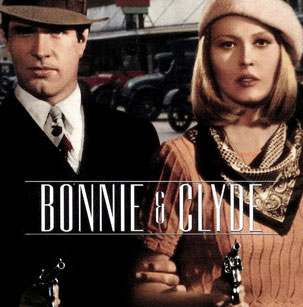
| Warren
Beatty was an unlikely pioneer for new cinema, battling studio executives
to get a script blessed by François Truffaut made into a movie.
Dismissed as just another pretty face and far from the powerbroker
he would later become, Beatty shrewdly tapped Warner Brothers for
a budget of $200,000 and a percentage gross of the profits for a movie
called Bonnie and Clyde. Having slipped through the cracks, Beatty
and scriptwriters Robert Towne and Arthur Penn fleshed out the story
of two young and beautiful specimens of Middle America who ran rampage
through the heartland of the country robbing banks and remorselessly
mowing down authority figures. Despite almost being shelved by the
studio bosses, Bonnie and Clyde did finally see the light of day;
and its appeal quickly spread through word of mouth generated from
festival showings.Warner
re-released the movie and it made $16.5 million at the box office
placing it in the top twenty highest grossing movies of all time. |
 |
| |
An
unusually brutal movie, Bonnie and Clyde, resonated with an America
at war in Vietnam. An entire generation frustrated with being shipped
off to fight and die in an unpopular war, now got their own back seeing
the establishment showered with bullets courtesy of Bonnie and Clyde.
Bonnie
and Clyde marked the dawn of a new era. It was the Raj of the Rebel.
Easy Rider made a star out of Dennis Hopper, a gun toting, LSD popping,
alcoholic who was given to bouts of violence mostly against his long
suffering wife Brooke Hayward. This became almost the norm in Hollywood,
destructive elements were celebrated in life and on celluloid; drugs,
sex and violence fuelled the creativity of the new film makers, giving
us The Godfather, Mean Streets, The Last Picture Show, Shampoo, China
Town, The Exorcist, Taxi Driver and more. For some this decade of
indulgence culminated in near death experiences; Martin Scorsese,
an A-list director after Taxi Driver, was in the midst of filming
Raging Bull when he narrowly escaped a brain haemorrhage after ingesting
dodgy coke. Francis Ford Coppola wrestled with his own heart of darkness
and an addiction to lithium as Apocalypse Now ran into delays and
overshot its budget. |
| |
For
two rather more straight laced directors, success inadvertently spurred
the return of the big studios. George Lucas' Star Wars, although a
director driven project, commanded a big budget which only a studio
could provide. While Steven Spielberg saw nothing wrong with bringing
the new Hollywood style to an old Hollywood script. The staggering
success of Jaws spawned the phenomenon of the blockbuster. Studios
scrambled to pour millions into special effects laden feel-good movies;
which in some cases had no more of a plot than a rehash of the original
theme through sequels.
By
the end of the 80's the experiment, which shifted power from studios
to directors, had come full circle back to the studios. The short
reign of the auteur director and the supremacy of his vision gave
way to megalomania and self-indulgence. A cinematic movement was cut
down in its prime by its own players.
|
 |
| |
|
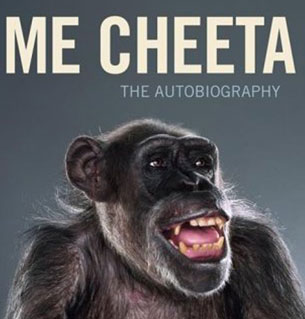
Me, Cheeta: The Autobiography
Me, Cheeta caused a sensation earlier this year by being nominated
for the Guardian First Book Award even before its release. Since
October it has achieved cult status and has sold in the hundreds
of thousands becoming an unlikely bestseller. Its US publication
is likely to be pulled forward due to the unexpected attention.
The massive popularity of the book stems more from its execution
as 'a memoir' rather than the subject matter itself. Me, Cheeta
is essentially a parody of every Hollywood memoir ever written.
It charts the journey of a remarkable chimp from captivity in deepest
darkest Africa, to the sets and screens of the golden era of Hollywood
where he made his debut in Tarzan and his Mate in 1934.
At the height of his career Cheeta kept illustrious company, dinning
with Douglas Fairbank's and prowling the streets of LA with the
libidinous David Niven. He writes of his deep admiration for his
long-time co-star Johnny Weissmuller (aka Tarzan) often giving way
to passion born of obsession. Verging on salacious, Cheeta describes
the vices of old Hollywood and the excesses that ruined lives. Although
subject to a more conservative standard then that applied to the
"movie brats" of the 70's, Cheeta talks of the loose sexual
mores, and the ingestion of 'star powder' which was common among
actors. Cheeta suffers like most of Hollywood battling an addiction
of sorts. He writes with the affectations of a star, harbouring
life-long grudges (in this case against Charlie Chaplin who he accuses
of stealing his act and continually derides for his laboured intellectualism);
and like all faded stars Cheeta suffers from delusions of grandeur
describing himself as the "true pioneer of simian thespianism".
Me, Cheeta is a satirical memoir. It has, in numerous reviews been
referred to as 'Swiftian,' a description I whole heartedly agree
with. Cheeta describes the powerful studio heads as alpha males
capable of tearing each other apart to assert their superiority,
much like the primates he had to battle with as a child.
Me, Cheeta is a wonderfully foulmouthed and egotistical creation
of a ghost writer who is yet to be outed. You'll find yourself laughing
out loud and in tears when you least expect it. It's the perfect
pinch of salt for an industry that takes itself too seriously.
|
| |
|


