|
|
| |
"My
agent thinks A Case of Exploding Mangoes is un-filmable. I think
it'll only be filmable if the producers can afford to blow up
a few planes."
– Mohammed Hanif
Hanif, who has relocated back to Pakistan from the UK talks
to Instep about his novel, future plans and whether his book has
filmi potential. His ready wit explains where his book got its
bite.
By Saba
Imtiaz
|
| |
 |
|
|
|
Not in recent history has a book captured the imagination
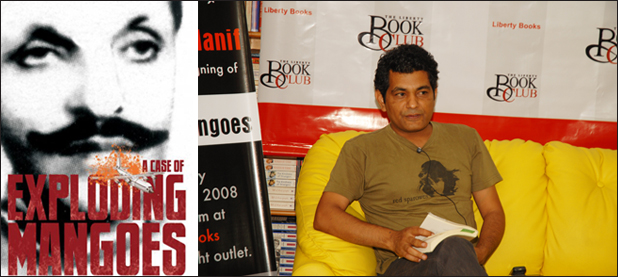
of so many, so fervently. Mohammed Hanif's A Case of Exploding Mangoes
flew off bookshelves this summer and drew in packed audiences for
its readings in June - and even a few weeks ago, a reading held
at a bookstore in Karachi drew in several enthusiasts. At each reading
of the book, Mohammed Hanif painstakingly explains that his novel
is a work of fiction, yet one sees many a reader adamant to hear
that it isn't! And given the fact that the novel's storyline deals
with General Zia's assassination, it brought back to mind, for many,
the Zia era and the conspiracy theories behind his demise. Riveting,
engaging, poignant and hilarious - A Case of Exploding Mangoes is
possibly Pakistan's English literary hit of the decade.
Instep: You've been working for the BBC for twelve
years – how is it to be working in Pakistan again?
Mohammed Hanif: It has obviously changed a lot. We have too many
news outlets, too many journalists and even more anchor persons.
There is breaking news every five minutes but it's mostly about
President Zardari coming and going or Altaf Bhai addressing a study
circle. For hard news you still need to trawl the newspapers. When
I left Karachi it was very much an MQM city and it still is. It's
always reassuring that some things haven't changed.
Instep: What is the most ludicrous question you've been asked about
A Case of Exploding Mangoes?
MH: I am often asked how much of it's true which I find endlessly
amusing. But one Indian journalist asked me: 'You have spent time
in Guantanamo, what was the experience like?' I think I said it
was so bad that I had forgotten all about it. (I think the journalist
mistook me for another Mohammed Hanif who was the Taliban spokesperson
for a bit.)
Instep: Has Ejaz-ul-Haq or any member of Zia-ul-Haq's family been
in touch since your book was released?
MH: No, I think they are too busy counting their blessings. I don't
think I have heard Ejaz mention his father's name in a very long
time. We can all have a family member who is a bit embarrassing.
Instep: Are you currently working on a second novel? What
else is in the pipeline?
MH: I am thinking about one, scribbling a line or two but I don't
think you can dignify it by calling it either work or a second novel.
I also keep threatening to write a play but haven't actually started
yet.
Instep: You recently staged A Dictator's Wife in the UK.
How was the response to that like? Are you planning to stage it
or any other production(s) in Pakistan?
MH: We had a great response in London and then we took it to Edinburgh
Fringe Festival, which is something I had always wanted to do. Considering
that there were more than three thousand shows on at the festival
we did quite well. I think there is no greater feeling in the world
than putting up a show and then waiting and wondering if anyone
will show up to watch it. Yes, we are planning to stage it here
in Karachi early next year.
Instep: Has Bollywood been in touch yet about turning A
Case of Exploding Mangoes into a film?
MH: Yes, some very enthusiastic producers and scriptwriters from
Bombay have asked if they can do a film. Some UK based Pakistani
filmmakers have also made some encouraging noises. But my agent
thinks it's un-filmable. I think it'll only be filmable if the producers
can afford to blow up a few planes.
Instep: On that note, are you planning to stage or sell film rights
for the book?
MH: Yes that is the plan. Although I sometimes think that it might
work better as a stage musical.
Instep: A Case of Exploding Mangoes was lapped up eagerly
in Pakistan, and your first reading in Karachi was jam-packed. Moreover,
you were on the Booker Prize longlist and the shortlist for the
Guardian First Book award. Did you expect this reaction to the book?
MH: Nah. I was hoping for some readers. I was quite cynical about
the whole thing. I thought people from my generation who grew up
during the Zia era might relate to it. But a lot of people who have
actually read it are scarily young. So that has been a nice surprise.
People from my generation have bought it and put it away which is
not surprising at all.
Instep: What do you think is the future of Pakistani fiction?
MH: I have no clue but there are quite a few good things coming
out next year. Kamila Shamsie has an epic novel coming out early
next year. Daniyal Mueenudin has a brilliant collection of short
stories due in January. I have just met some other writers in Karachi
and they are all doing brilliant and bizarre stuff. So it seems
we'll get lots more to read which can only be a good thing.
Instep: Aravind Adiga's The White Tiger, which won the Booker Prize,
has been panned by Indian critics for being contemptuous and stereotypical.
Have you read the book? If yes, what did you think of it, given
that it paints a very similar picture to Pakistani society?
MH: I haven't read it but Indian media, as we have recently been
reminded, can be very patriotic and I am sure sometimes that seeps
into their literary criticism as well.
Instep: You were in India right after the Mumbai terror
attacks. How was the experience of being in India at that time,
especially since the Indian news media is taking a very hard line
against Pakistan?
MH: It was quite freaky actually. Because two days after the attacks,
everything was so normal. In a little corner of Delhi I must have
seen at least six big baraats (wedding processions) with horses
and brass bands in one evening. And then I was asked on a TV show
to talk about India-Pakistan tensions. And for that half hour I
felt I was in enemy territory but as soon as the cameras were off
everything was back to normal.
Instep: In the time since you've been away, news media in
Pakistan has witnessed an incredible boom. At the time you worked
here, there were a handful of monthly magazines and newspapers and
one state-run television channel. What advantages and disadvantages
do you think the media boom has had for Pakistan?
MH: I think it has been great for us journalists and maulvis. Their
influence has increased beyond their wildest imagination. There
is more competition but the owners are very cautious as well. There
is much more money at stake. There has been a huge shift towards
the right. Pakistan's Urdu press has traditionally been very conservative
but then only a few hundred thousand people could read what your
average pundit wrote in their column. Now their audience is in millions.
Also I am still trying to figure out why do the editors think that
they need a maulvi to balance every discussion. I mean, come to
think of it, what were these Ulema-e-karam doing before satellite
TV channels arrived? Even General Zia had the good sense to keep
mullahs away from prime time TV. Now religious programmes have become
prime time entertainment. I hope someone will issue a fatwa against
ulemas appearing on TV.
Q: Have you read Pervez Musharraf's In the Line of Fire?
Do you think it has stage or film potential?
MH: Of course I have. Actually I have only read the juicy bits and
skipped the rest. I think it's a patchy piece of fiction. I think
people who ghost written it have a lot of potential to be good novelists
if they had access to more interesting material. Yes, it could have
made a good film but the problem is that only person who could have
done justice to the lead role - Sultan Rahi - has been dead for
a very long time. It could be done on stage as well and I think
Omar Sharif will do a brilliant job. He should think about it seriously
because I think it could be even a bigger hit than Bakra Qiston
Pe.
|
| |
|


