


|
|
|
|
 |
 |
|
|
Editorial ideology ‘Their’
favourite child Closure?
That is the question
It is important to
know the context for a greater and better understanding of events. On
November 22, 2008, President Asif Ali Zardari said in his video address to
the Hindustan Times Leadership Summit that Pakistan will not be the first
country to use nuclear weapons and that Pakistan and India had a great
future together. On Nov 26, 2008, Mumbai
happened. No coincidence that, because a plan of that scale could not have
been put together in four days. Four years later, on Nov
21, 2012, Ajmal Kasab, the lone survivor of the 26/11 terrorist attacks on
Mumbai, was hanged to death. There was a muted response in Pakistan over his
execution; the reaction from the TTP came only as an after-thought. In between, a lot has
happened in Pakistan. But what the events of Mumbai did, in terms of
shredding the India-Pakistan relations to pieces in the subsequent four
years, is what we at TNS have tried to discuss in today’s Special Report.
There are a hundred and one angles to the Ajmal Kasab story; for one, his
hanging has not brought a closure to the case. Just to get some sense of the
magnitude of the loss, we in Pakistan have yet to see an Indian prime
minister step on the Pakistani soil in the last four years. The reaction to Ajmal
Kasab’s execution in Pakistan was understated not just because it was
Muharram and we were apprehending, and actually seeing, sectarian killing on
our own soil. It was because Mumbai attacks when they happened had rendered
us to a state of collective guilt. Soon after 26/11, Pakistan had to accept
the attacks were planned on its soil and that the terrorists and their
masters were all Pakistanis. The details that were
filtered and reached us afterwards, through Kasab’s interviews largely,
made us skeptical about the collusion of our own state. Pakistan and India had
agreed to resume their relations, step by step, much before Kasab’s
hanging. They had decided to put 26/11 behind them. Let’s just hope that
this process continues and peace returns to the region and it does not
become another case of two steps backward.
impact Ajmal Kasab, the
lone survivor from among the 10 attackers of the two five-star hotels in
Mumbai on November 26, 2008, finally met his ‘fate’ when he was hanged
to death in a jail in the Indian city of Pune, ahead of the fourth
anniversary of the carnage. India alleges that the
attack, which held parts of Mumbai hostage for around three days and killed
at least 160 people, was carried out by the terrorists who had been trained
in Pakistan by the (banned) organisation Lashkar-e-Taiba (LeT). The Mumbai attacks
derailed the then ongoing peace talks between the Indian and Pakistani
governments, creating diplomatic tensions between the two neighbours. It was
only after some time that the two nations were able to resume high-level
meetings in order to mend relations all over again and agreed to take ahead
the investigations separately. The President of India
Pranab Mukherjee rejected the mercy petition of Kasab. The authorities said
they had informed Pakistan well ahead of the execution. Through the Indian
High Commission in Islamabad, the authorities sent a letter to his mother
through courier as per his last wish. Earlier, in January 2009,
Pakistan admitted that Kasab was indeed its citizen but, so far, neither
Islamabad nor Kasab’s family has asked for his body which has been buried
in the premises of the prison. The eventual hanging of
Kasab, according to political analysts, is unlikely to have much impact on
the ongoing composite dialogue between India and Pakistan. Indian External
Affairs Minister Salman Khurshid, in a statement, said that he expected
Pakistan to expedite action against the plotters of the attack. “We hope
the rule of law will be followed in Pakistan.” The slow pace of Pakistan
towards punishing the plotters of the attacks is a constant complaint of New
Delhi — something which kept peace talks from resuming till 2010. However,
since then, the two countries have made considerable progress in increasing
trade ties and easing visa restrictions. In his cautiously issued
official statement in reaction to Kasab’s execution, Pakistan Foreign
Office spokesperson Moazzam Khan says, “We condemned terrorism in all its
forms and manifestations. We are willing to cooperate and work closely with
all countries of the region to eliminate the scourge of terrorism.” It seems that both sides
are careful not to put the peace process in jeopardy. Kasab had initially
pleaded not guilty but later confessed to his involvement in the horrific
attacks. CCTV footage of Kasab, armed with an automatic weapon at Mumbai’s
rail station, became the enduring image of the Mumbai attacks. “The hanging to death of
Kasab will not affect Pak-India relations,” says reputed political analyst
Hassan Askari Rizvi. “It is only certain Islamic groups that came out with
a statement; the society at large has remained silent on the issue, creating
the impression that whatever was done has been accepted.” According to Rizvi, even
at the official level there is barely a change in the policy. In the case of
the six people in detention, the prosecution has admitted that the attackers
were trained in Pakistan. He maintains that the
chapter is not closed yet as “India will now apply tactics to step up
pressure on Pakistan to secure mileage in its domestic politics and also
call for results of the trials of the people detained here. “We will have to wait
and see whether they are convicted or not.” In Pakistan, the
authorities are trying the seven accused that include Zakiur Rehman Lakhvi,
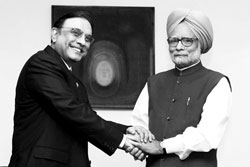
the alleged commander of the LeT and a key planner of the assaults. This April, President Asif
Ali Zardari met with Indian Prime Minister Manmohan Singh in New Delhi
during his brief private visit. It was a Pakistani head of state’s first
visit to India in seven years. Earlier this year, Indian sporting
authorities announced the resumption of bilateral cricket tournaments. The
sport has often been seen as a diplomacy track to ease relations between the
two countries. “I believe the matter
isn’t over yet,” says Lt Gen (r) Talat Masood. “They have brought him
to justice but at the same time they will continue to put pressure on
Pakistan.” Masood says it is in
Pakistan’s own interest to pursue the case by fairly putting the accused
on trial. “As a responsible state, it will be good if Pakistan can fight
against militancy and not indulge in the policy of using proxy.” For long-term solutions,
he says, Pakistan needs to gradually move towards its “chronic issues”.
“They hanged Kasab till death because they needed to satisfy their own
people; it was still fresh in their memories.” The people of Faridkot,
Kasab’s native town in district Okara, Pakistani Punjab, are still in a
state of denial, not owning the reality of Kasab’s roots. Showing
hostility to media, they have always denied any links with Kasab but their
hearts are filled with hatred for India. A few days ago, as the media was
visiting the village, the locals pushed the journalists away, threatening
them with severe consequences if they tried to establish Kasab’s relations
with the place. “We have nothing to do
with him,” said a septuagenarian man. “However, if they have hanged our
man, we should also hang their man,” he declared. Certain sections in
Pakistani press are being ‘forced’ to whip up a kind of a hysteria
around the execution of Kasab with the purpose of mounting pressure on
President Zardari to turn down the mercy petition of the death-row prisoner
Sarabjit Singh, an Indian spy who was convicted by a Pakistani court some
years ago. Sarabjit’s latest mercy
petition was filed before the Pakistani President on November 11, a few days
before Kasab’s execution. He was arrested in 1990 and tried on charges of
spying and carrying out a series of blasts in Lahore, Kasur and Faisalabad
which, according to reports, killed 14 people. Subsequently, he was
sentenced to death and his mercy appeal was rejected by the then President
Pervez Musharraf on March 5, 2008 and, later, deferred by President Zardari.
A spokesman of the
right-wing religio-political party Jamaat-e-Islami (JI) has also demanded
that Sarabjit be hanged as he too had killed many an innocent Pakistani.
“If Ajmal Kasab was a terrorist, Sarabjit Singh is no saint either,”
said a JI statement. “He is also a terrorist. Why should he be released?
We want to ask President Zardari why he is considering mercy for Sarabjit
when India is hanging our people.” In what remains a shocking
development, the Tehrik-e-Taliban Pakistan (TTP), which never really spoke
about Kasab in the past four years, has come out with a statement which is
more of a vow to carry out attacks against India in order to “avenge”
the death of a man executed by the Indian authorities for his role in the
2008 terrorist assault on Mumbai. In the words of Ihsanullah Ihsan, the
spokesman for the Pakistani Taliban, “We would attack the Indians in
response to the execution.” The TTP has also demanded
that Kasab’s body be returned to Pakistan for an Islamic burial.
Reportedly, the TTP has lashed out at the Pakistan government for not
raising its voice for the return of the body. Interior Minister Rehman
Malik, on the other hand, has said this on record that the government would
not link the issue of Sarabjit with the execution of Kasab. Talat Masood seconds
Malik’s statement: “Sarabjit’s is a different case [of spying]. I am
not justifying it but, frankly speaking, all countries carry out spying,”
he says, adding that “tit for tat policy isn’t done and the expression
and intention of revenge, if there is any, will only make matters worse. “We should not do an
ostrich and bury our head under the sand,” he says. “It is a childish
way to address problems.” vaqargillani@gmail.com caption The peace moot, stalled
for a time, has restarted for good. Timeline A brief look at the key
events that took place since the Mumbai attacks n November 26, 2008 Ten
militants arrive on Mumbai’s shoreline in a dinghy, before splitting into
four groups and embarking on a killing spree. They hold off elite commandos
for up to 60 hours in two luxury hotels and a Jewish centre. Mohammad Ajmal
Kasab is arrested while the other nine gunmen are killed n January 16, 2009 Arthur
Road Central Jail in Mumbai is chosen for Kasab’s trial n February 20/21, 2009
Kasab pleads guilty before the court n February 25, 2009
Investigators file charge-sheet against Kasab n January 2010 (date not
disclosed) Bodies of the nine Pakistani gunmen are buried secretly n May 6, 2010 Special
court sentences Kasab to death n February 21, 2011 Bombay
High Court upholds Kasab’s death sentence n July 29, 2011 Kasab
challenges death sentence in the Indian Supreme Court n October 10, 2011 Indian
Supreme Court stays execution of his death sentence n August 29, 2012 Indian
Supreme Court confirms Kasab’s death sentence n September 18, 2012 Kasab
sends mercy petition to the Indian President Pranab Mukherjee n November 5, 2012 Indian
President rejects Kasab’s clemency petition n November 21, 2012 Kasab
is executed and buried inside Yerwada Central Jail (Source: Reuters)
He
no evil The Mumbai attacks
in November 2008 came as a huge blow to whatever was left of the
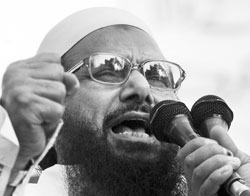
Pakistan-India relations. Understandably, the focus shifted on Hafiz Saeed
once again. After the, India submitted
a formal request to the to put
the Jamaat-ud-Dawa (JuD) and Hafiz Muhammad Saeed on the list of individuals
and organisations sanctioned by the United Nations for association with
terrorism. India accused the
organisation and its leader Hafiz Muhammad Saeed of being interchangeable
with Lashkar-e-Taiba (LeT). India maintained that the close links between
the organisations, as well as the 2,500 offices and 11 seminaries that the
JuD has in Pakistan, “are of immediate concern with regard to their
efforts to mobilise and orchestrate terrorist activities.” In December 2008, Hafiz
Saeed denied links between LeT and JuD in an interview with
channel stating that “no Lashkar-e-Taiba man is in Jamaat-ud-Dawa
and I have never been a chief of Lashkar-e-Taiba.” On December 11, 2008,
Saeed was again placed under house arrest when the United Nations declared
JuD to be an LeT front. Hafiz Saeed was held in house arrest under the
Maintenance of Public Order law, which allows authorities to detain
temporarily individuals deemed likely to create disorder, until early June
2009 when the Lahore High Court, deeming the containment to be
unconstitutional, ordered Hafiz Muhammad Saeed to be released. India
expressed its disappointment with the decision. On July 6, 2009 the
Pakistani government filed an appeal of the court’s decision. Deputy
Attorney General told the that
“Hafiz Saeed at liberty is a security threat.” On August 25, 2009
issued a against Hafiz
Saeed, along with , in response to Indian requests for his . Hafiz Muhammad
Saeed was again placed under house arrest by the Pakistani authorities in
September 2009. On October 12, 2009, the
Lahore High Court quashed all cases against Hafiz Muhammad Saeed and set him
free. The court also notified that Jama’at-ud-Da’wah is not a banned
organisation and can work freely in Pakistan. Justice Asif Saeed Khosa, one
of two judges hearing the case, observed “In the name of terrorism we
cannot brutalise the law.” On May 11, 2011, in an
effort to place pressure on Pakistan, India publicly revealed a list of its
. India believes Hafiz Saeed is a fugitive, but the Indian arrest warrant
had no influence in Pakistan and presently has no effect on Saeed’s
movements within Pakistan. Following the Lahore High Court ruling, Saeed has
been moving freely. Lashkar has been keeping
focus on India and Saeed is stated to be among those who are thought to have
helped Pakistan in capturing important
members like . In April 2012, the
announced a bounty of $10 million on Hafeez Saeed, for his alleged
role in . Saeed stated that he had nothing to do with the Mumbai attacks and
condemned them. When asked about the
bounty Saeed replied, “I am living my life in the open and the US can
contact me whenever they want.” He subsequently stated that he is ready to
face any American court to answer the charges and added that if Washington
wants to contact him they know where he is. Saeed boasts of having a
leading role in the Council and
US attempts to placate India as reasons behind the bounty. More recently,
Saeed offered aid to those Americans who were affected by .
was prepared to send volunteers, medicine and food to those on the
East Coast. The US Embassy in Islamabad rejected the offer stating, “We
respect the Islamic tradition of help to the needy but we can’t take Hafiz
Saeed’s offer seriously.” It may be mentioned here
that led a gathering of thousands in offering funeral prayers for
near Lahore. — Ather Naqvi
ideology As expected, the
Jamaat ud Dawa (JuD) stayed calm over the execution of Ajmal Kasab. Some may
dub the silence ‘tactical’ as Kasab’s arrest after the Mumbai carnage
played the substantial role of bringing international focus on the group.
JuD leadership was forced to issue disclaimer about its possible links with
the terrorists. Though condemnations of the attacks would not help to avert
the United Nations Security Council sanctions over the group. JuD’s silence is
understandable but its splinter groups that have joined the ranks of al-Qaeda
and Taliban, have assumed the ownership of Ajmal Kasab. While declaring him
‘Hazrat Ajmal Kasab Shaheed, RA’ (mercies upon him) have vowed to
continue his mission. It may be embarrassing for
JuD that its rebels have claimed the credit but most importantly, it
indicates that the internal pressure is mounting over Hafiz Saeed. JuD is
now struggling to adjust itself as an important player in the country’s
religious-political landscape, but the splinters thinks Hafiz Saeed is
betraying the jihad. Even the few Pakistani Taliban factions criticise JuD
for taking a “U-turn” and not a part of the jihadist discourse anymore. Jihad was considered among
the primary credentials of the group. It is a very delicate position for JuD
which still believes in achieving its goal through the use of violence but
is at the same time cautious in its sociopolitical rhetoric. Although it has
not yet abandoned ties with Lashkar-e-Taiba (LeT) it avoids admitting its
links with it at a public level. The 26/11 Mumbai terrorist
attack was the turning point for the group. It served to increase not only
the international pressure but also that from the state institutions to
scale down the level of rhetoric which put the state of Pakistan in an
awkward spot. In trying to cope with
these challenges, the JuD leadership has showed flexibility and decided to
avoid confrontation with the state as well as the international community.
This is not surprising as JuD has stakes in the system which forced it to
adjust to the new realities. It can be discerned from
the recent history of radical and militant organisations that when the
infrastructure of one of these organisations expanded on a large scale, the
group’s stakes grew within the same system it had opposed previously. The
charity wing of JuD boasts one of the biggest fleets of ambulances in the
country, seven hospitals and more than 200 health centres. The group is the
second largest charity network in Pakistan after the Maymar Trust, formally
known as Al-Rashid Trust. It means the JuD cannot afford any confrontation
with the state that could force it to abandon its activities in the country. Contrary to this, the
militant groups that failed to develop their organisational infrastructure
were subjected to divisions and became more violent. The JuD has succeeded
over time in diversifying its infrastructure and resources, employing the
strategy of social delivery programmes and exploiting contemporary religious
and political issues. Many militant groups in
Pakistan — contemporaries of the JuD — could not diversify their
ideological and physical resources and ultimately faced erosion within their
organisational structure. Their breakaway factions became involved in
terrorist activities inside the country, which forced them to limit their
links and remain underground. Though many mid-rank members left the
organisation and joined the al-Qaeda, the process of erosion was
comparatively slow to happen in case of the JuD. The second factor was the
increasing stakes of the group in religious politics. During the last one
decade or so, it has launched and led many mass movements — for instance,
a campaign against the Holy Prophet’s (PBUH) images by a Danish
cartoonist; countrywide protests against the Iraq war; Tehrik e Hurmat e
Rasool (in reaction to the desecration of the Holy Quran in Guantanamo some
years ago); a movement against the women’s Protection Bill; and the
pro-Saudi Arabia campaign in the context of Riyadh’s role following the
unrest in Bahrain. The group is now among the leading members of the
Difaa-i-Pakistan Council (DPC). Many analysts suspect that
the JuD had links with the al-Qaeda but it severed them because of its
equation with Riyadh. The reason was that Saudi Arabia’s biggest terrorism
challenge came from those who had accused other Muslims of apostasy;
Pakistan was also facing the wrath of terrorist groups who had absorbed
similar tendencies and developed a close association with the al-Qaeda. It was JuD’s militant
wing Lashkar-e-Taiba (LeT) that had pioneered fidayeen strikes in
Indian-held Kashmir — when militant factions in Pakistan turned against
the state, did Hafiz Saeed declare that suicide attacks inside the country
were prohibited by religion. When the Saudi government
launched a programme in 2003 to engage religious scholars to build a
response against extremist tendencies and terrorism, the impact on the
Salafi clergy in Pakistan was immediately discernible. The JuD took it upon
itself to condemn such thoughts among militant outfits and the LeT distanced
itself from all such groups and even spurned any cooperation with the
Pakistani Taliban. This defines the direction
of all pro-state militant organisations in Pakistan and signifies the
far-right’s preference for change in the country through peaceful means,
while justifying the use of force to protect regional interests. It remains to be seen
whether the JuD will remain on this transformational path or not, especially
given the context that it was not the choice of its leadership but
circumstantial pressure which forced the group to find some middle path for
survival. Ajmal Kasab’s execution may remain a demon for its leadership
which could not take advantage of his ‘martyrdom’.
‘Their’
favourite child Four years after
26/11, India hanged Ajmal Kasab, the sole survivor of the 10 attackers, but
Pakistan hasn’t got to first base with the trial of Zakiur Rehman Lakhvi,
the former chief of Lashkar-e-Taiba (LeT) and the suspected mastermind of
Mumbai attacks. It was Ajmal Kasab who
told the Indian authorities that Lakhvi — aka “Chacha” — was his
trainer as well as the chief plotter of the attacks. India demanded of
Pakistan to extradite Lahkvi several times after 26/11 but Pakistan refused
to hand him over to India, saying it would hold the trial of the alleged
planners of Mumbai attacks under the country’s own law. Arrested only two weeks
after the Mumbai attacks — on December 7, 2008 — Lakhvi’s trial is
still going on, in camera, by the Anti-Terrorism Court (ATC), inside the
premises of Adiala Jail in Rawalpindi. Interestingly, the ATCs
were established to ensure a speedy trial of the accused. Under Section
19(7) of the Anti- Terrorism Act of 1997, speedy trial of the accused is
mandatory. But in Lakhvi’s case, it seems the law is being used to delay
the trial. So far, at least five judges hearing the case have been
transferred as well. Last month, India exhorted
Pakistan for a speedy trial of Lakhvi and others arrested in the country on
charges of training the attackers and planning the Mumbai attacks. According
to a report published in the Indian media in the second week of November
this year, Lakhvi is being kept as a ‘guest’ in the jail and has
fathered a child while being held on terrorism charges. Abu Jundal, who was
extradited from Saudi Arabia, a 26/11 plotter who claimed to be in the
control room in Karachi along with Lakhvi, told Indian intelligence
officials that Lakhvi had shared the above information with him when he
called on him in Adiala jail. The American government too shared
intelligence with India that Lakhvi had access to a mobile phone in jail and
that he was running the Lashkar’s operations from prison. Pakistani
authorities, on the other hand, have refused to give Lakhvi’s voice
samples to India, needed to establish that he controlled the Mumbai attacks
from Karachi. In July this year, the ATC
also ruled the report of the judicial commission that had visited India in
March to cross-examine the witnesses of the case as illegal and said it
could not be made part of the prosecution against Lakhvi and others. But Khawaja Haris Ahmad,
Lakhvi’s lawyer, has no information about his child or any facilities.
“As far as I am concerned, the trial is being conducted within the
jail,” he says. “Abu Jundal was arrested as the trial commenced and he
is not part of the court record.” Ahmad, over the last four
years, also filed several petitions to Lahore High Court and higher courts
on different aspects of the case which further delayed the hearing. The
prosecutors of the case have accused the lawyers of Lakhvi of filing a
string of petitions in higher courts to delay the proceedings in the ATC. In
an application submitted to the court on November 3, 2012, the chief
prosecutor of the case Chaudhry Zulfiqar Ali requested the court to start a
day-to-day hearing as the delay was creating a negative image of Pakistan to
the world outside. “The day-to-day hearings should be conducted for an
early decision in the case,” he told the court. Ali also accused the
defence lawyers, during the court proceedings, of resorting to delaying
tactics. “If the accused is proved innocent, he should not remain in
prison for a long time. But the prosecution wonders why the counsel of the
accused are not pressing for a speedy trial if their clients are
innocent,” he told the court. The FIA, which has been
investigating the case, has already testified in court that USD 250 were
transferred from Pakistan to the US to get Voice over Internet Protocol (VoIP)
connections that were used by the terrorists who attacked Mumbai in November
2008. It also claimed that the Mumbai attackers were trained in LeT camps
located in Mansehra, Muzaffarabad (in Azad Kashmir), Khairpur, Thatta, Lakro
and Gadap Town in Karachi. Defence analyst Dr Ayesha
Siddiqa isn’t sure Lakhvi’s case shall reach its logical conclusion in
the near future. “Why would they allow it to happen? What can the judges
do? They are scared; they also have families. In this particular case, there
would be a two-sided pressure on the judges — one from the followers of
Lakhvi and second from ‘them’,” she says, without describing what she
means by “them”. “He is ‘their’
favourite child and ‘they’ would never allow him to be tried in the
open, leave alone handed over to another country,” she says.
Closure?
That is the question Despite Ajmal
Kasab’s hanging on November 21, four years later, 26/11 is still hanging
in balance. The question doing the rounds is whether the execution of the
death sentence to Kasab has brought, or is likely to bring, any
“closure” to the macabre incident that jolted Mumbai, India and the
world. The answer is: if at all the hanging has brought a closure to
something, then it is to Kasab’s life only; everything else remains
unchanged. Those posing this question
need to expend some grey cells before even posing the question. And, those
in India rejoicing the young lad’s death, perhaps, need to grow up and
grow out of their perception of a death sentence bringing closure to an
organised crime nexus. This article is neither a lecture on compassion nor
Human Rights 101. So, to address the question of closure on a formal,
government level is out of the scope of this article. There also was no
explanation from the government on the “closure” issue. The other
important question is how this has or will impact the Indo-Pak relations.
Let’s deal with the two questions one by one. Closure. That is the
question. How can killing an agent — who didn’t even have any agency —
put a stop to an ideology? Did Kasab or his nine colleagues in the 26/11
raid plot and execute the Mumbai massacre amongst themselves? And, to
believe that they didn’t enjoy the support of local handlers is also
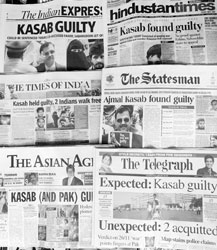
naive. A look at the headlines of major Indian newspapers gives a broad idea
of the various moods Kasab’s hanging generated. The largest-selling
English daily, The Times of India pretty much summarised what has been said
in the paragraph above. Inspired by Alistair MacLean’s Puppet on a Chain,
the TOI’s headline tried to establish the credentials of a mere
handmaiden. The headline, “A puppet’s life ends on a string,”
explained how discredited a follower of evil masters actually is. The
largest selling business daily, a sister concern of the TOI, Economic Times
gave political underpinnings to the execution, with “Kasab hangs, govt
gets some oxygen” on its front page. Business Standard, another popular
pink paper read: “Justice done after four years; Kasab hanged.” If only.
Pioneer appeared gung-ho with “Kasab hanged, India rejoices” while The
Asian Age’s “Secret death, public celebration” carried a somewhat
toned-down hailing of a death while subtly underlining the fact that the
event was kept under the wraps. Why wouldn’t it? Was it the Lok Sabha
election that had to be announced? The headline in Hindustan
Times, another popular English daily, was like a sledgehammer: “26/11
butcher hanged” attempted to drive home the point that matters have been
put to rest. Wordplay was visible in The Indian Express headline: “Op X-ecution:
Kasab hanged, buried,” softened the shards that the news of a death tends
to embody. The Hindi papers, much
like the Urdu papers of Pakistan, cater to a different audience and perhaps
reflect more crude emotion and raw zeal. Dainik Bhaskar, billed as one of
the largest selling dailies in the world, headlined Kasab’s hanging with
“Desh ki ichha poori” (the nation’s wish is granted). The overdose of
Bollywood and saas-bahu serials to Pakistani audiences spares me the effort
of translating “ichha”into Urdu. (Tangent: Uttaran nahin dekhte? Ichha
is the soap’s female lead.) Punjab Kesari is India’s Jang: “26/11 ke
zakhmon par marham: Kasab ko phaansi”. No further talk on that. Three other headlines
remain — and I have deliberately saved them for the last — that should
take the discussion forward. Business daily Mint asked THE question: “Has
India achieved closure?” The Hindu’s headline was a comment: “Kasab
hangs, justice for 26/11 still elusive” and Mail Today’s “Qasab
hanged, Guru next?” — a follow-up query. India has NOT achieved
closure. Justice certainly continues to elude the kith and kin of the
deceased and the terrorised 1.20 billion of India and hanging Afzal Guru is
not the logical next step for the 26/11 files. So, where have we got post
November 21? Why are we even expected
to close the 26/11 files by executing and burying Kasab? Only Kasab’s body
has been buried, not the case. Forget burying the hatchet. Zakiur Rehman
Lakhvi’s trial in Pakistan continues to remain in limbo for months
together now. India continues to rue the lack of cooperation from Pakistan
on proceeding in a result-oriented fashion on those accused of masterminding
26/11 — and Lakhvi was at the nucleus, as reported worldwide. No amount of
chest-beating, hooliganism on the roads, firecrackers and rejoicing on
social media can put a closure to the gruesome case that will only be
addressed by Kasab’s and Lakhvi’s home country with help from India. The other question
pertains to Indo-Pak relations taking on a new colour post Kasab. India
officially conveyed to Pakistan that it will carry out Kasab’s death
sentence. This was certainly some days prior to November 21. On November 20,
we read about Pakistan President Asif Zardari’s confirmation for the
ratification of the new visa agreement between the two countries that
includes a radical and happy addition: a visitor’s visa which will be
issued for visiting relatives and friends. Till today, there is no such visa
category between the love-hate couple that is India-Pakistan. The upcoming
cricket tournament is as per schedule. The MFN saga is progressing.
Bilateral ties only seem to have moved forward if not back. They have
certainly not stagnated. Some are proposing poor old Sarabjit’s head for a
tit-for-tat treatment by Pakistan. Why, in God’s name? His is a whole
different legal matter. I personally want to ask
both countries one question: why should we behave like Tom and Jerry all the
time? Growing up never hurt anyone. The writer is a leading
columnist with The Indian Express caption Headline-grabbing.
|
|