


|
|
|
|
 |
 |
   |
city
calling culture issue karachicharacter
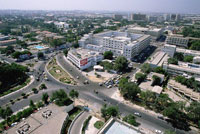
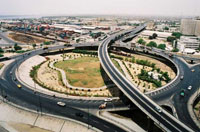
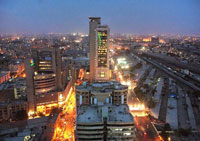
From Karachi to Davos "Karachi has been chosen as one of the 12 megacities ideal for investment." – the Nazim after returning from the World Economic Forum at Davos. Kolachi investigates why By Rahma Muhammad The melting Magic Mountain Davos a scenic resort-town in eastern Switzerland is well loved by those who can afford the luxury of skiing in Swiss mountains. The town has always been a popular destination for the rich and the ailing because the microclimate in the high valley was deemed excellent by doctors for the ill. A vacation there is highly recommended for recuperating from the stresses of managing mega businesses, countries and economies. Accommodating movers and shakers of the world is nothing
new for Davos. So it is hardly surprising that the mighty gather there every
year to attend the annual meetings of the World Economic Forum. This year with much fanfare Karachi city's Nazim Mustafa Kamal also went to Davos for the WEF along with the Prime Minister. Papers reported that the Nazim was invited to speak on urbanization at the annual WEF, along with mayors of nine other major cities of the world and economic wizards. Addressing a press conference at his secretariat before
leaving for Davos, Mr Kamal said it was an honour not only for Karachiites
but also for Pakistan that Karachi had been selected out of 25 major cities
as a mega city. Excited at the prospect of marketing the city as an ideal
city for investment - something on top of the current government's agenda,
to the host of leaders, CEOs and policy makers that gather at WEF - the
Nazim was very proud that the "world had acknowledged our stance." The invitation from the World Economic Forum was apparently proof that they had chosen Karachi as one of the 12 mega cities as being "investor friendly". He was also quoted as saying that it happened due to the positive initiatives taken by the present city government. Addressing a press conference after he returned from Davos, the Nazim was reported as saying, "The participation in the World Economic Forum has given us a realisation that the policy adopted by the present government for the development of Karachi, investment and other related matters is in the right direction and our goal is nearer now." No MoUs were signed by the Nazim in Davos, but the ground is set for mega planning to turn the fortunes of this city around.
The mega importance of a mega city Among the many topics discussed at Davos this year ("North Korea's Mysterious Geopolitical End Game", "Regulation and Financial Market Competition", "Simple Cell Solutions to Complex Problems" etc.) experts presented the results of a worldwide research on mega cities in a press conference. The research project was conducted by two research institutes GlobeScan and MRC McLean Hazel and supported by Siemens the German telecommunications and electrical company, actively involved in infrastructure development of megacities world over, including Karachi. Over 500 public and private sector experts from over 25 cities were asked their opinions on local infrastructure challenges. The key findings of the report were presented in Davos, and mayors from some of the cities were invited to speak on the occasion. In 1800, only three percent of the world's population
lived in cities. 2007 will mark a unique milestone in human history: for the
first time ever, more people on earth will live and work in cities than in
rural areas. According to UN estimates by 2030, 61 percent of the population
will reside in urban centres, pushing up urban population from three billion
today to a total of five billion. Interestingly only four of the twenty biggest megacities with populations over 10 million will be in industrial nations; the others will be in threshold and developing countries. By 2015, some 350 million people will live in these megacities. Growing population means growing needs. Accelerating urbanization will fuel a massive demand for adequate infrastructures - such as energy and water supplies, transportation and traffic management. This increases the economic attractiveness of cities like Karachi, where almost 14 million people live and work. The city generates almost 60 per cent of the country's tax revenues and is an undisputed hub of business and commerce activity in the country. The report predicts Karachi's population to double by 2025. With the city's population increasing on a daily basis with people from rural areas coming here in search of work and a better future, this is hardly surprising. However, resources are not increasing that rapidly. With growing demand for housing, the city's construction companies are having a field day building apartment blocks left right and center. Inadequate monitoring ensures no rules are being followed and one death trap after another is being constructed and then filled to capacity. Real estate prices have gone up 300 to 400 per cent in ten years and show no signs of abating. Expensive real estate is one the two reasons investment doesn't come in to this city according to Gulzar Feroz, former Chairman of Korangi Association of Trade and Industries. The other one is power supply. "It costs 5 crore rupees for an acre of land in Korangi, whereas it costs 50 lakhs per acre in Lahore. Why would then anyone want to set up a factory in Karachi?" he asks. Electricity is another issue, according to Mr Gulzar, "Not only is electricity expensive but the supply is uncertain. Electricity is far cheaper in India and Bangladesh. It is altogether free in China." These reasons according to him are major ones that hinder foreign or local investment in the city. The only foreign investment that has come in in Karachi is in the stock exchange, which does nothing for industrial growth. Real investment is setting up plants and factories in the city that will provide jobs, increase exports and create industrial activity. Traffic in Karachi has been described as an urban nightmare. Fast increasing population has resulted in public transport being massively over burdened while the private system is unable to cope. While negotiations are underway for a mass transport solution at present there is no mass transit transportation system and few good roads. Karachiites depend on unreliable, poorly maintained and outdated public transport which does not have sufficient capacity to move the hundreds of thousands of commuters and visitors who require transport. A lot of roads, flyovers, and expressways are in final stages of completion but the true solution to Karachi's transport problem is to make public transportation better and discourage the use of cars. Under the umbrella of the Tameer-e-Karachi Program both public and private sector is being encouraged to contribute to the city's infrastructure development. As a result of which a lot of positive actions have been taken yet there is still a far way to go. Uncoordinated and haphazard planning has resulted in fiascos like the drowning of the KPT Underpass because of the rains last year. The sewerage issue that also exploded after the rainfall is being addressed as the rainwater drains are being restored again and the encroachments are being removed. The Karachi Water and Supply Board has even sought Orangi Pilot Projects help on the matter. Such public and private involvements will only take Karachi's development a step further. Karachi's infrastructure needs are many and urgent; the city needs a solid waste management system, it needs to manage its electricity better, better housing, traffic management and definitely a better law and order situation. Where the city's future is looking up, it is also frightening at the same time. If public and private sector policy makers do not move with the increasing population Karachi's future might be nothing but a mega urban disaster.
The hot topic at this year's World Economic Forum was climate change. Keep watching this space for a detailed report on climate change in Karachi and the effect of development on the city's environment.
Karachi's culture corner Kolachi visits Koocha-e-Saqafat to review its present state after it has enjoyed a year of popularity with the masses By Bilal Tanweer Every Sunday, the patch of M. R. Kayani Road, lying in
between the Arts Council and NAPA is closed for traffic, and opened to
people who are interested in things related to culture and art. The event
which fills the space is fittingly named, Koocha-e-Saqafat, Culture's
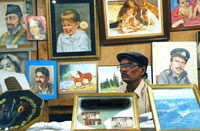
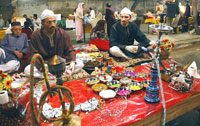
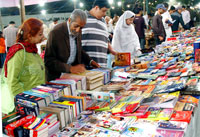
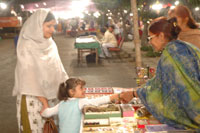
Corner. Koocha-e-Saqafat was initiated by the National Arts Council last year following government's directives of reviving cultural activity throughout the country. Families, art aficionados, book lovers thronged to the event, and after a string of twelve successful Sundays, the governor awarded the event with official patronage. Unarguably, Koocha-e-Saqafat was a hit with Karachi's recreation-starved population. More than a year later, the weekly cultural festival still remains the highlight among Karachi's events which attract an audience from a cross-section of society. Painting, theatre and the musha'ira are the focal points
of the festival. Old booksellers are the other big attraction. It was
revealed upon interviews that a number of these book-sellers were the ones
who were sent packing when the government closed off the Frere Hall gardens
for general public - a highly objectionable 'security' measure which has
deprived Karachi's residents from one of the oldest and most popular
recreational spots. The commendable thing about Koocha-e-Saqafat is the way the organizers had tried to make it into an event for the family. Indeed, one of the most exciting parts of the event is the children stage shows which draw a large audience and seating capacity falls short. Children are the performers and the applauders. However, the mood is not upbeat. The stall owners strongly complain of negligence on the part the organizers. The biggest problem, they say, is the irregularity of the event. "It almost seems that the organizers are looking for an excuse not to hold the event," says the owner of the Baloch handicrafts stall. "Close this for Muharram, close this for KaraFilm, close this for anything that happens in the city!" The book-stall owners have similar misgivings. Aside from
the regularity and the lax attitude of the organizers, they pointed the lack
of publicity of the event. "Public does not know when this is
happening, and there is not motivation on the part of the organizers to come
up with new ideas and make this event even bigger. People are always looking
for something like this. And this is such a good event." The other important concern is the changing character of the festival. What started off as a cultural event is fast deteriorating into an ordinary mela with an emphasis on cheap food rather than cultural activity. Bashir, one of the oldest painters, who has been exhibiting his work diligently since the start of the exhibition, complains of this. "At the beginning there were so good people coming here! People who understood art and painting; even foreigners came in large numbers. I sold many of my paintings as well. There were only painters in this section. Now people are coming only to eat channa chaat! This place is for art, not channa-chat!" Culture and activities relating to it have always
remained at the whims of the decision makers in this country. It seems that
there is no notion of institutionalizing cultural activity in this country -
a festival, an event, a school survives till a said ruler is personally
interested in it. As soon as he/she has something else on his/her mind, the
patronage and support vanishes. Perhaps the most significant performing arts
institution in the country, NAPA was the doing of the General-President
himself. Now that culture and artistic activity is at the forefront of government's policy, the government must look to institutionalize it. And it is small initiatives like the Koocha-e-Saqafat which can help revive and sustain the cultural scene in this city. Indeed, events like Koocha-e-Saqafat are opportunities for the government to revitalize Karachi's cultural scene. Government should focus on taking such events to other parts of the city and not let it spurn to negligence.
– Photos by Ather Khan
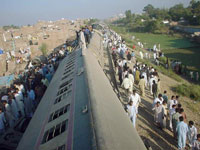
Train journey: Cheapest but not the safest option Nationwide rail traffic came to a standstill once again when a passenger train derailed in Hyderabad. Kolachi investigates By Adeel Pathan The recent train accident on February 2, when seven
coaches of the Sialkot bound Allama Iqbal Express derailed in Hyderabad is a
sign of concern. Thankfully the catastrophe did not result in any fatalities
but the many were injured, mostly women and children. Two hours after its
departure from Karachi, four coaches out of seven derailed near the Women
Police Station in Latifabad. "It's a miracle that everybody is safe," commented a woman who was also on board the Allama Iqbal Express. She does not wish to ever travel in a train again. The accident caused Railway authorities to halt upcountry and Karachi bound rail traffic for 18 hours making thousands of passengers all over the country suffer. Panic spread in the city and especially at the site but preliminary inquiries dispelled the possibility of a terrorist act. Dozens of ambulances reached the spot and Edhi volunteers with the support of Army, Rangers and Police personnel took part in the rescue operation at the site. After the incident many people waiting to catch a train at the Hyderabad Station decided against it. "My brother in law was at the railway station when it happened. His family was supposed to travel on that train but they decided to return to their home instead,"' comments Nadeem Baig on the tension in the air after the accident. Trains in Pakistan are one of the cheapest and most popular modes of transportation but a train journey is increasingly becoming a bane for thousands who are literally risking their lives every time they choose this mode of transport. However they far from being the preferred mode. In most countries, including many developing ones, trains are one of the most efficient modes of transportation and a large number of people prefer trains to planes. The troubles plaguing our Railways are many. Derailment is not the only issue; there are no clear boundaries near railway tracks which causes many accidents, the infrastructure is shoddy, the management is poor and there is hardly any proper monitoring. A recent example of criminal negligence by Railway authorities resulted in the death of several people in Shikarpur who were electrocuted sitting on the roof of a train. The recent incident, once again brings to light the terrible state Pakistan Railways is in. To repair and clear the track in Hyderabad, railway teams were sent from Karachi with equipment. They were naturally hours late. Finally when work did begin on clearing the area, it resulted in the death of a child and injury of four residents of the area. During the "rescue operation" a coach fell on a nearby house when it was being lifted. Somehow a casualty was avoided in the actual accident, but a life was lost during the clearing up of the mess. Railway authorities have announced no compensation for the child's family so far. The cause of the accident still remains unclear. As the train was in city limits, it was moving slowly. The loss could have been monumental if the train was moving at a higher speed. "The train was moving at a slow speed of 30-35 kmph and suddenly the bogies derailed with a bang," says driver Mohammed Nisar Ahmed. He, however, insists that the derailment was not a result of some terrorist activity since a train's engine is usually the first target of these acts. The Chairman of Pakistan Railways Shakeel Durrani along with other concerned officials visited the damaged site and as is the case usually, the Chairman appointed an inquiry committee to probe into the incident and submit its findings shortly. The inquiry committee is to be headed by the Principle Officer of Pakistan Railways along with the Chief Engineer and the Chief Mechanical Engineer. According to the Chairman, the Kotri-Hyderabad track is an old one; repair and up gradation work is underway at the cost of 10 billion rupees and the project would be completed in 2008. The Chairman did not say anything about compensating passengers traveling on that train that were injured, delayed or stranded in Hyderabad. On the mercy of an unhelpful staff, trying to get their tickets refunded, many passengers narrated their tales of ordeal. "The railway authorities do not seem to take any notice of the recent increase in rail accidents and train derailments. They are busy starting new train services and providing luxuries at a time when the infrastructure is crumbling," a passenger who was on board Allama Iqbal Express told Kolachi. The number of accidents continues to rise with no concrete plan or immediate solution being offered by the Railways, he deplored. Accidents and derailments like are becoming a routine part of rail journeys nowadays. With no check and balance and maintenance of obsolete systems, the tall claims of the Railways Minister seem to bear little fruit. According to the Divisional Superintendent (DS) of Pakistan Railways Karachi, Mir Mohammed Khaskheli derailment occurs mainly because the tracks are old and proper and regular maintenance is required to check the status of track and trains. "Sometimes derailments occurs because of increased load on trains, sometimes simply because of the poor condition of trains. Train parts are outdated and need to be replaced. Railways staff should check tracks and trains condition properly as haphazard maintenance causes such accidents." Tracks are also affected by changing weather conditions and especially in winter the number of derailment incidents rises. When asked whether his department is facing shortage of funds to improve the system, Khaskheli responded that the infrastructure is old and the number of trains running on these old tracks was increased without replacing them. "Tracks are being replaced and upgraded under a phase wise program that has been launched. The present government is providing adequate funds for improving the rail network and signal system is also being overhauled." This incident of derailment of a passenger train is fresh on this outdated track. Goods trains however, have been derailing regularly on this track for many years now since an efficient system of checking and maintenance is missing. What authorities need to focus on is not just the causes of the derailment; there is a dire need of reviewing existing policies regarding the maintenance of the existing infrastructure. Policymakers should focus on preparing passenger friendly policies, proper maintained rail tracks, good quality and speedy trains. It is high time now that Railway and top-level government officials implement their plan to revamp the railway network that is outdated and may cause more tragedies. Immediate action is necessary before it is too late.
– Pictures by Mohammed Rehan
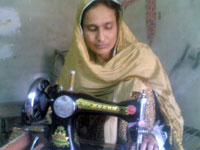
Stitching dreams By Shagufta Fazal A home-to-home tailor, 45-year-old Shehnaz assists her
husband Ajmal by finding work from nearby houses. Hailing from interior
Punjab, Shehnaz and her husband moved to Karachi to make a better life for
themselves and their
Kolachi: Where are you from? Shehnaz: We are from Khanpur, a town near Rahim Yar Khan.
Kolachi: How long have you been in Karachi? Shehnaz: It has been almost seven years that we have been
living here. We feel more content after moving to Karachi than living in
Khanpur. We moved to Karachi to better our standards and to raise our
children in a healthier and more appropriate environment.
Kolachi: How much do you make in a month? Shehnaz: It is on a daily basis. No regular or specific day or date is fixed for payments and whatever we earn in a day is spent by the evening, leaving nothing for our savings.
Kolachi: Are you satisfied with your earnings? Shehnaz: Being a home-to-home tailor is not an easy job - to earn well to give our children a better life and education is a difficult task for us. It is sometimes hard for my husband and I to pay our children's fees along with other basic expenses like rent. My eldest daughter is about to get married and these days we are preparing and saving for the wedding. Weddings can be quite a worrisome task for people like us - we have to arrange for her dowry and wedding arrangements, which are very expensive.
Kolachi: Is life better for you in Karachi? Shehnaz: Yes, it is. We thank Allah for all that He has ordained for us in our lives. At least we are not leading a hand-to-mouth life and are in a much better position than thousands of other poor people in this city. But one thing I should point out here is the rising prices which is making things worse for poor people like us. Sometimes it seems very difficult to live a straight life in such a price-hiked atmosphere.
Kolachi: Do any of your children support you in this profession? Shehnaz: Yes, of course my eldest daughter did her Matric last year and now she is helping her father and me in this work. She does it well and I feel happy that she is getting better and better day-by-day in sewing clothes.
Kolachi: Is there anything you dislike about Karachi? Shehnaz: I find nothing bad about this city. The increasing rents maybe but otherwise life is good. We have to move houses and are looking for a good place to live in on a reasonable rent but that is turning out to be an impossible task.
Kolachi: Do you have any plans for your future? Shehnaz: My eldest daughter's getting married this month and we are busy with that. Arranging for all the expenses and so on. I also want to get all my four daughters married off in a proper way, according to society's conventional practices. Though we are not in a steady position to provide our daughter with a substantial amount of dowry but Inshahallah where there is a will there is a way! We will do our best not to let her down in front of her in-laws. Kolachi: What about your children? Shehnaz: We find it hard to send our children to good schools for a better education but at least we try for their betterment and provide them with basic education which we feel is sufficient. Kolachi: Do you go out much for fun? Shehnaz: We do not go out that much as we do not get enough time. We just visit some of our relatives in this city and that is also very rarely. We have barely visited the recreational areas of Karachi. Though not being in an even position to provide her children the riches of the world she has made a resolute approach and is determined to make the most of what they get and have and to strive hard to do better. Striving hard and at the same time leading a life of a courageous mother and a wonderful wife, she has proved to be the one of the many struggling and strong-willed women of Karachi. On discovering her love for this city she thinks she will remain bound to it for life where she can support her family in what she sees as a worthy manner. Persistent and not ready to give up without struggle, such is Karachi's character. |
|

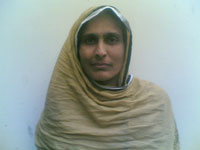 children. Besides being a tailor she also manages the house and looks after
her infant boy and five other children. She patiently reveals the
intricacies of her life in a chat with Kolachi.
children. Besides being a tailor she also manages the house and looks after
her infant boy and five other children. She patiently reveals the
intricacies of her life in a chat with Kolachi.