



|
|
|
|
 |
 |
   |
cricket An
exhibition at Lord's: Photographs from India and Pakistan 1900-1960 cricket Defeat in
finals won't affect Aussies' chances Pakistan's preparations:
cricket World Cup 1975-1979: Trail-blazer for cricket, outstandingly successful Lloyd was at his blistering best and Lord's rang to the sound of his bat; joy in the sun By M Shoaib Ahmed Saturday, 21 June, 1975: The longest day of the year and one of the longest and most glorious days in cricket history. Throughout the inaugural
World Cup competition West Indies had batted second, Clive Lloyd asking the
opposition to bat whenever he won the toss. But this time Ian Chappell won
the toss and invited the West Indies to bat first, probably Whatever his real reasons, the Australian captain's decision met with quick success. Gilmour had bowled three no balls in the opening over, much to the noisy delight of the West Indian contingent near the tavern, but then, with 12 runs of the board, Roy Fredericks, who had savaged Lillee and Thomson at The Oval, hooked a Lillee bouncer over the boundary at long leg, but lost his balance and fell on his wicket. Alvin Kallicharran, too, had batted splendidly in the previous match against Australia and he began confidently, but he cut unwisely at a ball from Gilmour and was caught behind. Greenidge was totally unable to capture his usual exciting form and after eighty minutes of ineffective groping he edged a slower balls from Thomson low to Marsh. 50 for three and Clive Lloyd joined Kanhai. Ian Chappell brought Lillee back into the attack to test Lloyd. Almost immediately the West Indies captain hooked Lillee, mightily and majestically, square for six. He drove Walker through the covers off the back foot with an ease that denied the power of the shot. Rohan Kanhai accepted the responsibility and uncharacteristic role of anchorman. For eleven overs he did not score, but he gave Lloyd exactly the support that was needed in the circumstances. Lloyd was at his blistering best and Lord's rang to the sound of his bat; joy in the sun. In thirty six overs they added 149, Lloyd reached one of the most brilliantly exciting and inevitable hundreds ever seen at Lord's. In venue, occasion and execution it was in perfect context. He batted for 108 minutes and received eighty-two balls in making his hundred. Besides his two sixes he hit twelve fours. His innings ended on a controversial note. He was given out caught behind down the leg-side and showed a certain annoyance at the decision. The bowler was Gilmour who had returned for an economical spell in which he also took the wickets of Kanhai and Richards so that West Indies were 209 for 6 in the forty-sixth over and Australia hyped again. But the platform was now firm for the temperament and technique of Boyce and Julien and they engaged in a whirlwind stand of 52 with Deryck Murray, no mean batsman, as low as number nine, the West Indies were a formidable proposition for any attack as the last over were bowled. 291 for 8 was the final score so that Australia were asked to score at a rate of nearly five runs an over and to set a record for the competition if they were to win. It was this pressure to score quickly too soon that threw the Australians into trouble. Turner suggested authority, but McCosker was fretting across the line, looking for runs. With the score at 25 he tried to work the ball through midwicket, but it was Boyce's away swinger and the ball found the edge and was well taken low down, at second slip by Kallicharran. Turner batted solidly and effectively and with Ian Chappell quickly assured, runs came briskly. There were signs that the West Indies would have real fight on their hands, but suddenly, and inexplicably, a corporate madness gripped the Australian batsmen. Runs had been coming at a good rate and it was surprising therefore that there should be an agitation that they should come more quickly, but, within a short space of time, Turner and the Chappell brothers were all run out in going for inadvisable runs. The loss of the Chappells was a grave blow to Australia and the West Indies, exhilarating in the field, sensed victory. At 162 for 4, Australia needed 130 runs from the last twenty-two overs. There were some elegant shots from Doug Walters, but once more he failed to demonstrate his true worth to an English public. Marsh flurried briefly and 76 runs were needed off ten overs with four wickets standing. A fine mid-innings spell from Keith Boyce accounted for Marsh, Edwards and Gilmour. Ross Edwards played a pleasant miniature and then skied the ball as did the dangerous Gilmour. Max Walker ran himself out and Australia were 233 for 9 with one ball of the fifty-third over left when Jeff Thomson was joined by Dennis Lillee. Fifty-nine runs were needed and only forth-three balls in which to get them, number ten and eleven at the wicket. West Indies one imagined had already captured the World Cup. These two mighty men threw their bats with such force that even when they did not hit the ball with the middle of the bat, they still cleared the field. The West Indies were forced back to the boundary, conceding the singles. There were some fierce and authentic drives, and there were some narrow escapes, but the score mounted. Twenty-one runs were needed from two overs. An impossible task suddenly looked as if it would be accomplished in one ball from a most bizarre incident. Holder bowled a no-ball which Thomson skied to Roy Fredericks at cover. Fredericks threw at the bowlers wicket in an attempt to run the batsman out. The ball missed the wicket and with no one backing up went for over-throws which Lillee and Thomson gleefully accepted. In the constant roar that was issuing from the excited crowd few heard the call of no-ball and, believing that when Frederick caught Thomson the West Indies had won, thousands swarmed onto the pitch. Fielders were knocked over and the ball was lost from sight as in the middle of the arena Lillee and Thomson tore up and down. The Umpires called 'dead ball'. The crowds were ushered off and three runs were added to the score. Lillee and Thomson had added 41 runs. Nine ball remained and 18 runs were required for victory. It was three minutes short of a quarter to nine and Lord's was a cauldron of excitement. And then came the last great irony. Thomson played and missed, and the ball went through to Murray. Believing that his partner was prepared to take a bye to the wicket-keeper, Thomson charged up the wicket. Lillee sent him back. Diving in the dust, Thomson was some six inches out as Murray threw down the wicket. In the craving for runs, Thomson became the fifth Australian batsman to be run out. The field and the players are swamped with happy crowds. Clive Lloyd holds the cup on high. West Indies -- and cricket -- have won.
WORLD CUP 1979 ANOTHER OUTSTANDING SUCCESS Without being graced with exemplary weather or the initial venture, the second World Cup proved another outstanding success. Once again West Indies, the favourites, won the Prudential Cup but against different finalists. The tournament was run on similar line to its predecessor with eight teams playing 15 matches spread over as many days. Again only Test match grounds were used but with a different distribution. Headingley, Old Trafford and Trent Bridge each hosting three games, while Edgbaston, Lord's and The Oval staged two apiece. This time a special mini-tournament of 60-over matches for the ICC Trophy was held on Midlands Club Grounds to determine which two associates members would qualify to join the six Test-playing countries in the Prudential Cup. Fifteen associates (all except West Africa and Hong Kong) entered this qualifying tournament. They were divided into three groups. Wales replaced Gibraltar, who withdrew at the eleventh hour. Wales, not being an associate ICC members, were ineligible for the competition. They did not compete for a place in the semi-finals but points scored against them counted the three group winners plus best of the runners-up qualified for the semifinal. Denmark (16), Bermuda (14) and Canada (12) were joined by Sri Lanka (10), the latter being equal on points with East African and USA but having superior run rate. Apart from the final, which was staged two days prior to the World Cup final itself, all the matches were played during the fortnight immediately preceding the major tournament. Unfortunately those two weeks attracted an abnormal amount of rain and six matches were abandoned. FINAL: ENGLAND v WEST INDIES The weather for the day of the final was as glorious as the occasion. Hosts v Holders and Lord's in all its glory. West Indian supporters already beginning their rhythmic accompaniment to the days entertainment. Brearley won the toss and asked the champions to bat. Whatever his reasoning, the first England success had nothing to do with it. Along with Gooch, Gordon Greenidge had been the outstanding batsman of the tournament. He was a player whom England feared for he could tear on attack apart in very quick time. It was he who opened the innings with the quieter Desmond Haynes, till something of an unknown talent of the English public. The sun was shinning; the Crowd was bubbling with excitement. The batsmen began quietly. Maiden overs by Hendrick and Botham greeted with ecstasies of patriotic applause. The score moved uneventfully to 22 before Greenidge played a ball from to mid-wicket and went for the run. Randall's under-arm throw hit the stumps before Greenidge could make his ground and England were jubilant at the removed of this potential scourge. The great Viv Richards was most uncertain at the start, particularly against Edmonds, but he survived. Haynes did not. An outswinger from Old had him caught at second slip by Hendrick who cupped the ball with ease. Kallicharran was the next man in. He had not enjoyed a good season and there was to be no revival now. With astute captaincy, Brearley brought back Hendrick into the attack and he clipped Kallicharran's leg-stump. 55 for 3. Clive Lloyd meandered from the pavilion for what would surely be the crucial partnership of the match. If this partnership were broken, it was thought, then England were on the edge of triumph. The West Indies captain started circumspectly, but then he began to strike the ball more firmly. The stand threatened England ominously. Old was bowling from the pavilion end and Llyod drove the ball close to the ground. The West Indies were 99 for 4 and England were winning. Collis King was next and England had no great fear of him. He had seemed a moderate cricketer, greatly vulnerable, in his days with Glamorgan. But he was quickly into his stride. At lunch he was still there and so was Viv Richards with a fifty to his name of which, initially, he had hardly seemed worthy. Edmonds had troubled him and had Bob Taylor been up to his usual high standard behind the stumps, Richards may have been dismissed. At lunch England's hopes were high. In the hour after lunch they evaporated. Richards was now at his magnificent best and Collis King revealed himself in one of the greatest attacking innings that can ever have been seen at international level. In cold statistics they put on 139 for the fifth wicket in only seventy-seven minutes, but these figures give little indication of the glory of the hour. King received sixty-six balls and scored 86 runs. In an innings of great excitement and tremendous power he hit three mighty sixes and ten fours. This was not the slightest element of luck nor of the technical profanity in King's innings. He drove with immense force. He pulled and hooked with disdainful belligerence. His innings was breathtakingly beautiful in the enormity of its strength and manner of its execution. In the fifty-first over Kind Swung Edmonds high to square-leg and Randall took a fine catch on the boundary rope. In the following over Richards reached his century. After those early minutes of uncertainty it had become an inevitability. Since lunch he had been in total command, dismissing the ball with regal arrogance to all parts of the field. There is no-one who can bowl to the man when the mood is upon him. Murray, Roberts, Garner, Holding and Croft scored only five runs between them in the final dash of runs. Irrelevant wickets fell. The final gesture belonged Richards. The last ball of the innings was bowled by Hendrick. He aimed a Yorker on off-stump. Outguessing him, Richards stepped outside his off-stump and lifted the all over the leg-side boundary for his third six. He also hit eleven fours and his innings hard lasted just under three and a half hours. It was majestic stuff. Boycott and Brearley gave England a very solid start, essential if England were to come anywhere near the target of 287. The England openers batted with great determination, but they never got on top of the bowling. The overs ebbed away. It took Boycott seventeen overs to reach double figures. They were still together at tea and England had their platform for the assault on the bowling that was necessary if victory was to be achieved, but the assault never game. Even Richards, the fifth bowler, escaped lightly. Brearley was out in the thirty-eighth over. The score was 129, Brearley swung Holding high to square-leg where Collis King took a catch similar to the one with which he himself had been dismissed. It had been a courageous opening stand, but the rest of the England batsmen had been left the task of scoring at well over seven runs an over against the bowling of Garner, Holding and Roberts -- an impossible task. Two overs after Brearley's dismissal Boycott went and now there was a brief, glorious attack. Randall swiped until he swiped once too often and Gooch gave a glint of hope that the impossible could be achieved. He hit Garner high to the mid-on boundary and pulled and drove with great power. In thirty-one minutes he received only twenty-eight balls and lashed 32 runs. If only the task had been smaller or he had come to the wicket earlier! Gooch was bowled by Garner, the ball kept low. Gower tried too much too soon, he had no alternative. Larkins went first ball, as did Taylor. Garner took five wickets in eleven balls and finished with 5 for 38 -- he was twice on a hat-trick. Richards took the man of the match award although Garner and King had run him very close. Richards bowled tightly and took a marvelous running catch to dismiss Botham. An exhibition at Lord's: Photographs from India and Pakistan 1900-1960 Some of the photographs
though off the field were equally attractive for the viewers, like the
Quaid-e-Azam in his usual immaculate dress watching a cricket match, the Ali
Brothers, fondly remembered for their fiery speeches, ready to go in action
in their cricket outfits By Yahya Ghaznavi Cricket has always been the top sport in the sub-continent and the exhibition at the Lord's Cricket Museum, in June 2006, of cricket during the early 20th century in the subcontinent, was a trip down the memory lane, for sports enthusiasts in general, and cricket enthusiasts in particular. The exhibition comprised a
private collection by the writer, of cricket photographs from 1901 to 1960,
capturing memorable occasions in the history of the sub-continent's cricket.
The event was coordinated with the ongoing cricket series The cricket audience was entertained with a unique view of the pictorial history of cricket in the sub-continent. In fact the response was so enthusiastic that the MCC has decided to have a rerun of the exhibition, on popular demand, in 2007, when the Indian cricket team plans a cricket tour of England. One hundred and seventy five photographs, duly captioned, have been chosen for display and a nicely designed a brochure by MCC gives an interesting insight to the display. MCC arranged a reception for the guests at the famous Long Room, which has been host to many historical cricket gatherings. The display got a good coverage in the media with an exclusive coverage in BBC. The exhibition brought together a large number of former cricketers from the sub-continent including Sunil Gavaskar, the Nawab of Pataudi, Asif Iqbal, Mushtaq Mohammad and Alimuddin among others. Adrian Loxton, First Secretary of the British High Commission in Islamabad, specially came over with his wife to attend the opening ceremony. The photographs put on display were a blend of cricket related activities, both on and off the field. While on the one side the display had all the cricket action on the field, the other euqlly captivating part was a selection of pictures featuring known political, social ad showbiz personalities supporting cricket through their presence at the venues or being photographed at receptions held for the cricket teams. Some of the photographs
though off the field were equally attractive for the viewers, like the
Quaid-e-Azam in his usual immaculate dress watching a cricket match, the Ali
Brothers, fondly remembered for their fiery speeches, ready to go in action
in their cricket outfits, Prime Minister Jawaharlal Nehru posing in a
friendly style with the visiting Pakistani cricket team, Masood Salahuddin
wearing a hat in The display in one of the most elite sports galleries of the world in indeed a big honour for Pakistan and me. I doubt it if anybody from the sub-continent has been given this privilege, to display his/her private collection in the Lord's Museum. The display is still on at the Lord's museum and any Pakistani visiting the display would hold his head high on seeing the Quaid's photograph at the entrance to the display. This was my fourth exhibition abroad, prior to this I had held displays in Dubai, Sharjah, Paris while three displays have been held at home, including one inaugurated by President of Pakistan, General Pervez Musharraf. As you are aware I have the privilege of having a substantially large private sports photographs archive. The collection includes nearly every sport played in the sub-continent, from 1860 to 1960. I have called this project "A Tribute to Pioneers", the wide-ranging collections include photographs of Gama Pehalwan, Bombay Customs hockey team of the 1930s, the Quaid with the famous Mohammedan sports football club from Calcutta, Agha Shah Rukh winning the silver medal in cycling at the 1958 Asian Games and the list goes on. This passion has indeed been very demanding and painstaking; we live in a society devoid of any sports archive, very weak recordkeeping, and unreliable statistics records. In a society which worships the rising sun, this is a no mean achievement, and a lot of toil and sweat has gone into it. To remember and pay homage to heroes is so essential for a proud and self respecting society. This passion is being pursued with a noble cause to educate people on our rich sports heritage and inculcate the interest of sports in the young generation. I am lucky that three persons who supported me to tabulate the data, F E Chaudhry, Masood Salahuddin and Feroze Khan, were institutions within themselves; I will always cherish my meetings with them. In addition to this passion of archiving the sports heritage I have also continued to pursue an academic education in sports. My dissertation for a Master's degree in Mass Communication was on; "Developing Cricket through Television", published in 1999, it was a maiden venture in this field. I am working on a related book for which Imran Khan has been kind enough to write the foreword. I am currently based in UK and would Inshallah be graduating in March, with a Master's degree in Sports Management from the University of West of England at Bristol. I had chosen this enterprising and academically demanding subject to support the cause of Sports in Pakistan. We badly need professionally qualified persons to handle sports development in Pakistan, rather than depending on self proclaimed pundits in sports management. My stay in England has given me an opportunity to experience sports management at an elite level. I am lucky to be associated with the Hartpury Sports Academy, which is hosting the world dressage championship this year, and likely to host the equestrian events for the 2012 Olympics. I am happy that my efforts to bring the unsung heroes into the limelight have started giving dividends. I feel proud to see large photographs of our sports legends are now displayed high above the eyeline on the wall of the Liaquat Gymnasium, at the Pakistan Sports Complex. It is an attraction for visitors and young sports persons visiting the Compex. Sports are so essential for a healthy society. In these rough times of international confrontational moods and racial, religious and national tensions, what can be better medicine to smooth out the raw edges than the spirit and comraderie of sports. The government of Pakistan should take advantage of such displays to build bridges. Sports, in the subcontinent, have always been popular moots and sports heroes are our only real heroes, who have never needed publicity departments. Men and women, side by side, have achieved high standards and won accolades with limited resources, and honesty and dedication, which made the nation proud of them. We need to appreciate these unsung heroes and hold them up as our role models. They do not have any political agendas and speak an international language of sportsman spirit. It would be most appropriate to exhibit them on National Days, in the country and abroad. The
writer can be contracted at ghaznaviyahya58@yahoo.com
cricket Inclusion of too many all-rounders -- Shahid Afridi, Abdul Razzaq, Shoaib Malik, Muhammad Hafeez and Azhar Mahmood -- was also one of the main reasons for Pakistan's defeat. Specialists always set the track for the team's victory By Khurram Mahmood Pakistan concluded the South African tour on a disappointing note as they lost the Test series by 2-1 as well as the one-day series by 3-1. The lack of discipline and unity among the team members can be described as the root cause of Pakistan's below par performances. Frequent changes to the playing eleven and reshuffling of the batting order, too, have not helped. In the ODI series Paksitan tried three different opening combinations in five one-dayers. After losing the first ODI by a record margin at Centurion, skipper Inzamam-ul-Haq said his bowlers should practice yorkers. But he didn't mention who will train them, head coach Bob Woolmer and a leg-spinner for an assistant coach. During Waqar Younis's short tenure Pakistan pace bowlers, he not only controlled their line and length but also curtailed wide and no balls. But after his resignation people saw the difference. In five One-day Internationals Pakistan bowlers bowled 52 extra balls (34 wides and 18 no balls). Actually Pakistan bowled in four matches as the third ODI was washed out after Pakistan's batting. 52 wides and no balls means 52 extra balls, a minimum of 52 runs, and the additional runs made on extra deliveries. On the other hand South African bowlers only gave 23 wides and 5 no balls in all five ODIs. Except Mohammad Asif and Shahid Afridi other Pakistani bowlers failed to utilise the favourable conditions in South Africa. Even Asif took only three wickets in five ODIs at a high average of 46.66. Afridi was the most successful bowler with five victims and an average of 13.40. Mohammad Sami, Rao Iftikhar, Abdul Rehman played one match each and failed to take any wicket. For Rana Naved it was a horriable tour -- in five games he just took two wickets at a towering average of 96 but his economy rate was even terriable at 9.60. Sami conceded 68 runs in his seven overs and Abdul Rehman 27 in two overs. All-rounder Abdul Razzaq's economy rate 8.33 was also very high. Figures show disappointing performance by Pakistan bowlers even in favourable conditions. Nobody can deny that there was no direction for the bowlers, no one was available to guide them to bowl in a pressure situation. That's why Pakistani bowlers only managed to take one wicket in the last two games where the Proteas bowled out the Pakistan team on just 107 and 153 runs. In the batting department as well, apart from Mohammad Yousuf and Shoaib Malik no other batsmen performed consistantly, specially skipper Inzamam-ul-Haq was totally off colour and looked tired. He scored just 74 runs in five matches including an inning of 45 not out -- this means that he only scored 29 runs in four matches at an average of 7.25. Now with the World Cup just a few weeks away this is indeed a troublesome situation not just for Inzamam but Pakistan as well. Younis Khan, Shahid Afridi, Imran Nazir played just one major innings in the series and threw away their wickets with immature shots. On a gentle pitch, Pakistan's batsmen showed complete lack of application and perished mainly due to their cavalier approach in the face of a disciplined bowling attack supported by excellent fielding. The situation was such that Pakistan depended only on Inzamam, Younis Khan and Muhammad Yousuf, if they fail none of the other batsmen score. The opening problem was not new for Pakistan, the best start was 27 in the first ODI, while the other opening stands were 1, 20, 0 and 0. In the last two games Pakistan lost their first wicket in the opening over without even opening an account. Last year after losing the series against England, Pakistan coach Woolmer said that the loss of their most established opener, Shoaib Malik -- who was injured -- was a big blow for Pakistan due to which the team did not get a reasonable start. Everybody knows opening is a very important position and most of the times the team's performance depends on the opening stand. Pakistan needs a specialist opener, not half a batsman, half a bowler and it will be the most concerned area for Pakistan in the upcoming World Cup. Inclusion of too many all-rounders -- Shahid Afridi, Abdul Razzaq, Shoaib Malik, Muhammad Hafeez and Azhar Mahmood -- was also one of the main reasons for Pakistan's defeat. Specialists always set the track for the team's victory. How many all-rounders were playing in the Australian side? If all-rounders can win matches for their team, New Zealand should be the world champion, Oram, Styris, McMillan, Astle, Vettori etc. are among the best all-rounders, but Black Caps never won any major tournament except the ICC KnockOut Champions Trophy. Even in the recently concluded tri-series in Australia, New Zealand failed to qualify for the final while England were passing through their worst period. Mohammad Yousuf was the most successful batsman of the ODI series with 245 runs with the help of one hundred and one fifty at an average of 61.25 while A B de Villiers was the highest scorer for the Proteas with 231 runs including three fifities with the average of 115.50. On the bowling side Shaun Pollock was the most successful bowler with 9 wickets at an average of 18.66. From Pakistan unexpectedly Shahid Afridi took the most, five wickets, at an average of 13.40. Khurram
Mahmood works in the art department of 'The News on Sunday' in Karachi khurrams87@yahoo.com PAKISTAN IN SOUTH
AFRICA: 2006-07 ONE-DAY SERIES AVERAGES South Africa Batting and Fielding Name Mat I NO Runs HS Ave SR 100 50 Ct St J H Kallis 5 3 2 193 88* 193.00 88.94 - 2 2 - A B de Villiers 5 4 2 231 71* 115.50 92.40 - 3 1 - M V Boucher 5 2 0 99 78 49.50 176.78 - 1 16 - G C Smith 5 4 1 143 72 47.66 136.19 - 2 2 - S M Pollock 5 2 1 34 32 34.00 91.89 - - 1 - A G Prince 5 2 0 41 39 20.50 78.84 - - 4 - J M Kemp 5 2 0 33 22 16.50 75.00 - - - - H H Gibbs 4 1 0 14 14 14.00 100.00 - - 1 - M Ntini 5 1 0 9 9 9.00 47.36 - - 1 - A Nel 2 1 0 5 5 5.00 35.71 - - 1 - L L Bosman 1 1 0 4 4 4.00 133.33 - - - - C K Langeveldt 4 1 1 0 0* - 0.00 - - 2 - A J Hall 3 0 - - - - - - - - - R J Peterson 1 0 - - - - - - - 1 - South Africa Bowling Name Mat O M R W Ave Best 4w SR Econ A J Hall 3 22.4 1 89 7 12.71 4-35 1 19.4 3.92 S M Pollock 5 50 8 168 9 18.66 5-23 1 33.3 3.36 J H Kallis 5 29 2 153 7 21.85 3-34 - 24.8 5.27 M Ntini 5 46.5 3 226 8 28.25 3-51 - 35.1 4.82 J M Kemp 5 12 0 57 2 28.50 2-9 - 36.0 4.75 G C Smith 5 11.4 0 59 2 29.50 1-6 - 35.0 5.05 C K Langeveldt 4 32.5 1 160 3 53.33 1-18 - 65.6 4.87 R J Peterson 1 9 1 49 1 49.00 1-49 - 54.0 5.44 A Nel 2 17 1 108 1 108.00 1-26 - 102.0 6.35 A G Prince 5 2 0 3 0 - - - - 1.50 Pakistan Batting and Fielding Name Mat I NO Runs HS Ave SR 100 50 Ct St Shoaib Malik 5 4 2 155 52* 77.50 64.31 - 1 1 - Mohammad Yousuf 5 5 1 245 101* 61.25 89.74 1 1 - - Shahid Afridi 3 3 1 102 77* 51.00 192.45 - 1 - - Mohammad Sami 1 1 0 46 46 46.00 71.87 - - - - Younis Khan 5 5 0 155 93 31.00 71.10 - 1 3 - Azhar Mahmood 3 2 1 27 26* 27.00 84.37 - - - - Imran Nazir 4 4 0 92 57 23.00 109.52 - 1 - - Inzamam-ul-Haq 5 5 1 74 45* 18.50 49.33 - - 1 - Abdul Razzaq 5 4 0 46 27 11.50 65.71 - - 1 - Mohammad Hafeez 2 2 0 21 21 10.50 91.30 - - - - Kamran Akmal 5 5 0 44 22 8.80 48.88 - - 5 2 Naved-ul-Hasan 5 4 1 26 15* 8.66 65.00 - - 1 - Iftikhar Anjum 1 1 0 4 4 4.00 30.76 - - - - Mohammad Asif 5 3 0 7 5 2.33 20.58 - - - - Abdur Rehman 1 1 0 0 0 0.00 0.00 - - - - Pakistan Bowling Name Mat O M R W Ave Best 4w SR Econ Shahid Afridi 3 19 1 67 5 13.40 3-25 - 22.8 3.52 Mohammad Hafeez 2 11 0 78 2 39.00 2-69 - 33.0 7.09 Shoaib Malik 5 15.2 0 88 2 44.00 2-27 - 6.0 5.73 Mohammad Asif 5 28 1 140 3 46.66 2-29 - 56.0 5.00 Azhar Mahmood 3 8 0 47 1 47.00 1-23 - 48.0 5.87 Abdul Razzaq 5 15 0 125 2 62.50 2-59 - 45.0 8.33 Naved-ul-Hasan 5 20 0 192 2 96.00 2-92 - 60.0 9.60 Iftikhar Anjum 1 7 2 26 0 - - - - 3.71 Mohammad Sami 1 7 0 68 0 - - - - 9.71 Abdur Rehman 1 2 0 27 0 - - - - 13.50 Defeat in finals won't affect Aussies' chances Australia have no fitness problems as far as their bowlers
are concerned. In Nathan Bracken, Mitchell Johnson, Brett Lee, Glenn McGrath,
Shaun Tait, and Shane Watson they have got an attack that is second to none By Imran Farooqi The rolling Australian juggernaut came to a somewhat
screeching halt last week when England capped an otherwise demoralising Ashes
tour with a thumping one-day finals victory in Sydney. The Englishmen
produced their finest The turnaround must have left the Aussies scratching their heads in disbelief, wondering what went wrong and where. The side that had won seven out of eight league games went down to England thrice in the last three encounters. Full marks to England, who did not lose heart despite taking a nasty beating in the Ashes series which they had lost 0-5. It must have been very difficult for England to pull themselves out the mess they had fallen into following their massive defeats in the Tests. Finding themselves into an unfamiliar role of defending the Ashes, England could not live up to their billing as the second best Test outfit in the world and failed miserably in pursuit of the title's defence. Beating the Aussies in their own backyard has always been a very tough task. But following their unexpected, but equally fantastic, 2005 Ashes victory England were not supposed to go down as tamely as they did. And injuries to their key players kept on adding to their seemingly never-ending problems. Captain Andrew Flintoff deserves special praise for leading the team well in the absence of vastly-experienced and shrewd Michael Vaughan and guiding them to a memorable one-day triumph that could not have come at a better time with the World Cup just three weeks away. Although Flintoff's personal contribution was not outstanding, he kept his cool in difficult situations and played his cards effectively. Vaughan's participation in the World Cup is still in doubt, and if he does not play at all England will not have too many worries in Flintoff's presence. Overall England possess a balanced and talented outfit with fitness being their only major concern. The top-order is a bit vulnerable chiefly because of inexperience. But if Vaughan is back in the side for the all-important tournament, that problem would be solved to a greater extent. Besides, they have got a very strong middle-order that is rich in experience and class. Ian Bell, Andrew Strauss, Paul Collingwood and Flintoff form a formidable line-up. Collingwood had had a terrific one-day series Down Under, specially the last four games where he fought gallantly and engineered sensational wins for his team. He is a kind of player who knows his limitations and does not indulge in flamboyance. He has a very simple technique and accumulates most of his runs through singles and doubles. And before anybody knows he's into the thirties. In the West Indies, too, he is likely to play a similar role if England are to qualify for the semifinals. Australia, on the other hand, will have an opportunity to repair the damage done by England before the main event starts on March 13. Their three-match one-day rubber against the Black Caps will enable them to recover from the shocking twin defeats and give a final shape to their best combination for the World Cup. Their only concern will be the injury-forced absence of allrounder Andrew Symonds, who's not touring New Zealand and is unlikely to figure in the initial matches of the mega-event as well. Symonds's place on the team is assured once he gets fit. Australia's medical staff will be making all-out efforts to ensure he's able to make a quick and complete recovery before the Super-8 phase of the tournament begins. Symonds is a vital component of the Aussies' game-plan and his availability gives Ricky Ponting a lot of options in the field. The big Queenslander is a true fighter and his contribution with bat and ball makes a lot of difference for the opposing teams. There are not too many bowlers around who would fancy bowling the right-hander in the later stages of a One-day International innings. Australia have no fitness problems as far as their bowlers are concerned. In Nathan Bracken, Mitchell Johnson, Brett Lee, Glenn McGrath, Shaun Tait and Shane Watson they have got an attack that is second to none. Lee, Bracken, and McGrath are bowling as well as they can be expected to. All-rounder Watson is also back after a long injury-related lay-off. He will be a certain selection as long as Symonds is unavailable. Johnson and Tait will provide an ideal back-up support if any of the three front-line pacers breaks down. Brad Hogg is the lone specialist spinner in the 15-man squad, but Ponting can hand over the ball to Michael Clarke whenever needed. Regardless of what happened in the tri-series finals, Australia will again be the hot favourites when the ninth edition of the World Cup gets underway in the Caribbean islands on the 13th of next month. Pakistan's preparations: The spoiled broth If anyone of the Pakistan cricket hierarchy is asked to call out a comprehensive list of their fit players, chances are they would struggle. The comings and goings among the team have been so fast, most onlookers have become confused By Dr Nauman Niaz Pakistan's present problems started at the end of World Cup 2003 when we lost too many senior players more or less at the same time, and, like a lot of other sides who are successful, we didn't quite have the amount of cover that we should have had. By the time one tended to earmark the cricketers for the World Cup 2007, most of those available had become a drag, the panic-ridden officials and selectors finding themselves in a sticky situation. Ill-planning of his predecessors seemingly struck Dr Nasim Ashraf hard. The plight of affairs could be adjudged from the fact that February 13th, 2007 was the last date for announcing the final team for the competition, embarrassingly one the PCB saw their back-to-back requests for postponement being rejected by the ICC and then they had to pick at least three players with 'subject to fitness'. Imagine, a team entering one of world cricket's top tournaments with three to four players not fully fit or barely hitting the ground. Only a miracle can allow such a team to go unscathed through the super-eight stage? (Miracles do happen). The biggest examples of our injury-management and rehabilitation are Mohammad Asif and Umar Gul. One would not like to name the likes of Shoaib Akhtar and Shabbir Ahmad -- Shoaib because of being incorrigible and Shabbir, rusted and out of cricket for over a year. Sending Shabbir in haste to South Africa, after Inzamam had personally asked for him was a shambles. Expectedly, he broke down bowling only two plus overs in the Twenty20 international. Recurrence of an elbow injury made Asif look a pedestrian in the fourth one-day international. Regrettably, it proved one's point that the injury maskers so often used by the players and rehabilitationists simply don't help theirs or the team's cause-proper injury assessment, treatment, rehabilitation and post-therapy introduction modules are needed to be put at place -- in our case we have believed in blatant eyewashes. Pakistan's fitness card hasn't made for happy reading in recent times. Not once since the beginning of the last season have Pakistan had the luxury of having the best possible pool of bowling talent to choose from; at any given time, at least one (and frequently more) of the leading bowlers has been injured. Any of the following reasons, or a combination of them could be the cause: too much cricket, lack of training, absence of injury rehabilitation, and failure on the part of the players to adhere to the basics of the fitness routine. Whichever way you look at it, there is reason to worry. If any of the Pakistan cricket hierarchy is asked to call out a comprehensive list of their fit players, chances are they would struggle. The comings and goings among the team have been so fast, most onlookers have become confused. Pakistan's team presently looks as much as anything hard-stricken due to the litany of accidents, injuries and illnesses, and despite the disasters, they haven't settled any precedents. And then there was Inzamam-ul-Haq's comment that his players are not mentally tough. Somewhere in all there may lurk the skepticism about his own role. His remarks upon the vacillating performances of the modern Pakistan team and of how the lows make the highs are another masker. Can the intrinsic strength of the team be increased sufficiently to render Pakistan a force from the first ball in the World Cup 2007? The Australians start World Cup 2007 as favourites -- Australia is a confident nation, and it shows in sport, and this confidence is necessarily evident every day of the year. They have their own share of reversals and heartbreaks on the cricket field as in general life. But when a thirty plus year old man strolls to the middle in his first match and strokes a handsome century, seemingly free of nerves, merely carrying out some sort of pre-ordained mission, it seems so natural. Mike Hussey has been incredible. Ricky Ponting told the world that Hussey would now find life harder. There are numerous uninhibited men like Hussey sprinkled all over Australia. They have learned their cricket in the hard, uncompromising school, from the age of nine upwards. This is the system, competitive rather than politics ridden or recreational, the enjoyment coming only-only-through winning. Their team selection for the competition is most impressive. With Glen McGrath's wicket taking ability on the wane they have added another striker Shaun Tait in place of the more sedate Stuart Clarke. With Bret Lee, McGrath and Tait, and a couple of bowling all-rounders in support role, their attack now looks redoubtable. It shows the mechanisms with which selectors and team management work in Australia-true champions. And as a side-thought, who could imagine a spinner like Shane Warne ever being produced from Pakistan cricket or, come to that, from rotten systems? Danish Kaneria, nowhere near Warne but the best of his type in the country, was sacked and then reinstated to share the wicket taking responsibility for them in West Indies-shambles! He should have been retained in the one-day team after his success in Tests (15 wickets) in South Africa if he was to be part of the team for the world cup? What should one expect from Rao Iftikhar Anjum, selected and chopped, sacked and reincarnated? There are no players adequately equipped to replace injury-prone bowlers on the Pakistan team. In the meantime, there is no bewildering range of cricketers from which to choose. Finding the truly best squad should not have been easy. Lamentably, the new Pakistan that Inzamam was so keen to mould a year ago has still not started to take shape. Four years ago, when the fortunes of Pakistan cricket, at a dark low then in the wake of the World Cup 2003 defeat began to turn, the Pakistan supporter prayed that the onward journey would be a straight line, however gradual, and not a circle: there was just too much rotten baggage that needed to be left behind. Till the beginning of the current season, this hasn't been the case. Pakistan didn't find a stirring captain and had to suffice with Inzamam-ul-Haq, senior most on the party. He somehow the other has failed to bring a refreshing openness, a strong backbone, a disregard for parochialism, and a stomach for a scrap. Bob Woolmer, Pakistan's supposedly thoroughbred coach was imported in 2003-04 and was expected to bring with him a strong work ethic, discipline, and the team cause. Together, in their contrasting ways, Inzamam-ul-Haq and Woolmer set about shaking off diffidence, banishing intrigue, instilling belief and aggression and as strong work culture. The results began to come when Pakistan toured India in 2004-05. Tests were won abroad, a one-day series was comprehensively annexed, Test series against England and India were taken in 2005-06 in our backyard and Pakistan cricket was heady with hope and anticipation. And then suddenly power-share crept into the team-both Woolmer and Inzamam became immensely powerful. Inzamam became one too authoritative; he was scoring heavily and was emerging as the strongest man in countryís cricket. His was a reflection of Imran Khan, so he assumed. Bad PCB policies, incapable administrators, power-concentration and poor injured players rehabilitation started to prop up as Pakistan toured Sri Lanka. Shoaib Akhtar stayed true to his description-an enigma. Despite an advent of Mohammad Asif, Pakistan tottered aimlessly to choose his partner. Shoaib and Umar Gul both were beset by frequent injuries. The Pakistan batting, which had been the axle around which the team's recent success had been built, creaked and groaned for so long on unfriendly pitches abroad that it couldn't simply be explained away as early season rust. Inzamam's back injury didn't help, but it was staggering how much such a dazzling constellation could have lost its shine so abruptly and collectively. As the season has gone increasingly sour there's more to be alarmed about than just the batting or bowling failures. Not losing in South Africa, what that should worry the Pakistan supporter more are the signs of complete disillusionment, of certain new values being debased, and consequently, an incessant deterioration? The key to this Pakistan team used to be the fact that Inzamam had bound them together so well that if they weren't one big happy family, they certainly weren't letting on. But now the displeasure some of the players felt at Shoaib's somewhat mysterious injury was becoming obvious. One must admit we're never going to be a truly great cricket nation till we put the team ahead of our personal triumphs and accords. Pakistan's has been an attitude problem and it is not being remedied. What happens in the PCB does not have a direct bearing on how the players perform on the field. But players don't operate in a vacuum. A cricket team, like any other, derives stability from a stable environment. For over three years, the Pakistan cricket administration has been rife with confusion, manipulation, skullduggery, and petty politicking. During Shaharyar Khan's stay in office, the uncertainty over the PCB operations, the selection process and appointments, whether it was legitimate or not, stank. More than anything, it betrayed desperation on the part of the chairman to install in offices people of his choice by any means, and in the process it laid bare the fault lines within the administration in the starkest manner possible. Redemption, like recrimination, comes cheap in Pakistan cricket. The Pakistan cricket fan is demanding, but he is also easily satisfied. It will take no more than a couple of wins to wipe away the blues. But for Pakistan cricket to not heed the warnings would be self-defeating. Just as success acts as the strongest cement, failure exacerbates every little crack. Thatís why it is important not to lose perspective. Failure is nearly as important as success because it makes you alive to problems that exist. To remain successful it is perhaps necessary to fail once in a while. We should look deep and hard within. Inzamam hasn't led the team with passion. The age and back injury has taken its toll on his batting. He has lost his majesty in one-day cricket, and despite the odd flourish in a Test at Port Elizabeth, like the spirited 92 not out against South Africa he is now a less reliable batsman of the Pakistan middle order. But Inzamam, it just can't be disputed, provides hope, if any for our chances in the World Cup 2007. We don't have any replacements. The question that needs to be asked, both by those who manage Pakistan cricket and by Inzamam himself: is he reaching the burnout stage as captain? At this one must reiterate Steve Waugh in 2004 was candid about the ill effects of leading an international team. Four years, he reckoned, was about the most a man could handle. It may not yet be the time for Inzamam to go, but it is time to give thought to the succession plan. A much bigger crisis of leadership looms over Pakistan cricket at the very top. Dr Nasim Ashraf is the Chairman of the PCB. He must be having a vision for country's cricket, though he is yet to share it. The worst fear is that Pakistan cricket is headed towards a state of limbo. |
|
 reasoning that it
was what they would like doing least.
reasoning that it
was what they would like doing least.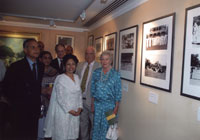 between Pakistan
and the host team. It was made possible due to the patronage of the British
High Commission in Islamabad, Marylebone Cricket Club (MCC) and the kind
support of Majid Khan who used his good offices to coordinate the event.
between Pakistan
and the host team. It was made possible due to the patronage of the British
High Commission in Islamabad, Marylebone Cricket Club (MCC) and the kind
support of Majid Khan who used his good offices to coordinate the event.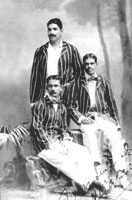 Humphrey Bogart Style with his cricket gear, photographed
with Mahomed Nissar who interestingly was wearing a broad black belt on his
white cricket trousers, actress Mussarat Nazir batting in a charity match
played at Lahore in the 1950s, Fazal Mahmood, wearing a black Tuxedo dancing
with a female fan during a reception for the Pakistan team on their first
visit to India, Khawaja Nazimuddin raising his arms in joy as Pakistan win
the 1951 unofficial Test against MCC in Karachi, President Eisenhower,
wearing a green Pakistan cricket blazer, while meeting players in a Test
against Australia at Karachi, the New Zealand cricket team travelling on the
Government Transport Service, on their way for a practice session at Lahore
Gymkhana during their visit in 1955.
Humphrey Bogart Style with his cricket gear, photographed
with Mahomed Nissar who interestingly was wearing a broad black belt on his
white cricket trousers, actress Mussarat Nazir batting in a charity match
played at Lahore in the 1950s, Fazal Mahmood, wearing a black Tuxedo dancing
with a female fan during a reception for the Pakistan team on their first
visit to India, Khawaja Nazimuddin raising his arms in joy as Pakistan win
the 1951 unofficial Test against MCC in Karachi, President Eisenhower,
wearing a green Pakistan cricket blazer, while meeting players in a Test
against Australia at Karachi, the New Zealand cricket team travelling on the
Government Transport Service, on their way for a practice session at Lahore
Gymkhana during their visit in 1955.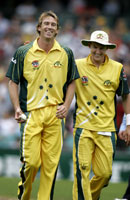 performance of the southern summer to clean-sweep the
best-of-three finals 2-0 and thus regain some of the pride they had lost
during the preceding Ashes battle.
performance of the southern summer to clean-sweep the
best-of-three finals 2-0 and thus regain some of the pride they had lost
during the preceding Ashes battle.