|
|
| |
instep
profile
Music's new visual messiah
Bilal Lashari is the new video director in town, but he's quite
a sensation already. The four videos he has made are captivating
and they are as innovative as they are diverse.
Bilal talks to Instep about the creative process and taking it further…
By Aamna
Haider Isani
|
| |
| Last
year was a volatile year for entertainment; the industry virtually
came to a stand still by October. But like everything corrosive, it
unearthed some exceptional talent, especially in the line of music.
While album launches were being delayed, concerts cancelled and the
top line of video directors like Saqib Malik, Jami and Asim Reza were
taking a long break from making videos, in stepped Bilal Lashari.
With merely four music videos - Abrar ul Haq's 'Islamabad', Overload's
'Dhamaal', Jal's 'Sajni' and recently Atif Aslam's 'Hungami Haalat',
Bilal brought back an artistic consciousness that had been invaded
by videos of bands playing in old, demolished monuments. (Either that
or incredibly macabre videos of young kids electrocuting themselves
in a bath tub.) |
 |
| |
| Other
than Zeeshan Parwez, who also raised the bar with thought provoking
videos like Ali Azmat's 'Teri Perchaiyan' and Hashim's 'My Moment',
Bilal Lashiri's work cropped up overnight, like a proverbial bean
stalk. His videos were technologically sound and they were intelligently
conceptualized. 'Islamabad' depicted Abrar as a US President in search
of "Ishq"; 'Dhamaal' honed percussion with the wild movement
of horses and an angry sea; 'Sajni' brilliantly retold the 'Beauty
and the Beast' story whereas 'Hungami Haalat' simply blew one away
with its rock mode. The videos were innovative and yet they were diverse.
People were sitting up to take notice. |
| |
| These
are videos worthy of being nominated for any award. And yet amazingly,
despite the maturity of thought, they stem out of a very young mind.
26 year old Bilal is a young undergraduate in Motion Pictures and
TV, studying at the Academy of Art University in San Francisco. "I've
been traveling back and forth to get this work done," he spoke
to Instep. Bilal took the backward route into video direction. While
generally the best directors had moved from directing advertisements
to music videos, Bilal began his journey with the creative instead
of the corporate. "I just felt it's a good way to get your name
out there," he said. "Eventually I will get into ads as
well." |
 |
| |
| The
"exhausting and sometimes frustrating process" was crammed
into summer vacations and numerous trips to Pakistan. When in the
US, he was also offered to assist Shoaib Mansoor in the making of
Khuda Kay Liye in America. According to Bilal, "I was totally
blown away by the script when I read it but I had to quit the film
because of the delays it was facing." He decided to focus on
music videos, polishing his skills while at it. Much to everyone's
surprise, Atif's 'Hungami Haalat' was the first video he shot, almost
two and a half years ago, though it was only recently released on
TV. Bilal was traveling, Atif was inspired to write the song at an
airport and somehow the whole concept came together that way. |
| |
'Hungaami
Haalat'
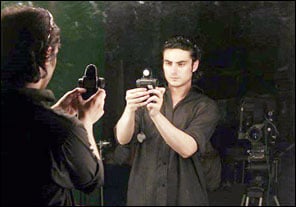
"Shooting 'Hungami' was a crazy and frustrating experience,"
remembers Bilal. "It was the first time I was working on 35mm
and we had a moderate budget; the sponsors came in much later. But
I did everything - even the shooting - myself. We went for the whole
terrorism thing and brought in a bit of everything, including global
warming. I had fun with effects and ended up throwing in a bit of
everything I could. But it's not an experience I'd want to repeat."
Confessing to being a bit of a control freak, Bilal adds that the
experience just got a bit too much. As with most "control freaks",
he does the direction, cinematography and post work as well. With
'Hungami', he even took up shooting. But the hard work paid off. Despite
the video facing a two year delay in release, it won him a Best Music
Video award at University. He got the same award, plus one for Best
Cinematography, for 'Islamabad' as well. |
 |
| |
|
'Islamabad'
"I don't think 'Islamabad' was my best work," says Bilal,
"but the Americans loved Abrar. They found the song so unusual.
They are generally used to a very sanitized look and this mix really
worked for them."
It worked in Pakistan as well as people were extremely amused to
see a skeletal 'Thriller' like portrayal of the Capital that is
often alluded to as 'the city of the living dead.'
The learning process continued and by the time Bilal shot 'Sajni',
he according to him, "was no longer a control freak."
|
 |
| |
'Sajni'
"I asked Neil Lisk - who had worked with Shoaib Mansoor on Khuda
Kay Liye - to shoot the video and help with the cinematography. We
had a really great budget and the group was easier to work with than
Atif. In fact I'd love to work with them again. My job as a director
is to allow others space for creativity and I could do that in 'Sajni'.
It was teamwork."
The maturity spoke for itself in the slick way the video was shot.
Though the story, adapted from the fairy tale, wasn't quite original,
the way the video was shot certainly was. Bilal cast an unconventional
model - Juggan Kazim - in the role of Beauty and wove the story around
love. 'Sajni' was as lyrical as 'Islamabad' was satirical |
 |
| |
|
'Dhamaal'
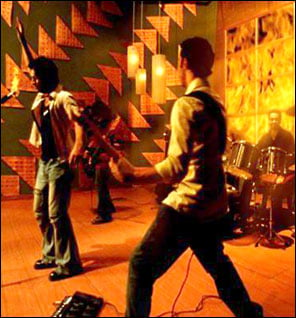
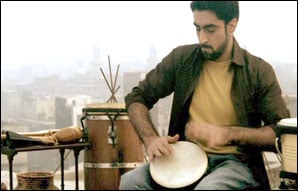
Then came Overload's 'Dhamaal' which was "the most difficult
video to shoot."
"Technically it was a different ball game and a whole lot more
difficult. Though it apparently looks really simple, it wasn't.
Performance videos are always tough to shoot on 35mm. Plus when
it's an instrumental, the tempo is constantly shifting and you have
to move with it. 'Dhamaal' was about simple, clean images. By then
I really did want to get out of complicated imagery."
Bilal is ready to head back to the states these days but the story,
rather story telling, isn't over for him yet. He's already worked
on Atif's next song 'Rabba' and is in talks with Ali Azmat for 'Gallan',
which is the working title from a song from Ali's next album Klashnifolk.
That's quite an exciting platter for a new comer.
Bilal is extremely talented but he's also been lucky with the budgets
his videos have gotten. It's bizarre, but all four of his videos
have been sponsored by four different telecom companies: 'Hungami
by LG', 'Sajni' by Wateen, 'Dhamaal' by Mobilink and 'Islamabad'
by Telenor, though Bilal mentions that the LG sponsorship came much
after 'Hungami' had been completed. But what's interesting is that
many of the respective artists are also 'faces' of the telecom companies
they have been sponsored by and it's the subsequent interest in
promoting their brand ambassadors that inspires companies to dole
out huge budgets for making and promoting these videos. It's a healthy
trend, as long as it doesn't get carried away by the sponsor, as
the Tulsi sponsored ads once did.
"It's okay as long as the companies do not interfere with the
creative process," adds Bilal. It's more than fine; it's fabulous,
we think. It makes an artist's product more appreciable and it makes
the whole process lucrative and beneficial for the industry.
All this has convinced Bilal Lashari to return to Pakistan once
his studies commence; he graduates in three months. He has been
inspired and motivated by his experiences, though he is quick to
add that some have been "frustrating". He also appreciates
the path that has been caved by senior directors like Saqib, Jami
and Asim. "They've paved the way for us with their boldness,"
he says. While at some point last year, when Pakistan's instability
was at its peak, he had his doubts about coming back, now Bilal
is convinced he wants to. And he beleieves the next step for him
will be making a feature film in Pakistan. He seems like a doer,
and since he has worked under Shoaib Mansoor's shadow, there's a
good chance he just might be able to do so very soon.
|
| |
|


