|
|
| |
instep
analysis
The KaraFilm Festival plans to go ahead without
Bollywood and big bucks
Even though corporations have pulled out of sponsoring the KaraFilm
Festival, the organizers of this prominent event are putting their
best foot forward to make it happen. Instep takes a look at how
Kara will be going back to its modest roots this year, as their
regression has been ushered in due to the lack of money and debilitating
security.
By Saba
Imtiaz
|
| |
 |
| |
Every
city has its cultural institution around which its axis tends to revolve.
In Karachi, that is the KaraFilm Festival, an event that has grown
by leaps and bounds since its inception in 2001. What was a small
festival in a tiny venue with one screening hall, and a crowd comprised
of people that one tended to see at every day of the Festival exploded
into an event with major sponsors, heavy media presence, multiple
venues, grandiose opening and closing ceremonies, and most notably:
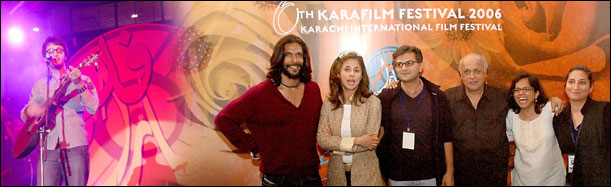
a heavy dose of Bollywood. It started off with Mahesh and Pooja Bhatt,
and in the years after one saw Ajay Devgan and Irrfan Khan at the
screenings of their films.
That dose of Bollywood was like the wildest fantasy come true. This
was before the very recent import of Indian films into cinema, and
suddenly the actors who had only been seen on televisions via pirated
DVDs were up, close and personal. It was only natural that the hysteria
translated itself into added hype to the Festival. What was an event
that film aficionados would flock to, became one where society begums
would push and shove their way in to meet the stars of Omkara and
Maqbool in person.
And while one wondered what would happen to the twice-postponed seventh
edition of the Festival post the 26/11 attacks in Mumbai, the answer
came in a very recent public missive from Hasan Zaidi, the Festival
Director. Kara's sponsors for the scheduled Festival in February 2009
have pulled out at the last minute citing the global economic recession
as a reason for their withdrawal of financial support.
This has left the organizers in a lurch and they have now launched
a fundraising appeal for five million rupees to be able to run the
Festival on schedule. What this means is that the organizers are now
pulling together a scaled back, minimal version of Kara: cutting down
on a venue, minimizing the number of films that will be screened and
not having the opening and closing ceremonies among other measures.
Without sponsorship and with a worsening security situation and diplomatic
impasse the Festival will be subtracting the same elements that made
it a hot ticket to a larger audience in the first place and attracted
a media circus of sorts.
The timing of it all is ironic. Barring a miracle, it clearly looked
impossible that a Bollywood contingent would arrive at Kara this year,
and that already translates into less publicity and fanfare. While
the economic recession has hit everyone and corporations are no exception,
what is interesting to note is that even in these times, sponsored
events are still taking place. And these are events that have absolutely
nothing to do with Bollywood such as the World Performing Arts Festival,
Chicago, the highly successful musical that just completed its second
run in Karachi and is now touring Lahore, Shark's stand-up comedy
tour that went to Karachi, Lahore and Islamabad, and other musicals
and drama performances that take place in all major cities. |
| |
| It is extremely
unfortunate that companies are not stepping up to the plate
to support Kara, an event which not only brings together filmmakers
from all over the world, screens films and displays art, it
is an event that seeks to educate people on films through the
quality of the work put up, as well as the discussions that
are part of the Festival. With or without Bollywood, Kara is
a fantastic endeavour that needs the support of those who can
pay to be able to go ahead. It should not be contingent on the
presence of stars from across the border. .And this isn't just
the case in Pakistan: look at any country in the world and the
major events of the year are still going ahead, be it the Academy
Awards or Paris Couture Week or theatre festivals in India. |
 |
|
| |
While one could argue that these are platforms that have been around
for decades, one must remember that they still have the same elements
attached to them,of corporate sponsorship and support from the communityThese
much-established events abroad are still looking at ways to prioritize,
and even get funding from non-traditional sponsors. Mattel, the maker
of Barbie dolls, will be sponsoring New York Fashion Week this year
and even though several designers in the US have opted out of showing
within the pricier tents and are doing low-key shows, they will still
be present. In a nutshell, this is how one adapts with the times.
At home, organizers of platforms such as Kara and Carnival de Couture
have prioritized what they need to do to make their events actually
take place this year.
The organizers of Carnival -- a magnum opus fundraiser event that
has brought in big name Bollywood superstars and Indian fashion designers
over the past few years - are looking at bringing in a designer from
Lebanon to replace the Indian designers that were slated to show at
the event.
The grandiose events that Kara and Carnival are have attracted huge
crowds, and a rush for pricey tickets in Carnival's case. While Kara
has its own cult audience that have been loyally attending the Festival
since its inception, one wonders whether those who flocked to Kara
for the glitz and glamour will deign to support a more localized version
of the Festival? One would hope the answer to be yes, yet that is
a question one can only answer when the Festival takes off on February
4.
After all, even the Rafi Peer Theatre Workshop faced similar problems
last year including lack of sponsorship and support - but they were
undeterred and put together a brilliant World Performing Arts Festival
in Lahore – one which citizens of Lahore took ownership of by
marking their attendance in throngs particularly as a mark of solidarity
on the closing day.
Yet the absence of Bollywood that one will see at both Kara and Carnival
this year makes one think whether the glamorous expectations many
associate with both these events can be lowered. While Bollywood has
had, is and will continue to be a dominating presence in our lives
via cinema and television, one wonders whether that same buzz and
excitement can be generated at an event where only local filmmakers
and stars are present. Having personally attended several Kara events
focusing on Pakistani shorts, films and discussions with filmmakers
that have brought in large audiences (though not as hysterical as
those that went to see Omkara) it is entirely possible.
This situation with events being scaled down or altered whether it
is film, fashion or cricket makes one ask the proverbial question
of 'is the glass half empty or half full?' Cynical souls would say
that the glass is half empty and that this is a sign that the security
situation and economic recession has completely taken hold of everything
enjoyable. But for the optimistic that have seen a turbulent country
like Pakistan get up every time it has been knocked down this is a
tailor made opportunity. An opportunity to get up, volunteer, fundraise
and prove that Karachi needs these events to take place.
Novelist and journalist Mohammed Hanif, who recently wrote a brilliant
piece for the Times of India dispelling common myths about Pakistan
including 'Pakistan is a failed state' put it best: "If it is,
then Pakistanis have not noticed. Or they have lived in it for such
a long time that they have become used to its dysfunctional aspects.
Trains are late but they turn up, there are more VJs, DJs, theatre
festivals, melas, and fashion models than a failed state can accommodate.
To borrow a phrase from President Zardari, there are lots of non-state
actors like Abdul Sattar Edhi who provide emergency health services,
orphanages and shelters for sick animals."
After all, the surge of citizen activism one saw after the crackdown
on the judiciary in early 2007 and the imposition of Emergency later
that year, proved that despite appearances, we are not an apathetic
nation. That same spirit has imbued the KaraFilm Festival, a platform
that have consistently been driven by the hordes of youth who visit
them as well as volunteer at the Festival.
One element that must be applauded is the determination in the air.
Kara will not be postponed beyond its current dates. In his email
explaining the circumstances and launching the fundraising appeal,
Hasan Zaidi, the Festival Director wrote, "We have seen what
the Festival is capable of achieving and how it has revitalized a
cinema culture in Pakistan, built bridges between Pakistani and international
filmmakers, initiated an environment of debate and inter-cultural
tolerance, and encouraged creativity especially among the youth. And
we have given too much of our lives and have too many hopes for it
to let it die. We intend to go through with the Festival on the scheduled
dates even if it means we have to drastically scale back the Festival
and its activities, cut down on venues and film screenings, and apologize
to invited guests for being unable to bring them to Karachi. We will
have the Festival regardless but how much of it we can pull off depends
entirely on how much we can afford. We intend to carry on against
all the odds."
This is the spirit that we need, and it is a spirit one hopes to see
imbued in the audiences who should show up to support Kara. This is
not a time to let Kara be hijacked because corporations backed out
of sponsoring it and no Bollywood presence. As Kara puts its best
foot forward and concentrates on making it happen, so should its audiences
and patrons of the arts who must come out in support.
|
| |
|