|
|
| |
instep
overview
Cinema of belief
The KaraFilm Festival was all about belief this year. Hasan
Zaidi’s belief that it could and therefore should happen.
Nandita Das’ belief that she could make a controversial film
like Firaaq and her and Mahesh Bhatt’s belief in building
bridges to the extent that they flew down for the Festival despite
the hostility between India and Pakistan. They all believed and
more importantly stood up for it, making this the most memorable
Kara yet.
By Saba
Imtiaz
|
| |
 |
| |
This
year’s KaraFilm Festival came to life with fits and starts,
much like the rickshaw that was its logo. But it ended with a bang
that took Kara to a whole new level. And that was due to the rather
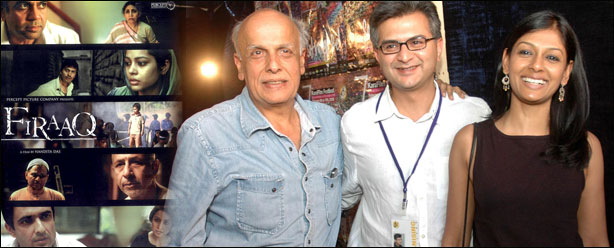
surprising appearance of Nandita Das and Mahesh Bhatt from India,
marking the first visit by any Bollywood luminary since the Mumbai
attacks brought everything to a standstill. It made one sit up and
think ‘how are they here?!’, considering how a gutsy
a move it was.
While this year’s Festival was very well attended, even featuring
a slew of local celebrities at it’s opening, it didn’t
have the buzz of the Bollywood deals that get set into motion at
the event. And it was slated to end its nine-day journey on the
same way it had started: on a low-key note, with no appearances
from visitors from Bollywood that usually dominate headlines about
Kara. But a day before the Festival was closing news spread like
wildfire via email and text messages that making appearances at
the KaraFilm Festival were filmmaker Mahesh Bhatt and activist and
actress-turned-director Nandita Das. And true to the news they were
there, at a crowded gathering of the press corps, ready to answer
the plethora of questions being fired at them.
In any other year of Kara, a scene like this may have been commonplace.
But this year the arrival of Mahesh and Nandita at Kara had a new
significance. In an edition of Kara where the usual Bollywood quotient
was missing, and newspaper headlines were dominated by news of intelligence
reports that proved that the 26/11 attacks had been planned in Pakistan,
their presence was indeed jaw dropping.
And the buzz was not ‘who’ was there: but more of ‘how?!’
After all, visas to both Pakistan and India are hard to come by
now given the diplomatic situation, and Hasan had very emphatically
announced that even “people who want to be at Kara aren’t
getting visas.” But thanks to the Pakistani High Commissioner
in India, Mahesh and Nandita both were granted visas to come to
a Festival that they have both attended in the past: Mahesh for
the past four years of Kara, and Nandita who came to Kara’s
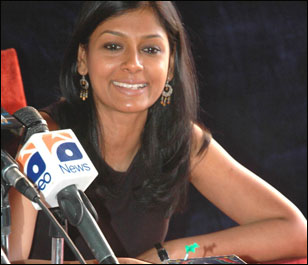
first edition. And it appeared like once word of Nandita’s
appearance had got out, all of Karachi showed up to see Nandita’s
film Firaaq. It showed to a full house on the night of the screening,
with queues stretching through the foyer of the Arts Council, and
one spotted Shahi Hasan, Faisal and Seema Kapadia and Mohammed Hanif
in the line, patiently waiting to get to the auditorium.
Mahesh Bhatt, who has been such a regular fixture at the Festival,
was adamant that it was not possible that Kara take place and he’s
absent, even saying that it compares to how devotees pay attendance
at shrines “jaisay log mazaar pe maatha tekne jaate hain”.
For him to speak of Kara as such an exalted platform was indeed
welcome, given the lack of full-fledged corporate support that the
Festival has had to bear with this year. One did wonder how those
companies must be feeling now, given the buzz around Mahesh and
Nandita’s presence.
Mahesh spoke at length about the importance of Kara’s platform
as a ground where “we saw the dream of Indian and Pakistan
co-productions” as well as the current sentiment vis-a-vis
Pakistani artistes working in India. Mahesh said that “these
are dark times”, while talking about the cross-border exchange
of talent, he also added that there has been no official revoking
of cross-border productions; and he is still going ahead with making
the film Jashn that stars Pakistani actor Humayun Saeed, hopeful
that by the time he comes to India for its dubbing et al, the situation
will be better. He explained that the reason why filmmakers are
hesitating to use Pakistani talent is “because of producers
who cannot risk seeing their investment go down the drain if the
film doesn’t get a license or exhibitors who cannot afford
to have 24/7 security outside cinemas.” |
| |
 |
| |
This
made Nandita coming to Pakistan with her directorial debut Firaaq
even more extraordinary: she had to take a stand to be able to bring
the film here and risked the fact that were the film to have raised
hackles in Pakistan, or be seen as apologist it would have created
problems with its release in India. It is applause-worthy in itself
that Nandita took such a stand, and that Mahesh and Nandita’s
appearance in Karachi at the Festival could in itself be a cause
of consternation for the extreme right-wing parties in India.
While our multi-national companies denied sponsorship to Kara because
they thought the stars weren’t coming, one saw two people,
who have nothing to gain from Kara per se but everything to give
back, put so much on the line just to support the platform it has
become. Its win as Best Feature Film at the Festival prompted the
film jury to release a disclaimer of sorts, saying, “Many
people might mistakenly believe, especially given the current state
of relations between the governments of Pakistan and India, that
the choice of Firaaq is an attempt by a festival based in Pakistan
to embarrass India regarding its record in Gujarat. However, the
jury wishes to emphasize that its reasons for choosing Firaaq as
the best feature film are far removed from such politicking. Filmmaker
Nandita Das has demonstrated through her film that it is possible
to explore the contours of a communal holocaust not by focusing
on the rancour and prejudice of the perpetrators but instead by
looking at the devastation it visits upon the ethos of the victims.
In doing so, Nandita Das brings out the healing power of those who
strive to provide moral support to the victims through material
help and human sympathy. While Firaaq is an eloquent indictment
of the savagery that characterized communal frenzy in Gujarat, it
is not simply shining a light on the charred remains of a society.
It is also a plea for societal forces to come together to reduce
the anguish of the victims before it is too late. In the end, the
film clearly advocates the need not to turn away or indeed to run
away, but to stay behind and fight bigotry with all the dignity
and determination that communities can muster. Firaaq is also a
testament to the power of cinema to fill a vacuum in public discourse.”
In response to questions asked by members of the press about statements
given by Bollywood fraternity members about the 26/11 attacks and
Pakistan’s role, Mahesh pointed out that it was a freedom
of speech issue - and everyone has a right to their own opinion.
However he was swift to deny any ‘conspiracy’ behind
Bollywood bigwigs making such statements, or that Bollywood would
now switch gears towards making anti-Pakistan films. Mahesh cited
the example of Pakistani comedian Shakeel Siddiqui who was forced
to leave India after Shiv Sena activists targeted a set he was shooting
on. According to Mahesh, when he called Shakeel to apologize on
everyone’s behalf, Shakeel said that at the airport, fans
among the airport staff were apologizing - leading Mahesh to say
that any hateful sentiments should be attributed to opportunists,
not the people of both countries. As he put it, “in times
of peace, talking about love and friendship is fashionable, and
in difficult times, talking of hate has now become fashionable.”
But what took center stage with their appearance was the film that
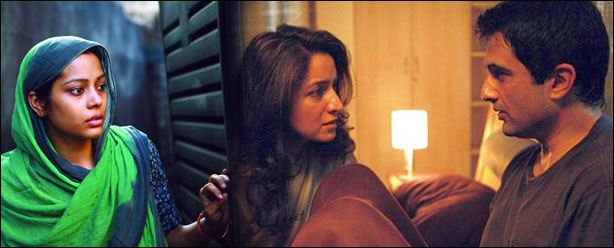
Nandita Das brought to be screened at Kara. Firaaq (Separation),
which marks her directorial debut, is a film that deals with the
aftermath of riots in Gujarat in 2002, after hundreds of Muslims
were massacred in sectarian clashes. Controversial by the fact that
it is set against such a volatile backdrop, Nandita described the
film as “very timely after 26/11, as it deals with the prejudices
and perceptions that are raised after a period of violence.”
And it was eerily timely in its screening. Over the past few months,
one has seen prejudices of all sorts being developed on both sides
of the border, a flurry of accusations and counter-accusations,
and an ironic sense of patriotism and pride in Pakistan. Moreover,
these clashes are something that we have seen in Pakistan all too
often. And while Nandita said after the screening that she believes
that India is a secular, democratic country where everyone is entitled
to their right to free speech, one wondered how this film would
be received in India - a country where even films like Billu Barber
have to be renamed, or Jaya Bachchan is attacked for a passing comment
on speaking Hindi - given its theme of Gujarat, which is just not
a topic in mainstream cinema. Nandita, when asked what reaction
she was expecting. |
| |
With
the film, Nandita hit the nail on the head with its portrayal
of human relationships and how they evolve after the unimaginable
violence that occurred in Gujarat in 2002. The film, which
stars Naseeruddin Shah, Paresh Rawal, Deepti Naval, Tisca
Chopra and Sanjay Suri among others, saw a collective gasp
of shock and eye-shielding with its opening scene that depicted
a truck dumping a number of bodies into a graveyard, and deserved
the rounds of applause it got after the screen faded and the
credits began to roll. The questions of identity, displacement,
loneliness, suspicion and desperation dominate this film,
and provided an all too real reminder of what riots do to
the people that are directly or indirectly affected by it
- as we, in Pakistan, know all too well. |
 |
|
One
was oddly reminded of another film that sent waves of shock and
horror in a Kara audience - Rakesh Sharma’s Final Solution
which screened in 2004 - an eye opening documentary about the Gujarat
carnage. However, while Nandita aptly chose to not depict violence
(saying, “films that talk against violence often have too
much violence”) she also chose to highlight stories of friendship,
of people from different religions coming together, and of compassion.
These are stories that one often does not hear, and while Firaaq
is fictional, it came with the claim: ‘based on a 1000 true
stories.’
It was also interesting to note how the most poignant figure of
the film was the child actor, who plays Mohsin/Mohan. With Slumdog
Millionaire’s child actors having been shot into the limelight,
and the Ramchands of Mehreen Jabbar’s Ramchand Pakistani that
captured our collective interest last year, it is definitely interesting
how the subcontinent’s stories are being told best by children
whose outlook on the world is not yet cynical and jaded, but their
circumstances lead them into situations they have absolutely no
control over.
Firaaq doesn’t attempt to deal with how or why the riots took
place, nor does it offer any solutions on how to bridge divides
or heal rifts. Instead it delves into the questions that we find
ourselves asking as we watch the aftermath of a bomb blast from
our television screens or windows, wondering what drives people
to madness, but also how we feel. It is the same defiance that drives
people to adopt a new found identity, as Pakistanis and Indians
did with their displays of patriotism after 26/11, or Americans
after 9/11. It is a dilemma that one saw in Shoaib Mansoor’s
Khuda Kay Liye and one wishes more local artistes would deal with.
One hopes that this film sees a cinema release in Pakistan, because
the feat of bravado that Nandita has pulled off in this poignant
film, deserves to be shown here to help people think about the consequences
of irresponsible actions and words.
One of the most pertinent questions that leaped out from Firaaq,
and from Mahesh and Nandita’s presence at the Festival, stemmed
from a verse uttered by Naseeruddin Shah’s character in the
film, along the lines of ‘sirf saat sur mai itni taaqat kahan
ke itni gehri nafrat ko nahee khatam karsakte’ (only seven
chords do not have the power to end this deep-rooted hate). That
line prompted one to think of whether musicians may be thinking
the same and Mahesh Bhatt to ask Nandita whether she felt that arts,
film and culture could actually bridge differences - to which she
responded that ‘one cannot just not try’. As Nandita
and Mahesh pointed out, it is activism as one saw in India with
the Pink Chaddi Campaign, a citizen response to the Mangalore incident
of women in pubs being targeted by the Sri Ram Sena, and a “long,
sustained engagement” that will help this situation. He quoted
Mirza Ghalib to drive the point home. “yeh ishq naheen aasan
/ bas itna samajh lijiye / aik aag ka darya hai / aur doob ke jaana
hai” (this love isn’t simple / but just understand this
/ it is a river of fire / and one must swim in it).
That sentiment has been proven right by the fact that Pakistani
singers like Atif Aslam enjoy incredible popularity in India and
Shah Rukh Khan’s Billu, which premiered last weekend, saw
a huge traffic jam in Saddar with the number of people driving to
cinemas to watch SRK shake a leg. Kara has developed these linkages
and one cannot help but look back in awe of what this fledgling
festival has achieved, both in turbulent and peaceful times. The
sub-continent’s deep-rooted love for music, for film, and
for literature and poetry is what has brought our teeming populations
together. And citizens on both sides of the border have already
shown that they will continue to enjoy art from both sides of the
border: Pakistani authors were feted as celebrities at the recent
Jaipur Literature Festival, Pakistanis throng to cinemas to watch
Ghajini and Billu and are addicted to their daily dose of gossip
via 24/7 Bollywood news channels.
And it was on this extraordinary note of Mahesh and Nandita’s
unexpected arrivals that Kara came to a close. While one is glad
that the Festival was this year well-attended despite the lack of
glitz and glamour, and that citizens turned out in support to watch
films and prove why Kara is such a necessary platform, one is even
more glad to see that the cross-border linkages have continued even
in these turbulent times. While Kara ended on a high note in part
of the presence of both the above-mentioned filmdom members, it
definitely gives rise to the belief that Kara will carry on and
keep weaving its filmi magic. |
| |
|


