



|
|
|
|
 |
 |
  
|
touristry Vanishing
relics Preparations are on to market Soon Valley to local tourists By Shahzada Irfan Ahmed Not many people travelling
on the Lahore-Islamabad Motorway know they can take an exit from Lillah or
Kallar Kahar interchange It won’t be wrong to say it’s one of the best-kept secrets of the country. Interestingly, the Punjab government has decided to develop and market the valley to the local investors as an easily accessible tourist hub. The thought at work, as mentioned in the project’s concept paper, is that it’s time to give an option to tourists who are reluctant to go to tourist points like Swat, Chitral and Mansehra due to security concerns. Similarly, Murree is crowded and expensive whereas Gilgit-Baltistan region is inaccessible. Soon Valley is within reach, especially for the people of Punjab, and serves the purpose for which they go to hill stations. An additional attractionis its all-year-round pleasant weather, whereas tourist activity comes to a stand-still in the areas mentioned above in fall and winter season. In this backdrop, the Khushab district administration gave a presentation to the Punjab government last month about tourism-oriented development in the Soon Valley. The government has agreed in principle to go ahead with this plan and has already released funds for the initiation of some of the related projects. The district government hopes it will be ready to host tourists by coming September, and that the subsequent approvals and financial support from the Punjab government will flow in. Presently people come here on a day trip but are unable to enjoy the spectacular views of sunrise and sunset for lack of boarding facilities. On the developments, Syed Gulzar Husain, District Coordination Officer (DCO) Khushab tells TNS the Punjab government has agreed to set up a Project Management Unit (PMU) to discuss related proposals and execute them. “Our aim is to set up basic infrastructure in four to five years, after which the private sector can come in full sway.” He says that six different
locations in the valley shall be developed and lakes will not be used
for any extraordinary activity The proposed facilities include different treks and trails along the boundary of Soon Valley for mountain biking, rock climbing, camping sites, lake view points, a paragliding centre at Katha Shagral, wildlife parks, bird-watching centres and so on -- both for families and the adventurous lot. The best part, Gulzar adds that the project will take minimal investment and proper marketing to make it a success. “Most of the required infrastructure already exists, all that is needed is its proper management. The government will avoid mega projects requiring large-scale financial commitments and instead, focus on the creation of a culture -- and tourism-oriented stakeholder base.” Gulzar says tourism department is already planning the construction of tourist resorts at lakes which involves a phased construction of five youth hostels and the utilisation of government rest houses as tourist accommodations. Also, conversion of primary schools and teachers’ residential building at Boys’ College, Naushera, recently vacated under the school rationalisation policy into tourists lodging or youth hostel is on the cards too, he says. Gulzar tells the government is trying to introduce the concept of home-stay at various rural sites like the village in the foothills of Sakesar. This village oversees the huge Uchali Lake, which is home to many species of local and migratory birds. Uunder the plan, a limited number of houses per population will be cleared for tourism purposes after due screening, verification and validation. In case the number of aspirants is high, a short-listing will be done through balloting or auction -- and appropriate training and education will be imparted to such households. There’s no shortage of suitable houses in these areas as every village or locality has a sufficient number of retired army personnel residing there. “They can host people as they have much more exposure than those who have never left their place,” says Gulzar. Malik Javed Awan MPA, says
that the Punjab CM has approved Rs170 million for the construction of the
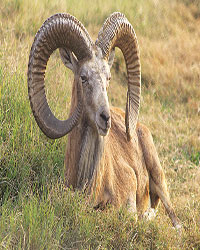
Nowshera-Jaba Road. Awan says a proposal has been given to the Punjab government to dig a tunnel in a mountain to shorten the travel time between Khushab and Mianwali by three hours. Masood Arshad, Senior Manager, Pakistan Wetlands Programme, WWF says the Soon Valley development initiative was taken by Khushab DCO who has immense interest in environment and conservation , “WWF was taken on board and asked to give its input on the project. The rationale behind the whole plan was to provide the local tourists with entertainment opportunities in the heart of Punjab.” Masood says foreign tourists will be kept out-of-bounds as the area is sensitive in terms of security and national defence. WWF had concerns about threat to the eco-system in case there were too much brick and mortar constructions, solid waste disposal and activity in freshwater lakes. Besides, there are no rules and regulations about setting up a nature park and governing it. “We suggested there should be a legislation in this regard.” He informs water sports have been dropped because of fears it will deter the migratory birds and change the ecology. Instead, they have suggested setting up “bird hides” from where tourists can watch the varied species of birds without being noticed. Masood tells there are 150 species of local and migratory birds in the valley, including the globally endangered white-headed duck. Besides, he says, “there is Punjab Urial which is nearing extinction and, if not protected, will be found only in the game reserve of late Nawab Amir Muhammad Khan of Kalabagh. The proposal to establish Urial watching centre is also a good idea.” He suggests the local community should be involved and compensated for activities like hunting and fishing. Culling trees will be prohibited. Besides, there is a need for proper management of water flow in springs, floodwater and reverie areas to ensure presence of water in lakes and maintenance of ground water level. The Khushab DCO tells that they have identified counter-points in the valley as some areas are not open to the general public due to security concerns. For example, he says, they have pointed out an alternative site for valley view as there’s PAF radar installed at the Sakesar hilltop. The first phase of the marketing plan focuses on government schools that will be asked to bring their students to the valley once boarding facilities are in place. A proposal is also in place to include chapters about Soon Valley in the curriculum, he adds. “Unlike in the past, the rural youth nowadays is also confined to home-based activities like cable TV viewing, mobile phone usage and internet surfing. I think they will be equally attracted by the facilities the government plans to offer in the area.” Email:
shahzada.irfan@gmail.com Vanishing relics The gradual deterioration of the grand Shahpur graveyard in district Kohat By Mohammad Niaz Historical infrastructure
and relics are symbolic to a locality that not only reflect the chronological
traces but also become Located in the heart of Kohat, at a distance of about four km towards south-west of the urban area along Shahpur Road amid the famous guava orchards, the graveyard relics can be observed from a distance as the road passes through the time tested relics which reflects the family traces such as Mohammad Jamhur Jan which is the grandson of the Ahmad Shah Abdali. Plant called mesquite having thorny feature is luxuriantly growing in the graveyard area which not only deters people to get inside the graveyard but also serves as an element to protect it. However, it also serves as potential cover to robbers as visitors would not get into the graveyard because of the thick outgrowth of thorny mesquite. Around the graveyard there are high hills with plants including Sanatha and Dodonaea species that have witnessed changes to the graveyard over time. The graveyard has three main infrastructures -- the mosque, the rectangular-shaped room, and the main tombs. The mosque, constructed in 1305 Hijri has a central tomb and stone plates engraved in Persian phrases and verses. It has now been whitewashed and courtyard made of bricks by the local caretakers. Near the mosque the long main minaret of a rectangular room structure in dilapidated condition attract attention of many passers by. This place was used to be the kitchen and sitting area of the Abdali family. The minaret has five levels tapering to the top with a pointed ending. The room has four small hexagonal minarets with rounded tops one at each corner. Main door entrance towards the south has wooden frame and outward tiles some of which have dismantled and the rest are soon to follow. Elongated flat stones engraved with Persian phrases are still affixed above the main entrance. The entire structure has no
rooftop, which has fallen down in due course of time. Inside the room there
are two lamp chambers Towards the east is located the main structure having central tombs and four entrances one at each side. The tombs have been built over graves of important figures of the time. These graves that are built of rocks cut in different sizes form the main attractive features where a lot of labour must have been put in to carve the stone in such sizes and shapes. The taller tomb has four hexagonal minarets one at each corner provided with slits towards top. The tombs have turned to dark greenish tinge due to time and weather factor. The smaller tomb having flat rounded top has a wall in front with stones slabs engraved in Persian phrases some of which have fallen down and lost. The boundary wall of the graveyard has been completely demolished. One of the main reasons to maintain this graveyard is not only to preserve the history over time but the place is also a hotspot for tourists as it is situated in the vicinity of the Tanda Dam which is famous for having a wildlife park and water reservoir. The graveyard is en-route to the Tanda Dam and has high potential of preserving it to check further deterioration in its present status. The Tanda Dam is famous for its landscape and ecological features such as serving as the staging ground to the migratory birds in winter. Preservation and maintenance of the graveyard will not only preserve the historical heritage but will also serve as tourist site as most of tourists are not aware of its history and existence. This heritage remains unnoticed by the visitors who avail recreational resources of the Park and the Reservoir in the nearby area. Such heritage buildings need to be preserved through time which will not only help in boosting up the local economy through tourism but will also serve as exposure to the locality. The
writer is Deputy Conservator Khyber Pakhtunkhwa Wildlife Department
|
|
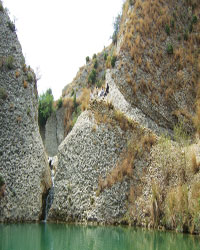 and make it to the land of their dreams, in less than an hour. The reference
here is to the picturesque Soon Valley in district Khushab, which is home to
vast natural forests, wildlife, hills, natural springs, numerous species of
local and migratory birds -- and one of the most beautiful lakes in the
world.
and make it to the land of their dreams, in less than an hour. The reference
here is to the picturesque Soon Valley in district Khushab, which is home to
vast natural forests, wildlife, hills, natural springs, numerous species of
local and migratory birds -- and one of the most beautiful lakes in the
world.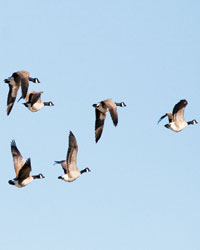 such as water sports etc. This will help conserve the ecology of the area.
 This will facilitate the tourists and minimise the time spent on the journey.
Funds for transformation of government’s guesthouses, schools,
dysfunctional Basic Health Units (BHUs) into tourist housing facilities have
also been approved by the Punjab government. Teams of Planning and
Development (P&D) Department have completed their surveys in the valley,
which, he says, is proof of the fact that the ball is rolling.
This will facilitate the tourists and minimise the time spent on the journey.
Funds for transformation of government’s guesthouses, schools,
dysfunctional Basic Health Units (BHUs) into tourist housing facilities have
also been approved by the Punjab government. Teams of Planning and
Development (P&D) Department have completed their surveys in the valley,
which, he says, is proof of the fact that the ball is rolling.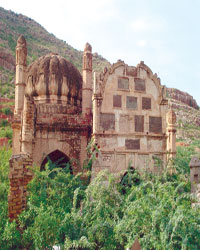 elements of recognition for an area when preserved through time. The gradual
deterioration of the Shahpur graveyard in district Kohat is causing a cheap
loss of its grandeur left at the mercy of time.
elements of recognition for an area when preserved through time. The gradual
deterioration of the Shahpur graveyard in district Kohat is causing a cheap
loss of its grandeur left at the mercy of time.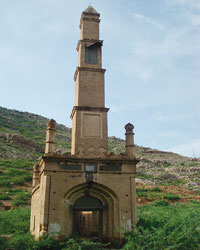 and a small entrance opening to the east with a window towards the west. Long
bricks have been used in construction of the room. Southwards remnants of an
underground bathing drench with bricked top reveal the point used for taking
bath in the by gone times. Next to this place lies a huge boulder with some
inscription that is barely to decipher now. There are also two structures
with lamp chambers that were used to lit lamps in the graveyard by the
relatives of the princes.
and a small entrance opening to the east with a window towards the west. Long
bricks have been used in construction of the room. Southwards remnants of an
underground bathing drench with bricked top reveal the point used for taking
bath in the by gone times. Next to this place lies a huge boulder with some
inscription that is barely to decipher now. There are also two structures
with lamp chambers that were used to lit lamps in the graveyard by the
relatives of the princes.