



|
|
|
|
 |
 |
  
|
rendezvous review Spring
for music Image
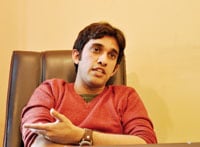
and reality rendezvous Gameboy for the World Cup A down-to-earth guy, Baber Ahmed is the CEO of MindStorm Studios. MindStorm Studios is housed in a large, anonymous looking building. Step inside and you find clean-cut, casually dressed men and women hunched over laptops, drawing cartoons on a whiteboard or if the mood demands strumming a guitar. Nothing out of the ordinary, really. Except the fact that Mindstorm Studios, does not only design apps for the iphone and graphics for advertisements, but is also behind designing Pakistan’s first PC game Cricket Revolution in 2009 and the developers of ICC’s official cricket game Cricket Power in 2011. An electrical engineering graduate from the University of Texas and a teacher at LUMS, Ahmed is Pakistan’s Steve Jobs. He took out time from his busy routine to chit chat with The News on Sunday. Excerpts... By Naila Inayat and Ali Sultan
TNS: What was making Cricket Revolution like? BA: We didn’t know anything about the procedures and it took us three years to make Cricket Revolution. All we knew was that we wanted to make a video game. A team of eight people got together for it; usually you need 30-40 people for the development. And it was because of our naivety that we took on the challenge. Now that I’m in the industry and someone would tell me
that he wants to make a game my response would be "dude! forget about
it!" It’s just that tough. We thought we’ll finish the game in one
year but we ended up taking three years to complete Cricket Revolution. It
was the first-ever video game launched from Pakistan and it had a global
appeal which made it a success. It was very tough for my family and me
because we never knew how long it would take. Because there was no industry
to look forward to, there weren’t any set rules of working; it was just a
shot in the dark. The News on Sunday: A country with an emerging market and a non-existent game development industry. How difficult was it for you to start afresh? Babar Ahmed: It was in 2006 that a bunch of friends came together and formed Mindstorm Studios. I was in the US and I decided to come back to Pakistan and do something different. I was teaching at LUMS and in the middle of it I realised that there was an opportunity to do something unique in gaming. The fact that we later would get to do a cricket world cup game is something I never thought about. TNS: So many people are starting off small IT companies that only provide services. Why did Mindstorm Studios not take the same route? BA: I wanted to do something new, something different. If you take a look at the IT industry everyone is doing services (work for other companies.) Our mandate was to make our own product. We are not a services company -- we wanted to make something that had a "Made in Pakistan" tag on it. We are based in Lahore, we make our products in Pakistan and that’s how it is. TNS: So finally we do have Pakistan showing somewhere on Asia’s World Cup map. BA: Yes! For us that’s the epitome of the product. From an entertainment perspective, sure there is a business end to it, but the goal of an entertainment product is that people enjoy your product. And from a nationalistic point of view I think we couldn’t have done a better job. We weren’t a part of a world cup and Cricket Power at least gives us a foot in the door. So I can proudly say it has achieved its purpose. TNS: Do you think gaming has taken the next step? From the hardcore gamers, to now everyone playing games on Facebook. BA: Globally speaking in 2007-08 gaming took a turn, it went over-the-edge -- from a niche thing that a little kid used to do in a drawing room to a mainstream thing. Zynga and FarmVille on Facebook made a big push towards that, so we all wanted a piece of that pie and we started a gaming company. Though at that point our focus was towards core gaming. With our first product Cricket Revolution we decided to target the cricket market because here there was no exposure to the talent of making a video game and cricket was a popular topic. Also there were only two cricket games in the market at that time so we thought by making a third game we could cater to a bigger market. TNS: How do you forecast the future of the gaming industry
in Pakistan? BA: The console market overall is shrinking. However, they are and always will be hardcore gamers that will pay anything for the games they want to play. But to appease that market, you have to make something that is cutting-edge, which needs a lot of resources and financial investment and that is a very tough thing to do for small companies. All core games take three years to complete and thousands of dollars to make. In Pakistan, you can do that but its really expensive and risky. Online is the way to go to. All you need is a team of 5-10 people, and a game that is so good that it becomes like a virus. No one really plans for FarmVille to do what it did, today hundred million users are playing the game. For example we made a game for the iPhone, it clicked and within weeks we got millions of downloads. It is just like music, you make a song and you instantly put it up on Youtube and you get feedback, the same goes with the gaming business. TNS: Who do you think will win the World Cup? And who would win in the game? BA: I hate to say it but India is the favourite; it has a great batting line-up. So even within the video game itself, India has the strongest team.
Anatomy of a garden David Alesworth’s work displayed at Rohtas 2 reflects the artist’s need to establish himself in a different but not unknown world By Quddus Mirza It was just a coincidence that David Alesworth’s solo
exhibition began on Feb 16, 2011, the day Muslims were celebrating Eid
Milad-un-Nabi in Pakistan. Apart from the usual processions, recitals of naats
and distribution of food among the poor and the neighbours, children
commemorate the birth of the prophet in a peculiar way: They build tiny and
temporary structures on hills with clay and coloured dust and decorate it with
plastic trees, toys and other stuff, known as pahari in common parlance. It would be worthwhile to track the history of this child’s play or ‘art’. The avenues, waterways, beds of flowers and spread of green patches reaffirm man’s desire to control nature and transforming it into a planned symmetrical area. This symmetry is not found anywhere in nature. The simple activity of designing a garden is thus an act to impose man’s mind on the world around. David Alesworth was trained to be a sculptor but also
worked as a garden designer along with his art practice. For years the two
sides of his personality, the maker of images and the producer of garden
layouts, survived side by side. Now in the present exhibition the two areas
appear to have come closer, in order to infuse new meaning into his art. In
his solo exhibition ‘Gardens of Babel’ at Rohtas 2 (February 16-23, 2011),
the main exhibits were inspired from the theme of garden, though dealt with in
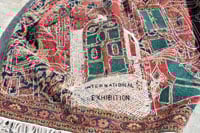
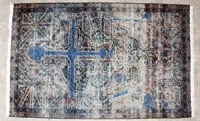
diverse manner. The artist has used two large pieces of old rugs to render
outlines of gardens, of different sorts. On a faded carpet, the map of
Versailles Gardens of France is sewn (through long stitches) while the other
rug using the same technique has a section of Central London’s map with Hyde
Park in the middle. Both images were decisively drawn on the carpet, which
traditionally is supposed to have a pattern of a stylised garden. Alesworth’s attempt to construct a garden on top of another one is related to the artist’s personal history. Originally an Englishman, David has been living and working in Pakistan for the past twenty two years, first in Karachi where he taught at the Indus Valley School of Art and Architecture and now in Lahore after he joined Beaconhouse National University. So the act of planting a garden on another land could be a metaphor for the artist’s situation. It would also be relevant to examine his art practice in this country. In Karachi, David was associated with a number of other artists in discovering, documenting, appropriating and assimilating urban popular art, mainly transport art, in his own work. In addition, he commented upon the impact of globalization, consumer culture and violence in his sculptures shown at Canvas Gallery in Karachi. His shift from Karachi to Lahore has understandably altered his aesthetic concerns. Now by using Eastern carpets to construct new visuals (belonging to European history, culture and geography) he may be depicting his own position: Of a person who has adopted this land and established himself as one of the important personalities of contemporary art in Pakistan. Hence the Western designs and drawings of garden on Eastern
motifs of rugs could be read as a visual substitute of being Yet with all these opportunities to physically or virtually meet the Other, one is still bound to act in some strange way. Whenever we come across a new situation or individual, we begin to form our perception based upon our biases. Usually we start by classifying the world around us into categories. We put good people on one side and bad on the other. Once we have categorized everything, we feel in command: A custom that reminds of first man’s act of naming things and to have a power on them. This practice continued in the following generations, especially during the colonial periods where outsiders tried to baptise plants, animals and objects from the occupied land and hence sought to include those into the realm of civilized world. Their studies of plants, insects, flora and fauna are records of this patronising endeavour and David has commented on this tendency through his digital print of enlarged studies of flies and bees -- printed from the old slides of scientific queries. In fact both acts, cultivating nature into a garden and the effort to classify everything with specific term, are attempts to have dominance on nature and unfamiliar entities. It is not a process of knowing them but is actually a procedure to make them known -- thus taming them. In two of his prints, with collage/mosaic of the Latin names of trees and the number plates of vehicles, Alesworth appeared to be addressing this phenomenon, which was a continuation of the desire to access items, as well as to secure one’s position among them. So if on the one hand David’s work is a comment upon colonial practices of describing the unknown, it also reflects the artist’s need to establish himself in a world different but not unknown any more.
A festival in Lahore highlights the difference ghazal singing has gone through By Sarwat Ali As if to announce the arrival of spring, a two-day Ghazal Festival was held at the Alhmara in Lahore last week. In the not too distant a past the arrival of spring was heralded in a big way. A series of events/ rituals were held over a couple of months beginning with Basant, Holi, Mela Chiraghaan and then Baisakhi. In the middle somewhere the National Horse and Cattle Show, variously called Jashan-e-baharan, as indeed the music programmes broadcast over the radio also titled Jashan-e-baharan were nudged. The main focus of the music programmes used to be the
singing and playing of the raags usually associated with spring like Basant
and Bahar. Basant is not celebrated with singing or the flying of colourful
kites and Mela Chiraghaan is a shadow of its former self, no longer the main
event of the cultural calendar. But now spring comes upon us unannounced and unacknowledged, though the potency of the changing season as well as the unseen weight of tradition does force itself upon us. The evening of ghazal was not held overtly to celebrate the onset of spring but to herald a season that shakes off the lethargic effects of a season that does not regenerate. The ghazal singers who took part in the programme were Hamid Ali Khan, Tarannum Naz, Javed Niazi, Babar Niazi, Nadeem Salamat, Humaira Channa, Noora Lal and Aqeel Manzoor. These two evenings of ghazal just highlighted the difference which ghazal singing has gone through in the last decade or so. The musical taste of the people has undergone a drastic change and now ghazal is usually placed within the classical forms of music. In all the shops and outlets vending in cassettes and CDs, Medhi Hasan and Ghulam Ali are to be found in the small section dedicated to classical forms, while the real classical forms like dhrupad and kheyal have all disappeared from the horizon of music. One of the influences on the contemporary ghazal has been of the geet. Ghazal initially was sung probably as an accompaniment to dance and was more composed, especially the asthai-based on the intricate pattern of rhythm while the antara meant for bhav was independent of the rhythmic accompaniment. But gradually as ghazal became independent of dance it came under the influence of geet till it was infused with greater musicality by the vocalists who switched to singing ghazal due to a variety of reasons. In Pakistan, primarily, ghazal enjoyed a larger audience as compared to kheyal or even thumri. The virtuosity of kheyal and thumri was transferred to the ghazal, which enriched it sufficiently. It is now returning to that geet ang as the number of vocalists trained in kheyal and thumri declined with the passage of time. The second influence has been of the qawwali. Recently with the rise of qawwali especially at the international level it has influenced all forms of music including the ghazal. It is sung or its intonation is more in the manner of qawwali than it was twenty years ago. One wonders whether the evolution of the geet as a form of poetry along with the form of music has been concentric. Usually it is beheld that geet is much more musical in the sense of being melodic and lyrical which helps itself to be composed to or set to music. While the same thing can be said of the ghazal, but only partially so -- for ghazal though lyrical in its metrical pattern may not always be melodic -- the concepts of taghazzul and of naghmagi probably do not always coincide, and if they do then it is probably the understanding of the poets against the understanding of the musicians. Since the poets are good with words they are able to propagate their point of views much more than musicians who just has the musical expression as their medium and not words that may operate at various level. In the last few years the improvisational aspect has been reduced compared to the compositional aspect and that has affected the quality of musical expression. It has limited its scope and probably provided an open space to the use of heavy orchestration. The ghazal because of its couplet format was easily set to music with the first line of the matla forming the asthai and the second line the saani while the first line of the succeeding couples gave way to the improvisation of the antara. Similarly the lack of a necessary relationship between the various couplets gave the musicians the autonomy to play around with the verses and the phrases. The ghazal since its inception probably in the nineteenth century has existed in the musical tension unleashed between the compositional aspect and the improvisational aspect of music. Its content in the sense of its poetry has been more properly enunciated through the compositional aspect while the musical aspect is displayed through the ability to improvise. In live music programmes, it is very difficult to be restricted to a single format or a theme. The audience begin to make requests and any number, which is more popular, has the highest number of requests After an initial resistance the singer begins to accede to these and the ghazal evening easily transforms to a geet, kaafi or polyglot evening. It is a matter of conjecture as to when our pop groups and the bands will start in earnest to sing the ghazal as that will be a radical departure as some of the forays into the singing of kaafi and geet have shown. The basic difference will be of intonation because the application of the sur in that case will be totally different.
Image and reality Dear All, Having missed the film Catfish when it was on in the cinema,
we rented a copy last week and finally settled down to watch it. And it was a
bit of a shocker: it starts off interestingly as it documents the Facebook
friendship that springs up between a NYC photographer and an 8-year old
artist Abby in some Michigan backwater who begins to paint from his
photographs and send him the work. The photographer Nev befriends not just
Abby but also her parents and her older brother and sister -- they all link
up not just on Facebook but on the phone as well. But then it all gets a bit
creepy and you are filled with foreboding -- as my spouse who refused to
watch it (not enough action or glamour) commented in passing: "This
seems to be the Blair Witch Project of the Facebook age..." Well it is sort of like that because the documentary film underlines the essential weirdness and creepiness of Facebook -- a tool that can be used not just for keeping in touch with friends and like-minded people but also as a platform for living out fantasies and inventing new and exciting personas for yourself. It is all self-projection easily carried to an extreme because of its very public nature. I notice that a friend of mine is asking a friend of hers -- on her wall -- how her colonoscopy went. Is that appropriate? Should that be on a wall for all to read? Perhaps that person did not want their medical status publicised in this manner. For me anyhow, it was just an example of far too much information. I almost never write on people’s walls so that I won’t then have all kinds of lame comment and ‘like’s’ tagged onto our conversation... Then there are the friend requests from random people who you have never met and who may well be psychopaths or stalkers or fundos for all you know...(even if you do have a mutual ‘friend’ or two). I actually enjoyed Twitter to begin with and used it quite a bit through the general election coverage last year. It was great fun-making comments as one watched the debates and other coverage and one kept up a good banter with various other people. But then I later discovered that one’s tweets can appear on Google searches completely out of context. It was horrifying -- I might have made a comment about an irate TV presenter for example and that would appear on a Google search on its own, completely detached from the conversation or context it featured in. Dangerous stuff! I thought it was so appalling that I stopped tweeting. But to get back to Facebook. Well I still do not
understand how some people are addicted to it and seem to spend hours ‘socialising’
on it every single day, and I do think it encourages one’s worst
voyeuristic instincts. I also find the concept of collecting and accumulating
‘friends’ and ‘followers’ slightly disturbing. But having articulated all of these apprehensions, I must also tell you of an amazing rescue story that was possible only because of Facebook. A British woman had custody of her two sons after a bitter breakup with her French husband, but during one visit he got a French magistrate to rule in his favour and kept the boys in France. She did not see or hear from them for two years until the parents of one of her younger son’s old school friends called her. Her son had told his friend that he was planning to escape and wanted his mother to come and collect him. His father was sitting with him but as he could not understand English, he thought the boy was just chatting with his friend. The mother travelled to the remote area of France where the boy was, the communication maintained only through her son’s friend on Facebook. The friend was in England, moment to moment messages were sent on Facebook, then relayed onwards by mobile phone -- even when the mother was right outside her son’s house in France. It was a thrilling story, and despite all sorts of unexpected problems it ended well, and it was an amazing example of the sorts of unexpected ways in which Facebook has changed our lives. Social Networking is cool, but it is definitely a double edged sword. And a weird sort of mirror, which reflects back on to the virtual world what you want it to.... My advice: don’t ‘collect’ Facebook friends, stick to people you know or who those come with some sort of reference or recommendation. A bit old fashioned I know, but it is a weird world full of bizarre fantasists... Best Wishes Umber Khairi
|
|

 transplanted into another culture. A phenomenon that is not particular to
Alesworth; it takes place on many levels in our present circumstances and has
happened as well in the past. People travel from one region to another, change
residences and switch identities. So much so that today whatever is identified
with one culture, for example the Persian carpet, Indian miniature painting,
Buddhist sculpture etc, has incorporated influences from other regions and
societies in various eras. So no culture or cultural product is pure and no
man can remove himself from the universal culture of humanity or refuse to
enjoy the benefits of civilization and the impact of globalization.
Consequently, all of us living today are citizens of one world; a claim that
is connected with this epoch but was equally true for ancient times
(especially from the Tower of Babel, when everyone from the known world spoke
one language and understood each other just like what we see in this age of
internet and social networks such as Facebook etc.).
transplanted into another culture. A phenomenon that is not particular to
Alesworth; it takes place on many levels in our present circumstances and has
happened as well in the past. People travel from one region to another, change
residences and switch identities. So much so that today whatever is identified
with one culture, for example the Persian carpet, Indian miniature painting,
Buddhist sculpture etc, has incorporated influences from other regions and
societies in various eras. So no culture or cultural product is pure and no
man can remove himself from the universal culture of humanity or refuse to
enjoy the benefits of civilization and the impact of globalization.
Consequently, all of us living today are citizens of one world; a claim that
is connected with this epoch but was equally true for ancient times
(especially from the Tower of Babel, when everyone from the known world spoke
one language and understood each other just like what we see in this age of
internet and social networks such as Facebook etc.).