



|
|
|
|
 |
 |
   |
Special
Report A
personal memoir pattern nwfp 'It could not
be handled by police' 'It is a
domestic issue' On
hold, for now
Analysts are expected to analyse, theorise and give a thesis on any given issue. Sometimes they fail to understand one or more questions and raise them in their analysis. These questions provide a lead for any further research on the issue. But the events around the Lal Masjid Operation have precluded any possibility of a fair analysis because, to begin with, there was no possibility of knowing the facts. Hence journalists in newspapers as well as on television have been invariably found to be asking questions and more questions. They've been forced to interview people left, right and centre, asking questions. But they've not been satisfied with the responses because they've not been convinced that the interviewees were a good enough choice. They've interviewed interior minister, religious affairs minister, information minister, ulema or religious leaders of all beliefs, and still felt it was a useless exercise. Perhaps we are too close to the incident to expect a fair analysis. Perhaps the questions being raised now shall be answered in due course when the truth will be gathered and sifted and widely circulated. Perhaps then the liberal and extremist tags being so recklessly imposed now would become irrelevant. Perhaps then the vested interests of all concerned would be truly exposed, once and for all. Till then, we too are forced to ask questions and ironically from none other than the interior and the religious affairs minister.
A
personal memoir I first met Maulana Abdul
Aziz in 1999, much before I met his younger brother, at the The gunman at the gate of the madrasa stopped me by saying that outsiders were not allowed to go in. I requested him to put me through to someone responsible in the madrasa. But, he flatly refused. What was more offensive was the way he pointed towards my European colleagues and remarked, "These infidels will not be allowed to enter the sacred building of the madrasa." I refused to leave without doing the interview. In the meantime, I saw a saintly man coming out of the madrasa building. Every one around stood still and silent in a very respectful manner as the man approached them. The mild-mannered maulana asked me to follow him to the library when I told him why I had come here. "You can ask me any question about Islam. I cannot answer political questions. I am not a political man," he spoke thus. "Tell him it is
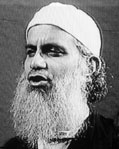
unIslamic to take photographs!" he pointed towards the cameraman. There His younger brother, Maulana Abdul Rashid Ghazi turned out to be quite a pleasant contrast. I first met him in October 2001 at a small rally outside the Lal Masjid. He was ranting about the consequences of a US-led assault on the Taliban. He seemed to be the most radical cleric I had ever come across. I decided to shoot a few questions after he was done. The maulana had no issues with the interview. Sensing that I was working for the foreign media, he asked me to ask the questions in English. For the next few minutes, he spoke only in English, without faulting with words. "If Pakistan sided with the Americans, there will be a civil war in Pakistan very soon," he said. "Will you fight against the Pakistan Army?" I asked. "Why not?" No one had dared to use such a language in the media; at least, not to my knowledge. Later, I got to meet with and interview the maulana quite often. Rashid Ghazi seemed to understand the media and its requirements very well, and knew that journalists were a 'necessary evil'. We became rather frank overtime. Sometime in the year 2004, I reminded the maulana about his first interview with me and told him that he had been proved wrong. He laughed and said, "You think that Waziristan is not part of Pakistan?" I said sheepishly, "But, it's not happening in Islamabad, Lahore, and Karachi." He again laughed and said, "It will. Just wait! "Islamic revolution is the fate of Pakistan and the ummah!" he declared. He was a rather 'candid' jihadist and never minced his words. When I asked him to shoot a documentary film inside the Jamia Faridia, he was game for it and escorted us inside the madrasa. He did not stop us from taking any shots. I remember, when I spotted a poster of Harkatul Ansar in a classroom and asked whether the madrasa belonged to the terrorist organisation, he laughed and said, "No, but the students are allowed to be a part of any religious party such as the Sipah-i-Sahaba Pakistan, or Harkatul Ansar." "And al-Qaeda?" With familiar ease, he replied, "Why not? They all work for the same goal." The maulana denied that he himself had ever been a part of al-Qaeda, but said that his deceased father had been a close associate of Osama bin Laden. -- Arif Jamal
The Lal Masjid episode has further convinced the people of how deep rooted the mullah-military alliance actually is 'Yeh topi drama hukumat-e-Pakistan
Lal Masjid key ta'awan sey pesh kar rahi haey,' (The As a matter of fact the two SMS's express a popular perception -- for the first time, the Lal Masjid episode has only further convinced the people of how deep rooted the mullah-military alliance is. The happenings around the Lal Masjid have raised many questions over the last six months. Although the Lal Masjid Brigade has dispersed and the security forces have occupied the Lal Masjid compound, most of these questions remain unanswered or answered unsatisfactorily. The most important question is why did the government take so long to take action against the Lal Masjid Brigade? The official position taken
by the government that it wanted to save the lives of innocent As a matter of fact, an earlier action would have excluded the use of force. A senior police officer in Islamabad told TNS that the police could have ferreted out most of the occupants in the early days of the crisis by cutting off the supply of electricity, food and arms. This could and should have been solved at the lower level. But, the government stopped the police from taking any action. Strangely, the police had little or no say in planning operations against the Lal Masjid Brigade from the very beginning. The police were given only the menial jobs at best. In fact, they were used as guinea-pigs in the whole episode when the militants kidnapped four of them while the police forces looked helpless. The only possible explanation for the delayed action is that some of the actors in this drama on both sides deviated from the given script and kidnapped seven Chinese nationals on June 23. This endangered the military-strategic alliance between Pakistan and an emerging world power. It is unrealistic to believe that the kidnappers could have escaped the attention of the security forces and intelligence agencies when they left the Lal Masjid under the given circumstances. In fact, the government tried to drag its feet even after the kidnapping of seven Chinese nationals from a massage parlour but it could not do so under the increasing Chinese pressure. Finally, the security
forces started gathering around the Lal Masjid compound on July 2. During the last six months, the government pretended to work on several agreements by engaging the Lal Masijid administration in negotiations through PML-Q President Chaudhary Shujaat Hussain and Deobandi jihadist ulema such as Maulana Rafi Usmani and Maulana Masood Azhar. In fact, the government kept negotiating till the last moment with Ghazi Abdul Rashid. If the government honestly wanted to negotiate a solution, why did all efforts to settle the crisis through negotiations scuttled? Who stopped the CDA from reconstructing the illegally constructed mosques after Chaudhry Shujaat Hussain struck a deal with the Lal Masijid administration? The answer to this question can also be found in the above-mentioned SMS's. There were definitely invisible forces which wanted to prolong the standoff. In the last few days, prior to the storming of the Lal Masjid compound, the government and most of the media cooperated to create the impression that the two brothers had held most of the students hostage. They hardly explained how they could hold hundreds of baton-and-gun-toting men and women hostage. Later, they tried to create the impression that Maulana Ghazi Abdul Rashid had agreed to ceasefire but that he was being held hostage by Uzbek militants. Who in the government/establishment was interested in depicting the armed students inside as innocent? Who wanted to bail the two brothers out even at the last moment? We may never know the answers to these questions. There are hundreds of such questions but, unfortunately, most of them will remain unanswered. What did the government want to hide from the press and the people when it banned journalists from covering the events in the areas around the Lal Masjid and hospitals? If it was done only for the sake of their security, as the government claims, who threatened the journalists in the hospitals in Islamabad and Rawalpindi? Journalists, like soldiers, understand the gravity of professional hazards. Asking them to leave the battleground is like asking the soldiers to leave the front when the war comes. What happens in the near future is surely more important than what has happened in the recent past as far as the Lal Masjid is concerned. The failure to take action against militant madaris, which number into tens of thousands, is no more an option for the government. Delaying action against them would only worsen the situation as the case of Lal Masjid shows. Maulana Abdul Aziz has committed too many crimes against the state and people of Pakistan. The government must not obstruct law if it wants to regain credibility. A close analysis of how the events unfolded in Islamabad during the last six months shows that the pattern of events has a close similarity to that of the tribal agencies. This cannot be avoided unless we abandon jihad as an instrument of our foreign and defence policies, which is unlikely. The Lal Masjid has brought militancy, which was so far limited to the tribal areas and some settled areas of the NWFP, to Islamabad and Punjab. The way the militancy inspired the people in settled areas such as Tank and Bannu, the Lal Masjid may inspire hundreds of thousands of inactive militants in Islamabad and Punjab in the months and years to come. Pakistan is the newest theatre of war for jihadis, after Afghanistan and Kashmir. This is what looks to be the objective of the script-writers of Lal Masjid drama.
Focus is now shifting to Swat where the security forces have taken positions against trained and committed supporters of Maulana Fazlullah Maulana Abdur Rashid Ghazi
had claimed that the whole of Frontier and the tribal belt In two recent incidents on Thursday July 12, two suicide bomb attacks killed at least seven people, including three policemen, in town of Miran Shah in North Waziristan tribal region and Mingora, Swat. In the north and the north-eastern districts of NWFP the militant outfits and students from seminaries did make their presence felt by attacking the personnel of the security forces and resorting to looting, burning offices of foreign NGOs working for the welfare of the survivors of the October-8 earthquake and blocking the roads after the military operation in the country's capital was over. The only open support for the besieged clerics came from militants like Maulana Fazlullah in Swat, son-in-law of the jailed cleric Maulana Sufi Muhammad, head of the banned Tehrik Nifaz Sharia Muhammadi (TNSM) and Maulana Faqir Muhammad another loyalist of Sufi from Bajaur Agency. An army convoy heading for Swat came under attack through an Improvised Explosive Device (IED) at Chakdara, killing four personnel of the force including a major and a lieutenant. The police personnel were the target of the IEDs and armed attacks in Swat which left one policeman dead and several others including the District Police Officer (DPO) injured. As many as 10 policemen including a DSP were injured in two separate IED attacks in Dir Lower while Maulana Fazlullah announced the annulment of the peace agreement signed with the government that he would not use his illegal FM radio for propaganda against the government or challenge its writ. The government took serious notice of the announcement when the Maulana called upon his would-be suicide bombers to accomplish the mission assigned to them if the government did not stop the Islamabad operation. "I call upon my jacketed brothers to accomplish the task and reach the targets," Maulana Fazlullah had announced through his radio. Maulana Faqir Muhammad, the cleric from Bajaur, who is wanted by the government for instigating public and indulging in the target killing of security personnel, addressed his masked armed force and the tribesmen near Khaar, headquarters of the agency to storm the government installations and wage Jihad if the operation was not stopped. However, violent demonstrations were held in the Battagram district of Hazara Division soon after the news of Maulana Abdul Rashid Ghazi's death spread around. Students from a religious seminary run under the patronage of MNA Qari Yousaf came out and stormed the offices of the foreign NGOs working in the earthquake-hit zone. The offices of Care International and French Red Cross were looted, burnt and damaged. The reaction, the locals said, was due to the result of the killing of two students from the same area in the crossfire between militants and forces at Lal Masjid. Armed militants took positions on the mountain tops coming down from the lawless Kala Dhaka area and targeting the offices of the foreign NGOs unless the army and the militia force known as Frontier Constabulary was rushed to control the situation. Focus is now shifting from Lal Masjid to Swat where the security forces have taken positions against trained and committed supporters of Maulana Fazlullah, who too like Ghazi has announced his last will through his mouthpiece. He was able to assemble hundreds of supporters at Kanju ground at a short notice and asked them to be ready for any eventuality in case the military operation is initiated in Swat. Maulana Abdul Rashid Ghazi and his brother had been addressing the supporters of Maulana Fazlullah through telephone, motivating them for Jihad against the infidel rulers and states. In the South and North Waziristan agencies where it was widely believed that the government would face a tough time at the hands of the tribal militants if Maulana Ghazi was harmed, suicide attacks have now begun. Even the Maulana had mentioned in his statements that tribal militant leader, Commander Baitullah, would come to his rescue. Though, in a belated move, the MMA leadership is trying to use the post-operation scenario against the government by organising public rallies in Peshawar and other parts of the province, the people seem skeptical about the intentions of the Jamaat-i-Islami and the Jamiat Ulema-i-Islam-Fazlur Rehman. Qazi Hussain Ahmad and Maulana Fazlur Rehman, heads of JI and JUI-F respectively, preferred to attend the multi-party conference called by the exiled former Prime Minister Nawaz Sharif in London when the Lal Masjid operation was in full swing. Situation in the scenic Swat valley is tense where the Maulana is busy preparing to set up resistance as the government plans to bring him to terms. The Maulana has even made his intentions known by assigning the task to his loyalists through the FM channel to occupy Saidu Sharif Airport, target police stations and other government installations, and also to take control of the courts and government buildings when they are asked to do so.
'It could not be handled by police' -- Interior Minister Aftab Ahmed Khan Sherpao (Interview was conducted on Tuesday morning) The News on Sunday: Who is incharge of Operation Silence? Aftab Ahmed Khan Sherpao:
This is a very complex situation. We have different people TNS: It seems that no one particular person is in charge of the situation. Who is taking the decisions? AAKS: There are collective decisions being made. We have had high level meetings chaired by the president and the prime minister. TNS: As Interior Minister were you aware of such a huge number of arms and ammunition lying in Lal Masjid? AAKS: We were fully aware of it; that is why we were reluctant to go ahead with a full-fledged operation. But, the situation that was created led to the operation. The inmates of the Masjid snatched rifles from the Rangers and fired shots at the law enforcing agents, killing and wounding a host of them. TNS: But why wasn't any action taken against these militants when they were amassing arms and ammunition in the madrasa? AAKS: We were trying to engage them in a dialogue. We wanted to try all options. It was not matter that could be handled at the level of police. Nor was it easy to send someone and round them up. TNS: How far back would you trace the accumulation of weapons and the presence of the militants in the area? AAKS: Well, they had been accumulating weapons for quite some time and the militants who had come there had weapons with them. They also had petrol bombs they made themselves. In a city like Islamabad you can't check each and every person. TNS: You knew it all; still you couldn't check or prevent it? AAKS: You cannot check each and every car coming into Aabpara. This was a Jamia Masjid and every Friday hundreds of people would flock the place. Anybody coming for prayers might be carrying a few grenades etc under a shawl or a shirt. Weapons are easily available in Darra and other northern areas. TNS: So can we say that this is going on in other places also right at the moment if it is that easy? AAKS: I did not say that. You have to know their bent of mind. This madrasa was a special case. It has tarnished the image of all madrasas in the country. The message that has gone out internationally is that if it can happen in one place it can happen any where else. TNS: Does that mean that the government is not to blame for whatever happened? Considering that state has unlimited powers, what were you waiting for? AAKS: There were a number of things going on. They had encroached and were quite firmly placed. We had options but we wanted minimum casualties. If we had tried to clamp down the madrasa or cut off their electricity earlier, it would have triggered the same results. They had been interacting with the media. Ghazi was always on the TV channels and putting his views forward, explaining the high morals of the madrasa authorities that were behind the kidnapping and the CD burning incidents. TNS: Why did the state not try to arrest Maulana Aziz and Ghazi Rashid when FIRs had been registered against them and they were in easy access? AAKS: No, they were never in easy access of the authorities, and they would have resisted all attempts to get them arrested. Once an attempt was made to arrest Ghazi Rashid, a year and a half back, but he immediately went instantly vanished into the madrasa, and the police could not follow him there. He had armed guards and militants protecting him. It was very difficult. They all were living in the vicinity of two thousand-plus women and children. Even if we tried it, we would not have succeeded. TNS: That means they were getting stronger by the day, whereas the government could do little. So, why the grand operation now? AAKS: We ran out of all options. The women and children were the biggest consideration for us always. Even in this operation, we have been able to save hundreds of innocent lives. We did not want a conflict and tried our best for a compromise till the very end, but Ghazi wanted things on his own terms. Our conscience is clear. Chaudhry Shujaat tried his best, the parliamentarians tried hard, Edhi and his wife did. TNS: Don't you think that these were very informal negotiations and that no agenda for a minimum agreement was set, no formal objectives defined and no formal negotiator appointed by the government on which there could be a consensus? AAKS: This was not a formal hostage situation. We wanted to exhaust all options and find a way out. But we could not have provided a safe passage to militants because no other country offered to accept Ghazi. In Pakistan, even if he had gone to his village, the same law would have applied. TNS: Have you been advised by the US on the operation? AAKS: Not at all. We have got no advice and we don't need any. We are capable of handling this issue ourselves. TNS: Will there be a policy change regarding madrasas in the future after this operation? AAKS: There will be no policy change and no clampdown on any madrasa at all. We don't expect a similar situation to develop in any other place. This was an isolated example. These brothers were really playing to the gallery and lying to the media. Ghazi almost always contradicted himself in his various appearances on TV and never stuck to his word till the end. He would wriggle out each time. For instance, he said that some 40 students had been buried in a mass grave in the madrasa. We will allow the media inside to see for themselves that there is nothing of the sort there.
-- Ejazul Haq, Federal Minister for Religious Affairs The News on Sunday: We haven't seen or heard anything about the foreigners since the commando operation started? Ejazul Haq: There are lots
of things that will come up now. One thing is for sure that 30 Whatever information the government has would be passed on to the media. TNS: Maulana Rafi Usmani and others have disputed your claims regarding Ghazi talking of foreigners inside the mosque. EH: Ghazi Abdul Rashid was a media wizard and knew what to say to whom. At the time when ulema were in negotiations with us, he did not mention foreign fighters but only raised the issue of people who were wanted. He was conveyed that these people would be dealt with in accordance with the law. He knew that, too. Around 3 in the morning, he asked me about the foreigners and I told him the same thing. He said that he would get back to me on this, but never called back. TNS: Any solid evidence of foreign fighters so far? EH: There were reports that certain conversations were heard in an alien language. I cannot confirm as to what language the people were talking in. All I know is that the foreign militants married local Pashtun girls. They were inside the Lal Masjid complex. There were intelligence reports and information. TNS: Did the death toll rise to many a hundred as we hear from different medical sources? EH: I repeat, it was the highest death toll from the security forces' point of view. The DG ISPR also briefed the cabinet about the same, but he did not have the final figures. After we have combed, swept and sanitised the areas will we be able to know how many people got killed. But, the last figures that came in show between 250 and 500 people inside the compound. I can quote these figures because I remember when we were holding negotiations with Abdul Rashid Ghazi, at one point he spoke of food being prepared for 250 to 500 people. TNS: In Islamabad alone, there are a number of seminaries. What would be your strategy for dealing with any kind of backlash? EH: The ulema will have to manage the situation. There will be a few incidents here and there. There could be protests and rallies, and we are not worried about these but only concerned. We should be able to control them. TNS: If the death toll rises further, popular discontent could be a likely outcome? EH: There going to be deaths. We also lost one of our most favourite officer while making a breach into the wall. TNS: There are people who say that a bullet hit him in the back. EH: You will get to hear all sorts of rumours. TNS: Why was media not allowed in the hospital premises where no military operation was taking place? EH: The media was not allowed in because there was an emergency situation in the hospital, and the doctors were busy. You have to let them work and save as many lives as you can. TNS: Do you think the media would believe the official version about the injured, dead or surrendering people? EH: The first thing that was decided in the meeting was that nothing would be kept from the media or any body else. The argument is going to be there. People are going to doubt. There are going to be various stories that will come up like the one about Ghazi Abdul Rashid being injured. He was not killed the way the media reported him to be. TNS: Could you explain as to how was he killed? Was he caught injured and expired later? EH: I can't enlighten you on that. The ISPR would tell you the whole thing. TNS: Who is responsible for Lal Masjid being converted into a private cantonment? EH: The government will have to assess the situation seriously and take certain responsible officials to task. We don't want a similar situation to develop again. It is very embarrassing. It is also very unfortunate. Certain people who don't have respect for religion will take full advantage of the situation and blame everything on Taliban. The operation sends a strong message of zero tolerance. TNS: Coincidently, Pakistan has just received two brand new F16s. EH: One thing I would like you to recognise is that it is a domestic issue. We don't want any appreciation from the international community. It is Pakistan's internal situation and we have worked to resolve it. The foreign friendly nations can keep their sentiments to themselves.
There have been some headway in terms of collection of statistics and there are more registered madrasas but the envisaged educational reforms have failed to materialise By Nadeem Iqbal The warning by Prime
Minister Shaukat Aziz that the government will take stern action A highly-placed officer in the Federal Religious Ministry told TNS that before the enactment of the ordinances, there existed 6,000 registered madrasas in the country. Now an additional 8,200 have been added to this number that makes the number of registered madrasas in the country 14,200. The registration continues as the ministry sends fortnightly report about the registration of madrasas to the prime minister. The madrasa reforms have been a part of international counter-terrorism measures. The laws themselves were incorporated under UN Security Council (UNSC) Resolution 1373 adopted on September 28, 2001, as a counter-terrorism measure that aimed to place barriers on the movement, organisation and fund-raising activities of terrorist groups. In the follow-up to that resolution, reports are to be sent to UNSC detailing the measures taken by respective governments. In one of its 2003 reports, the government of Pakistan said, "A plan is being prepared to bring 'deeni madaris' (religious schools) into the mainstream education system... In this context, a separate Board has been instituted in 2001 through an ordinance with the task of preparing contemporary curriculum for deeni madaris/religious schools." However, in later reports, there is no mention of the regulation of such madaris. Interestingly, according to the law, Pakistan Madrasah Education Board (PMEB) is an autonomous body under the Federal Ministry of Religious Affairs that is to be headed by an educationist of eminence as its chairman, since representatives from the ministries of religious affairs, education, and science and technology (below the rank of joint secretary) along with two ex-members of Islamic Ideology Council, DG Dawa Academy and provincial education secretaries etc are its members. For the last couple of years, the Federal Secretary Religious Affairs Vakil Ahmad Khan has been serving as the chairman of PMEB. PMEB has established model madaris at Karachi, Sukkur, and Islamabad (for girls). Their curriculum includes English, Mathematics, Computer Science, Economics, Political Science, Law, and Pakistan Studies for different levels. A similar curriculum was also to be developed by PMEB for all the other madaris but has not yet been done. An official of the Religious Affairs Ministry told TNS that it has been decided that the federal board's syllabus will be adopted and that it will be approved in the board's next meeting. These initiatives of the PMEB are not welcomed by the ulema. The other law, Voluntary Registration and Regulation Ordinance 2002, was introduced to control the entry of foreigners in the madaris, to keep a check on them and also their sources of funding. This law has been rejected by most of the madaris which want no state interference in their affairs. All these reforms and regulations were to be coordinated by the Federal Religious Affairs, Education and Interior ministries by a 'carrot and stick' policy. However, a source in the Religious Affairs Ministry informed TNS that "Since the Education Minister, Lt Gen (retd) Javed Ashraf, is a former ISI chief, therefore the ulema are reluctant to talk to him. The Interior Ministry is already out as the original Madaris (Registration and Control) Ordinance was renamed Deeni Madaris (Voluntary Registration and Regulation) Ordinance. Therefore, only the Religious Affairs Ministry has something to offer to the religious lobby in the shape of appointments in mosques. The Religious Affairs Ministry is not comfortable with the findings of the Education Ministry that conducted a National Education Census (NEC) last year that stated the presence of 13,000 madaris with over 1.5 million students in the country. A source has claimed that the Religious Affairs Ministry's data is authentic as it gathered the data through its provincial coordinators, who had carried out the registration. The Education Ministry madrasa reforms are also on hold. The Federal Education Ministry under its Education Sector Reforms (ESR) Action Plan 2001-02 -- 2005-06 says that: "Madaris reforms envisage introduction of formal education in 8000 madaris, (primary education in 4000, middle and secondary education in 3000, and intermediate education in 1000 madaris). Selection of madaris will be made in consultation with provincial governments including Azad Jammu & Kashmir, Federally Administered Tribal Areas, Federally Administered Northern Areas, and Islamabad Capital Territory. The madaris will be mainstreamed through the provision of grants, salaries to teachers, cost of textbooks, teacher training and modern equipment. Apart from establishing new institutions, the ESR added, formal subjects will be introduced in madaris. The programme will bridge the gap between formal education and madaris education system. Incentives have already been provided to 140 selected madaris at secondary and 200 at intermediate levels. The reforms also envisaged the monitoring and evaluation of these initiatives. But media reports suggest that although the government has earmarked Rs 500 million in the Public Sector Development Programme (PSDP) 2007-08 for the madrasa reforms, the money would only be released when a new PC-I of the project is accepted. Till then every thing is on hold.
|
|
 Jamia Faridia in
Islamabad's posh neighbourhood -- Sector E -- where I had gone to interview a
maulvi for a European TV channel.
Jamia Faridia in
Islamabad's posh neighbourhood -- Sector E -- where I had gone to interview a
maulvi for a European TV channel.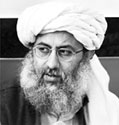 was no way that he could be persuaded. The maulana, however, allowed us to
take snaps of the building and the empty library. He was no help to a
journalist under performance stress. I rarely met him afterwards.
was no way that he could be persuaded. The maulana, however, allowed us to
take snaps of the building and the empty library. He was no help to a
journalist under performance stress. I rarely met him afterwards.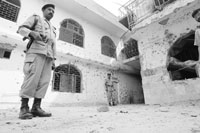 government of Pakistan
is presenting this drama sponsored by Lal Masjid), said one of the most
popular SMS's on the six-month old 'standoff' between the Lal Masjid Brigade
and the security forces. Another SMS followed, 'Islamabad mein zabardast
kamyabi key ba'ad, yeh topi drama aap key shehr mein circuit key behtereen
cinemaon mein jald pesh kia jaey ga' (After the huge success in Islamabad,
this drama will soon be shown in the best cinemas in your city).
government of Pakistan
is presenting this drama sponsored by Lal Masjid), said one of the most
popular SMS's on the six-month old 'standoff' between the Lal Masjid Brigade
and the security forces. Another SMS followed, 'Islamabad mein zabardast
kamyabi key ba'ad, yeh topi drama aap key shehr mein circuit key behtereen
cinemaon mein jald pesh kia jaey ga' (After the huge success in Islamabad,
this drama will soon be shown in the best cinemas in your city).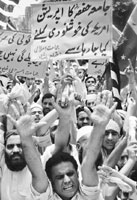 children is
belied by latter events. According to the information available, only the
security forces personnel and armed militants were killed while 'innocent'
girl students and a large number of armed militants were allowed to escape in
order to reduce the number of casualties. A similar operation earlier would
surely have caused fewer deaths. The only plausible answer to this question
is to be found in the above-mentioned SMS's.
children is
belied by latter events. According to the information available, only the
security forces personnel and armed militants were killed while 'innocent'
girl students and a large number of armed militants were allowed to escape in
order to reduce the number of casualties. A similar operation earlier would
surely have caused fewer deaths. The only plausible answer to this question
is to be found in the above-mentioned SMS's.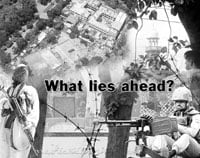 The Lal
Masjid Brigade retaliated by setting the Environment Ministry building on
fire and attacking the security personnel. The firing from inside the mosque
killed one Ranger. The security forces were still visibly reluctant to storm
the Lal Masjid compound even after the death of one of their colleagues.
However, the killing of three Chinese nationals by suspected militants in
Peshawar on July 8 and the death of one Lt Colonel as a result of firing left
no other choice but to storm the Lal Masjid.
The Lal
Masjid Brigade retaliated by setting the Environment Ministry building on
fire and attacking the security personnel. The firing from inside the mosque
killed one Ranger. The security forces were still visibly reluctant to storm
the Lal Masjid compound even after the death of one of their colleagues.
However, the killing of three Chinese nationals by suspected militants in
Peshawar on July 8 and the death of one Lt Colonel as a result of firing left
no other choice but to storm the Lal Masjid.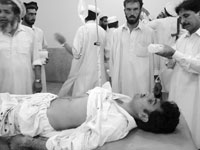 would rush to his
rescue if the military operation was launched against Lal Masjid and Jamia
Hafsa.
would rush to his
rescue if the military operation was launched against Lal Masjid and Jamia
Hafsa.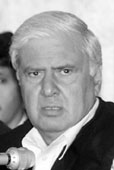 looking at
different things. They have coordination with each other.
looking at
different things. They have coordination with each other.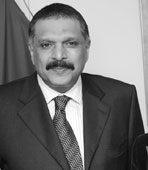 hours since it
started, the operation continues. There were hardcore militants and at least
I know two of them had head money. During the negotiations I remember Ghazi
himself mentioning the presence of foreigners in the compound.
hours since it
started, the operation continues. There were hardcore militants and at least
I know two of them had head money. During the negotiations I remember Ghazi
himself mentioning the presence of foreigners in the compound.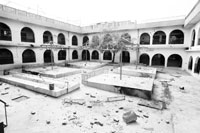 against the
madrasas involved in illegal activities or promoting militancy and extremism,
seems hollow as the two laws -- Deeni Madaris (Voluntary Registration and
Regulation) Ordinance 2002 and Pakistan Madrasa Education (Establishment and
Affiliation of Model Deeni Madaris) Board Ordinance 2001 -- designed to undo
the educational network that breeds extremism in the country, have failed to
achieve desired results even after the passage of five years.
against the
madrasas involved in illegal activities or promoting militancy and extremism,
seems hollow as the two laws -- Deeni Madaris (Voluntary Registration and
Regulation) Ordinance 2002 and Pakistan Madrasa Education (Establishment and
Affiliation of Model Deeni Madaris) Board Ordinance 2001 -- designed to undo
the educational network that breeds extremism in the country, have failed to
achieve desired results even after the passage of five years.