


|
|
|
|
 |
 |
 
|
profile The
people’s language
Zia Mohyeddin column
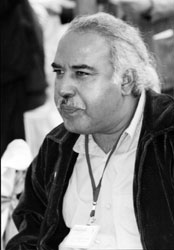
profile Maqsood Saqib
started his literary career in the early 1970s. He wrote some articles for
both Urdu and Punjabi journals, but his first love was Punjabi. At the
department of Punjabi, Punjab University he had the opportunity of being in
the company of literary giants like Najm Hosain Syed, the head of the
department, and professors like Asaf Khan and Ali Abbas Jalalpuri. Najm
Hosain became Saqib’s mentor and he acknowledges his guidance and
inspiration. Joining the Mazdur Kisan
Party was not the beginning of a career but of an intellectual and political
commitment. Punjabi language activism has its roots in pro-people politics of
the left. But in Pakistan, like the politics of the left, Punjabi language
activism remains a daunting uphill task. Punjabi, the mother tongue
of more than sixty per cent of the people of Pakistan and the 14th major
language of the world among several thousand, is rarely the subject of
literary discourse. Under such circumstances Saqib’s work is all the more
critical. His learning and growth has continued unabated for the last forty
years, making him a literary figure to reckon with in both West and the East
Punjab. Saqib founded ‘Maan Boli’
in 1986 with his friend Muniruddin Khalid and later launched ‘Pancham’
with his wife in 1998. ‘Maan Boli’ was awarded the prestigious art and
literature award Bhai Veer Singh in 1990 for the best magazine of Punjabi.
The award ceremony presided over by HH Dalai Lama included Saqib’s fellow
awardees Mulk Raj Anand and Pandit Ravi Shankar. Saqib continued the
publishing of the magazine under the title, ‘Pancham’, he didn’t
compromise on its standards and format. He set up Suchet Kitab Ghar, a
publishing house which became a leading house of Punjabi in Pakistan. It
publishes literary works and history of Punjab and Punjabi language. Saqib has written seven
books: two collections of his short stories, one collection of translated
short stories from Europe, three books on classical music, and a translation
of Arundhati Roy’s ‘Walking with the Comrades’. His countless write-ups
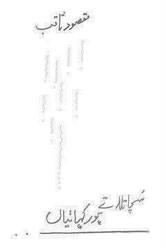
and editorials would make several more volumes. ‘Sucha Tilla tay hor
kahanian,’ contains remarkable character sketches of the working class, the
class whose people and language he loves. James Joyce once wrote in Dubliners
“How can you write stories of people you do not love?” These
stories are not structured like the conventional stories with a beginning,
middle and an appropriate end. In modern stories the structures are not
fixed. His second collection of short stories ‘Kahanian’ was published
soon after. By now, he is an icon of
Punjabi prose. His language is chaste, and conceptual clarity is his forte.
His language is a composite mixture of Punjabi dialects. He has a scholarly
command of Punjabi folklore, myth, literature and tradition. It is Maqsood’s three
books on classical music that are real gems. Two volumes
consist of translations of various well-known writers on classical
music. The remarkable feature of these books is their readability and the
detailed description of technical terms used in Indian classical music. The
life stories of these classical singers who became legends in their lifetime
are most fascinating. There is a subtle link between language and music. The third volume consists
of interviews conducted by Maqsood Saqib with the masters, teachers and
singers of classical music in Pakistan. What adds to the reader’s interest
is that most interviewees are film music directors. Saqib displays his own
encyclopedic knowledge of music and popular movie songs. He frequently
prompts and reminds the musicians of their own forgotten work. The first volume, ‘Sur
Sangeet Day Hiray’, is mostly translated from Pandit B.R. Deodhar, written
originally in Marathi language and translated into English by Ram Deshmukh.
Saqib shows consummate knowledge of music as well as of Punjabi idioms to
explicate it. The volume includes well-known masters of music like Khan Saab
Allahdia Khan, Abdul Karim Khan, Allauddin Khan, Pandit Vishnu Digambar, Baba
Sainday Khan, Pandit Bhaskar Rao, Kesar Bai Keerkar, Baday Ghulam Ali Khan,
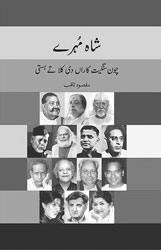
Pandit V.N Bhat Khanday, Pandit Omkaar Naath Thakhur and Muggo Bai Kurdikar. The second volume ‘Shah
Mohray’, is mostly translated from G.N. Joshi’s book in English. Besides
repeating some of the masters already covered, it includes legendary Kesar
Bai Keerkar, Ameer Khan, D.V. Paluskaar, Wilayat Khan, Kumar Ghandarav, Ustad
Allah Rakha Khan, Bismillah Khan, Bheem Sen Joshi, Kishori Amonikar, K.L.
Saigal and Lata Mangeshkar. ‘Sangeet Karan Dian
Gallan’, the third book compartmentalises interviews conducted by Saqib
himself. The luminaries included: Noor Jehan, Farida Khanum, Zahida Parveen,
Shahida Parveen, music directors: Master Inayat Hussain, Tufail Farooqui,
dhurpad master Ustad Hafeez Khan, Arif Hussain Shah, Ustad Muhammad Tufail
Khan Ustad Khadim Hussain, Ramzan Khan and Talib Hussain Khan. Pandit Hari
Parasad Chaurasia during his visit to Lahore was also interviewed by Saqib. The book also has an
article on Noor Jehan. He theorises that Noor Jehan’s singing
single-handedly lifted Punjabi movies in Pakistan, till Urdu movies almost
died out, because Punjabi was the language of the majority. Although, Noor Jehan sang
some unforgettable numbers in Urdu, directed by Master Ghulam Haider and
Khurshid Anwar; her Punjabi songs were catchier and made box office
blockbusters from the first Punjabi movie till her death a decade ago. These
songs became hit with the Punjabis. Saqib says that Noor Jehan,
independently, settled the Punjabi language question that was always ignored
by the government and the media. He also has a collection of
short stories translated from English. Translation is the engine of progress
in any language. Besides the short stories of three well-known writers of the
world, Dostoevsky, Brecht and Garcia Marquez, there are stories from writers
from Poland, Hungary, Africa, and Palestine. These stories have been readably
translated. Saqib’s interests are not
restricted to music; he is essentially a man of literature, but in a wider
application of the term. The definition of creative literature has changed
from novels, poetic narrative and literary tropes to all fields of writing.
Freud is also taught as literature in Germany. Saqib has also translated
Freud as well as the book ‘Second Sex’ by Simone de Beauvoir (volumes
which are yet to appear). In this age of new media
Saqib’s websites, blogs on music and poetry are very popular and show great
application and organised work. Archives of all previous magazines and a lot
of books have also been consistently put online. Saqib’s wife Faiza Rana
is also well-versed in Urdu and English and makes substantial contributions
in Saqib’s landmark work. She is also the co-editor of ‘Pancham’. What
makes this couple an unbeatable team, it is difficult to say!
The
people’s language
In the last few years the
debate about the region or area that speaks Saraiki has intensified in the
context of it being a cultural entity in itself. If so, the logical next step
was a political manifestation of it being made into a province carved out of
the existing boundaries of the Punjab. The argument was put on the
backburner, as the electorate did not consider it to be an idea whose time
has come. The party or the politicians who had espoused the cause of the
Saraiki Province were defeated, while those who wanted to maintain the
existing political divisions won a resounding victory. As it is, the Punjab
as known during the Raj has suffered multiple divisions. It was divided in
1947 into East and West Punjab and then East Punjab was further divided into
three provinces — Himachal, Haryana and East Punjab. Some say that the time
has come to divide West Punjab as well, if for nothing else, for purely
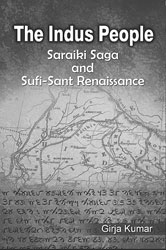
administrative reason. Based on something called
the Saraiki culture, encased in the larger entity of the Indus Culture, this
larger entity has been earmarked by Girja Kumar in this book, ‘The Indus
People’. Girja Kumar was born in Dera Ghazi Khan in 1925 and has been away
from the land of his birth for many decades due to the family moving out of
the area in 1945. Then the exigency of partition made it impossible for them
to go back to their ancestral land. The sand that “entered every crevice of
his body” has necessitated him to look back and re-evaluate the
contribution of the civilisation that developed along the banks of the Indus. A kind of an informal
cultural history of the Saraiki speaking areas, a mixture of ethnicity and
folk culture, it dwelled on the language and the famous people who lived on
the land and made contributions towards the creation of ideas and values. It
had bits of history, how the various towns and cities grew and became centres
of culture. Due to its informal
structure it was very easy to read — it had more information as events
unfolded than building a tedious theoretical structure to prove a point. It
did not strive to prove anything except that the Saraiki as people were
inclusive and build their culture by imbibing various ideas, religions and
ideologies. This made them large hearted and pacifist. If there was a focal point
to this argument it was the Saraiki language. There was no such thing as
Saraiki people because it had no ethnic connotation but in terms of language
and culture perhaps the argument carried more weight. For him the most
important aspect of that culture was tolerance and inclusiveness. In every
Saraiki there was a bit of Sant, Sufi, Baloch, Kirar, Khatri, Pathan, Arora,
Sarasvar, Ancient Kshatriya, Buddhist, Hindu, Muslim and Sikh reflecting its
composite nature. There are certain salient
points that he wanted to record very early on. The Sanskrit language too was
born on the banks of the Sindhu River and its tributaries. Later the identity
of Saraiki language became its identity. Earlier known as ‘lahnda’,
saraiki’s development was a gift to the subcontinental culture as the real
transformation took place with the arrival of Baba Farid. The fact that the
sacred book of the Sikhs incorporated the poetry of Baba Farid was sufficient
proof of the continuing dialogue between several communities of North India. This area too was very rich
in literature. A Saraiki expression of liberal thoughts at its secular best
was the pioneer of Muslim-Hindu dialogues. They chose to be constantly in
touch with the Bhakti movements. They spoke the people’s language and were
social reformers and vehemently opposed to orthodoxy. Religion was more of an
experience than a code of conduct in the subcontinent. Personal god was the
greatest invention of human ingenuity. While the Bhakti movement travelled
from the South to the North, the Sufi cult travelled in reverse direction. Sindhu was revered as one
of the gods in Rigvedic times. Mahabharata too was a storehouse of historical
events concerning the Saraiki people and could be applied as the careful
reconstruction of Indian history. The Mahabharata was a war between the
kingdoms of Indus basin and that of the Gangetic plains. The main supporters
of the defeated Kauravas were the six kingdoms of the ancient Punjab. It is generally accepted
that the Aryan conquest and first settlements were in the region, which is
now known as the Indus Basin. The great books like the Rigveda too were
written in this region and described the conquests and other heroic deeds
that took place here. But later as civilisation matured and developed, it
moved further east; the Gangetic plain monopolised civilisational growth.
This shift was recorded with so much poetic delight in Mahabharata. Kumar too
read it likewise and thus pointed to the significance of the epic. The hilly tracts of the
Punjab bordering the mighty Indus gave birth to the Kshatriyas, Khatri, Arora
and Saraswat Brahmins. No wonder these communities collectively made
substantial contribution to the intellectual, administrative and professional
leadership of India and Pakistan. In his late eighties, Girja
Kumar retired as the Chief Librarian Jawaharlal Nehru University. He has
written Brahmacharya, Gandhi and his women associates and definitive
biography of Ranganathan, a world-renowned librarian. He has also contributed
regularly to the various literary magazines and journals. The Indus People Saraiki Saga and Sufi-Sant
Renaissance Author Girja Kumar Publisher: Vitasta Publishers New Delhi, 2013 Pages: 444 Price: INR 595
Zia
Mohyeddin column
The twentieth
century produced many powerful, influential, epoch-making European
dramatists, but I cannot think of any one more complex and enigmatic than
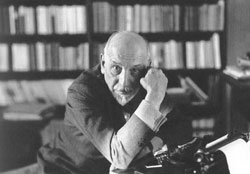
Luigi Pirandello. He was born in Sicily in
1867. He was a small, fragile child. His father was a gruff, autocratic
Sicilian who may have loved his children but never made any display of his
affection. As a child he was looked
after by a maid-servant of a humble origin who wanted to share with the
little boy some of her superstitious beliefs and her peasant, mystical
tendencies. It was from her Luigi learned to believe in ghosts — both
concrete and abstract — who could appear at any moment of the day or night
and say what they had to say. In later life, Pirandello would draw upon his
childhood beliefs and reveal, dramatically, illusory characters that appear
on the stage, make their statements, and disappear. Throughout his adolescence
Pirandello remained actively rebellious. The rebelliousness came out in acts
of disobedience to his father, but later he kept it strictly repressed only
to appear in the shape of outrages and anarchy in his writings. Gaspare Giudice,
Pirandello’s biographer, describes a crucial episode in his childhood: “In those days Luigi had
never seen a corpse, but one day he heard that there was one in the tower
used as a morgue. He couldn’t resist the desire to see it so he sneaked
into the tower and almost tripped over the coffin. He suddenly saw the body.
But at the same time, in the silence of the hall, he heard a soft noise,
almost a rustle. He held his breath. He heard the rustle again, not a rustle
of wings, or of air but a strange, continuous, live noise. He peeped through
a skylight and gradually perceived two bodies, a woman and a man, entwined
together and performing a slow, strange, uninterrupted motion as though they
were rocking. They held each other tightly and the woman’s skirts were
raised. The starched frill, rubbing between the two bodies produced that
unforgettable rustle.” This episode must have
influenced Pirandello’s mind a great deal because in his poetry, and his
plays, love always retains a smell of death, not the idea of death, but the
physical, putrefying aspect of death. Love is ever tarnished by madness or
poisoned by betrayal. From his early youth
Pirandello displayed a certain scepticism to the world. In a letter to his
sister, written at the age of eighteen, he says: “Meditation is a black
abyss, peopled with dark ghosts guarded with desperate discomfort. A ray of
light never seeps through and the desire to have light plunges you ever more
deeply into the dark. The silent immensity freezes you. When you manage to
live without an ideal because life, when observed, seems a great force with
no like or explanation; when, in a word, you live without life, you will
think without a thought, you will feel without a heart — and you will no
longer know what to do. I am like that. Greatness, fame, glory no longer
stimulate my soul. Is there any point in exhausting one’s brain and one’s
spirits in order to be remembered and appreciated by men? Ridiculous! I write
and study in order to save myself from despair. But don’t think my lack of
illusion and hope will destroy me. A positive and scientific concept of life
makes me live like all the other worms.” Pirandello arrived in Rome
as the age of twenty with a definite vocation to be a playwright. He had
already written a play (The Birds in the Sky) derived from classical Greek
drama. It was a prelude to his later theatrical innovations. In this play, by
means of a scenic inversion, the auditorium turned into stage and the
spectators, having become actors, performed a function similar to that of a
chorus in classical drama. The play was not performed. Another play that he wrote
some years later shows by its title the interest that Pirandello already had
for ‘a play within a play’. It was called ‘Rehearsing the Play’. This
too, was never performed. * * * * * After he received his
doctorate in philosophy from the University of Bonn, Pirandello was engaged
as lecturer of Romance philology in the university of Rome. His salary was
meagre and, as a newly married man, he would have found it hard to make ends
meet, but his father, who owned sulphur mines and was a rich man, kept
sending him a monthly cheque. He set up home in the fashionable part of the
city and lived comfortably, but this wasn’t to last. His father foolishly
gambled away not only his own savings but his daughter-in-law’s entire
dowry in a business venture. Pirandello who now had two children and a wife
(who was slowly losing her mental balance) to look after, moved to poorer
quarters. He worked like a slave to eke out his earnings, writing stories and
poems, newspaper articles, pamphlets and critical essays which he sold for a
pittance. Playwriting had taken a back seat. By the time he was forty,
Pirandello was an established poet who was talked of as a writer who showed
the same qualities of subtlety, irony and observation in his short stories
and novels as in his poetry. As an individual he was an enigmatic person —
even to his friends. He would sit with his literary and artistic friends and
play patience for hours while they talked of art and literature and politics.
“He smiles,” wrote one of his friends,” but he never laughs. I can’t
remember having seen him laugh in twenty five years.” He was generally
regarded to be a man who is always outside, if not above, life. The reason for this
summation could have been an article he wrote for a literary magazine, titled
‘Art and Consciousness.’ Evaluating contemporary civilisation, Pirandello
writes: “…. Modern philosophy has tried to explain the universe as a
living machine and has tried to specify our awareness of it. And what is the
result of all this? This poor earth of ours! A tiny astral atom, a vulgar
little top thrown from the sun and moving round it. What has become of man.
What has this microcosm, this king of the universe become? Alas poor king!
Can you not see king dear hopping before you, armed with a broom, in all his
tragic comicality? * * * * * Pirandello’s first
experience of live and continuous theatre came about when he was fifty two.
Three of his plays were produced in three different theatres in Milan. Two of
his other plays were staged within months in Venice and in Rome — all to
wide acclaim. And then in 1921, when he was fifty four, came “Six
Characters in Search of An Author”. (to be continued)
|
|