


|
|
|
|
 |
 |
  
|
nostalgia
nostalgia “Giyari is
gone!” my friend Shahzad Hassan’s frenzied call sent memories reeling
back 20 years, when we had spend some unforgettable weeks in Giyari. I was a probationary
officer at the Civil Services Academy, Lahore in 1992 and was planning to
ramble in extreme north for a month-long military attachment. On my
instigation, a few probationary officers joined me to volunteer for Siachen .
The adventure started
sooner than we expected. On reporting at 10th Corp
office in Rawalpindi, we were paraded through various rooms and verandahs,
where excited eyes widened and heads swivelled round to get a look at us as
if we were outlandish beings from Mars. Civilian officers were considered too
soft for such assignments and an officer actually shook our hands for
assurance that we existed. Like condemned men, our
last wishes were granted and we zoomed off to Gilgit in C-130, all dressed up
in jeans and some with flowing locks. Accompanying us was a smart army
captain in perfect uniform. At Force Commander Northern
Areas (FCNA) Headquarter in Gilgit we underwent a similar treatment and were
finally given a choice either to spend time at the base of K-2 or do parading
at Kale sector in Kashmir. In that case, I demanded
that we be sent back with a letter that officers from the Civil Services
Academy are not good enough for the Siachen sector. The ruse worked and at
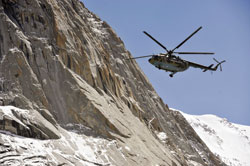
day-break we gathered at the Gilgit airport to hitch ride on a chopper to
Skardu. Accompanying us was the same smart captain, only this time he was
suspicious of our presence and no pleasantries were exchanged. At the Skardu airport, the
captain disappeared in a jeep while we inquisitively gathered around the
pilots listening to their stories of adventure. Two hours later we were
bundled in jeeps for Dansum, the brigade headquarter, about 12 hours bumpy
ride on a ‘shingle road’. Once again our travelling companion was the
same captain who was yet again wary of our presence. The road was rickety but
scenic. After an hour we drove along Shyok River, leaving behind Indus River
on the right side which seemed to be a tributary of Shyok. Around Khaploo we
stopped at an overcrowded roadside inn where it was announced that no food
would be available beyond this point till we reach Dansum. And at Dansum the captain
habitually disappeared… We reached Giyari around
midnight. Stepping out of the jeep was like stepping into a maelstrom. We
dashed into a dug-in trench which remained our abode for the rest of the
stay. Sleeping bags spread over empty barrels formed our beds. Other constant
companions were bugs, soot from kerosene lamps and mice trained to jump over
our heads each night as a routine military drill. Next morning, after
breakfast, we marched to salute the Commanding Officer (CO). His simple room
built of stones and mud, which reminded me of cartoon character Fred
Flintstone’s office, the only addition were few maps on the wall. We were
introduced to all officers and ranks as a pack of daring civil officers who
had volunteered for the right cause, a treatment which was sadly missing
earlier. Later, at lunch, we met our
travelling companion, the smart captain who had gone missing at Dansum. After
introduction there was a burst of laughter when he confessed that he mistook
us for secret agents snooping on soldiers and decided to jump off the jeep.
More laughter followed when he, with tinge of regrets, narrated his bumpy
journey hitch hiked on a military lorry. Capt. Wahab became our friend
straight away. Daily schedule, just like
the harsh weather at Giyari, was predictably simple. At dusk all officers,
armed with a torch, would dutifully assemble in the mess. The arrival of CO
was announced by coughing of a generator and the mess gets lit up. Some would
play bridge which at times entailed costly side bets in the form of dinners.
Others would simply watch Hollywood movies on videos. One may get connected with
outside world if lady luck or a telephone operator favours him. The lines
remained hopelessly inaudible. Captain Dr Nadeem used to step outside in
freezing cold and yell on phone, his romantic utterances echoing in the dark
valley. Meals consisted of tinned food, the taste of which was barely
palatable and often resulted in depressed appetite; though in my case it was
the reverse. Everyone compulsorily
possessed two things. A pack of mixed food ‘Energile’ to make water
drinkable, which otherwise tasted metallic and a torch at night. After the
dinner, with the departure of the CO, the generator was switched off and the
area descended into pitch darkness. Blindness was at times
completed by a howling blizzard. Once we all forgot to carry a torch and
covering 300 meters to our abode became a nightmare. A wrong step by this
disoriented party meant either bitten by a pack of savage dogs or get gorged
by herd of yaks, both wild groups abundantly cuddled on the ground
surrounding the mess. A group of officers started
a daily routine of walking down hill on the shingle winding track and then
would jog or at best limp back. I kept aloof from this exercise called
‘acclimatisation’ and would spend time reading a book. A conspiracy was
soon hatched by men in uniform to square things with ‘soft’ civil
officers, most of whom would enjoy viewing their labour from the top of a
boulder. The CO passed an order that
all officers would undergo the acclimatisation test on Friday and the last
five to reach the mess would pay for the weekend dinner of fresh meat and
vegetables, items costing ten times their normal price elsewhere. It was
presumed that the ‘Famous Five’ civil officers were going to be the host. No sooner we started
jogging the count for the magical figure of first five dropouts was achieved,
which included two uniformed officer. With my lungs on fire I kept gasping
for oxygen, I and Captain Wahab managed to reach the mess still running,
followed by Captain Tariq while the rest of the party limped back an hour
later. Wahab was surprised at my
stamina and I at his. A resident of Gilgit, he was a champion middle distance
runner in PMA and had served with NLI in Northern areas. I was an allround
sportsman at Sadiq Public School who kept myself fit even afterwards. After
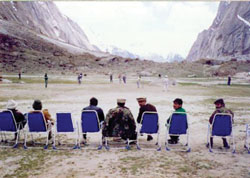
endless days of devouring tinned food, all of us enjoyed this weekend feast. Giyari camp was in the
centre of flat broad valley with a stream flowing pass it. Whenever weather
permitted and a pale sun appeared, cricket was played in the afternoon on the
relative flat ground. It was like a T20 version, where it was easy to hit
6’s and 4’s rather than taking singles in a rarified environment. The
pitch was at times used as a helipad. Matches with Dansum brigade were
closely contested, though some games had to be ‘strategically’ lost to
appease the visitors. Nevertheless, we were proud
to have played cricket at the highest altitude — a feat that needs to be
properly acknowledged by PCB. Alas cricket cannot be
played at Giyari anymore; as the world’s highest pitch lies buried under
tonnes of rubble after a dislocated glacier swept down unexpectedly on this
valley in the wee hours of April 7, 2012. Gone is the 18th century
mosque built by Hazarat Ali Hamdani, and which was subsequently renovated by
7th NLI Company in July 1986. This tragedy catalysed renewed bondage amongst
us. Farouq Mazhar (DIG) in
Sahiwal, Brigadier Tariq in Swat, Colonel Dogar in Islamabad, Dr Nadeem in
Lahore and Mashood (Joint Secretary) in Peshawar got connected via phone. We
missed out our smart friend Wahab (Major) who was posthumously awarded
Sitra-e-Jurat in the Kargil war. I always think that this brave man deserved
much more. I had penned down happy
memories of the time spend at Giyari with 57 Baloch Regiment, yet the most
critical part was mentioned in ephemeral. The life at Siachen was miserably
tough and only those who dare can endure it. 135 brave souls of the 6th
Northern Light Infantry lay trapped in a white shroud. Inhospitable weather
hampered desperate rescue efforts by the jawans, while the mental agony of
the families continues. Major Zaka’s spiritual father (Housemaster at Cadet
College Hasanabdal) wrote an emotional letter in this newspaper bidding him
one last farewell which watered many eyes. Let us salute all those unsung
heroes of Siachen who laid down their lives so that this nation could live
— and live with honour. Adieu Giyari. The writer is a
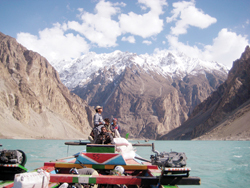
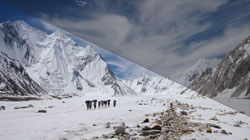
conservationist and an animal rights activist. dr.raheal@gmail.com caption Crossing Giyari stream with
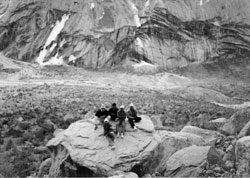
the flat broad valley in the background. caption 1992: From where the
avalange hit Giayari Camp, Siachen Glacier.
|
|