


|
|
|
|
 |
 |

|
Practice
what you preach Australia have sacked
Clarke
has it all to do bookreview Constitutional prowess A
Plea to the Patron in Chief of the PHF
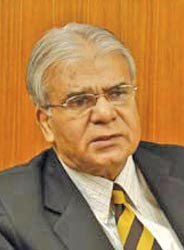
Practice what you preach Australia have sacked Mickey Arthur and replaced him with home grown Darren Lehman. Why cannot we? By Chishty Mujahid Mr. Shahryar
Khan is a person of princely birth with sound education at Dehradun,
Cambridge, and Fletcher School. He has a brilliant record as a career
diplomat. He served as Ambassador, High Commissioner, Foreign Secretary
of Pakistan, and also Special Representative of the UN Secretary General
in strife torn Rwanda. He played cricket at school and Cambridge and has
the enviable experience of having watched Sir Donald Bradman in action
seven times. A cricket “buff” Mr. Khan successfully managed the
Pakistan cricket team in India and was the manager of After that prologue
the purpose of which was to illustrate that the stewardship of the PCB
is no bed of roses even for career diplomats with an impeccable track
record; and particularly these days when most matters relating to it are
sub judice or “padded’ up to go to the courts. As such all paths
must be treaded with care and caution. I refrain from making any
comments on the legality or otherwise of the interim appointment made by
the Prime Minister. I am not privy to the new constitution of the PCB as
I still await the copy promised both by the Media Department and the
Public Relations Department of the Board some time ago! Having said that, I
would like to extend my greetings, felicitations, congratulations,
support and best wishes to the Interim Chairman. Mr. Najam Sethi is a
person of exemplary merit. A fearless and forthright journalist. He won
the Golden Pen of freedom Award in 2009. He has proved himself as an
outstanding administrator. Like Mr. Khan he is also a Cambridge man. I
have been an ardent admirer of his writings and also his telecasts.
I am confident that he will make his mark on the ICC and the
other members with his charismatic personality. He should also use his
skills and charm at “lobbying” with the ICC and its members be they
permanent, associate or affiliate. It helps. Our one time representative
at the ICC, Mr. Ehsan Mani, and the former Chairmen (late) Air Marshal (Retd.)
Nur Khan and Lt. Gen. (Retd.)
Tauqir Zia were past masters of this craft. Our PR with the powers that
be slid to their lowest ebb during the last few years and urgently need
to be resuscitated. However, if we plead
for clemency for Mohammad Amir as the top priority item that may not go
down too well with anyone including our own cricket fans. Pakistan
should take a firm stand on discipline and “practice what they
preach.” Remember we have a zero tolerance policy on misconduct. If
Amir is old enough to commit a felony, he is old enough to be punished
for it. And what about pleas for Salman Butt and the much harassed
Mohammed Asif? Of course Asad Rauf the Pakistani Umpire dropped from the
“elite” panel of the ICC would also expect help fro Meanwhile, Pakistan
performed disastrously in the farcical Champions Trophy 2013 in England
and Wales. The event has been hailed by the ICC as a great success and
there is a probability that the 7th edition may not have been the last.
All that the ICC seems interested in is how many pounds, shillings and
pence found their way into the coffers. By the way many an eye brow has
been raised about some aspects of the Championship. Pakistan have a
crowded calendar. They go to the Caribbean, Zimbabwe and then set up
camp in UAE for their “home” series against South Africa and Sri
Lanka. The squads have to be announced. The Selection Committee is still
in place. The squads are signed off by the Chairman. Is the
“interim” authorised to approve? If not what is the status? The
Chief Selector is an upright person who will go according to the book.
It is rumoured that the squad has already been formed. Leakages (or was
it the interim Chief) say that Misbah will be retained as captain.
Shahid Afridi is set to return. More power to him. What about the much
trumpeted Abdul Razzaq and Imran Nazir? There are to be a few casualties
— Imran Farhat, Kamran Akmal, Shoaib Malik, Abdul Rahman (?), Ehsan
Adil (rested —why? He has had enough rest and recreation by non
activity on the field in England and Wales). New faces are expected.
Umar Akmal who will also don the wicket-keeping gloves, Azhar Ali,
Rizwan as Umar’s deputy, Ahmad Shahzad, Sohaib Maqsood, Raza Hassan,
Hammad Azam — all good choices. It is reported the
authorities have ordered fitness tests for eight players. What about the
rest. I feel that in the end the entire squads will have to go through a
test to prove their fitness. The management team is to be unchanged. If
the players do not get along with the manager he must be a good
administrator. Keep him on. What about the “world cup winning”
coach? If coaches won World Cups Intikhab Alam and John Buchanan would
be in demand by every team. Australia have sacked Mickey Arthur and
replaced him with home grown Darren Lehman. Why cannot we? The rest is
silence. chishty.mujahid@yahoo.co.uk capion Mohammad Hafeez (left)
and Dav Whatmore
Clarke
has it all to do Suddenly
cricket is football. Two high-profile coaches sacked mid-season within a
week or so of one another. First Surrey dumped Chris Adams and then
Australia paid off (presumably) Mickey Arthur. In the age of instant
gratification, instant success is an unremitting pressure. Both are good
men but both have failed to convert the promise of their empire into
results. When the names are big, the stakes are bigger. Mike Brearley
once wrote: if the fish is rotten, look at its head. Surrey’s master plan
for 2013 involved Graeme Smith but injury did for that. It is a team
with some oldish cricketers and one who is struggling with the demands
of a county calendar that brings no respite. Smith would have injected a
sense of purpose and unity, along with a feeling for reality. The wounds
of last summer may not yet have healed but they are unlikely to be the
cause of the indifference that pushed the club’s governance into such
radical action. Tom Maynard is a dreadful loss in every way. Right now,
though, his batting is most missed. Smith was a good
choice because it is clear he is the boss. Cricket teams run best when
the captain is just that. Players like to know whom they must answer to.
This could continue to be a difficult season for Surrey because the
captaincy is in limbo. Bravely, Gareth Batty has once more stepped into
the breach, and for another month he has Ricky Ponting close by. Also at
hand are Stuart Barnes and Alec Stewart but the layers of management are
not as crystal clear as they might otherwise have been. Such confusion
is compounded by poor results, so the players must find something extra
if the wheel is to turn for them. If Surrey surprised
us, Australia shocked us. Here, on enemy territory and on the eve of the
battle, they court-martialled one of their own. Except he wasn’t one
of their own, he was a gentle, approachable, cap-doffing South African,
and appointing him was a ghastly mistake. At least that is how it
appears now. Back in the days when Arthur was going okay, the players
spent a lot of rhetoric saying how they loved him. He was an
arm-round-your-shoulder sort of guy, good at lifting you up when down at
heel and better still at taking you to the clouds. But the players have
cost him. First the tour of India and the “homework” saga; then
David Warner’s second face-off in a month (one by handheld phone, the
other by fist); then the calamitous cricket in the Champions Trophy.
Poor Mickey, we knew him well. The appointment of
Darren Lehmann is a good idea. There is huge respect for the way in
which he approached his cricket and for the early signs in his coaching
career. He knows the Australian way, and believe me, it takes some
understanding. He arrives at a bad time or a good time, depending on the
way you see it. If the Australians come out of the Ashes summer with
their heads held high, he is a shoo-in for the job full time. The smartest thing
Lehmann can do is put the captain out front and slip in just behind him.
Michael Clarke must be accountable; not Lehmann or Pat Howard, Clarke.
When Kevin Pietersen organised the coup that did for Peter Moores, he
also did for himself. The result was that England made new appointments
and created a clear structure of management. Hugh Morris is managing
director of England Cricket. He, along with his board and the selectors,
choose the captain and coach and then let them get on with the cricket.
Andrew Strauss was made captain after the Pietersen-Moores affair, and
Andy Flower was appointed coach. Though they worked together, the buck
stopped with Strauss, as it does with Alastair Cook. Pat Howard’s job
description is subtly different. His title is General Manager Team
Performance and, thus, he is more hands on than Morris, which is not a
good thing. If the lads are out on the piss at 2 o’clock in the
morning, who takes the rap? Captain, coach or GM Team Performance? The
CEO, James Sutherland, called the incident “despicable” and you had
to wonder how things had got so out of hand. Well, the captain was in
London and the GM in Australia, all of which left the coach drowning. Clarke cannot stand
away from the team. Though not a selector, he should drive its culture
with his every move and word. The team should perform in his image. This
may not please all Australians, a number of whom still find him hard to
trust, but at least Australia will know where they stand. The first thing Clarke
must do with Lehmann is establish the responsibilities of every member
of the touring party, both on and off the field, and then spell them out
one on one. There is but one week till Trent Bridge and the first Test
against an increasingly buoyant England, who are looking on with much
amusement. By then each member of the team must know exactly what is
required of them. And that should literally mean how to bowl and bat and
when to party. Damn the diets and sleep patterns, close ranks and give
‘em nothing. You, yes you! Bat for the morning session, come what may.
And you! Bowl a foot outside off stump at all the England right-handers.
And you, bowl gun-barrel straight with another fielder leg side. Oh, and
you Davy, get out of the bar and smash these Poms to Sherwood Forest and
back. Forget the blocking, that notion that you must play an innings:
bat like you hate the bastards. As for Clarke himself?
He should think back to Allan Border in 1989, who arrived in England
with yet another of those teams considered to be the worst that ever
left the Great Southern Land. He put the happy go lucky AB of 1985 —
when the Australians got beat with a smile on their face — he put that
fellow on the back burner and morphed into more than just Captain
Grumpy. He played it hard as nails and the Aussies won 4-0 against an
English team led by David Gower that never got off the floor after the
pounding they took on the first couple of days of the first Test at
Headingley. Gower had put them in to bat. The response was 600 and a
declaration. It was one of the great psychological heists, one that
turned the predicted result on its head. Charming as Clarke is by
nature, he must de-charm himself pretty damn quick and throw his every
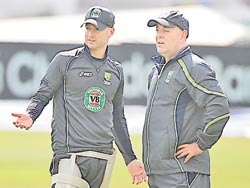
waking hour at overturning the odds. —Cricinfo caption Michael Clarke (left)
and Darren Lehman
bookreview Test cricket,
known as the purest form of cricket, began in 1877 but before that,
there was a lot that we don’t know. Who bowled the first ever
delivery, who scored the first run or who was the first batsman to be
dismissed, these facts can be found anywhere on the net or in record
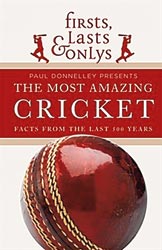
books. Paul Donnelley’s First, Lasts and Onlys is cricket’s that
treasure trove that you don’t get to find easily. It provides you the
most uncommon of information on the game, in the most amazing of styles.
Not once during the entire reading of the book do you feel bored and
that’s what makes any cricket book worth your while. Heard that before
about a cricket book? I doubt that because then you must know the name
of the first ‘teenager’ to score a century in Test cricket, or the
name of the bowler who dismissed four batsmen off as many deliveries.
Since you don’t, you need this book! Be it the name of the first
batsman to be dismissed for 99 in Tests or the last white player to
captain the West Indies in a Test, this book has it all. It also brings
to you information that is not to be found anywhere, like England’s
last match overseas as MCC, the identity of the only player to hit a six
on all 5 days of a Test and the name of the only man to play both first
class cricket as well as top flight football on the same day! Interesting, isn’t
it? Well that’s only 1 percent of the information this book holds. If
you want to know about the most useless of all Test cricketers — one
who never batted, never bowled or even took a catch in his Test career
— you will find him in this book (no, he is not in the current
Pakistan squad!). But what I can tell you is that the only father-son
duo to ‘carry a bat in completed Test innings’ are from Pakistan —
Nazar Mohammad and his son Mudassar Nazar. Three categories —
The Firsts, The Lasts and The Onlys — make the book fantastic to
follow. The narrative is witty, sad and unbiased at the same time. Witty
when it talks about the first Test cricketer to die — James Southerton
— who didn’t know that he had played a Test match! Sad when it talks
about the death of Pakistani first-class cricketer Abdul Aziz who died
after being stuck in the chest during a cricket match. Unbiased since
all the Test playing nations (and those with rich cricket history) are
given due coverage in these pages. This small book may
not cover the history of the game, but it surely is different and
refreshing. Old and young cricket fans can find anything, anywhere
amongst these pages that would give them the edge over their will
friends, families and fellow cricket fanatics. You can read it in one
sitting or use it as a quiz book, but one thing is certain, it is better
than most of the cricket books available in the market. Where else would
you get to know the name of: *
The first batsman to be given out by the third umpire *
The first cricketer to turn to umpiring after retirement *
The only cricketer to captain England and win an Olympic Gold in
Boxing *
The only cricketer with links to three different countries —
Zimbabwe, South Africa and Egypt, and *
The only English captain who had a busy Hollywood career as an
actor after quitting the game. The book also tells
you about facts that might entice a history buff — Blackheath
cricketer John Druitt was (and still is) suspected to be the notorious
‘Jack The Ripper’, Wallis Mathias was the first non-Muslim to
represent Pakistan in Test cricket and Sir Vivian Richards represented
Antigua in World Cup football qualifiers in 1972 before he became the
mightiest batsman to represent West Indies a few years later! As expected, the
inaugural Test between England and Australia gets the best coverage
since it had most of the ‘Firsts’ to happen in Test cricket. But did
you know when the first recorded game of cricket took place in England?
In 1598, more than 400 years ago, and no one knew about it till now!
Wow. The first overseas tour — England to France — was cancelled
because of The French Revolution in 1766, while the first international
match played outside Britain happened in 1844 — United States versus
Canada! The author must be
commended for his brilliant research as he has gathered over 300
brilliant, bizarre and at times unbelievably true events that have
actually happened on the cricket field during the last 500 years. The
book is compiled in chronological order but if you go through the
content, you can browse through your ‘favorite’ facts with ease.
Still think you know all there is to know about cricket, think again.
You just don’t know anything! Omair Alavi works for
Geo TV and can be contacted at omair78@gmail.com
Constitutional
prowess The new
constitution of the Pakistan Cricket Board purportedly brought into
force in accordance with the guidelines set out by the ICC is in my
opinion in violation of the settled norms of transparency and
accountability. It is pertinent to add here that the Woolf
recommendation had advised that all member boards of the ICC should
focus on having a constitution with minimal or no government
interference. By way of background we must not forget that Pakistan
cricket has always been governed in the same fashion a dictator governs
a country with the patron of the cricket board having unfettered powers
to govern the board at his sweet will. However, due to the constant
political turmoil in the country different patrons over the years have
appointed their own chairmen to run the show over the years, one of the
main reasons for the team’s turbulent performance. Furthermore, the
latest match-fixing and spot-fixing saga has played a crucial role in
the adaptation of a new constitution with little or no government
interference whatsoever. Former Pakistan captain Rashid Latif, who was
one of the first whistleblowers of match fixing in Pakistan has served
the nation at the highest level and continues to do so by operating an
academy free of cost inspiring young cricketers who aspire to play for
Pakistan. As always for the betterment of Pakistan cricket the former
captain filed a writ petition before the Hon’ble High Court of Sindh
challenging the previous constitution of the PCB. Such was the impact of
the challenge that the PCB had no option but to resort to forming a new
constitution which has now been challenged by different petitioners in
different provinces are currently subjudice. The purpose of this
series of articles is to do a comparative analysis of the
Constitutions’ of different cricket boards around the world with that
of Pakistan. I will first discuss
the constitution of the United Cricket Board of South Africa and discuss
its democratic nature and its application in South Africa. The Proteas have
always been a formidable force in cricket and have always given Pakistan
a tough time be it any form of cricket but the basis of their rise in
world cricket and their dominance like any other business model lies in
the implementation of a democratic procedure. Interestingly, soon after
the apartheid, the two cricket boards prevalent in South Africa, the
United Cricket Board and South African Cricket Board immediately
realized the need to do away from division and decided to combine into
one board known as the United Cricket Board of South Africa, this laid
the basis for a move towards democracy and fair and transparent system.
Another fine example of this is the rule where at least four coloured
players need to be selected in the team which is not only a positive
move but one which shows the nature of democracy in South Africa. Like any democratic
nation and one that upholds its constitution, the constitution of the
UCBSA also follows the principles set forth in the constitution of the
Republic of South Africa. This sets the tone for the constitution to be
completely democratic and not in derogation of the constitution of South
Africa. Moving on the Board includes different affiliates akin to that
of different provinces in Pakistan, the difference being that in South
Africa the affiliates as in their boards are part of the governing board
whereas in Pakistan individuals from different regions are elected by
way of election which is completely in accordance with law. However, it
is important to note that it is the General Council of the Board which
is the highest authority under the UCBSA and consists of the President,
Vice President and the Treasurer of the Board voted for including a
President from each affiliate, one delegate from each associate member
and three black persons to be nominated and voted for. The Key word here
remains ‘voted for’ and it is imperative to peruse the manner in
which such key posts are assigned. Thus, like any other business
organisation or set up the UCBSA constitution allows for an annual
general meeting to be called which allows the members and affiliates of
the board to vote for their respective President, Vice President and
Treasurer (the office-bearers). Hence, accordingly nominations are filed
before the chief executive officer fourteen days before the annual
general meeting. The Chief Executive is appointed by the General Council
of the Board and this mechanism allows for free and transparent
elections to take place. It may be pointed out that the affairs of the
board are governed by the executive committee which includes the three
office-bearers who are in turn elected by way of nomination and voting
prescribed under the constitution. The electoral system
placed in the South African constitution allows the President who is
akin to the Chairman in the Pakistan setup and other office bearers to
be appointed by way of transparent and fair elections and limits the
appointment of the three office bearers to a period of two years
followed by another two where after the same person may not be
appointed. This system of accountability within the hierarchy of the
UCBSA allows the board to be governed in an efficient manner which
ultimately has an impact on the team and its performance, which has been
exemplary over the last decade or so. Such a system also allows a
complete wipe out of any nepotism that may exist, also eliminating
elements of high handedness and groupings. Furthermore, it allows South
African cricket to focus on the game itself and produce high quality
players which not only add to the image of the sport at an international
level but also help a nation to progress and achieve prosperity by
encouraging competition and producing the best. It also allows South
African cricket to streamline and implement anti corruption policies put
forth by the ICC and do away with the vice of match/spot fixing which is
rampant in international cricket today. We must not forget the stance
taken by the UCBSA when Hansie Cronje had admitted to match fixing, but
this all has been allowed due to the democratic constitution which
governs South African Cricket. The writer is a practicing lawyer umairkazi@gmail.com
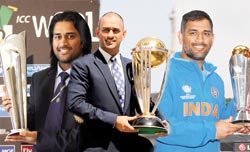
Dhoni
on top again People believe
in luck and luck believes in Mahendra Singh Dhoni. He has the ability to
turn the odds in his favour. Dhoni proved this again in the Champions
Trophy 2013 when his team successfully defended their 129 runs total in
20 overs rain-hit final. A promising new
opening pair, energetic fielding and accurate bowling made MS Dhoni the
most successful captain ever in the history of the game. No other captain has
won all three ICC titles: the 50-overs World Cup, the Twenty20 World Cup
and the Champions Trophy. Ricky Ponting captained the Australian team to
wins in ICC World Cup and Champions Trophy but he was unable to win the
World T20 Cup. Dhoni won the Twenty20
World Cup in 2007, 50-overs World Cup in 2011 and now this Champions
Trophy. He took over as the
skipper in 2007 after India had crashed out of the 2007 World Cup in the
first round. In just six years Dhoni has taken the team India to new
heights of the game. Dhoni immediately made
a difference and in his first major assignment, led India to the World
T20 title in South Africa in 2007. Beating Australia on
their soil has always been a difficult task for any team. But Dhoniís
charges surprised everyone by winning the first two matches of the
best-of-three final against Australia of the tri-nation ODI series in
2007-08. Dhoni had an
impressive presence out in the middle as a leader, which made a major
impact on Indiaís performance. He also has under his
belt the Asia Cup won in Dambulla on June 24, 2010. He also won the
Compaq Cup on September 14, 2009. Apart from these
triumphs for his country, he also won IPL and Champions League with
Chennai Super Kings. After success in
limited overs game, India became the number one side in the ICC Test
ranking after they defeated Sri Lanka 2-0 in December 2009. They also
trounced Australia at home 2-0 a year later and then drew the series in
South Africa 1-1 in late 2010. By beating Australia
in the second Test at Hyderabad (Deccan) in March this year, Dhoni also
overtook Sourav Ganguly’s record of 21 Test wins as captain and became
India’s most successful Test captain ever with 22 victories. Then he
became the first Indian captain to whitewash Australia 4-0. Dhoni won the World
Cup 2011 at home for India after a 28-year wait. He led the team from
the front with a magnificent unbeaten 91 in the final against Sri Lanka.
India landed England
for the Champions Trophy 2013 as one of the four teams expected to
qualify for the semi-finals. But no one expected that India will remain
unbeaten throughout the tournament including the warm-up matches. Indian
bowlers performed better than what was expected of them. Fast bowlers used the
English conditions extremely well. Dhoniís decision to select Ravindra
Jadeja in the team worked as he served very well as the fifth bowler and
in fact was the highest wicket-taker in the event with 15 wickets at an
average of just 12.83 with an economical rate of 3.75. Dhoniís success
percentage in One-day International is 63.5, in Twenty20 internationals
51.25 and 51.06 in Test matches. No other Indian captain enjoys 50
percent success rate in all three formats. Dhoni was under
criticism when India were routed 4-0 in England in 2011, and he was also
the captain for the tour of Australia when India were whitewashed in a
four-match series in 2011-12. Criticism became even
harsher when India were beaten 2-1 by England late last year, their
first series loss to the Englishmen on home soil since 1984-85. Defeat against
arch-rivals Pakistan in the home ODI series created more problems for
the skipper and some people started weighing the option of making young
Virat Kohli the leader. But the selectors
showed their confidence in Dhoni and he bounced back with a whitewash
against Australia in March this year and now he is one of the most
successful captain in the game. khurrams87@yahoo.com
A
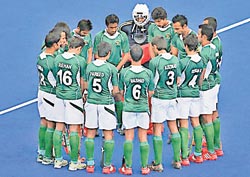
Plea to the Patron in Chief of the PHF Dear Mr Prime Minister We know you love
sports. Hockey is Pakistan’s
national sport and also the only discipline that has given the country
Olympic gold and silver medals. By virtue of your
office, Mr Prime Minister you are the Patron in Chief of the PHF. In the initial days of
its government, your party has declared that the performance of the
cabinet ministers would be regularly evaluated and if found wanting they
would be replaced. It is hoped the same
criterion is followed vis-a-vis sports federations. The present set-up of
the PHF assumed charge in 2008 immediately after the PPP government came
to power. As expected, Olympian Qasim Zia, a PPP stalwart was appointed,
as the president of the PHF. Asif Bajwa, another former Olympian, who
also enjoys a lot of political backing, became the secretary general of
the PHF. With two technocrats
who played international hockey in not so distant past at the helm,
people expected better days for the Pakistan hockey. The duo did use their
political clout in obtaining hefty grant for hockey, and quite
regularly. Everyone would agree
that the main yardstick to gauge the performance of a sports body is the
showing of the national team in the international arena. Starting with
Pakistan’s performance in the two global title tournaments during this
period: In World Cup 2010,
Pakistan finished last out of the 12 teams. In Olympics 2012,
Pakistan finished 7th. They lost to Australia 0-7 in the last pool game
— this was Paksitan’s worst ever defeat in an Olympic tie in more
than 100 matches that Pakistan has played in the Olympics since 1948. Now coming to other
major tournaments: In Commonwealth Games
2010, Pakistan finished 6th, their worst showing in the event’s
history. In the Champions
Trophy, Pakistan participated in the last two editions only on a wild
card; they had failed to qualify. The number of participants was
increased from six to eight so two wild cards were given. In 2011,
Pakistan finished 7th, equalling their worst ever position. In the last two
editions of the Sultan Azlan Shah Cup, Pakistan finished last: 7th in
2012 & 6th in 2013; again their poorest showing in this tournament. So this PHF set-up has
achieved a dubious grand slam: *
Worst ever position in the World Cup *
Worst defeat in an Olympic match *
Worst ever position in the Commonwealth Games *
Worst ever position (equalled) in the Champions Trophy *
Worst ever position in the Sultan Azlan Shah tournament Yes, in a period of
five years there have been a couple of minor successes about which the
PHF has been bragging all this time. Pakistan won the Asian
Games gold in 2010. The officials repeatedly point out, “Pakistan
regained the gold after 20 years”. In Asia, the
competition is only between Pakistan, India, Korea and Malaysia. Barring
one odd occasion, Pakistan always reached the podium. Then luck played a
major part in this 2010 success. Pakistan managed to beat South Korea in
the semi-final only on a penalty shootout. Then they were fortunate to
come across Malaysia in the final. The Malaysians were playing the first
ever Asian final having lost in the semi-final on no less than 11
occasions since 1958 when hockey was first included in the Asian Games.
The tension of the big day was very much visible as the Malaysians
fumbled throughout the final and made innumerable unforced errors. Pakistan finished 3rd
in the 2012 Champions Trophy — an annual non-title event. Again luck
played a major part. Spain didn’t participate due to the financial
crunch. That Champions Trophy
was played on a strange format. The eight teams were divided in two
pools. After the pool matches, all the eight teams qualified for the
quarter-finals! Pakistan faced Germany
in the quarter-final. For a very long time, Germany have been using the
Champions Trophy (when it is held immediately before a World Cup or
Olympics) to try out new players in order to build side for the next
global title event. It was no different this time as the German side for
the 2012 Champions Trophy carried just three players from their 2012
Olympics side. Pakistan beat Germany to enter semi-final where they were
demolished 2-5 by Holland. In the 3rd position match, Pakistan beat
India. So these minor
successes in a period of five years can only be called aberrations. The
norm was poor show and poor results. It was under Dutch
coach Michel Van Den Heuvel that Pakistan won the gold at the Asiad
2010, yet he was shown the door after sometime as he objected to some
selections. A few months before
the Olympics, out of nowhere, Akhtar Rasool was appointed Manager and
Head Coach. Akhtar, though a great player of his time, has no experience
of coaching at any level. Despite the Olympics disaster, he is still
there. Coming to some other
steps: Immediately after
coming to power, the new set-up of the PHF, announced the formation of
18 hockey academies across the length and breadth of the country: to tap
the talent at the grass roots level and polish it to provide quality
players for the national side. Have the academies
served anything so far? Pakistan’s national
team still has to bank upon Waseem Ahmed, who is now almost 40 and other
veterans like Shakeel Abbasi. For the latest camp for preparing the team
for the forthcoming World Hockey League in Malaysia, Abbas Haider, who
last played for Pakistan in 2009 has been recalled. All this clearly
shows that the much talked about academies have failed to throw any
worthwhile talent. In the couple of inter
academy competitions held so far, only 10-11 academies participated.
While the PHF’s record shows 18 academies. Some exist only on papers. The PHF has appointed
their near and dear ones as coaches in these academies who are getting
regular monthly salaries. Pakistan’s minor
achievements at junior level owe to the age-old practice of fielding
overage players. In the Junior Asia Cup last year in Malaysia,
Pakistan’s balding captain Umar Bhutta became the talk of Malaysia.
His photos were especially published in the Malaysian newspapers. Before
the final, a couple of Malaysian players wearing shirts displaying,
“How old is your captain?” circled the Pakistani team. Hence, the last five
years have been disastrous for the Pakistan hockey. Mr Prime Minister, It
is earnestly hoped the new government takes some concrete steps to stem
the continuous decline. Even qualifying for the World Cup/Olympics has
now become a challenge in itself for Pakistan, once the most dominant
power in world hockey. ijaz62@hotmail.com |
|
 the national side in the 2003 ICC World Cup in South Africa when we
crashed out in the initial stages after a series of dismal performances.
I recall that hosts South Africa were also eliminated early and every
time the (late) Percy Sonn, Chairman of Cricket South Africa and later
Head of the ICC used to meet me his greeting was a cheerful “Hello, My
comrade in defeat!” When Mr.Khan was offered the Chairmanship of the
PCB in 2003 and I happen to come across him he asked what it was like at
the PCB. My response was simple, clear and straight forward. I said
“Compared to the PCB, Rwanda would seem like a cake walk...” The
rest is history.
the national side in the 2003 ICC World Cup in South Africa when we
crashed out in the initial stages after a series of dismal performances.
I recall that hosts South Africa were also eliminated early and every
time the (late) Percy Sonn, Chairman of Cricket South Africa and later
Head of the ICC used to meet me his greeting was a cheerful “Hello, My
comrade in defeat!” When Mr.Khan was offered the Chairmanship of the
PCB in 2003 and I happen to come across him he asked what it was like at
the PCB. My response was simple, clear and straight forward. I said
“Compared to the PCB, Rwanda would seem like a cake walk...” The
rest is history. 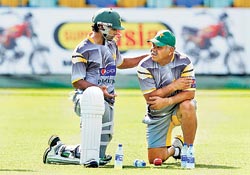 m
PCB. This way the Board’s time and efforts will be spent in helping
out and assisting offenders. Others may be tempted to follow suit when
assured that PCB will come to their rescue. Felons and criminals should
have no place in Pakistan cricket. I say even if the ICC reduces the ban
on our convicted cricketers PCB should impose their own ban. Any one
aggrieved is free to appeal to the courts of law. I am told the trio
have already gone down several avenues of appeal in England and
Switzerland. I am not sure what they can resort to next. They have the
services of top notch legal beagles who will advise them on their next
steps.
m
PCB. This way the Board’s time and efforts will be spent in helping
out and assisting offenders. Others may be tempted to follow suit when
assured that PCB will come to their rescue. Felons and criminals should
have no place in Pakistan cricket. I say even if the ICC reduces the ban
on our convicted cricketers PCB should impose their own ban. Any one
aggrieved is free to appeal to the courts of law. I am told the trio
have already gone down several avenues of appeal in England and
Switzerland. I am not sure what they can resort to next. They have the
services of top notch legal beagles who will advise them on their next
steps.