|
Hemlines rippled in asymmetric waves, in double
layers or fell in handkerchief points. Sleeves followed the line
of the arm, but often billowed out at the elbow; one sleeve was
a regular refrain.
There was a slight atmosphere of austerity, a reliance on darker,
muted hues, a desire for longer hemlines, as we saw in Milan. But
this was no knee-jerk reaction to an economic climate; it was a
case of designers using fabric and volume to express their ideas
or simply of a longer line being part of the mathematical equation
involving proportion, as Pilati at Yves Saint Laurent explained.
But joy and gaiety prevailed in patchwork and paisley, in electric
brights and jolts of colour. As in the tailoring, technique was
all-important, especially when done by hand. Knitwear, dresses,
accessories and, especially, shoes showed an extraordinary amount
of detail.
The stand-out examples were the hand-painted "Coromandel Screens"
on Latex at Balenciaga; the passementerie and gilded embroidery
at McQueen; and the ultra-shoes at Chloé - one pair featured
appliquéd leaves and a bunch of grapes.
-- Courtesy:
The Telegraph
Captions:
Chanel
Coco Chanel once remarked "there is no fashion for the old".
Karl Lagerfeld offered one of the youngest collections ever to bear
the Chanel label. In Paris
models with messy teenage hair, sprinkled with gold, and hardly
any make-up, save for a slick of gold shadow on their eyelids, appeared
in ripped denim mini-skirts with black, knitted 'sloppy-jo', boyfriend
jumpers.
They wore clingy, girly sweater-dresses in grey, or tight, clubby
dresses in black crochet or black PVC. Even the classic, Chanel
'cardigan suit' had drunk from the elixir of youth.
Alexander
McQueen
Alexander McQueen played history master with delicacy and romance
at the Paris prêt-à-porter season with a spectacular
show inspired by the British Empire, the Battle of Waterloo and
Queens of England.
The collection was divided into two sections. The first focused
on military dress, primarily in black. The second section featured
full-blown regal regalia and silhouettes based on both Victoriana
and 1950's British couture.
The jewellery – coronets, head-dresses, chokers and breastplate
pieces – were all made in Jaipur, from raw, uncut diamonds,
in the manner of that worn by the Maharajahs during the British
Raj.
Louis
Vuitton
Marc Jacobs, the creative director at LV, was clearly keen to strike
a more grown-up note than he did last season and the clothes were
more elegant and sophisticated.
Clean structured lines put the emphasis on the cut and quality of
the fabric, as well as ruching. Sparing embellishment came from
small scrolls of fabric and these also appeared as hats. The hips
were emphasised throughout, by exaggerated ruching on pale mint
silk taffeta skirts, cropped jodhpurs in wool and leather, and a
pale blue wool coat with moulded waist and hips. Black dominated
along with chocolate, cream, pale mint and camel, and the eveningwear
featured black pencil-shaped cocktail dresses – the most daring
of which had a net and wire bustle – as well as stiff silk
dresses with fitted bodices and bunched skirts.
John
Galliano
Galliano concentrated on a look that was brilliantly coloured, instantly
wearable and infused with a sense of the retro-boho, devil-may-care
chic that is his hallmark.
The key look depended upon two contrasting elements which merged
West and East: The tailored, more constructed outer-layer, over
something loose, Oriental or Arabian Nights-inspired, flowing and
altogether softer.
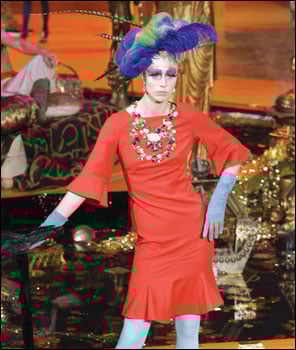
The oversized, multi-coloured, handknit "Rasta" hats and
feathered millinery concoctions, all by Stephen Jones, were as fantastical
as the rainbow-coloured eye-shadows.
Jean
Paul Gaultier
With wolves howling and lions roaring on the soundtrack, Gaultier's
show turned into a quite savage affair.
Anything that could be was made from, trimmed with or accessorized
with fur – heaps of fox-skins dangled from heads and waists
and bags, croc-skins were turned into jackets and mink into scarves.
When it wasn't fur, it was printed like fur. Tiger-stripes, leopard-spots
and zebra-stripes patterned trench-coats, short skirts, shirts and
jackets. Surely a collection to go wild over, no pun intended!
Givenchy
Disciplined tailoring with a hint of Spanish sensuality was the
keynote of Riccardo Tisci's collection for Givenchy.
After several seasons of struggling this young avant-gardist has
finally nailed it: A minimum of themes, a resonating colour scheme
that does not stray from the inspiration, precision cuts and a dash
of the girlish, 'parisienne' indifference with which Hubert de Givenchy
always sprinkled his collections.
This last came with the blouses, which are sure to be an instant
'hit': in cream silk satin, frilled; in white cotton, multi-ruffled
under a black nylon, padded bomber jacket; or, more abandoned, in
black 'midnight lace' and satin.
Dresses for the party circuit included lacey, short dresses with
one billowing peasant sleeve in pale apple, or a naughty-but-nice
big-sleeved baby-doll in black lace.
Yves
Saint Laurent
With identical short, black, fringed bobs hiding their eyes and
dark plum staining their lips, the 38 Yves Saint Laurent models
marched through the bright, white, modernist tent in the Grand Palais.
"I've learnt not to try and show every single thing,"
said creative director, Stefano Pilati – and not a single
handbag on show. "Everyone knows we do bags, why clutter?"
This autumn/winter 08/09 was a master class in merging tradition
and tomorrow's new world of fashion.
The DNA was there; a hint of the Ballets Russes, a suggestion of
safari, a touch of Modern Art and Morocco, a flicker of graphicism.
But this was more hint than homage.
The concept is taken from the YSL perfume, Opium, and includes shiny
lacquered surfaces, polished brass and stone and parquet flooring.
|