



|
|
|
|
 |
 |
   |
The
way we are karachicharacter
sporting The Pakistan Women Cricket Team has qualified for World Cup 2009. Kolachi speaks to four cricketers from Karachi who made it from home to pitch and plan to pursue the game if PCB cooperates. By Sabeen Jamil When Umer Rashid
started coaching the Pakistan Women Cricket Team (PWCT) Now, when the PWCT has qualified for World Cup 2009 for the first time ever, Umer is proud for having believed in Pakistani women. "Women in Pakistan are as competent in sports as in other walks of life," he says. "A player is just a player, not a man or a woman," Umer says, adding that players should be evaluated on the basis of their performance instead of gender. Umer’s criterion to evaluate players is correct, yet considered idealistic in Pakistani society where almost every sport including cricket is tagged as being 'a man’s game’. Though
the game is equally loved and played by both girls and boys in Pakistan,
girls are Given this situation, though, it is less likely for a Pakistani girl to pursue cricket as a career. Some girls have been daring enough to ignore raised eyebrows and sexist remarks, proving themselves at international level. Syeda Batool Fatima is one of them. Playing at international level since 2001 and equaling the highest record of dismissals by having taken three catches and three stumps, Batool had never even dreamt of playing at domestic level let alone the international level seven years back. "I knew there was a women’s cricket team but I never thought of approaching it," Batool tells Kolachi, adding that she was approached by the team when she was successful at trials held by her college team in 2001. Pakistan Women Cricket
Team was made in 1996 and was taken over by Pakistan Cricket Batool Fatima had been playing cricket at international level way before PCB took over and has established herself as wicket keeper in the team. She has not only made 41 dismissals but has been acknowledged as the second best wicket keeper during the World Cup qualifying series in South Africa. "We worked really hard to win this series," Batool says, adding that playing this series was a kind of do or die situation for the team. "Because if we had not won this time," Batool says, "PCB might have lost interest in us; the team’s future was at stake." Batool adds that the team fought to secure it’s future this time and to get more attention from authorities which otherwise seem to be "focused on men’s cricket only," she says. The team’s
performance during the series proves Batool’s claims of fighting to
achieve their goals. During the series, the team managed to win against
Ireland, Scotland and Zimbabwe, who have been in women’s cricket for
decades. The team was also appreciated for Though there is great talent among girls for cricket, it is ironic that there is no academy to train or coach women cricketers to compete at international level. This is why they have to face a lot of fitness problems when they join the national team. In Karachi alone, there are approximately six teams playing at regional level and600 girls were reported to have appeared in the trials held for zonal matches last year. "Yet we have no place in Karachi to practice except at National Stadium," says Sana Mir, who scored 150 runs and won the award for best player during the qualifying series. Sana thinks that given the talent in Karachi girls, "there should be at least one ground catering to one zonal team." However, ground shortages apart, there is not even a single club catering to female national level players in Karachi and those who make it to the national team get all their training afterwards. "I got all my
training after joining the team," shares Sana, who joined the team
inspired by Sana tells Kolachi that unlike other cities, National Stadium, Karachi, always welcomes the national team. At National Stadium, players of the national team undergo rigorous physical training and regular net practices. Besides this, the board holds almost three training camps per year, yet she feels the girls have a long way to go. "Compared to
boys," says Umer, "girls start playing cricket at an older
age." Umer tells Nain Fatima, another player of the team tells Kolachi that this is because, "we don’t have a single cricket academy for girls in Karachi." Nain adds that to stay fit a player needs to exercise regularly which is possible by joining an academy, or frequenting the gym. "However," she says, "there are no gym facilities for us except during camps." Therefore, most of the players end up exercising at their homes as, "gym facilities in the city are very few and too expensive," says Nain. Besides working out at
the gym, what the team needs to improve are, "frequent Having played for the Karachi Gymkhana team for years, Urooj didn’t have fitness problems as such but she feels the need of frequent matches against international teams, "to boost confidence of the team." Urooj says that at the moment they have matches against the boys’ under 17 and 19 teams, because even at that stage, the boys’ game is far superior to theirs’. "The exposure we will have through international matches will be far greater than playing against boys," Urooj believes.Besides that, she thinks that there must be frequent camps to cater to fitness issues of the team. "The more we practice," she says, "the more will the team improve." Umer Rashid, being the
coach of the team realizes the problems faced by these upcoming Initiative of domestic cricket is one such step. "Besides," says Umer, "we are suggesting under 21 and under 19 teams as well." Umer says that after the recent victory of the team, the cricket board is considering improved facilities for the girls. Yet, these four players from Karachi do not foresee a career in cricket. Urooj Mumtaz for instance is studying medicine at a dental college along with playing cricket. Batool Fatima with a Masters degree in Mass Communications is considering a career in journalism after some years. Similarly Nain Fatima and Sana Mir having bachelors in Economics plan for careers in English literature and Economics respectively. They have planned so for two reasons. Firstly, "women cricket right now is not earning us much money," they share collectively. Women cricketers are not getting any fixed stipend right now. All they get is around 300 rupees a day during camps and nothing during other days. Girls think that jobs offered by departments or banks as are offered to boys may help them. "If we are offered jobs we might rethink our priorities," they share. The second factor is more complicated and there are no concrete solutions as such. These four girls think they won’t continue playing cricket if they get married. "I won’t be pursuing a career at all after marriage," Nain Fatima says bluntly. Nain thinks that as even before marriage she is criticized enough by society for enjoying "undue freedom," it won’t be tolerated at all if she continues playing after marriage. The girls’ fears seem true as most of the players in the team do not come back after marriage. Umer is saddened by this. "Finding a replacement creates problems for us," he tells Kolachi, adding that to correct this problem, girls should be trained at school level. Does this mean spending time and resources on women’s cricket is a waste? "Not at all," Batool says, adding that cricket is just like every other profession for women and considering it a waste just because girls do not pursue it after marriage means, "not investing in any profession for women, as our society largely believes and practices this notion." However, Nain and Sana maintain that sports for women in our society are essential, as "they have tougher lives ahead of them as compared to men." women’s days Encouraging empowerment: Sindh acknowledges its talented women Women in rural Sindh are extremely skilled with their hands and can form an indomitable workforce if given the chance. This became clear as their work was displayed along with that of students at the University of Sindh, Jamshoro. International Women’s Day was celebrated this year as usual on March 8, with promises and demands for the empowerment of Pakistani women; those living in the rural areas in particular. Women in Pakistan have immense potential which often goes untapped because of the social and legal constraints they face. The situation of women
in Sindh has become as depressingly oppressed as it could. While they
must leave the security of their houses to earn money and support family
income, To observe the international women’s day in a unique manner, a simple and very sober ceremony was organized at the central library of the University of Sindh at Jamshoro, displaying artwork by female students of Institute of Women Development Studies (IWDS), where over a dozen student displayed their skilled artwork and handicrafts reflecting their strengths. The postgraduate students displayed handicrafts, pottery, paintings, designed dresses, embroidered cloth as well as showpieces coloured in an attractive manner. The artwork displayed at this very small exhibition sent across a clear message of encouraging empowerment of women and also symbolized the hard work through which the talents of these young students have been harnessed and groomed by the teachers at IWDS. The skills students have procured may well prove to be tools they can use to build viable careers out of in future. A final year student,
Shaista, tells Kolachi, "we have been trained with one month short Shaista says that it takes her a month to make a complete suit embellished with traditional embroidery as she has to balance work and studies. Another student, Nighat, sharing her views said that she has special interest in working on clothes and adds that marketing these products effectively is essential for recognition of both work and talent. "Designing clothes is part of home-based industry and I do want to continue with this as a profession," she says, "but women definitely need a little more assistance and input to do even better." IWDS students transformed simple pots into colourful decoration pieces and other smaller gift items and pots with impressive colour combinations which greatly appealed to visitors. There were also some students who admitted to have found creatively using the skills they had been taught a bit hard, but persevered through the process to come up with the works of art that they did. "Its difficult
when you start but after spending some time with your work, you find
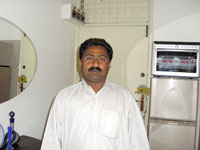
that it These students belonged to different regions of Sindh and brought the distinctive flavour of their areas into the work they did, making each piece even more eye-catching. Afshan Solangi, a student who hails from Shikarpur District in Upper Sindh, infamous for tribal clashes and honour killings, painted her perception of violence against women and gender discrimination. She tells Kolachi that she highlighted the violence and cruelty going on against women of the province, especially those belonging to rural Sindh and was also inspired by the situation in her home district. These students are full of potential and their abilities should be enhanced and ecouraged in a manner which can be used as an example for future students. These students should then be armed with enough knowledge and confidence to at least guide rural women with their available education and information keeping in view the market trends. Azmat Arfi’s work comprises of decoration pieces. She says that teachers at the institute have taught them their skills meticulously and it is because of the teachers that students have been able to exhibit their work on Women’s Day. A teacher at IWDS, Najma Gopang sharing her views with Kolachi says, "not only does the institute display students’ artwork, but also of rural women who are not able to do so by themselves. This display center has been established to sell handicrafts and clothing made by these women." "We visit the rural areas to guide home-based workers on market as well as fashion trends," she explains and adds that the real makers of traditional and cultural handicrafts are given their just share of profits. Much attention needs to be given to the nurturing of skills that women in rural areas hold to bridge gaps between urban and rural areas. This must be done under proper legislation, along with non-profit organisations contributing to the cause and the national commission on the status of women should also become more efficient and functional. As the Vice Chancellor of Sindh University, Mazharul Haq Siddiqui and Director of the institute, Dr Parveen Shah promised, the work done by rural women will be highlighted in upcoming events , they also pointed out that the contribution of these women to the economy of Pakistan is notable. --Photos by Rashid Silawat The way we are One small step for man, one huge leap for KESC By Amina Baig There is something extremely enigmatic about bad days. They have a way of winning nature’s favour to serve up one unpleasant experience after the other. There is something doubly many-edged about having a bad day in a metropolis; there are that many more things that can go wrong to turn an annoyingly hum-drum day into a tragedy of the Greek kind. Imagine bounding out of bed every morning, looking forward to starting what looks like a beautiful, sunny day, full of promise. Imagine then attempting to set the ball rolling on that day by taking a customary shower, or at least washing one’s face. But what have we here? No water! Is it because bills haven’t been paid? No, it is because the 'machine’ that aids in supplying water to most apartment buildings cannot be turned on, as there is no electricity. This is economy at its most prudent; water is being conserved at the same time as electricity. Water and electricity supplies in Karachi share an extremely stormy relationship. Stormy for consumers, that is. Both choose to bid adieu to Karachiites together on most days. So on those sweltering Karachi days, when the only silver lining on the cloud of pollution and fumes blasting out of that tank, (most likely bearing water and most likely leaking), into your face is either a few hours under the fan or in a bath; prepare to remain sweltering and fuming. Dire warnings of an equally dire summer in Karachi have periodically been issued to citizens over the last few weeks. Headlines in newspapers somberly proclaim that the electricity situation this year will hit an all time low. While this has propelled people into investing into battery-operated lights, fans, UPS devices and generators, all the while wishing that KESC could be a more efficient unit, one cannot help but feel that summer 2008 will actually be an all time low period for KESC. After being stoned, burnt, cussed at and rallied against during last year’s power outages, the folks at KESC must realize that if this year is to be worse in terms of power supply than the previous one, then surely the wrath of consumers will ebb and flow along with the (often absent) electricity. Good luck KESC, time to shake the mothballs off that combat gear. As a sneak preview of what is to come, the Water and Power Development Authority (WAPDA) cut off power supply to KESC on March 6, which in turn meant that Karachi faced its first taste of loadshedding for this season. As a thousand billboards light up announcing summer sales, arrival of lawn prints, extreme upgradation of existing products, all in sync with the light, festive feel of spring and summer, the words of the Pakistan Electric Power Company (PEPCO) Managing Director Baseer Munnawar Ahmed come to mind. According to the gentleman, billboards alone in Karachi consumer up to 20 megawatts of electricity, which can easily light up a 100 villages. If memory serves one correctly, during the previous monsoon season, insecurely erected billboards caused the most deaths on stormy days. These billboards exceeded the official number allowed by authorities by close to 90 per cent. Collecting bills from companies responsible for these billboards, especially if put up illegally must be quite a chore. If KESC’s claims of consumers not paying bills on time are to be believed, along with rampant electricity theft by kundas in Karachi, then all of this adds up to why KESC has been unable to pay outstanding dues to WAPDA. These dues, according to KESC are not the close to 35 billion rupee sum quoted by WAPDA but nearer to 11 billion rupees. At the same time, power being supplied to the ever-increasing industrial sector in Karachi is also a contributing factor to expected power shortages. A lot of industries generate their own electricity through captive power plants, but as of this year, subsidies on petroleum products may be lifted owing to a fiscal deficit. At the end of the day it is the end consumer of everything from electricity to sugar or cloth who will be paying a higher price for everything with the cost of overheads being added to retail price. In this very economic 'six degrees of separation’, each decision being taken by one department in any corner of the country is affecting the other. In fact, every individual is being affected by bad decisions made in the past, which obviously also includes replacing KESC’s previous management with one that has thus far not exactly proved it’s mettle. However, just to try suggestions meted out by KESC, perhaps consumers of electricity can be more prudent when using the facility. And outrageous as this may sound, perhaps paying outstanding electricity bills and putting that kunda away might help KESC pay off it’s own pending debts. Karachi is reverting back to it’s trademark balminess after winters far more colder and longer than ever, but KESC employees are still envisaging a dark winter of another kind as the summers and expected power cuts loom closer. Small acts of responsibility by citizens at this point, might go a long way to ease expected miseries for everyone. After all, KESC does promise zero power cuts after 2011 if consumers practice their rights and duties conscientiously. karachicharacter On the road to tomorrow By Ayecha Ahmed Sarwar hails from the town of Kandiaro in Naushero Feroz. Though he went to school when he was young, he ended up driving to earn a living. He has five children whom he has just moved to Karachi. His children, he says, are the reason he toils day and night, though he doesn’t get to see them much with the kind of hours he works. Nonetheless, one can’t help but hear the tone of gratitude and hope in his voice as he speaks about his life, which has brought him from a small town in Sindh to the biggest city in the province. Kolachi: How long have you lived in Karachi? Sarwar: I have been in
Karachi for around five years now. I came here because this is the Kolachi: What is Kandiaro like? Sarwar: It’s a lovely place, which I miss a lot. The town, its people, to me are the best. But of course, like everywhere else in Pakistan, the price of living has hiked up beyond the affordability of the common man. I made around 2500 rupees there, which aren’t enough to feed, clothe, house and educate my family and children. What I want the most is to educate my children and give them a good life. That is why I came to Karachi, to make that happen for them. Kolachi: What did you do initially in Karachi? Sarwar: Exactly what I
am doing right now- I have been driving for the same family ever Kolachi: Is this what you have wanted to always do, or did you have other options available to you? Sarwar: I went to school when I was younger and I studied hard. But as I grew older I saw that my family can’t make do with the meager resrources available to them. I went to an ustad, who taught me how do drive and handle cars. I drove in Kandiaro and worked really hard and finally found a job in Karachi. Kolachi: Why did you pick Karachi as the place you wanted to work in? Sarwar: It’s a huge city. If one wants to work, Karachi is where they should come to. Luckily, I am now making enough money to support my family as well as put my children through good schools. That is a cherished dream of mine, for my children to go to really good schools. Kolachi: Does Kandiaro have good schools? Sarwar: Yes, it has a lot of schools, both public and private, the latter are very good, but I don’t make enough money to send my kids there. Kolachi: Do you have any dreams for your children? Sarwar: All I want is, to educate them properly and give them good values. Once they have this foundation firmly in place, the future is their’s to do what they wish with it. Kolachi: Do you go out often in Karachi? Sarwar: My hours don’t permit me to. I get home after midnight, when my children are asleep. There are those rare occasions when I do get to spend a couple of hours with them. But I really don’t have the time to go out. Kolachi: What do you like about Karachi? Sarwar: I like that it’s a big city. Everyone here is very educated and very nice. Kolachi: Anything you don’t like? Sarwar: Well, inflation, things are expensive and so many people are still unemployed. I pray for them to find work and make money. Sarwar sounds emotional as he speaks of his children, but he sounds happy, as though he doesn’t mind a single minute of the extremely arduous duty hours he puts in every day. He has his eye on the future, with his feet planted firmly in the present. He is grateful for the opportunity to work hard to provide for his family. Giving everyone a chance, such is Karachi’s character.
|
|
 ,
he had to face predictions of failure. "Pakistani girls are not
sporty," critics had argued 18 months ago.
,
he had to face predictions of failure. "Pakistani girls are not
sporty," critics had argued 18 months ago.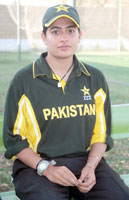 not promoted as much in the sport as compared to boys. Given society’s
expectations from women to be responsible and decent, Pakistani girls
are generally told by their mothers to play something more girly than
cricket, which is somehow 'larkon ka khel’, (a boys’ sport). Yet
passion wins over reason and girls continue smashing tube lights while
trying to score sixes in their backyards. Their brothers are luckier;
they have the privilege of aiming their balls to the sky on makeshift
pitches on roads and in stadiums.
not promoted as much in the sport as compared to boys. Given society’s
expectations from women to be responsible and decent, Pakistani girls
are generally told by their mothers to play something more girly than
cricket, which is somehow 'larkon ka khel’, (a boys’ sport). Yet
passion wins over reason and girls continue smashing tube lights while
trying to score sixes in their backyards. Their brothers are luckier;
they have the privilege of aiming their balls to the sky on makeshift
pitches on roads and in stadiums. Board (PCB) in 2005. Before that the team played at international level
under the International Women Cricket Council (IWCC) but never qualified
for the World Cup.
Board (PCB) in 2005. Before that the team played at international level
under the International Women Cricket Council (IWCC) but never qualified
for the World Cup.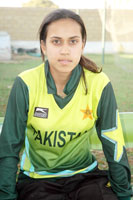 outstanding fielding and bowling throughout. However, the series
revealed the weak batting line and slow running between wickets.
"We need to work really hard on these areas to win the World
Cup," Batool admits.
outstanding fielding and bowling throughout. However, the series
revealed the weak batting line and slow running between wickets.
"We need to work really hard on these areas to win the World
Cup," Batool admits.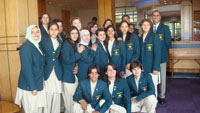 the performance of the women cricket team. Being with the team for two
years, she now serves as all rounder for the team and acknowledges that
her coaches and trainers are working really hard on them.
"Besides," she says, "we have complete access to National
Stadium."
the performance of the women cricket team. Being with the team for two
years, she now serves as all rounder for the team and acknowledges that
her coaches and trainers are working really hard on them.
"Besides," she says, "we have complete access to National
Stadium." Kolachi that cricket needs a high endurance level which is possible only
"after thorough practice." He says that since boys have
natural strength and they join academies when very young, they do
exceptionally well when they join the national team as compared to
girls. "Girls start working on their muscles only after getting in
to the national team," Umer says.
Kolachi that cricket needs a high endurance level which is possible only
"after thorough practice." He says that since boys have
natural strength and they join academies when very young, they do
exceptionally well when they join the national team as compared to
girls. "Girls start working on their muscles only after getting in
to the national team," Umer says. international matches," says the leg-spinning captain of the team,
Urooj Mumtaz.
international matches," says the leg-spinning captain of the team,
Urooj Mumtaz. cricketing stars. He says that steps have been taken to cater to
problems of the young women players.
cricketing stars. He says that steps have been taken to cater to
problems of the young women players.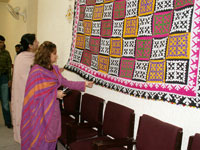 during these times of heavy inflation, they can still be targeted under
the pretext of honour killing. Yet there are women of substance who make
the best of opportunities available to them. A good number of women from
Sindh
during these times of heavy inflation, they can still be targeted under
the pretext of honour killing. Yet there are women of substance who make
the best of opportunities available to them. A good number of women from
Sindh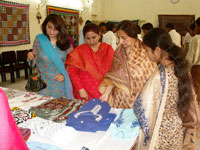 courses to learn these skills besides studying at IWDS; I think it’s a
very good thing that we are learning practical skills at the
institute."
courses to learn these skills besides studying at IWDS; I think it’s a
very good thing that we are learning practical skills at the
institute."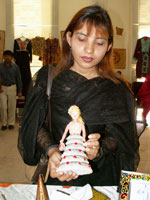 just gets easier," says Maryam Panhwar, an excellent glass painter.
 best place one can go to, to earn a living. I have a big family to
support and I want to do all I can for them.
best place one can go to, to earn a living. I have a big family to
support and I want to do all I can for them.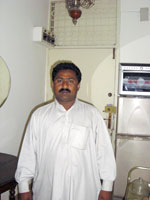 since I moved here.