



|
|
|
|
 |
 |
   |
The
way we were karachicharacter
city
calling Khushbakht Shujaat is still young in terms of political age, but has been elected to the National Assembly from NA-250 in Elections 2008. Her agenda for the constituency is based on providing basic education and vocational training for women . By Amina Baig When it comes to Karachi, Khushbakht Shujaat makes her stance very clear; "Karachi is Pakistan's heart and soul," she says, "if you seize Karachi, you seize all of Pakistan." Khushbakht
has entered the political arena with a one-point agenda: to serve the
people of Karachi. Being one of the 13 women to have won a place on the general seats in the National Assembly during elections, she has made a transition from television to education to politics over the years. She chose to contest elections against a seasoned politician instead of opting for the safer reserved for women seats. Khushbakht had in fact initially been nominated for a reserved seat but found she did not feel comfortable about it. "I felt that I didn't deserve that safe option," says Khushbakht, "I had joined the party a year and a half back, there are women who have worked for Muttahida Qaumi Movement (MQM) for years and have given the party their all, they have fought for the party and even gone to jail, if there is anyone who deserves a sure shot at being elected, it is these women." "When I filled
the form, I still didn't feel good about this decision, I had obviously
been given a ticket so early on in my career as the party expects a lot
from me," Khushbakht says, "so when Altaf Hussain bhai called
me and asked me if I want to contest for a general seat, I said yes
immediately, to Contesting these elections brought a whole new perspective to Khushbakht about the electioneering process and politics in Pakistan. She also learnt that the party she has chosen to work with is one she can admire for the concern it extends to it's workers. "When I was registering for elections, I ran into a lady from another party who was registering herself on a reserved seat," Khushbakht recalls, "when I asked her why she wasn't contesting on a general seat, she told me she couldn't afford the ticket, which she would have to pay for out of her own pocket." Khushbakht says she found this surprising. The lady in question had served her party for years and in Khushbakht's opinion, deserved to be paid for by her party, as all those contesting on MQM's behalf are. During her campaign, she sometimes would find herself facing a situation that would leave her feeling devastated. "There were times
when I would be sitting in a house when I would suddenly be hit by the
realization "Once, I went to a katchi abadi, and karkuns from my party told me that gas had just been installed in the area," she recollects, "they excitedly told me that they had been saving the announcement for me to make." Khushbakht recalls that she was close to tears when she heard this. "It seemed so unfair, to actually tell residents of an area that they had been given gas 60 years after the inception of their country and make it sound like an achievement. The women in that area had been cooking on makeshift wooden fires and most have developed lung and respiratory problems." It wasn't just people living in slum areas that Khushbakht aimed to help. Once she made the rounds all through her constituency, she realized that the other half of the constituency which resided in the Clifton, Defence and Sea View areas have their own set of issues that need to be addressed. "People who live in the southern part of the city, in areas such as Clifton or Defence are usually laughed off as 'burgers'," she says, "but one must realize a couple of things about them, a lot of them are self-made people who have worked hard and moved out of places like Lalu Khet etc., these are the kind of families where everyone contributes to the household income." "Yet," she
continues, "all of Karachi is plagued by the same problems and
living in an expensive area "Some of the largest commercial areas are situated in Clifton," Khushbakht says, "when there are gas, electricity or water issues, these commercial areas and consequently, the people who own shops here suffer. Similarly, when there are law and order breakdowns, these people will be affected too, whether it is by their businesses having to shut down till the situation picks up, or on a more personal level, for instance with the rising trend of children from well-to-do families being kidnapped or robberies in the house." These are all things that must be taken care of by the state, Khushbakht believes. What role does she foresee for herself in bringing these problems to the forefront? "We have laid the foundation for more work," says Khushbakht, "and hope that hurdles will not be created in the process to build upon this foundation." When asked what she and her party had in the pipeline for Karachi, Khushbakht does not reveal any concrete plans but mentions that, " things will become contained once proper policies are made; for instance, the city government which is made up of MQM at the moment has proposed that departments such as the police are placed under the nazim." According to her, as there is no cohesion between the city government and other departments, things on a basic level tend to go awry. "If the city government makes a bridge, the traffic police is not familiar with the engineering of the bridge and traffic tends to jam up because of this, but it does settle down in a couple of months," says Khushbakht, giving an example. "Once departments are centralized under the city government, then the nazim and the government can be accountable for any thing that goes off kilter in the city." Khushbakht points out that a lot of development work has been carried out in Karachi during MQM's tenure in the city government. "MQM has won more seats in these elections based on the performance of the nazims and councilors which had been elected from the party." But now, as MQM is refusing a coalition government in Karachi, there are sure to be some level of unrest in the city; would MQM not want to join hands with the ruling party if they have Karachi's best interests at heart? "MQM is still in discussion with the ruling party, we would like to work with the new government, but want to be given our dues in a dignified manner," Khushbakht tells Kolachi, "Altaf bhai had urged his workers from day one to maintain peace in the city, eager to promote goodwill between different parties." "When Benazir was returning to Karachi, anyone new to the city would have believed that Karachi is BB's city on October 18," says Khushbakht, "MQM facilitated the huge welcome the late leader received, to show MQM's support to other parties." Khushbakht shares that MQM leader, Altaf Hussain had also asked his workers to observe the election period peacefully. "Even when workers from other parties played foul during elections, MQM workers were asked to hold their peace," says Khushbakht. Whether MQM decides to oppose the current government, or work with it, Khushbakht knows exactly what she wants to accomplish during her tenure. She is largely interested in promoting education and economic independence for women while she serves in the National Assembly. "Firstly, I believe that women from destitute families should be encouraged to work so as to better living conditions for their families," Khushbakht says, "during my campaign when i visited different areas, i learnt that even when families in katchi abadis are starving, they will not let their daughters or wives work, as it becomes a question of pride for them." "This trend needs to be changed, women in Pakistan are very capable. I plan on aiding this process for them. Even if they have been unable to get an education, vocational centers in various areas can be set up to train them in skills which they can use to earn money." "Once a woman is economically independent, she reaches new levels of confidence," Khushbakht says, which will have set off positive changes in her own life and those that surround her. Khushbakht Shujaat has been running a school, Kids University, for the last 11 years and has new plans for the institute, as well as other schools. "I have just adopted a school in Lines Area," she tells Kolachi, "the idea is to provide resources for the school and manage it's affairs." "I have also planned to hold afternoon classes for the underprivileged in my own school, where teachers and senior students can volunteer as teachers; the latter will get credit for their services." Khushbakht says that women do not even need to teach at these schools, but if they have the money and the inclination to make a difference, they can adopt schools in various localities which will give the children living there a shot at getting proper education. She herself is planning on adopting another school soon. Khushbakht Shujaat describes herself as a doer. "I hope I will prove to be a good public servant," she says, "for the public that has elected me to the assembly." neighbourhood watch The colony by the canal Unlike other old neighbourhoods in Hyderabad, Phuleli Paretabad shines after the sun goes down and residents come out to enjoy the evening with their neighbours. By Adeel Pathan The narrow streets of Phuleli Paretabad come to life at night, bringing activity to the bank of Phuleli Canal that on which the neighbourhood rests. The fact that Phuleli Paretabad functions largely during the night sets it apart from other Hyderabad neighbourhood. The proximity of
Phuleli Paretabad to Phuleli Canal naturally led to early settlers
adopting farming and agriculture as their main profession. Though there
are no records available to determine when the Most people who live in Phuleli Paretabad work in mills and factories. A large number of also sell miscellaneous goods, earning their living by Others earn their bread and butter by cattle breeding and earn handsome amounts especially on Eid-ul-Azha. A large number of the residents is Urdu speaking . Marwari is the dominant language in the area after Urdu and then, Sindhi. There were about a dozen Hindu temples in Phuleli Paretabad, but now, as there aren't any Hindus in the area, locals have seized the opportunity to encroach on the temples or demolish them. Those temples that have been left alone, are in terrible condition. Despite being such an old settlement, Phuleli Paretabad still wants for basic facilities. This is largely because the local government ignores the area for most part. Small lanes and thoroughfares have only been constructed in Phuleli Paretabad recently. "There aren't enough houses to accommodate the entire population of Phuleli Paretabad," says one resident, "as most people living here belong to low-income brackets." Residents convene outside their houses in groups, sharing their day to day experiences and opinions. These sittings last late into the night, often bleeding into the next morning, till the working class of Phuleli Paretabad wakes up to a new day and goes about daily business as usual. Islamuddin, a resident
of Phuleli Paretabad loves the neighbourhood for the easy friendliness
that When Islamuddin returns home from his flower shop in the market area, he relaxes by chatting with his friends outside his house, which he says recharges him. There are many home-based industries located in the area, another thing that distinguishes the locality from other areas of the city. Tailoring, weaving and bangles industries are a few of the home-based industries in Phuleli Paretabad. As the neighbourhood is mostly populated by people belonging to low-income classes, large families occupy the same house. The population of Phuleli Paretabad is high; independent figures place the population at over 0.5 million, including adjoining areas. Though the inhabitants of Phuleli Paretabad can afford all kinds of transport, most people prefer to buy motorcycles; the narrow lanes of the neighbourhood cannot accommodate larger vehicles. Renting out motorcycles has also become a thriving business. Young people in the neighbourhood rent out motorcycles to ride in other areas of the city. A few tongas can also still be seen in Phuleli Paretabad, at it's famous tonga stand. Occasions, especially
religious occasions like Eid Milad-un-Nabi are celebrated with
enthusiasm in The people of Phuleli Paretabad celebrate national days with more zeal than is seen in any other part of Hyderabad. For instance, on Independence Day, the houses in the area, as well as the streets are lit up with lights. Another distinct aspect of Phuleli Paretabad is the biradri (clan) system. Many clans including Arain and Qureshi live in the area. People belonging to the same biradri live in closely clustered together houses, a factor that affects the electioneering process in a big way as well. Those contesting elections win according to which clan supports which candidate. Aqeel, a resident who lives with his clan in Phuleli Paretabad, admits that he feels living with one's clan is smart. "This way," says Aqeel, "there is no apprehension about the kind of neighbours one might end up with this way. Families tend to support each other thick and thin." The rate of crime at an average is high and residents of this locality lodge complaints of minor disputes and scuffles with concerned police for the settlement. A police officer who has been serving in the area for the last one and half years tells Kolachi that even women come to the police to settle petty disputes between their children over small issues, giving the police a chance to 'make' money from both parties. The former City Nazim of Hyderabad carried out some development work in this neglected locality of the city and constructed small, congested lanes. The present elected representatives are also carrying out development work including construction of parks and playgrounds provide a lively atmosphere to match the high-spirited residents of the area. Photos
by the writer The way we were Beatlemania Redux By Kaleem Omar Last month marked the forty-fourth anniversary of the Beatles' landing in New York on their first trip to the United States. Pandemonium ensued. Thousands of shrieking teenagers mobbed Idlewild (as Kennedy International Airport was then known) when the Beatles arrived on Pan Am Flight 101 from London on February 7. Thousands more laid siege to the swanky Plaza Hotel where the group was staying. Beatlemania had hit America. I remember the event as if it were yesterday, even though I was not much of a Beatles' fan in those days - having grown up listening to the music of Hank Williams, Frank Sinatra, Frankie Laine, Jo Stafford and Elvis Presley. To me, Julie London's haunting 1956 version of Cry Me a River meant more than any Beatles' song. I didn't like their voices. I didn't think they could sing. I didn't like their Merseyside accent or their mop-top antics. I would much rather have listened to Katerina Vallenti and folk singer Joan Baez any day. That, however, was before the music of the Beatles' later years changed everything. Was it that? Or could it be that distance always lends enchantment to every view - even in pop music? On February 9, 1964 the Beatles - fresh from their conquests of Britain and Europe - made their US TV debut on Ed Sullivan's CBS show. They played five songs that night, inside the same CBS studio in New York that talk show host David Letterman now inhabits. The songs were: All My Loving, Till There Was You, She Loves You, I Saw Her Standing There and I Want to Hold Your Hand. Five songs, performed (would you believe it?) for a measly $ 600 per player. Five songs, that is, at a time when most guests on the Sullivan show were lucky to get two. All those songs were original compositions, except for the second, a tune Paul McCartney liked from The Music Man. And that last number, their introductory single stateside, the one in which Bob Dylan thought they were singing "I get high," not "I can't hide" - it had just topped the US charts after entering at No. 45 only two weeks earlier. As Ben Wener writes in The Orange County Register, "That would kick off a year of unprecedented firsts - in this case, an unequaled four-month stay at No. 1, one hit bumping into another, to the point that during the first week of April 1964 they held the entire Top 5. Can't Buy Me Love came that week, too, racking up advance orders of nearly 2 million." Beatlemania had gone global. Looking at it now, it all seems so predetermined, as if it were something that was meant to be. After all, the phenomenon had spread like mad through Britain the year before, and the albums which would be reconfigured to form Meet the Beatles! and The Beatles' Second Album and Something New - all of which arrived in the US in 1964 - had become chart-toppers in Britain months earlier. Americans were merely catching up. And craving more, more, more. In Wener's words, "All that was required to open the floodgates in the US, launch the British Invasion and change not only the face of rock 'n' roll but ultimately mould popular culture the world over was one big push. A spark to start a wildfire." It came that February day four decades ago, when an estimated 73 million Americans tuned in to watch the Beatles on the Sullivan show. But that's not the real phenomenon. Nor is the Beatles' massively influential string of groundbreaking recordings the real phenomenon. Nor their personalities, looks or trend-setting sense of wit and style. No, as Wener notes, "the real phenomenon is that virtually everything about the Beatles, from the most important albums to the most trivial details, is every bit as prevalent today as it was 40 years ago. Though it's so commonplace now it's practically taken for granted, amazingly the Beatles' phenomenon keeps extending to each new generation." Indeed, their cultural domination today couldn't be more stupefyingly vast. In 1964, teenagers didn't spend their afternoons spinning dusty 78 rpm records of music that came 40 years earlier. Yet many teenagers today - not just in America and Britain but around the world - are as familiar with the Beatles' music as people of my generation. What's really astounding today is that, though there are more musical choices for young people than ever before, many still take to the Beatles first, as if their music had been created specifically for them. A rearranged retrospective like 1, composed of recordings that haven't been re-mastered in nearly 20 years, rocketed to the top of the charts. Tribute bands regularly pack them in at theatres around the world. American baby boomers and their grandchildren recently shelled out upward of $ 200 each to see Paul McCartney play sets consisting mostly of Beatles classics. McCartney's tour grossed close to $ 150 million in ticket sales - not bad for a singer now in his 60s. I Saw Her Standing There - One, two, three, FOH! - kicked off the Beatles' first UK album. Twist and Shout, the Beatles best cover song, was done at the end of the day they recorded their first album. They recorded 10 songs that day. Recording artists don't work that way any more - mostly because in a couple of years the Beatles did not work that way, either. Two songs in 10 hours, if they were lucky. Some of today's recording artists take months to record an album. She Loves You was the third song the Beatles sang at the beginning of Ed Sullivan's show before they went to a commercial. The viewing audience had to wait another 35 minutes before they heard from the Beatles again. The teens watching could hardly wait that long, and the parents weren't sure what to think - just as they hadn't been sure what to think when a gyrating Elvis Presley appeared on the Sullivan show in 1956 (shot only from the waist upward!) The Beatles won most of the Sullivan show audience over in the end. George Martin, the Beatles' producer, told them to start with the chorus and they convinced him the final Glenn Miller chord would work. Yeah, yeah, YEAH!!! All My Loving was the first song nearly 73 million Americans saw the Beatles perform on the show. The group was surprisingly loose and relaxed-looking for people about to take over the music world. McCartney added hoots and shouts to their songs. George Harrison walked over from sharing John Lennon's microphone to sharing McCartney's during his Buddy Holly/Carl Perkins-like guitar solo. Lennon's guitar triplets perfectly underpinned the whole song. I Want to Hold Your Hand was the one that started it all in the states, the Beatles' first US No. 1. The number just makes you want to dance. There is great guitar work by Harrison, and, as with all songs in the early Beatles canon, Ringo, on the drums, keeps it moving at a good pace. That, however, is not to say Ringo is a great drummer. For my money, he doesn't even begin to hold a candle to such legendary great drummers as Shelley Mann, Buddy Rich, Joe Morello and Gene Krupa. But they were all jazz drummers - and that, as they say down Okeefenokee way, is a whole different ball game. Joe Morello used to play with the Dave Brubeck jazz quartet. The quartet came to Pakistan in 1958 and performed at the Burt Institute in Lahore, where Morello's 20-minute drum-solo, Jazz in America, brought the house down. I know this for a fact because I was there. George Harrison is often considered a lesser Beatle, compared with the group's renowned song-writing duo, Lennon and McCartney. Yet when Harrison died two years ago, every major entertainment magazine in America and Britain featured his picture on the cover. As one American commentator noted, "The death of a Beatle is a very big deal." Some contrarians might argue that this awe must pass. It's easy to overstate the Beatles' importance, for it looms large in just about every aspect of pop culture. Yet for significant segments of the population, they're merely held in high regard. They aren't the only lasting influence from the past 50 years of popular music; Elvis Presley, aka "The King," is equally vital. That said, no one seems to vehemently dislike the Beatles. As the Rolling Stone Record Guide noted, "Not liking them is as perverse as not liking the sun." karachicharacter Buses and rickshaws and cabs, oh my! By Sabeen Jamil Irshad Bukhari serves as President for Karachi Transport Ittehad(KTI). An alliance of transport associations in 1990, KTI serves as a platform to resolve issues of transporters in Karachi. With Irshad Bukhari as it's first and only president ever, KTI is also transporters' face for the authorities. Born in Abbottabad in
1942, Irshad Bukhari moved to Karachi while he was in fifth grade. Kolachi: Why did you opt to enter the transporting business? Irshad: It was my family business. My family owned 10 buses when I decided to opt for this profession in the early '70s. Only big buses would ply on roads in those days and thus it was a very profitable business. A lot of educated people from varying ethnic backgrounds were in the business so I had no ego-related or financial reasons to back off from my family business.
Kolachi: Is this business still profitable? Irshad: Not at all!
Back in '70s the city used to be peaceful. There were no strikes and
Kolachi: How do you compare this business in Karachi to other cities in Pakistan? Irshad: Its very difficult being a transporter in Karachi. For instance if we compare it to Lahore, bus drivers there charge a fare of 12 rupees per 20 kilometers, which is profitable for them as compared to transporters in Karachi who charge just seven rupees. They feel secure while driving for there is no law and order problem there. Also they have a majority of people belonging to the same ethnicity, so transporters do not feel threatened. In Karachi, political anger is vented on transportation. Since we have people belonging to various ethnicities living here, transporters are affected if there is ethnic conflict.
Kolachi: How many public transport vehicles are there in Karachi? Irshad: There are almost more than a hundred thousand public vehicles plying on roads with 3500 big buses, 8000 mini-buses, 7000 coaches 25000 black taxis, 55000 rikshaws and 30000 yellow cabs. The city still needs a lot of public transport, especially big buses. We need at least 10,000 more big buses. The city Nazim Mustafa Kamal has promised help in this regard and we laud his efforts.
Kolachi: Why do transporters board male passenger on bus-roofs and in women compartments? Irshad: We never force people to sit on roofs. Actually there are not a lot of buses to cater to every one in the city. That's why commuters too do not mind boarding bus-roofs. Then the bus drivers themselves too tend to be greedy and board male passengers in to women's compartment where these men are equally responsible for they don't consider women's respect and barge into their compartments.
Kolachi: What are the issues of transporters on roads? Irshad: Strikes, riots, challans, broken roads, irritating passengers and bribery are some of the major issues transporters face on Karachi roads. Bribery to police is a major problem but the low pay of constables is a factor that leads them to ask for bribery.
Kolachi: how can transporters' issues in Karachi be resolved? Irshad: I think there should be a neutral body to resolve such issues. A centralized metropolitan transport authority having representatives from Police, traffic authorities, transporters and headed by some representative from city government with an authority to resolve issues of excise, permit etc. might be helpful.
Kolachi: Why is it that Pathans dominate the industry? Irshad: In the early '70s, the transport business had people from almost all ethnicities including Memon, Punjabi, Mohajir etc. But it was not a difficult business back then. Now with mini-buses and coaches plying on roads, it has become hard work. The owner himself has to drive the bus, sometimes work as a conductor and collect fare or even serve as a mechanic to save money. Now one needs to work up to 16 hours a day to earn a decent amount. Pakhtuns being strong and extremely hardworking easily survive all of this. Also, this profession is not considered respectable or for the educated anymore. That is the reason people do not opt for it. I myself did not encourage my children for this business and they now serve as software engineers and at other high positions in multi-national corporations.
Irshad Bukhari says that earlier there were a lot of incidents of forceful seizure of vehicles by political parties before and during their processions. However, he admits, that with the present government there has been a decline in such incidents. Irshad further says that while sitting among Pakhtun transporters, he always tells them that they are indebted to native Karachiites for they taught migrant ethnicities the modern culture, way of dressing and food. Graciously accepting others and allowing them to adapt as well, such is Karachi's character. -- The News photos
|
|
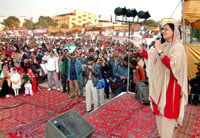 The only way Khushbakht says she could understand what "98 per
cent" people of Karachi need was by spending time with them in
their own environments. During her campaign, she visited various areas
which fell in her constituency, NA-250, which includes the Defence, Sea
View Saddar Town and Burns Road areas.
The only way Khushbakht says she could understand what "98 per
cent" people of Karachi need was by spending time with them in
their own environments. During her campaign, she visited various areas
which fell in her constituency, NA-250, which includes the Defence, Sea
View Saddar Town and Burns Road areas. contest elections and prove myself by winning is definitely something I
can make peace with!"
contest elections and prove myself by winning is definitely something I
can make peace with!" of what being elected would mean," Khushbakht says, "I would
be inside a tiny house in a katchi abadi, where there would be no
electricity, the cooking pots would be empty of food, but the women of
the house would be looking up at me, telling me they will vote for
me."
of what being elected would mean," Khushbakht says, "I would
be inside a tiny house in a katchi abadi, where there would be no
electricity, the cooking pots would be empty of food, but the women of
the house would be looking up at me, telling me they will vote for
me." means the cost of living is high as well. So while all of Karachi might
have water shortage, people in posh areas will buy themselves 10 000
rupees worth of water, but it isn't something they should have to do. On
top of the taxes that they pay, which katchi abadi residents don't, they
have added expenses due to the add-ons such as water or generators they
have to invest in."
means the cost of living is high as well. So while all of Karachi might
have water shortage, people in posh areas will buy themselves 10 000
rupees worth of water, but it isn't something they should have to do. On
top of the taxes that they pay, which katchi abadi residents don't, they
have added expenses due to the add-ons such as water or generators they
have to invest in."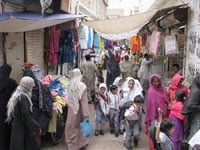 town came into being, long-time residents say that it was established
much before Pakistan was.
town came into being, long-time residents say that it was established
much before Pakistan was.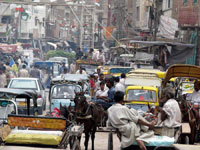 exists between neighbours. "Neighbours in Phuleli Paretabad care
about each other and stay in touch with each other," he says,
"this is something one doesn't see in other Hyderabad
neighbourhoods."
exists between neighbours. "Neighbours in Phuleli Paretabad care
about each other and stay in touch with each other," he says,
"this is something one doesn't see in other Hyderabad
neighbourhoods."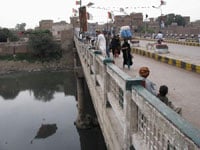 Phuleli Paretabad. Shopkeepers especially decorate main roads and lanes,
people from all over the city visit the area during the festivities, as
they did during the activity during elections this year.
Phuleli Paretabad. Shopkeepers especially decorate main roads and lanes,
people from all over the city visit the area during the festivities, as
they did during the activity during elections this year.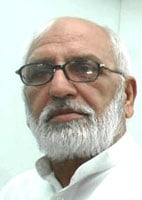 After having graduated from Islamia College Karachi, Irshad opted for
his family business of transport instead of pursuing studies. He became
a part of Karachi Bus Owner Association in 1978. Experienced in the
transport business as well as transporters leadership for three decades,
Irshad Bukhari has an educated insight in to traffic and transporters'
issues in Karachi.
After having graduated from Islamia College Karachi, Irshad opted for
his family business of transport instead of pursuing studies. He became
a part of Karachi Bus Owner Association in 1978. Experienced in the
transport business as well as transporters leadership for three decades,
Irshad Bukhari has an educated insight in to traffic and transporters'
issues in Karachi.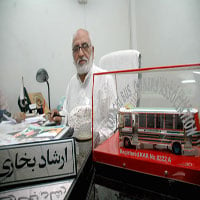 burning of vehicles then. Diesel was less expensive and therefore
profits were high. Now it's not only difficult driving on Karachi roads
because of frequent strikes and riots but it is not very profitable
either. On the one hand vehicles worth hundreds of thousands are burnt
to ashes in minutes and there isn't any compensation offered by the
government. On the other hand, as compared to the hike in diesel prices,
bus fares remain very low. As a matter of fact, last time we raised bus
fares was in 2005. However there has been a raise of 12 rupees per liter
in oil prices. And even then we are blamed of charging high fares, which
is unjust
burning of vehicles then. Diesel was less expensive and therefore
profits were high. Now it's not only difficult driving on Karachi roads
because of frequent strikes and riots but it is not very profitable
either. On the one hand vehicles worth hundreds of thousands are burnt
to ashes in minutes and there isn't any compensation offered by the
government. On the other hand, as compared to the hike in diesel prices,
bus fares remain very low. As a matter of fact, last time we raised bus
fares was in 2005. However there has been a raise of 12 rupees per liter
in oil prices. And even then we are blamed of charging high fares, which
is unjust