


|
|
|
|
 |
 |
  
|
issue performance
Views from outside Painting
the poet I am quite fascinated by a story I came across last weekend about a Liberal Democrat MP, who discovered that 'politics was in his genes'.
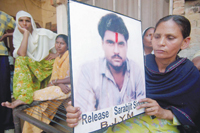
Waiting for a miracle Sarabjit Singh awaits execution amid pleas of mercy by human rights organisations, Indian government and his family
By Shahzada Irfan Ahmed The issue of the Indian national Sarabjit Singh awaiting
execution of the death sentence awarded to him has assumed great importance
and attracted immense media attention over the last couple of weeks. Tried on
charges of spying for India in Pakistan and involvement in a series of deadly
bomb blasts in Lahore, Faisalabad and Kasur in 1990 costing 14 lives, he is
languishing in a death cell of Kot Lakhpat Jail in Lahore. The date for his
hanging was initially set for April 1, 2008 but thanks to the everincreasing
pressure from human rights organistaions it has been deferred till April 30,
2008. Sarabjt, whose clemency appeal was rejected by President Musharraf on March 5, 2008, is waiting for some miracle to happen. Arrested back in 1990, he was charged and awarded death sentence by trial courts and the punishment was upheld by the Supreme Court of Pakistan. Pakistani authorities had stated at that time that Sarabjit had confessed to committing these crimes. His family, on the other hand, has repeatedly tried to defend him on grounds that it was simply a case of mistaken identity; he was not the person for whom the hunt was carried out. Sarabjit's lawyer in Lahore, Abdul Hameed Rana, had contended that confession, if any, had been extracted forcefully. President Musharraf was approached once all the legal
options had been exhausted. Initially, there were hopes that Sarabjit would
get some reprieve on humanitarian grounds or on the basis of a few
contentious issues pertaining to his case. Unfortunately things did not turn
out in his favour and a couple of unfavourable incidents at such crucial time
sealed his fate. The bid to procure pardon from the president received a setback when Kashmir Singh -- an Indian prisoner who was freed by Pakistan after spending 35 years in prison on charges of espionage -- confessed after reaching in India that he was a spy. Even more damaging was the case of Khalid Mehmood -- a Pakistani who had gone to India to watch a cricket match between India and Pakistan match at Mohali. Picked up by Indian authorities on charges of spying, he died in an Indian jail allegedly due to inhuman torture inflicted on him by the Indian authorities and his body was sent to Pakistan days after Kashmir Singh's release. It is quite natural that these incidents may have hardened the official mood in Pakistan, something that can hit Sarabjit's interest the most. The latest development is that the Indian government has made a formal appeal to Pakistan for mercy to Sarabjit Singh through their External Affairs Minister Pranab Mukherjee. At the same time Pakistan government has also acknowledged receiving it. Until now its functionaries were not ready to accept any formal efforts made by the Indian government to rescue Sarabjit. Brigadier (retd) Rao Abid Hamid of Human Rights Commission
of Pakistan (HRCP) tells TNS that his organisation along with the family of
Sarabjit Singh is making last ditch efforts to save him from the gallows. He
says Sarabjit's family is constantly in touch with him and finalising plans
to come to Pakistan and meet him. Rao also provides TNS with the copy of the
letter faxed by Sarabjit's sister Dalbir Kaur to the president of Pakistan on
March 18, 2008. According to the letter, Dalbir has sought permission from President Musharraf to come to Pakistan along with Sarabjit's two daughters which according to her would take at least two to three months. Dalbir has also offered to employ DNA test to prove that his brother whom Pakistan takes for some Manjit Singh is not the wanted man. Rao says his point is that even if Sarabjit cannot be freed his death sentenced should be commuted to life term. "After all he has spent 17 years in prison which is by no means a small period of time," he adds. The efforts for Sarbajit's release were renewed when President Musharraf pardoned UK national Mirza Tahir, convicted for murder and sentenced to death, even against the will of the family of the deceased, says an advocate of the Lahore High Court (LHC). On the condition of not being named, he says it is strange that none of the family members of those who died in 1990 blasts have appeared on the scene. It may be because they are not sure that Sarabjit was involved in those blasts. He also sites the example of Salim Shaukat, the main witness in the Lahore bombing in which his father was killed. He says Salim had retracted from his earlier statement in the court that it was Sarabjit whom he had seen at the site of the blast. He also admitted before the media that he had not seen the accused as he had fainted during the blast. The lawyer goes on to say that he strongly condemned the treatment meted out to late Khalid Mehmood. "But at the time I suggest that Pakistani government should press India to trace out the culprits and give them exemplary punishment. Reacting in a similar way is bound to increase the problems of the prisoners in both countries," he says. He suggests Pakistan should go for a prisoner swap with India in exchange for clemency to Sarabjit. The issue has become so sensitive that hardly anybody is ready to talk on it. Even the caretaker Human Rights Minister Ansar Burney who ensured Kashmir Singh's release has refused to intervene. His point is that being a proven terrorist, Sarabjit should not expect a treatment similar to that given to Kashmir Singh. But there are reports that he has talked to President Musharraf about commuting Sarabjit's death sentence to life term. In a newspaper article Pakistan People's Party (PPP) spokesperson Farhatullah Babar had also supported the idea of commuting the death sentence of Sarabjit back in 2005. When contacted for comments on the issue, he tells TNS that he cannot comment on the issue as well as his earlier article for the reason that he is writing another piece on Sarabjit's issue. Significant move The dance class passing out from Alhamra showed promise. What it now requires is resilience in transforming its interest into a profession
By Sarwat Ali The dance class which passed out recently at the Alhamra
held many surprises including one that dance classes were being held at the
Alhamra and that it has continued to do so with a degree of consistency,
despite immense pressure from certain quarters. Even during the very dark
days of Zia's regime kathak classes somehow survived. The fact that it was
tucked away in the basement may have helped but primarily it was the courage
and resilience of those who refused to buckle Dance has been totally neglected in Pakistan. In the absence of any full fledged institution, dance has struggled to survive in the shadows with the result that there has not emerged any significant movement or trend in this very vital form of art. It does not have a living tradition in Pakistan. Due to misconceptions and taboo the inheritance of a tradition has almost disappeared and it has only been reduced to either the folk variety that one sees, mostly performed by men, or the ones seen at the various shrines, exclusively performed by men. The other form of dance that has persisted has been in the films and of late the dance that one sees is in music videos. The classical tradition has suffered the most. And lack of reference has allowed dance to adopt a freewheeling approach which has not really had time to find a maturity of form for itself. Following a tradition has an advantage. It is conditioned by certain formal aspects and provides the discipline under which innovation can be made. In this age of globalisation the most difficult aspect is to bring into any kind of discipline and order all the various influences that one is subjected to all the time. Dance was probably the last major discipline to be taught at the Alhamra. The old building had a makeshift hall of about a 120 seats and it was used primarily for theatre productions especially after Faiz Ahmed Faiz became its secretary in the very late 1950s. There was a hut where art classes were held and occasionally an exhibition was put on display, and in the adjoining rooms Feroze Nizami and Khalid Anwer taught the shagirds the finer aspect of classical vocal music. While Sharif Khan toiled with his Veena and Sitar in an effort to pass on the intricacies of string instruments to the next generation. Dance classes started in the 1970s and Maharaj Ghulam Hussain Kathak took up the assignment with his usual flair. Naila Riaz was one of the first shagirds of the Maharaj and after his death had taken the responsibility of teaching the shagirds the finer aspects of kathak. Maharaj Ghulam Hussain Kathak too belonged to the Luchknow Gharana and somehow retained the original style which many in later generation found very fascinating and charming. Starting as a young enthusiast Naheed Siddiqui too had found her first ustad in Ghulam Hussain Kathak in Lahore. He gave her the formal training as he saw immense potential in the young woman. After her sojourn with Birju Maharaj in Kathak Kander at Delhi, her true potential found the right expression and style. She came out of that course as a complete exponent of the traditional kathak with the stamp of the Luckhnow ang visibly printed on her style. But the significant question to pose is: What is dance supposed to be and what are its perceived functions in society? In Pakistan dance by a woman has no other implication than its connection with base sensual pleasure as it is instantly allied to the dancing tradition of the salons. Since there has been no other avenue where dance is to be taken as a more serious artistic pursuit it has sunk deeper in the pool of crude hedonistic gratification. During the course of a century and a half of colonial rule, as dance in the temple and the court received dwindling patronage, it was transferred on to the stage. The most serious artists struggled to free the performance from the concept of those privately arranged mehfils at the homes of the rich and privileged, and preferred an institutionalised framework that liberated it from personalised patronage. Dance really had the most difficult of battles in justifying its place among the pantheon of the higher arts. It seems that both the classical tradition of music and dance have suffered an irreversible and irreparable loss. The other forms, some of which even defy definitions, have thrived while the established forms have really declined for lack of patronage. The question boils down to the taste of the people especially those who profess to patronise the arts. They have treated dance on the level where it has sunk to a very low level in this society. The shagirds Anjula, Raaniya, Mirrat, Uswa, Dumith Givnawardhana, Iqbal and Mashal as a part of the passing out ceremony performed the various parts of the kathak repertoire -- the salaami, the thumri, the tarana, the gats and moved on to the last part of pure dance -- tatkaar -- with subtle rhythmic variation on some taals. The division of the taals left everyone hopeful and reaffirmed the traditional view that the most important aspect in kathak is footwork Naila Riaz deserves to be saluted for her patience and truncated reward. Her biggest reward ultimately rests in her shagirds continuing with dance and developing it to the point that it reaches a higher threshold. Views from outside When artists present their subjects instead of living them
By Quddus Mirza Standing inside the gallery on Lahore's Mall Road, one
looks through the large window into the Anarkali market area. It is late
afternoon, and the bustle of bazaar is in full swing. Stalls of used
garments, plastic utensils and fruits line up most part of the street,
teenagers carry juice and milkshake to their customers, vendors trade in toys
made out of balloons, policemen stand on duty with their safety helmets and
almost scared faces, loafers ogle passers-by especially women, customers wait
for their mixed tea, beggars, junkies, bums and lunatics go their own way.
All of them constitute a typical urban landscape -- a world physically out of
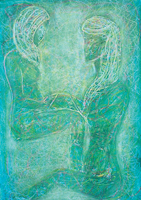
the gallery and clearly alien to the art circles of our society. Croweaters Gallery therefore offers a good opportunity to study the structure of our art world and its relationship with the general public. Though the distance between the works of art, artists, critics and viewers and the real life outside is not more than a few feet, it is a gap that appears unsurpassable. Yet one feels the two are connected at some level despite the big glass separating art activity from ordinary life. Artists who generally live most of their formative years trying to figure out their identity start detaching themselves from the world around them once they are recognised as artists. In most cases they assume a dream-like and mythological existence. Their interaction with real life becomes minimal. It culminates in becoming part of a social and special clique that is confined to openings at galleries, visits to artists' studios and homes or teaching at art institutions. Diverse activities indeed but all revolving within a limited circle Some artists choose to incorporate the world outside through painting people and their problems. In most cases the detached state of artist from the society manifests in a superficial 'representation' of ordinary people. Thus the exhibitions of water colour paintings of women from Tharparker and other areas of Sindh end up converting the dark, unkempt and poor nomadic women into objects of ideal beauty and idle lust. Not too dissimilar was the approach in the solo exhibition of Arjumand Faisal at the Croweaters Gallery, Lahore. A public health specialist by profession, Dr Arjumand has been painting for many years (proverbially -- since his childhood). In the recent exhibition, held between March 15 - 22, 2008, he showed oil pastels on paper. With a flowing hand, the artist drew female figures along with their male counterparts in jumbled up, swirling lines and subdued hues. The medium itself provided a blend of imagery and the background, to the extent that in some pieces, it was hard to detach bodies from the texture on the surface. But the delicacies of form and the details of technique apart, it was the subject matter that was obviously more important for the artist. He decided to paint the sex-workers during his research with them. The invitation card reads "Listening to their plight of helplessness and degradation Arjumand was painfully affected by their misery. Hence, Malka Aliya and Laila (MAL) series emerged." This explained the genesis of the term he has used to describe his subjects. Mal means commercial goods, but is actually the acronym of three women of easy virtue. It was an effort to increase awareness towards the conditions of prostitutes and improve the behaviour of our society, especially the males. Not only the theme but the intention as well reminded one of another artist, Iqbal Hussain. Although it is difficult to compare the two -- Iqbal Hussain enjoys a greater prestige, clientele and fame, both here and abroad -- it may still be useful to understand the difference in their attitudes and positions. Iqbal Hussian operates as an insider. Period. It is thus that his paintings, even if seemingly illustrative, exaggerated or repetitive, depict his 'connection' with the subject. He does not view them -- nor does he make us see them -- as embodiments of pity or objects of desire. He emphasises their human aspects. Hence his world is not of disgrace because he is not at a distance from his subject. Arjumand Faisal, on the other hand, adopts a humanitarian position -- a perfect choice in the medical profession though not particularly helpful in the realm of art. In the world of art, it assumes a condescending position, like a person who picks a subject because of its 'miserable' appeal and presents it to the public to evoke pity and sentimentality. A good cause is thus used for making art pieces, which are displayed in a commercial gallery, with a price tag. So in a way the works based on Mal -- commercial goods -- were Mal too, i.e. commodities for sale. This outsider's attitude was visible in another exhibition, opened the same day, but in another gallery -- Rohtas 2. Here installations and mixed media works by Qasim Riza Shaheen dealt with the issues of multiple identities -- related to ethnicity, religion and gender. The method of tackling these subjects (available especially after that fateful day of 9/11, which not only destroyed Twin Towers, but affected a lot of art practices!) and utilising it to create a convenient narrative suggested an outsider's approach, even though the artist belongs to the group of society called British Asian. The nature of his ideas and imagery affirm the artist's 'easy' choice in selecting an appropriate topic. Hence with his double pictures of father and granddad and bottles for eye lenses -- all of this supposedly insider's material -- his work did not move beyond being an exercise in fashionable visuals in predictable tones (the installation with white prayer caps and the footage of Qawwali being only one example). In that sense Shaheen's work was not so different from Arjumand's since both seemed to be 'presenting' their subjects instead of living them or being in them like Iqbal Hussain and several others.
Painting the poet Ghani Khan painted his surroundings in his own unique style
By Muhammad Sher Ali Khan Ghani Khan, the elder son of the legendary freedom fighter
and peaceful Abdul Ghaffar Khan (Bacha Khan), is well-known for his poetry in
the subcontinent. Among his contemporaries, he is regarded as one of the
greatest 20th century Pashto poet. He is equally lucid in prose, music, and
painting as well. Born in Charsadda in 1914, Abdul Ghani Khan got his early education in his native village in Azad High School, established by Bacha Khan and his friends for poor Pashtoon boys. After Matriculation from Peshawar, he left for England in 1929. From here his father sent him to Louisiana University in 1930 to study sugar technology. On return he joined Gola Gokarnath Sugar Mills, UP district. In 1934 he entered Shantiniketan School of Art. When Takht Bhai Sugar Mills was set up in 1940, he stayed for three years. In 1945, he decided to enter politics. He was imprisoned in 1947 and remained in various jails of the country till 1954. By then he left politics and devoted himself to art and literature. He died on March 15, 1996 in Peshawar and was buried in his ancestry graveyard in Uthmanzai. Ghani Khan enrolled in Tagore's Shantiniketan School of Art (Calcutta) where he studied painting with Rabindranath Tagore and Nand Lal Bose and sculpture with Ram Kinkar and Krishna Kirpalani for one year in 1934. He was keen in depicting images. According to his friend and cousin Jahanzeb Niaz, "Ghani Khan used to draw very clear and vivid pictures of his friends in his boyhood." He studied Impressionists, and other western painters and
sculptors, yet he painted his surroundings in a unique style entirely his own
and free from imitation which made his paintings different from other
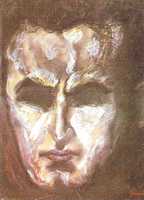
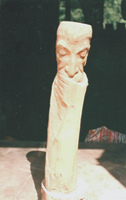
artists. Ghani Khan was a portrait artist. He only painted faces and sculpted heads of himself, friends and family. He also executed a few scenes from his imaginary world, portraying his poetic expressions. According to him, face is the most important part of human body as it reflects all the sentiments of man. He strived on expressions and opined that the most difficult task in painting is the expression of feelings through the human face. He argued that landscapes can be painted by any ordinary artist. Ghani Khan used to depict the images of people available to him any time. Thus he often posed for himself. Faridoon Khan, his only son and other family members were also caught on various occasions. One can see the human responses and attitudes in his various drawings and paintings. Ghani utilised his art, purely for the expression of his inner sense which is more visible in his visual art rather than his prose and poetry. This is why he did not remember the title and date of many of his paintings. He painted his feelings/emotions with dry crayons and watercolour in such a way that his images came alive. He worked with different techniques, such as oils, watercolours, and crayons, but preferred pastels through which he could transfer his "brief but intensive" inspirations in a short time. At times he mixed crayons with other mediums to produce tonal depths and textures. He worked quickly and deftly, with nervous, bold and free strokes. He applied complimentary colours alongside for intensity and luminosity. Often his tiny strokes of paint on dark and buff surfaces emphasised the bone structure and created highlight. Vibrant colours from free verse to close observation, dissolving into an image at a distance -- he painted the background in watercolour without mounting the paper on board which resulted in wrinkles in his paintings. His self portraits in gouache, crayons and mixed mediums, are dramatic in conception, as most of them have reduced to great simplicity. He created sensuous mouths. Sometimes he used Impressionist palate, such as 'Woman in Black'; whose features are exaggerated and the black surrounding has shades of purple and blues. Ghani's linear drawings can be considered as his best work. Though fewer in number but speak with greater clarity and force, and are full of movement. These are the drawings that reflect his maturity and a full command over line. While working he was not afraid of his strokes, nor did he feel they are faulty. Every line and stroke he sketched became a part of his drawing. Thus we can realise all movements of his hand almost in every artwork. He had a greater affinity to sculpture than to the two dimensional picture plane. During his early stay in Shantiniketan he developed a keen interest not only in painting but in sculpture. His early sculptures were in traditional academic style as apparent in the sculpture of Jan Nisar, Jahanzeb Niaz, and his father Bacha Khan. His sculptures, unlike his paintings, are more realistic in approach and he tried to capture the likeness of his models. If truth be told, "Ghani put tongue into the mouth of stone", writes Raza Hamdani. Mostly he sculpted in wood, but also modelled his subject in baked red clay, and plaster as well. Majority of his sculptures in wood are in Shantiniketan Museum, including the only full size sculpture of a prophet. He admired Rodin's sculptures; Michelangelo's David was superb to him. He also studied the paintings of Manet, Monet and Van Gogh. He appreciated Gauguin's colours. His works were exhibited at Abasin Arts Council, Peshawar in July 1970, and Lahore Art Gallery in February 1993. Some of his paintings are placed in National Art Galley, Islamabad and many in Ghani Dherai. For his contribution to Pashto literature and painting, in 1980 President Zia ul Haq conferred on him Sitara-e-Imtiaz. After his death, the NWFP government built a public library and a park as a memorial, known as "Ghani Dherai", the mound of Ghani.
Dear all, I am quite fascinated by a story I came across last weekend about a Liberal Democrat MP, who discovered that 'politics was in his genes'. The 45 year old Matthew Taylor, was taken away from his
birth mother few hours after his birth and given up for adoption. His adopted
father was a TV scriptwriter while his mother was a stage manager. His sister
went into the theatre as well, but Matthew Taylor chose to join the Lib Dems
and enter politics. About seven years ago he decided to trace his biological
family to find out more about them, and he discovered that not only was
politics a major part of his maternal lineage, but that his great
grandfather, Sir Percy Harris, had been a Lib Dem MP as well. Taylor's biological mother was also involved in local politics, something that none of his adoptive family had been inclined to. Taylor found this information somewhat overwhelming. "In that moment I felt everything I thought I knew about why I am who I am was turned upside now. In the battle between nature and nurture, nature seemed to be having a laugh." The whole question of nature vs nurture, or biology vs environment, or inherited traits vs upbringing is quite fascinating. Adopted children reunited with their birth mothers or siblings are amazed to see their own habits or mannerisms reflected back at them by people they have never met before. Similarly twins separated at an early age retain all sorts of similarities in behaviour and have almost instant recognition when confronted by each other. Matthew Taylor was astonished to discover that he had followed the aspirations of his biological family -- whose history he had not known -- and concluded that some things were just in one's blood. Of course the flip side of this conclusion -- that nature is stronger than nurture -- is rather depressing and all too often elitist. Would children descended from a murderer necessarily be inclined to murder whatever their upbringing is? Is violence a genetic tendency or is it a result of socio economic suffering? Is there a murder gene, a politics gene and perhaps even a Lib Dem gene? Food for thought really.... Incidentally I must record here a rather depressing encounter with a young Pakistani in London who had just finished his education and was about to embark upon a job in Finance. His pronouncements on the future of Pakistan were bleak enough (i.e. that nothing could ever change or improve in Pakistan), but what was worse was that he was unable to provide any reasons. First he accused Asma Jahangir of financial impropriety. Then he accused Asif Zardari of something similar. Then he accused various other people of various other things. Did he have any proof to back up any of these allegations? No, of course not. He tried to cite Wikipedia (I kid you not!), and then fall back on the 'everybody knows this' justification so often used by us Pakistanis... What was most depressing was that this 20-something-year-old had concluded that everything in Pakistan was rotten, and nothing anybody did could improve anything at all. Our other friends -- one a Human Rights activist from Sindh, and the other an incorruptible police officer from the interior -- were a little taken back by the young man's reading of the country and his absolute conviction that nothing could be done to effect positive social change, and they tried to impress upon him that there were in fact many people struggling for principles and progress, and the very existence of such people was an important factor in stemming evil by acknowledging and opposing it. What I found most disturbing though was the young man's absolute inability to examine any of the allegations he made before repeating them. Every statement was an articulation of prejudice and was repeated without any attempt at reflection or analysis. I hope he is not a good example of our young people, but I have a horrible suspicion that he might be... How can we encourage youngsters to think things out properly and be more precise in analysis and discernment? It is a question that needs to be addressed in general terms, both within families and communities. Best Wishes Umber Khairi
|
|


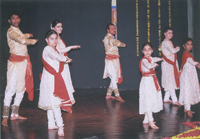 under pressure. The recently passed out students showed promise and now what
they require is the same resilience and courage to struggle against all
possible odds in transforming their interest into a profession.
under pressure. The recently passed out students showed promise and now what
they require is the same resilience and courage to struggle against all
possible odds in transforming their interest into a profession.