|
|
| |
Hotsteppers
of the week
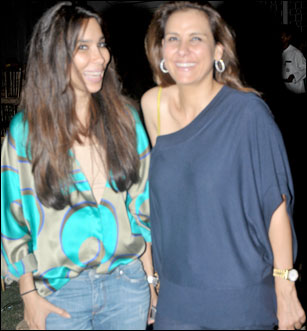
Sana Hashwani and Safinaz Muneer
|
| |
Come
summer and the word 'voile' brings on a deep sigh and a big
smile for women in Pakistan, for this is what a massive 51
per cent covets and hoards en masse. That's a huge number
and it justifies the droves of women who pile into exhibition
halls to stock up for the year. But while lawn prints come
a dime a dozen, there are some names that hold much more credibility
than others and Sana Safinaz would top that list. This is
their eleventh year in the voile business; they have worked
with Al-Karam, Firdous and finally Lakhany Textile Mills and
with every collection they have helped diversify the concept
of lawn in Pakistan. In fact Sana Safinaz have become so successful
as lawn designers that last year their prints sold out during
the exhibition and did not even make it to the market at large.
"We advised them (the mill owners) not to flood the market,"
Safinaz tells Instep. "It's good to be a little exclusive
and keep women yearning because when every woman ends up wearing
the same print (which is usually what happens with most brands)
then the print loses its value." |
 |
|
Sana
and Safinaz have had incredible vision in conceptualizing the progress
of voile in Pakistan and for that they are hotsteppers of the week.
Safinaz speaks to Instep about the lawn phenomenon and how it can
be furthered…
Instep:
As successful fashion designers, your forte has always been bridal,
trousseau and formal women's wear so how do you think your foray
into fabrics has benefitted your business? What are the basic advantages
of designing voile for the masses?
Safinaz:
Oh the benefits are tremendous. For one, designing lawn provides
the general public with the feel of designer wear. Whenever a designer
comes in, there is more thought process to the prints. They become
more artistic and in a way that changes the way all those women
who wear the shalwar kameez look. That translates tremendously well
because your name then is known by the masses as well. From a business
point of view, designing prints is lucrative to us because we have
been doing it for so long, otherwise it really doesn't have many
monetary benefits. We don't do lawn as a money making ploy.
|
| |
Instep:
How would you say this year's prints are different from the
previous?
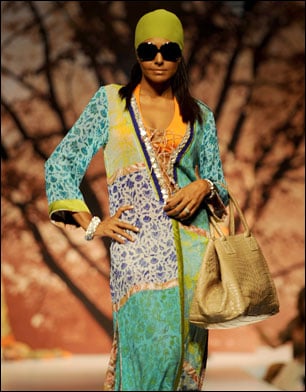
Safinaz: Basically we broke the market years ago when mills
were only putting out big prints in loud colours and combinations.
We brought in the softer pastels after which the trend caught
up and everyone started doing that. This year we have reverted
back to strong, monochrome tones. It's what is happening all
over the world. Then we were also the first to start embroidered
fabric, which everyone is doing now. We introduced the lace
number last year and will be repeating it this year as well.
But year after year we have been playing with the concept
of designer fabric, adding new concepts to it. Lace, I feel,
is a well received idea because it makes an ordinary outfit
a bit more formal. When it comes with the print, women are
saved from the hassle of matching etc and they pick up fabric
which is ready to be stylized. |
 |
|
Instep:
Don't you think that also restricts their individual creativity
in getting the fabric stitched according to their taste?
Safinaz: I think women just love that. They love the extra touches
of lace and embroidery. They look forward to designer expertise.
It doesn't constrict their individuality at all because they don't
exactly want to be hugely original. That is exactly why the prints
on the billboards or in the catalogues are the first to sell out.
We go to the extent of experimenting with our lawn shoots so that
women can borrow ideas on how to put their outfits together. When
they buy designer fabric, women are looking for designer vision.
Instep: You
are gradually bringing women closer to designer clothing by defining
the way the outfit should and will look. Do you see textile mills
getting into ready to wear voile clothing in the near future?
Safinaz: Only Gul Ahmad has managed to take fabric that one step
further into ready to wear, that too because they have a massive
infrastructure and they have their own retail outlets. Otherwise,
it's not a feasible idea. It is quite complicated. Plus the darzi
culture is huge in Pakistan and that's not going away any time soon.
51 per cent of Pakistan's women wear the shalwar kameez and they
love going to the tailor. There's plenty prêt, bridal and
diffusion happening already; the shalwar kameez is tailor galore.
Instep: Nevertheless,
your ready to wear collection has been much anticipated ever since
you showed at the Ensemble Avenue last year. When will you begin
stocking?
Safinaz: We're aiming for March 20, after which our ready to wear
will be available at six outlets: our studio in Karachi, Ensemble
Karachi, our studio in Lahore, Melange in Islamabad, Soiree and
Designer's Lounge in Dubai.
– Safinaz
was talking to Aamna Haider Isani
– The latest Sana Safinaz voile collection can be seen on
Style Section |
| |
|