|
|
| |
world
cinema
A Pakistani in Vesoul
A senior film critic from Pakistan attends the 15th Asian
Film Festival in Vesoul France and is bowled over by intimacy
of the event and the hospitality of the people
By Aijaz Gul
|
| |
 |
| |
NETPAC
had honoured me to head its jury for 15th Asian Film Festival Vesoul
in France from February 10-17, 2009. I got there on the eleventh.
The opening of the festival had taken place a day earlier on February
10 with Chants Des Mers Du Sud. The NETPAC jury was assigned to
evaluate nine Asian features.
The highly enjoyable train ride from Paris to Vesoul took a little
over three hours. A relaxing lunch, meeting my two other NETPAC
jury colleagues Cuneyt Cebenoyan from Turkey and Marie-Claire Kuo
(Quiquemelle) from France, and we were into the jury screenings.
Vesoul continues to remain a beautiful town with no traffic hassle
and no air-noise-pollution with snow-capped hills and it snowed
almost regularly during our week-long stay.
Why Vesoul ?
This was the fifteenth Asian film festival in Vesoul. The city has
been the venue for Asian Films because the festival management want
to continue enlightening the residents here with Asian films. Vesoul
is a small town with little population that was 19,000 in 1990.
And I didn't see an astronomical rise since just about every family
had one child. The city became part of France in 1618. Its inhabitants
are known as Vesuliens. The city has some beautiful historical buildings
including the 18th century St. George Church.
The city has over eighteen cinemas and now the new Multiplex with
five screens. The new multiplex, just slightly outside the main
town, where the festival screenings took place became the center
of attraction for everyone. Built as a pre-fabricate structure with
plush seats, digital sound and state-of-the art projection, restaurants
and cafeterias, the place was completed within a few months. The
residents of Vesoul are now flocking to the new site but some people
still prefer the traditional single screen theatres downtown. |
| |
 |
| |
I
also saw hundreds of school children visiting the multiplex with
their teachers. I was told that students have to write film previews
and reviews before and after watching the films as school assignments.
This is how you groom the children for film appreciation.
Vesoul has been holding Asian film festival for the last fifteen
years and it has a charm all its own. After all, Vesoul is a small
town away from the razzle dazzle of Paris and Cannes. The people
are friendly and the civic authorities are ready to sponsor this
event with delight and pleasure.
The films
All screenings took place in the new-stalled multiplex with five
screens. We began with Gulabi Talkies from India. Directed by Girish
Kasaravalli, the film deals with over the hill but skillful and
ironically childless, midwife, on a coastal fishing island in Karnataka.
Her real passion is watching movies and her dream come true when
she gets a color TV to watch movies, movies and more movies.
Tianmu Le Mirage directed by Zhou Hongbo from China was very ordinary
film about human relations and seclusion. Director Noh Young-seok's
Not Sool (Daytime Drinking) was a comical travelleague about a young
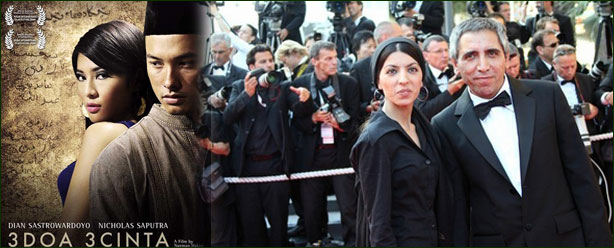
man on the road. The Indonesian entry 3 Doa 3 Cinta (3 Wishes 3
Loves) directed by Nurman Hakim, dealt with a challenging subject,
revolving around three friends facing a moral dilemma in an Islamic
seminary. The film 100 from Philippines, directed by Chris Martinez
was a slickly made film on terminally ill heroine who must complete
her 100 chores in a month and during these thirty days, for the
first time, she comes close to her mother. Podarak Stalinu (A Gift
For Stalin) directed by Roustem Abdrachev from Kazakhstan was a
charming yet tragic account of children and elders. It took us back
to 1949. The film brings us hope even when the going gets rough
and messy. Director Prassana Vithange's Akasa Kusum (Flowers in
the Sky) from Sri Lanka is a beautiful film about a retired film
actress whose forgotten past comes back with the dark secret of
grown up daughter who is now pregnant and dying of AIDS. The daughter
dies but the future is not bleak as the actress holds her baby granddaughter
in her trembling arms. This is the beginning of a new life. The
film was very slick with impressive direction and acting. And it
made me wonder that if Sri Lanka can do it, why can't we?
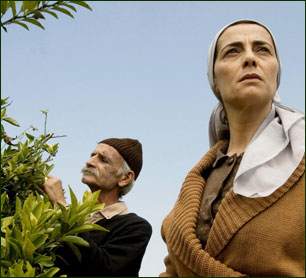
And now for the NETPAC Winner. L'aube Du Monde (Dawn of the World)
an Iraq-France co-production, directed with conviction by Iraqi-French
director Abbas Fahdel, was a moving experience. The entire film
running for 95 minutes has been filmed on location dealing with
the conflict in Iraq and its damages on people. The location is
the Mesopotamian marshes on the delta of two rivers in South of
Iraq. Two cousins grow up in the village and get married at a young
age. However before the marriage is consummated, the bridegroom
must leave for the battlefield where he is killed. Before dying,
he takes a promise from his friend that the friend would return
to his village and see his wife. The friend takes over from there
and returns to the village where he meets the bride, now a widow.
The jury was unanimous that the film portrayed the human sentiments
that come under fire during war with absolute courage and determination.
Director Abbas Fahdel works with competence on a subject, which
is both difficult and distant from box office-ridden formulas. |
| |
Vesoul
also paid a tribute to Iranian film maker Mohsin Makhmalbaf
and his two daughters, Samira and Hana. The entire family
was there with a body of remarkable film work including Salam
Cinema, Sekout (Silence), Kandahar, Abse Du-Pa (Two Legged
Horse) and Joy of Madness.
The NETPAC Certificate/ Diploma was awarded to Abbas Fahdel,
director of L'aube De Monde (Dawn of the World) in an impressive
closing ceremony.
The festival concluded with Tokyo Sonata. It was beautiful
film from Japan dealing with uncertainties of an urban nuclear
family in a financial crunch with a genius son who finally
triumphs with a piano performance. The film is directed by
Kiyoshi Kurosawa with passion and love. |
 |
|
Measuring
the success of Vesoul
It was estimated that there was an increase of 8.33 per cent in
audiences attending the festival this year, reaching over 26,000
filmgoers in seven days.
The festival was celebrating its 15th anniversary with a selection
of over 75 rare or unreleased films in France. The official competition
of feature films included eleven recent movies produced in 2008.
The aection Razzling Films showed classic and historical dramas
from Taiwan, China, Japan, India and Germany: Raining in the Mountain,
Hara-Kiri, Jodhaa Akbar and The Indian Tomb. There were also tributes
to French-speaking countries, Lebanese women film directors and
Japanese animation films.
Pakistan: Missing in action
Pakistan was missing from Vesoul this year. In fact, our only participation
in the past has been with Sabiha Sumar's Khamosh Paani. Our young
filmmakers working on digital format should make a point to participate
at Vesoul with short films, documentaries and docudramas. The festival
has even come up with a different technique of subtitling in French
where a small screen under the main screen is used and computerized
subtitles appear via a multi-media projection system. Film enthusiasts
here would be looking forward to Pakistan's participation in the
coming years.
It was now time to say goodbye. Some jury members and guests had
already left and some were about to leave now. As I boarded the
train for Paris, I was not parting with Vesoul. Vesoul will always
remain with me for the love, courtesy and unprecedented hospitality
showered by the Jean-Marc, his wife Martine, and the entire staff
of the film festival at Vesoul. |
| |
|