Artist: Devika
Album: Saari Raat ***
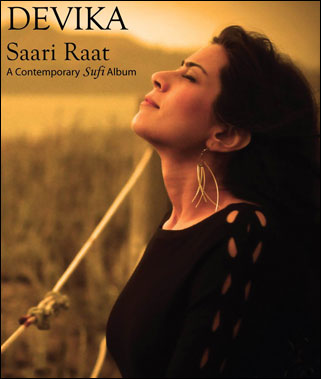 If
you are searching for traditional, Sufi inspired, lyrics and vocals
complemented by contemporary beats then Saari Raat by Devika might
strike the right chord. When this Indian singer/songwriter decided
to work with Pakistani producers (a rare occurrence), musicians
and lyricists, it became hard not to feel a certain sense of pride
and confidence in our music industry. If
you are searching for traditional, Sufi inspired, lyrics and vocals
complemented by contemporary beats then Saari Raat by Devika might
strike the right chord. When this Indian singer/songwriter decided
to work with Pakistani producers (a rare occurrence), musicians
and lyricists, it became hard not to feel a certain sense of pride
and confidence in our music industry.
After her self-titled debut album, this is the second time she has
worked with Shehzad Hasan. Better known as Shahi, the Vital Signs
bassist, his true talent is now seeping out through his production
work. Apart from mastering and producing countless local artists'
albums, Shahi's true genius is on display when Saari Raat is played
in its entirety.
Between arranging the music, composing and writing lyrics for several
tracks on the album, it is easy to see his hard work littered across
the album, with the exception of 'Andheri Lagan'. While he may have
an affinity for bass and drums, it is his arrangement and composition
of strings and percussion flowing with Devika's voice, which is
truly commendable.
The same can be said for Devika, whose understanding of the fusion
of Indian classical music and electronic music is manifest in the
seamless blend of melody with her controlled vocals, a result of
her apprenticeship under great gurus, such as Ustad Shafqat Ali
Khan and Ustad Sukhawat Ali Khan (sons of renowned Ustad Salamat
Ali Khan). The fact that her track 'Kehnde Ne Naina' featured on
a compilation of the hottest Sufi tracks, Teri Deewani, which included
the likes of Kailash Kher, Rabbi Shergill, A. R. Rehman, Rahat and
Nusrat Fateh Ali Khan, amongst others, puts her in good company.
She manages to navigate her voice well through the musical requirement
of each track, whilst eliciting emotions through a flurry of strings,
acoustic and electric, and the heavy bass, propped by the drums.
Her experimentation of switching between classical raags to a more
current style of singing is interesting as the music manages to
replicate that by adding traditional elements to the predominantly
modern production methods.
The order of tracks on the album are well organized as the rhythm
and foundation of the album remains consistent with light ebbs and
flows.
This is obvious from the opening track 'Barkha Baahar' which is
flawless in composition and music production. The tabla and drums,
like the darbuka and bass, are fused together to lend an eastern
soul to the western beats. The strings add an acoustic touch to
modern Sufi poetry.
The first two tracks, 'Barkha Bahar' and 'Saari Raat' play well
off each other as each complements the other with bass playing a
role in introducing the first track, and the strings taking over
for the second, which is the title, but not the best, track on the
album. Similarly 'Andheri Lagan' has much of the same feel as these
two.
'Unka Khayaal' and 'Kothay Uttay' are more mellow tracks, the former
actually having a downright eerie beginning as the third track on
the album. Supple strings coupled with the tablas are a result of
lighter composition for the former, at time purveying an eerie feeling
with some minimal production. Much of the same can be said for the
'Kothay Uttay' which has a more traditional feeling as the percussion
and strings harmonize with the lyrics to lend a more spiritual sense.
With the existence of mellow tracks there is a slight contrast with
two heavier tracks which use more electronic sounds, right down
to the heavy riffs of an electric guitar. While the heavy riffs
can be heard in 'Kyoon Nahi Aaye', the rest of the track seems to
have been made haphazardly, as at times the strings seem to misrepresent
the song. Though the friendly joust between the vocals and drums
is interesting, the constantly switching tempo makes it a bit of
a nuance to listen to.
'Rehna Tere Bina' is the other upbeat track on the album, whose
tempo almost deceives the lyrics at times. Also heavily produced
on the percussion end, the strings somewhat keep the song relevant
to the meaning.
Throughout the album however the listener gets a feel for good sound
production and gets an overdose of bass. This is where the last
track, the live version of 'Barkha Bahar' saves the talent on the
album. When the track is played we see that even without hours in
the studio and ample production work, Devika's voice is very soulful
and Shahi's composition sounds seamless.
The entire essence of the album and artist was to create a compilation
of tracks, which through the vocal performance, lyrics and music,
encompasses the pain and search for love in the real world, which
under Sufi context would be love for a divine eternal power.
While the vocals and lyrics manage to deliver that message, the
music simply provides a solid foundation instead of standing out.
Changes of tempo in a couple of songs and the relatively short length
of the album keep the music from getting monotonous, most of all
when a refreshing live track is heard at the end.
An expressive voice and pertinent lyrics, capable of carrying on
a tune with contemporary strings and percussion production, and
composition, is the selling point of the album. Unique as not many
have been able to successfully combine a traditional element with
an electronic one. If the production didn't rely on the bass as
much as it did in this album then a little more variation within
the tracks and album would have been a welcome one. However that
may change as Shahi continues to step out of the shadows of his
Vital Signs bass playing years and persists with production.
*****Get it NOW!
****Just get it
***Maybe maybe not
**Just download
the best song
*Forget that this was made
|