



|
|
|
|
 |
 |
  
|
adventure Fishful
thinking
adventure Exploring the waterfront and labyrinthine streets in Hydra, Greece, on none other than Christmas Day By Awais Manzur Sumra “Are you sure you will be able to go back today?”
asked the expressionless lady at the only souvenir shop we found open on the We shrugged and continued our search for that elusive souvenir that would adorn Zulfiqar’s mantel piece back in Karachi or impress his bosses or friends as a gift. We had arrived on the tiny, rocky, rustic island of Hydra, 35 nautical miles south of Athens, less than half an hour earlier aboard a hydrofoil, appropriately called ‘flying dolphin’. A row of cafés and restaurants welcomed us to Hydra. A handful of locals and a couple of tourists that had disembarked with us as the flying dolphin continued its onward journey to the island of Spetses, further south. It was Christmas Day, and having nothing worthwhile to do in Athens, we had planned a day trip to Hydra — an island I had heard much about over a period of three years. As a good host I had to make sure we experienced a bit of everything that Greece had to offer. Of course, no visit to Greece could be complete without experiencing one of its myriad islands. And so we found ourselves on Hydra for a day long trip. But we certainly did not wish to be stranded there on Christmas Day with hardly any place open to welcome us. “We are booked on the 3pm flying dolphin back to Athens and we don’t see why we won’t be able to go back,” I informed the lady as Zulfiqar finally selected a couple of magnetic souvenirs to take back with him. The lady replied, “The three-island cruise is due in
just under an hour. If it arrives that means weather is ok and you may be Later, as we meandered through the stepped streets and narrow alleyways leading to cool, leafy squares in the midst of Hydra town, we kept a watchful eye on the weather to detect any hint of deterioration that would potentially leave us stranded on a pretty but largely deserted island. Our hopes were raised as we ascended the low hill to the west of the town to have a closer look at a couple of windmills. A glistening dot in the vast expanse of water to the north caught our eye. By then the breeze had started to pick up and patches of darkish clouds had begun to appear over the rock-studded slopes to our right. The glistening dot grew in size inexorably and less than half an hour later a motley group of tourists streamed out on to the waterfront. The town sprang to life, a daily ritual no doubt in the off-season winter months, as shops and cafes opened their doors and shutters for some quick business. We resumed our exploration of Hydra. Hydra’s best sights are its myriad, imposing mansions, the works of 18th and 19th century Venetian and Genoese architects. Hydra Town, the only significant dwelling on the long and rocky, largely barren island, rises up a natural amphitheatre from the waterfront. The mansions, nationally recognised monuments, are well-preserved. They lie scattered in the midst of tightly packed red-tiled traditional houses on the two hills surrounding the waterfront. From her shop, the poker-faced lady had pointed out to us the important landmarks in the town. The waterfront is said to bustle with activity during summer months but, on that Christmas, only a couple of restaurants had opened before the cruise’s arrival, their proprietor’s serving coffee to the handful of locals and, no doubt, waiting for the cruise from Athens to bring some business. Immediately next to the port a few mules and donkeys —
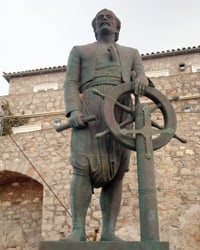
the only means of transport on the island — were being their usual To the right of the souvenir shop, a path led past an elegant mansion, now housing the Historical Archives Museum of Hydra, to a flight of stairs that ended at what once used to be a fortress that protected the harbour. At every five metres along the stone parapet a solid, heavy cannon lay pointing towards the sea. These cannons protected the entrance to the port in the action packed years of the early 19th century. Keeping a careful watch over them was the bronze statue of Admiral Miaoulis — perhaps the best known landmark of Hydra — with the Admiral wearing his military naval outfit and holding onto the wheel of a battleship. Above it, a couple of ragged flags fluttered in the strong, biting wind that blew out towards the sea. Admiral Andreas Vokos (1769 – 1835), better known as Miaoulis, was the commander of the Greek forces in their War of Independence in the early 19th century. At that time Hydra was a significant maritime power. It even trained the Ottoman navy, avoiding taxation in exchange. The island amassed tremendous wealth as a result. The mansions that dot the town are but one reminder of those prosperous times. It was thus a difficult decision for the islanders to join the War of Independence. But once they had made up their mind, it is estimated they contributed anywhere between 130 and 150 ships to the war effort and, under the command of Admiral Miaoulis, defeated the Ottoman fleet. That victory is now re-created in late June every year during the Miaoulis Festival. That victory, however, spelt the end of economic prosperity for Hydra for well over a century. The Hydraiots, having used up all their wealth in the struggle against the Ottomans, began abandoning their island. Almost forgotten for over a century, artists and intellectuals from Greece and abroad started re-discovering Hydra’s charms in the 1950s and began immortalising the island with their pens and paint brushes. We hurried back past the port, the donkeys and the rows of boats that bobbed up and down the harbour. Somewhere in the middle of the amphitheatre rose the impressive 17th century clock tower. An arched entrance beneath it led into the calm precincts of the monastery that now hosts the Byzantine Museum. In the forecourt of the monastery lay the grave of Lazaros Koutouriotis — one of the principal financial backers of the War of Independence who was subsequently appointed a senator by King Otto. Ignoring the offers by donkey owners for a ride, we preferred to utilise our own feet instead to explore the labyrinthine streets in the interior of the town. Cobblestone streets led past tidy, white-washed houses with bright yellow and blue doors and windows to quiet corners with locked taverns and sleeping cats. The bright yellow painted Lazaros Koudouriotis mansion, now a museum, hovered above all else. Accessible only through a steep flight of stone steps, it afforded a breathtaking view of the entire vista. Hours of traipsing left us yearning for a much-needed meal. Our only option was to leave the town’s secrets and return to the waterfront, at that time buzzing with tourists. As we delved into salad, tuna sandwich and chicken in lemon sauce at Sinialo, a queerly furnished American-style eatery, the cruise left and an eerie silence descended. For Hydraiots, that was it for the day. By then, the weather was indeed moving in and the sea was becoming rougher by the minute. We kept a watchful eye on our companions from the morning trip to the island as we waited for the flying dolphin to arrive from Spetses on its return journey. But, close to the departure time, there seemed no sign of the vessel. The sea and the sky had turned dark grey and, in the back of our minds, a Robinson Crusoe adventure beckoned. But we did not lose hope and again made our way up the steps and past the Admiral Miaoulis statue to the cannons for a better view of the sea. We looked impatiently for any dot in the open waters that could grow into our flying dolphin. Frustrating minutes passed. It was beyond departure time. Perhaps that lady, a local, knew better. But there was not much in our control, anyway. We stopped appreciating the scenic beauty, the changing natural colours around us. But then there it was, finally. A speck appeared in the grey vastness and gradually grew in size. It was our flying dolphin — the last of the day back to Athens. We hurried back to the port for our rescue. Gone are the days when people actually caught a 55kg Mahseer in the stony beds of Indus. It is the natural fish habitat that needs imminent preservation Few people would believe if told about a single Mahseer
fish catch as big as 55 kg, hooked in crystal clear stony beds of river Nature had blessed areas comprising modern day Pakistan, especially Punjab and Khyber Pakhtunkhawa with immense treasures of fish diversity. With an estimated area of eight million hectares as inland fresh water resources and around 180 species of fish including mahseer, carp, loaches and cat fish, potential for achieving food security was always immense. Inland fresh water sources covered a wide range of options ranging from cold, semi cold to warm river waters as well as streams, natural lakes, dhands and canals. But like several other promises unfulfilled, the natural fisheries sector in Pakistan also saw a quick decline due to a combination of natural and man made factors. Mahseer or king of freshwater fish reached near extinction in semi cold fresh waters of Indus to the extent of finding a place in IUCN red book. Frequent water shortages, construction of dams, dwindling river flows and human disturbances in Indus basin in northern Punjab and KPK, nearly brought several fish species to the verge of extinction in recent decades. As a matter of fact, degradation of fish habitat in fresh waters of Pakistan is part of the overall ecological devastation that has become more pronounced during the last twenty years or so. Rapid depletion of valuable high hills forests, mountainous scrub jungles, river bela and even irrigated tree plantations of plains is too well-known a phenomenon. Equally well-known are the sorrow tales about near disappearance of many migratory birds, water fowls, black buck as well as indigenous wild life varieties of reptiles and mammals. Much less known, though, is the plight of dozens of indigenous fish — the earliest variety of animal life in evolution saga — in our natural waters. While habitat destruction caused heavy damage to freshwater fish, human indiscretion also took heavy toll in speeding up this precious gift of nature down its extinction path. Closed season for fishing activities (critical for breeding) between June to August was audaciously violated. Excesses in shape of banned net mesh size for fishing and use of lethal explosives for killing fish in the name of sports was perpetrated. But reasons for protecting fresh water fish from total
extinction in Pakistan are far more serious than preserving a sporting The yawning gap of 5 KG per capita is readily translated in health challenges, especially in low income strata of society. In addition to feeding the less affluent, fish meat is also nature’s gift for health conscious with a desire to keep away from coronary diseases. An interesting comparison of meat prices in recent years by Punjab Fisheries Department indicates comparative stability and lower price ranges for fish during 2007-2010. Against an average price range of 250 to 450 rupees for goat meat and Rs120 to 190 for poultry, fish prices stayed between Rs80 to Rs150 for this period — something of good news for less affluent and health conscious. Apparently, the disturbing scenario in fisheries sector has been ameliorated to a considerable extent with several positive developments in recent years. Private sector has come in a big way to augment overall fish production in Pakistan. In the case of Punjab only, private fish farms presently exist over an area of 18260 hectares which was merely 491 hectares in early eighties. Similarly, share of private farms in overall annual fish production has witnessed a steady increase. From a negligible 610 metric tonnes in 1981-82, the share of private sector stood at 45650 metric tones out of total annual fish production of 86460 metric tones from all waters in 2009-10. Several enabling steps have been proposed to further boost fish production from private farms. These include provision of electricity on agricultural tariff, soft loans, provision of agricultural machinery on subsidized rates and extension services. Viable public private partnerships for fish processing and marketing can also boost the production and profitability in the sector. However, it is the natural fish habitat that needs imminent action in preservation for a host of reasons. Few pleasures can match the tranquil moments enjoyed by angling in natural waters when times come to a still. Providing fishing opportunities along our rivers and streams or water reservoirs can therefore be an excellent attraction for local tourism promotion. Winter visiting birds from north including geese, mallard and other water foul are largely dependent upon fish ecosystem during their centuries’ old migratory stopover in our wetlands. Communities of fishermen have historically lived on river banks along Indus and its tributaries. Fish in rivers and bela water provide these hardy people their staple food and their only livelihood. Days of crystal clear waters and big Mahseer may never come back in the face of increased water scarcity and burgeoning population. But protecting what little fish treasures are left in nature or promoting artificial fish farming is what we owe to our evolutionary partner of millennia. (The writer is a governance and environment expert and can be reached at rizwanmehboob@yahoo.com)
|
|
 island. I looked at my friend, Zulfiqar Shallwani, and both of us immediately
glanced outside at the calm, bluish waters of the Aegean Sea, ruffled now and
then by a slight breeze. Silhouette of distant mountains on the Peloponnese,
mainland Greece, appeared in the pale light spread around by the mid-day
mild-winter sun. “The weather does not seem to be encouraging,” the lady
cautioned.
island. I looked at my friend, Zulfiqar Shallwani, and both of us immediately
glanced outside at the calm, bluish waters of the Aegean Sea, ruffled now and
then by a slight breeze. Silhouette of distant mountains on the Peloponnese,
mainland Greece, appeared in the pale light spread around by the mid-day
mild-winter sun. “The weather does not seem to be encouraging,” the lady
cautioned.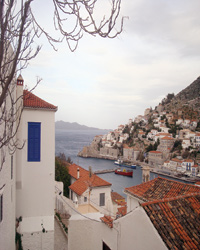 able to go. But let me inform you, all restaurants will close once the cruise
departs after a 90-minute stay. I will also close my shop. It is Christmas
Day, you know.”
able to go. But let me inform you, all restaurants will close once the cruise
departs after a 90-minute stay. I will also close my shop. It is Christmas
Day, you know.”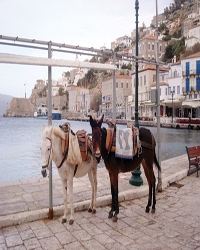 lazy self. One aspect that had attracted me to Hydra was its complete ban on
all motorised traffic — the only such Greek island. Donkeys and mules
charge €10 to transport tourists up from the port to their destination
hotel. On that day they were not finding many customers.
lazy self. One aspect that had attracted me to Hydra was its complete ban on
all motorised traffic — the only such Greek island. Donkeys and mules
charge €10 to transport tourists up from the port to their destination
hotel. On that day they were not finding many customers.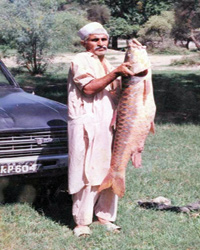 Indus, downstream of “Campbellpur” or modern day Attock. But that is how
the Gazetteer of Peshawar described the abundance of Indus Mahseer (Tor
macroplepis) as a prime sporting attraction for anglers in rivers Indus and
Kabul way back in 1880s.
Indus, downstream of “Campbellpur” or modern day Attock. But that is how
the Gazetteer of Peshawar described the abundance of Indus Mahseer (Tor
macroplepis) as a prime sporting attraction for anglers in rivers Indus and
Kabul way back in 1880s.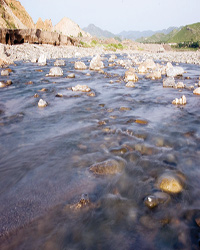 delight of unmatched proportions. FAO sources put animal protein requirements
for healthy humans at 11 KG per capita per annum. However, the present
availability from all sources does not exceed 6 KG per capita per annum in
Pakistan.
delight of unmatched proportions. FAO sources put animal protein requirements
for healthy humans at 11 KG per capita per annum. However, the present
availability from all sources does not exceed 6 KG per capita per annum in
Pakistan.