



|
|
|
|
 |
 |
|
trip Culture
in agriculture
My second trip to Chaman, the first being in 1993, the sights seemed to have changed little in the past 18 years By Salman Rashid Colonel Saifullah Khattak,
commanding the militia that oversees the border at Chaman, is an old friend.
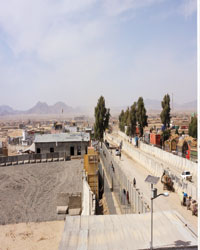
I should have asked him On the loose again after several weeks of work that wearies but keeps the bread buttered, I had ridden the foot plate from Quetta to Chaman. In railway parlance that means I rode in the engine. This was my second trip to Chaman, the first being in 1993, and both times I was fortunate to be permitted into the locomotive and as we trundled across the Balochistan landscape, the sights seemed to have changed little in the past 18 years. Only the evening before, when I casually mentioned to two other army friends in Quetta that I was on my way to Chaman, I was told of Saif. I asked them to call ahead and when I left the train at the Chaman railway station, there was a man with a sign: Maj (retd) Suleman. Though I successfully made lieutenant from captain after once having made captain long after even two years my juniors were promoted, I never made it to major. I just wasn’t the stuff. And sure enough, Punjabis and Pushtuns simply do not hear my name. It is always Suleman. Oddly enough, Baloch and Sindhis do not suffer from this hearing problem. Having breakfasted at 6:30am, I was famished now seven hours later. Saif called his man and ordered lunch: all sorts of meat dishes. I winced, but did not tell him that I had gone vegetarian two decades ago. Then he asked if I had ever been to the border. I hadn’t. “Let me take you to the border and we can order lunch from Spin Boldak in Afghanistan,” Saif said as he called for the man again to announce the change of plan. Food from Afghanistan without having to cross over would be a novelty and I happily succumbed to the projected orgy of meat-eating. But first we climbed up the
ancient ladder to view the scenery from the crenulated walls of the Chaman
militia fort. A few A lofty gatehouse emblazoned with the words ‘Friendship Gate’ flying three Pakistani flags and a giant image of Mr Jinnah marked the crossing. A marble plaque recorded that the gatehouse was built in 2008. Saif and another officer led me up the stairs to the observation rooms in the gatehouse. On the far side, a couple of dozen Pakistani lorries waited. Afghan Transit Trade, said Saif. The men and the buildings were the same, only they drove on the wrong side of the border. In the background we could see the houses and few trees of Spin Boldak where our lunch was coming from. Unlike our borders with Iran and India, there were no barbed wire fences; only a shallow ditch and a low wall of the earth turned up. There was no frenetic activity as I have seen on the three occasions I crossed into Afghanistan from Torkham. The mad hubbub of people scurrying back and forth with the border guards seeming not the mind them at Torkham, this was a rather quiet crossing. Only a few pre-teenage boys idly trundled their wheelbarrows this way and that. Older men with sacks on their shoulders too casually came and went. A beat up old Suzuki Mehran, that apparently refused to run, was being pushed across the border into Afghanistan. Another equally battered car of the same make and colour followed under its own steam. No one seemed to be checking them for export papers or anything else. No one seemed bothered. In this respect at least, things were quite like Torkham. Even as we reached Friendship Gate, I had noticed that the way through it was closed and barricaded. I presumed it being Friday; the officials were taking off for a post-prayer siesta. But then, everyone seemed very much at ease walking around the gatehouse. I must have looked confused and, smart of him, Saifullah solicited the information unasked. Since the Afghans did not accept the Durand Line, they refused to use the gateway preferring to cross over at any old place. That was sound Pushtun logic and the arrangement was respected by both sides. Witnessing this irregular set up at a regular, unrecognised border then was the highpoint of this visit. Since local people casually crossed the border, I asked Saif if I could hop over and grab a ride to Kandahar. Only if I was suicidal, said he. But if I came with a visa duly stamped in my passport, he could hook me up with a native Kandahar man who could be my guide. That would not be a bad idea. Moreover, from the walls of Chaman fort I had earlier seen the snow-capped peak of Khwaja Amran and Saif had mentioned the shrine on the summit. Having checked out some other mountain-top shrines, I was intrigued. Could this too be an ancient Dharti Mata shrine, converted to suit Muslim sensibilities? The next trip out then will be to climb Khwaja Amran before the snow melts and then cross the border to Kandahar. I know it will never be like Herat, a city to die for. But even dusty old Kandahar will, I am sure, be every bit worth it. Oh yes, the meat-eating orgy turned out just fine. After we were finished, I having polished off all the barbecued ribs that Saif piled on my plate, I told my friend how long I had been a vegetarian. But vegetarianism is something few Pushtuns approve of and Colonel Saifullah Khattak was suitably appalled. A 10-day
festival jolted Faisalabad back to life By Shahzada Irfan Ahmed The entertainment-starved citizens of Faisalabad had an experience of their lifetime this month when they were to host and entertain hordes of people pouring in from all parts of Punjab and beyond. Normally those amongst them
-- who can afford and there are many in this hub of textiles industry --
travel all the way to Their roles however reversed as the Golden Jubilee Festival held by the University of Agriculture, Faisalabad (UAF), on 50 years of its existence, offered endless entertainment to the visitors who thronged the place. To name a few there were horse and cattle shows, cultural shows, tent-pegging competitions, kisan mela, stalls exhibiting research in the fields of livestock and agriculture, kabaddi matches, fancy birds and animal shows, beauty contests among cattle, milk production competitions and what not. No doubt it was a nostalgic experience for a large number of visitors from Lahore. Their city had been host to Horse and Cattle and Industrial Exhibition shows for years at the strategically placed Fortress Stadium in cantonment area. Disbanded in Lahore for security reasons this show was held in Faisalabad, quite ironically less than a week after a major terrorist car bomb attack had rocked the city. “There was a lot of pressure on us and people were sceptical about the security situation. But we took up the challenge and made the event a roaring success,” says Dr Jalal Arif, UAF Media Director. He says every teacher, student and other employee of the university formed part of the security apparatus and extended a helping hand to the personnel of law enforcement authorities deployed in the vicinity. While the conversation is
going on, Zain Shahid, a fifth-grader at a local school, intervenes and
points to a nearby crowded And the venue was a display point for fancy/ornamental-imported birds including pheasants, expensive pigeons, rare breeds of peacocks, and the most-viewed miniature house. The cheerful Zain, who took on himself the role of a guide, had come here for the third consecutive day, mainly to have a complimentary ride on this horse. “These fully-grown horses may have an average height between two to two-and-a-half feet and may cost between three to five lakhs,” says Mian Naveed-ur-Rehman, the representative of Lyallpur Fancy Birds Society. He tells the miniature horse brought to the event belongs to a large textile group, which breeds them at its farms. “None of the species present here is for sale,” he says. The display has been put up on the request of the university to add colour to the event. Naveed says the Wild Life Department officials worry them needlessly particularly during the inland movement of these species. “We have asked the university to endorse us to avoid this irritation as we may move these birds to other parts of the country for research purposes. If this does not happen the society may refuse to display these birds next time the university requests us to do so, he says. “The wildlife officials must go after those who are destroying biodiversity of the country. By importing new species we are in fact adding to it and must be honoured for that.” Tent-pegging and kabaddi contests were the biggest attraction as many watchers gathered on the field, pavilions, boundary walls and some were even hanging by the trees. Every time a rider on the back of a darting horse succeeded in piercing and carrying away a ground target, with the help of a lance, there was deafening roar emanating from all around. Last but not the least was the beauty contest amongst various genres of cattle. None of the participants was less than those seen near Eid-ul-Azha carrying price tags worth hundreds of thousands of rupees per head. It was a treat to watch breeders parading their animals in front of judges and calling them with names like Sapna, Jamalo, Maharani and Lado. Surprisingly weight and size were not the criteria for success. Those boasting symmetric bodies, shiny skins, attractive gaits and postures and mastani akh (enchanting eyes), walked away with prizes while the overweight lot was disqualified right away. “Eh meri dhee aye, koi ehnu dangar naa samjhay (She’s my daughter and no one should take it as a cattle),” were the words of a proud owner that made every attendant of the prize distribution ceremony laugh.
|
|
 what Boldak meant, but it slipped my mind. Now, spin is white in Pushto. So
what is a white Boldak? As a native Pushto speaker, Saif should have been
able to answer the question.
what Boldak meant, but it slipped my mind. Now, spin is white in Pushto. So
what is a white Boldak? As a native Pushto speaker, Saif should have been
able to answer the question.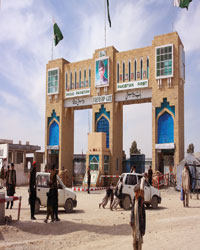 kilometres to the westward, a cloud of dust marked some activity. That was
the border crossing on the Durand Line as marked out by McMahon and his team
in the closing years of the 19th century. My interest lay in the numbered
border posts that carry on along this line. However, Saif said there were
none of those old posts remaining.
kilometres to the westward, a cloud of dust marked some activity. That was
the border crossing on the Durand Line as marked out by McMahon and his team
in the closing years of the 19th century. My interest lay in the numbered
border posts that carry on along this line. However, Saif said there were
none of those old posts remaining.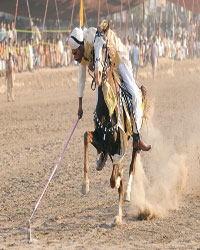 Lahore on weekends. Here they incite their taste buds at the finest food
outlets, watch some blockbuster at a newly set-up cinema and take their kids
to playgrounds, joy and fun lands and local versions of theme parks before
finally returning to their city.
Lahore on weekends. Here they incite their taste buds at the finest food
outlets, watch some blockbuster at a newly set-up cinema and take their kids
to playgrounds, joy and fun lands and local versions of theme parks before
finally returning to their city.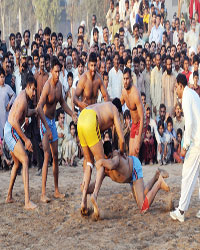 garden saying, “That’s the place where real action is taking place….
you must not miss it!” He was absolutely right.
garden saying, “That’s the place where real action is taking place….
you must not miss it!” He was absolutely right.