


|
|
|
|
 |
 |
  |
politics A
life well-captured Yeh
Woh elections Sceptic’s
Diary Opaque
transparency
politics The Pakistan
Peoples Party (PPP) leadership is in a difficult position as residents of its
stronghold Lyari have come under the hold of criminals, operating under the
flag of Peoples Amn Committee (PAC), supported by the PPP itself. “Yes, it is the PPP which
created the Amn Committee and imposed criminals on Lyari and handed them over
the entire neighbourhood to rule. Now it is up to the PPP to decide how it
deals with the situation, because the residents are feeling hostage to the
situation for the last three consecutive years and want a sigh of relief,”
said Abdul Rauf, a political analyst who was born and grew in the
neighborhood. Lyari, the home of
multi-ethnic groups like Baloch, Kachhi, Niazi, Punjabis, Sindhis, Pakhtuns,
Gujratis, Marvaris, Brahivis and others, at this juncture, seems divided
between Baloch and non-Baloch communities. Or at least that is how the locals
see it. Because the PAC mostly led by the Baloch exercises control over other
non-Baloch populated areas by force. Only the Kachhi community is showing
some resistance. “If the PPP continues its
support to the PAC, it will lose votes of non-Baloch and even some Baloch
people who feel insecure and unhappy about the criminal elements. Despite
being loyal to the PPP, they want to get rid of these criminals,” Rauf
said. Information gathered
through background talks with local people reveals that the PPP has put the
residents of the old neighbourhood at the mercy of criminals. These gangsters
enter the corridors of other ethnic group neighbourhoods for getting
“safety money” forcefully and deprive them of their businesses.
Presently, these people are seeing no option better than to shift to other
areas or show resistance for survival. In the face of this power
exercised by the PAC, they may decide not to vote for the PPP-nominated
candidates. About former legislators,
Nabil Gabol and others, local activists say they shifted to outside areas and
never turned back to see their voters. It is the PAC that is dealing with all
matters, including development work announced by the government. Since the legislators were
conspicuous by their absence, people had exhibited banners at different
places inscribed with messages like “We are looking for Talash-e-gumshuda
(missing persons).” They named legislators, including Gabol. “We will pay
a certain amount to whoever brings them to us,” the banner read. This
showed how these legislators served their voters. Nabil Gabol had once
confessed that when he was given the portfolio of the minister for ports and
shipping in 2008, administrative barriers prevented him from getting any
development projects for his constituency. In reaction, he tendered his
resignation within three months; saying why should he be in office when he is
unable to do anything for the people of his constituency? He accused the PPP
leadership of sidelining him and giving powers to the PAC to oversee
everything in Lyari. Elders of the old
neighbourhood of Karachi still recall the happy moments when Benazir Bhutto
after tying the knot with Asif Zardari had come to the famous Kakri Ground in
Lyari, instead of her home town Garhi Khuda Bakhsh, for her wedding
reception. But then the same people
realise that even the PPP Chairman Bilawal Bhutto Zardari himself could not
visit his political ancestors in Lyari and postponed his scheduled visit to
the area some time in 2011 due to the worsening law and order situation. It
was a challenge for the top leadership of the party which, after a long time,
realised the gravity of the situation and assigned a task to Nabil Gabol to
design a strategy for restoring peace to Lyari.
Gabol, being a traditional
person, initiated meetings with the leaders of old jamaats (welfare
organisations). He distributed 500 rickshaws among the unemployed youth of
the area, so that they could have a source of living. He supported 15 jamaats -
which represent Baloch, Kachhi, Lasi and other communities — by donating
buses; each of these buses cost Rs7 million, releasing small grants to run
their welfare schemes on their own. But again the situation
changed drastically and Gabol himself was abused publicly by the Lyari people
in early 2012. Since then, he has never entered his constituency again. Yet,
he continued patronising the Kachi Rabita Committee (KRC) and rivals of PAC. A few months ago, he
started a series of meetings to mobilise his own tribespeople in Malir and
other suburban areas of Karachi. Apparently, he was under pressure from the
party high command. However, he was waiting for
the day and just after the killing of Arshad Pappu, the notorious gangster
from the leading PAC rival group, Gabol switched his loyalties and joined the
MQM. The perception of Lyariites
is that both Gabol and MQM were struggling for the last few years to end the
Peoples Amn Committee. Arshad Pappu had been enjoying the backing of the MQM
for the same cause, they think. There are possibilities
that Gabol may get the MQM ticket to contest elections from the Malir
neighbourhood, where two parliamentarians Abdul Hakim Baloch and Haji Shafi
Jamot have already left the PPP and joined PML-N. Gabol’s departure is a
huge setback for the PPP which has already experienced declining votes in the
past elections. Senior PPP activists think Gabol has acted disloyal to the
party. Sher Mohammed Rais, the
head of committee dealing with the 450-bed Lyari General Hospital, says the
health facility is running without facilities and availability of senior
doctors. He could not tell the exact reason, but accuses the government of
negligence. But obviously the medical staff is reluctant to work in Lyari
General Hospital because of law and order situation. At least 5000 local
patients visit daily at the OPD of this hospital. Originally, Lyari being a
locality of workers, contributed workforce to the city ports, markets,
factories, harbour and construction industry (they are hard and efficient
workers who mostly work on daily wages). But then the most dedicated workers
faced deaths and discrimination in the job and labour markets, and moving
out. As a result, a large number of workers preferred to stay idle at home,
as their parents did not allow them to go out. Lyari has been the home of
politically-aware people. It has produced world-famed sportsmen, footballers,
boxers and cyclists. It is the only town, out of a total of 18 in the city,
which has more than 20 libraries and reading rooms, situated in different
neighbourhoods to develop the capacity of youth and promote literary and
cultural activities. In the movement for
restoration of democracy (MRD) in the 1980s, Lyari used to stay awake all
night with political activists, writers, intellectuals and artistes engaged
in heated discussions to find a way to strengthen democracy or bring real
change. During the martial law, almost all the political parties comprising
all ethnicities used to organise public meetings in Lyari, considering it a
safe place in the mega city of Karachi where they could engage in political
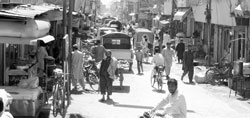
activity. Gradually, tension has
gripped this politically aware neighbourhood and horrible incidents took
place, pushing the artistes performing famous Lewa dance with crowds of men
and women in the streets to disappear. Of late, Lyari has become a ghost
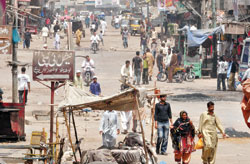
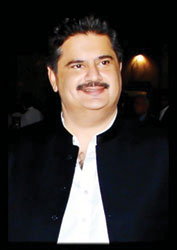
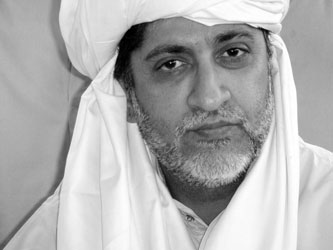
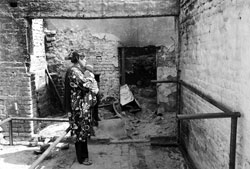
neighborhood where everybody wants to move to another place for security. caption Estranged Nabil Gabol. caption Disturbed insecure Lyari.
Just a few hours
before he was set to meet his friends for his 104th birthday celebrations at
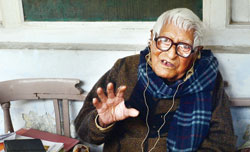
the Cosmopolitan Club, Faustin Elmer Chaudhry passed away quietly in his son
Cecil Chaudhry’s house, on Friday, March 15, 2013. A legendary figure in photo
journalism of Pakistan, F.E. Chaudhry was born in 1909 to a Christian Rajput
family in Saharanpur, India. His family moved to Jhelum, when Faustin was a
young boy and he had his early education at Mission High School Dalwal,
Jhelum. He came to Lahore to study at F.C. College (presently FCC
University), Lahore. Photography was his first
love, which he picked up as a hobby in those days when photography was a
skilled man’s job and opportunities for practicing photography as a
profession were few. In 1934, he started as a science teacher at St
Anthony’s High School Lahore while trying to find work as a freelance
photographer. His first break came a year
later, when one of his photographs was carried in the Civil and Military
Gazette, a leading English daily. Since photojournalism was yet to become an
important part of reporting, there were no photographers on the reporting
staff. Generally, the demand for newsworthy photographs was met by
freelancers, and FEC was one of them. In a few years, his
photographs began to appear in the Illustrated Weekly of India, Statesman,
and other papers. After the creation of Pakistan, FEC joined the Pakistan
Times, as a news reporter/photo journalist in 1949 and remained associated
with it until his retirement in 1973. He worked with all the leading editors
such as Faiz, Mazhar Ali Khan, Z.A. Suleri and K M Asaf. He also emerged as a noted
and respected leader of journalists trade unions like PUJ and PFUJ as well as
became a founder of the Lahore Press Club. He documented the entire
trade union movement in Pakistan, including activities led by Minhaj Barna.
He was secular to a fault — people belonging to all faiths had a
place under his large canopy of peace and affection. At the same time he
demanded full citizenship rights for himself and the entire Christian
community. After his retirement at the
age of 60, he never worked again; occasionally freelancing, he lived on to
spend his life championing the rights of the communities. For his
longstanding services, F.E. Chaudhry was awarded Tamgha-e-Khidmat in 1970,
Pride of Performance in 1987 and Tehrik-e-Pakistan Gold Medal in 1992. F.E. trained generations of
photographers, who carry on the legacy of their legendary mentor. With a prodigious memory
and an abiding affection for journalists, F.E. Chaudhry was known as Chacha
in the journalist community. What set F.E. apart from his peers, many of them
doing studio photography, was that as part of news reporting staff, he had
the professional obligation to photograph a diverse range of subjects in
especially outdoor photography. The challenges of news
reporting demanded profound knowledge of light and movement which he
demonstrated through his portfolio of pictures with remarkable effect. He
pioneered sports and action photography, pictorial and artistic studies of
birds and animals in photojournalism, photographs of natural and cultural
scenes, and much more, all of which is yet to be documented in the history of
photo journalism. Chaudhry would take a
number of photographs, out of which probably one was selected by the editors
to appear in the press. A large number of such photographs, with huge
documentary and photographic value, were never viewed by the public, as they
lay buried in private collections and archives. For instance, in the wake of
the 1950 floods in the Punjab, when the city of Lahore was the worst hit, FEC
took a series of photographs to document the plight of flood victims that can
be used to tell a visual short story. Consider the photograph of one such
family, taking refugee in a railway bogey which serves as a kitchen as well
as shelter from the blistering heat, as a prime example of the narrative
photography of F.E. The quality of F.E’s
photograph lies precisely in each character in the photograph telling its own
story without compromising on the overall composition and the melancholic
effect of the image. As a visual chronicler of
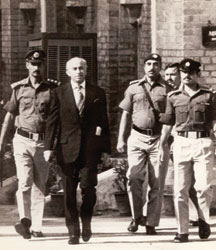
his times, he was witness to the annals of history. He took numerous
photographs of the late prime minister Zulfikar Ali Bhutto Bhutto’s court
appearance during his trial in the Lahore Hight Court, which capture a dark
period in the history of democracy in Pakistan. In those pictures, Bhutto’s
sense of defiance is reflected through his choice of clothes and his clean
shaven appearances. He always dressed in his best, to demonstrate his
unbroken spirit. Wearing a white shirt, matching tie on a business suit, he
walked elegantly in and out of the court while the police escorts followed,
keeping a respectful distance as if led by Bhutto to a state function. F.E.Chaudhry most fondly
remembered one of the last photographs of Bhutto, which he discreetly took on
the day when he was announced a death sentence by the Lahore Hight Court in
1978. He was adept in record
keeping as he kept most of the photographs that he had taken during his life
along with the negatives, at his house on Jail Road, carefully labelled and
arranged in a chronological order. Despite decades of neglect from the state,
media and academia to document, exhibit and publish his works, his collection
of photography comprised his old cameras, newspaper clippings, photographs
and his late wife’s huge collection of dolls and matchboxes. The National College of
Arts Archives made a modest attempt in preserving and exhibiting his
collection in 2004-6. Sadly, much needs to be done to perpetuate his legacy
and acknowledge his contributions to the field of photography and
photojournalism. His collection has scattered in many hands. A journalistic
rendering of F.E’s interviews is all that remains of the man, who has been
hailed by the journalist community as the Father of Photojournalism in
Pakistan. This is what needs to be
redressed. The contributions of the legendary photographer, who was also a
champion of inter faith harmony ought to be properly celebrated by collecting
all his works at one place for documentation, exhibition and publication. The writer is Director NCA
Rawalpindi who had the unique honour of documenting F.E. Chaudhry’s
photographs in 2004-2006 as head of NCA’s Archives Deparment. He can be
reached at director@nca.edu.pk caption Z.A. Bhutto coming out of
court. — Photo by F.E. Chaudhry
King of the jungle
came under attack from a pack of conniving hyenas when he went out in the
morning to relieve himself. The lion stood his ground and roared his
authority all he could but hyenas called his bluff by laughing in his face.
They knew he was alone and vulnerable. A monkey who was a loyal
subject of the king, happened to be brushing his teeth with a twig, sitting
on his high perch in a tree. Lion put two toes under his tongue and whistled
to get his attention: “distract them in some way so I can launch a counter
attack”. Monkey was moved. He was only a small animal who was considered
grotesque in appearance and taunted for being human-like, and he was just
given the honour of a direct address by the king, and that too an appeal to
save the king’s life! He felt important, and excited. He thought long and hard
but couldn’t figure out a way of distracting hyenas. So he started doing
the only thing he knew: tree-hopping. A languid swing here, a jump and
somersault there, he was all over the place and at his athletic best but
hyenas didn’t even look up once. Instead they kept their focus on lion and
cautiously started encircling him. Lion felt he was being trapped and did
what many kings before him had done in such situations: he swallowed his
pride and took off, chased by hysterically laughing hyenas. The next day lion summoned
monkey in the court. “I asked for your help. It was your duty to save the
dignity of your king, especially when commanded to do so. And yet you did
nothing, other than playing Tarzan. How do you explain your inaction?
‘Inaction?’ monkey exclaimed. ‘Meray aaqa I tried my very best. I ran
around trying to think of something until I was out of breath and my muscles
ached. And you call that inaction? Have a heart yaar …. oh sorry aaqa’. The federal government that
just ended its term in office did the monkey act the other day when the
executive head of the government told us that he and the rest of the
government tried their best. If truth be told, all his parliamentary
colleagues tried their best to squeeze every last privilege and benefit they
may or may not be entitled to. In fact in the last couple of weeks of their
term they were stepping over each other’s toes to snatch whatever they
could for themselves and give their cronies whatever was left in the state
purse. Now that we have had a
government that was made up of elected civilians, was allowed to complete its
term, and one that acknowledges that it had the opportunity to do its best,
we are finally in a position to judge its performance. Was it simply a
mindless running around for five years or did it do something, anything at
all, to address the ‘real’ issues? And let’s not have someone else tell
us what our real issues are, and what the government’s real duties are. Protection of life and
property is right at the top. From natural calamities like floods to man-made
crises like the Baldia factory fire and the war on terror, we lost tens of
thousands of lives under the watch of this government. Religious minorities
bore the real brunt; buses have been stopped and their passengers killed
after ID card checks showed them to be the followers of the wrong sect, a
visible minority community has been targetted repeatedly in the same city (Quetta),
another ‘non-Muslim’ group was massacred in Lahore as they offered Friday
prayers, another minority was killed and their houses burnt in Gojra,
thousands have been killed in Karachi and no one even knows in the name of
what. Can this government explain away this wholesale bloodshed? Did it do
enough to protect people? Did it do enough to catch and punish the murderers?
If we haven’t lost
someone to mindless violence, we have all suffered from a complete breakdown
of state sector. Scarcity and rationing of electricity, petrol, gas, wheat,
and sugar got worse in the last five years, while new ways of depriving
people of basic services provided by the private sector were found. Blocking
of mobile phone service and ban on Youtube, just to name two. If anything, this
government has shown us amply what we do not want in any future government
— monkeys who run around and make a lot of noise but can’t understand and
tackle real issues. And that is perhaps the only positive contribution for us
this government has made. masudalam@yahoo.com
elections After many twists
and turns, the Balochistan Assembly was finally dissolved on March 18 when
Chief Minister Nawab Mohammad Aslam Raisani advised Governor Nawab Zulfiqar
Ali Magsi to notify its dissolution. The two Nawabs, both
heading Baloch tribes signified by their last names, had often been at odds
during the past five years of their rule. However, they had to cooperate to
meet the constitutional requirement for dissolving the provincial assembly to
ensure that Balochistan, Pakistan’s largest province area-wise and smallest
in terms of population, isn’t left out when the nation goes to polls on May
11. President Asif Ali Zardari
had to make extra efforts to cajole and persuade Raisani, who was angered on
being sacked in his absence from the country following the imposition of
Governor’s Rule in Balochistan on January 14 due to the breakdown of the
law and order situation in the province, to do the needful. Earlier, there
were reports that Raisani had made certain demands, including the transfer of
Balochistan’s Chief Secretary Babar Yaqoob Fateh Mohammad, before agreeing
to dissolve the provincial assembly. The Chief Secretary, who apparently had
annoyed Raisani and his large cabinet by insisting on good governance and
financial discipline in a province rife with corruption and suffering from
misrule, was sent on forced leave so as not to provoke the Supreme Court
which had issued instructions in late 2012 that Babar Yaqoob Fateh Mohammad
shouldn’t be removed from his position. Earlier, Raisani had been
restored as the Chief Minister and his cabinet reinstated on the expiry of
the Governor’s Rule that was imposed for two months to cope with the
lawlessness resulting from the repeated sectarian attacks targetting the Shia
community of Hazaras in Balochistan. Though the Hazaras have been under
attack from the Sunni extremists belonging to the Lashkar-i-Jhangvi militant
group for the last many years, two devastating bombings in Hazara localities
in January and February 2013 Quetta killing around 200 people provoked
widespread Shia protests all over the country and forced the federal
government to sack Chief Minister Raisani and impose Governor’s Rule. It
was a difficult decision for President Zardari to fire his own partyman as
Raisani belonged to the Pakistan People’s Party and the provincial
coalition government in Balochistan too was dominated by the party. It was
like indicting his own party’s rule in Balochistan and giving ammunition to
the opposition to criticise the PPP during the coming election campaign. The law and order situation
in the province continued to be a matter of grave concern. Hearing a petition
filed by the Balochistan High Court Bar Association against target killings
and kidnappings for ransom, the Supreme Court directed the Balochistan
government to ensure enabling environment in the province for holding the
general election in a free, fair and transparent manner. However, the elected
provincial government led by Raisani was found wanting on this count and
there is no guarantee the caretaker government being installed in Balochistan
for three months would be able to create the right conditions for the polls.
As the Balochistan High Court Bar Association’s former president Zahoor
Shahwani told the three-member Supreme Court bench headed by Chief Justice
Iftikhar Mohammad Chaudhry, there was insecurity in a number of areas in the
province and the state had lost its writ in insurgency-hit districts such as
Khuzdar, Turbat and Dera Bugti where the people were being warned not to take
part in the coming election. In his view, uncertainty prevailed in most of
Balochistan and the main interest of the people was in the recovery of the
missing persons. There is no doubt that the
Supreme Court’s interest in the Balochistan situation has brought the issue
to the fore and put the government and its law-enforcement agencies under
pressure to devote attention to improving the law and order situation in the
province and recovering some of the missing persons. However, the issue is
far from resolved and it would be exploited by the Baloch separatists to
disrupt the polls and by the Baloch nationalists to seek votes. Balochistan was able to
hold polls in all constituencies of the National Assembly and the provincial
assembly in 2008 despite the poor law and order situation in the province at
the time and in spite of the boycott announced by some of the Baloch
nationalist parties and Mahmood Khan Achakzai’s Pashtunkhwa Milli Awami
Party (PMAP). The security situation deteriorated following Nawab Akbar
Bugti’s assassination in a military action in Dera Bugti in August 2006 and
bomb explosions and target killings were taking place even in 2008 when the
election was held and candidates and voters were being threatened. There
would be threats and challenges again during the 2013 election campaign, but
the government and the Election Commission of Pakistan with support from the
security forces, law-enforcement agencies and the participating political
parties and candidates would be able to hold the polls in almost every
constituency of the province. There is every chance that some of the Baloch
nationalist parties, including former Chief Minister Sardar Akhtar Mengal’s
BNP, would take part in the election if they are convinced that the polls
would be free and fair and that there would be level playing field for all
the contestants. It is not that the whole of
Balochistan is on fire. The Pashtun areas in northern Balochistan are
peaceful and enthusiastic about the election. In fact, the contest would be
tough in the Pashtun constituencies this time as the PMAP after boycotting
the 2008 general election won’t commit this mistake again and would try to
unseat Maulana Fazlur Rahman’s JUI-F, which swept the previous polls in the
absence of any real competition. Rather, its main rival in 2008 in the
Pashtun-populated districts due to the PMAP’s boycott was a JUI-F splinter
group named JUI-Nazriati, or JUI-F-Ideological, led by Maulana Asmatullah.
Imran Khan’s Pakistan Tehreek-e-Insaf too would be trying its luck in
Balochistan, more so in the Pashtun belt, this time with renewed vigour. It is apparent that every
institution of the state and the ruling elite want to make sure that the
right conditions are created for the general election. Every effort would be
made to enable the Baloch nationalists to enter the contest instead of
boycotting it as some of them did in 2008. Their absence from the assemblies
fuelled unrest and affected the representative status of the National
Assembly and Balochistan Assembly. Nawaz Sharif could play an important role
in this effort due to his close ties with his former ally, Sardar Akhtar
Mengal. Balochistan won’t become politically stable as a result of the
coming polls, but the situation would improve if the Baloch and Pashtun
nationalists are persuaded to take part in the election so that the province
gets a more representative government and is strongly represented in the
federal government and the National Assembly and the Senate. capttion Sardar Akhtar Mengal.
Sceptic’s Diary In one way what
happened at Joseph Colony could happen on any given day in Pakistan. It could
happen over and over and it may not make much of a difference. In one way, we are all
responsible for what happened at Joseph Colony and will continue to happen to
the Christian community and other religious minorities in Pakistan. We need targets to blame
and so the Punjab Police and its Inspector General offered an easy one. The
Supreme Court too had a ball with the rhetoric of injustice. But think about
it for a second. What is the reason that a police force does not intervene
when a mob is targeting a community? Either it is complicit, ill-equipped or
because it knows that it does not have the force of the State to
back-up/approve its actions? The latter two, to my mind, explain why the
police was reluctant to prevent damage to homes of Christians. The police do
not operate in a vacuum. The institutional weakness of our police forces
cannot be ignored either. Let us also not forget that
our courts, including superior courts, have often written judgments full of
derogatory remarks about religious minorities. In fact, many a time violence
in the name of honour and religion has been described in a language that
says, “Well, people can’t help it since they are so passionate about
it.” This mind-set of the courts and a large segment of the population
directly contribute to the helplessness of the police and their lack of faith
in themselves as well as their ability to act. Joseph Colony incident did
not happen because the police did not do enough. It happened because for
decades we have allowed and strengthened, by omission or commission, a
distorted narrative that facilitates vigilante justice — be it against
women or religious minorities. This narrative has received public support and
rather often has had the blessings of our courts too. Add all of that up and
you have a population that often feels entitled to hang people in the square
or burn homes. So, while one could argue
about the extent of measures the police could have taken, to blame the
tragedy on the police is the height of deliberate ignorance. Should they
shoot people? Do we have courts or even laws that will back up their actions
if they kill/injure a few to protect others? Do we have people willing to
come out on the streets in favour of police officers and jawans who make
tough judgement calls in enormously difficult situations? One needs to consider all
of this before we make a scapegoat of our men and women charged with
protecting us. Sure, the police are the easiest target. And if you want to be
myopic and focus on the pain rather than the disease, be my guest. But unless
the courts, law-makers and the people of Pakistan show more support for
aggressive police actions the police and its chiefs will remain uncertain
about what and, more importantly, how much to do in the face of a raging mob? Now to the second limb of
myopia — Joseph Colony did not happen because we are an Islamic State. An
Islamic State creates problems of its own but blaming Joseph Colony on it
will not do. So the “secularists” blaming this on religion need to take
stock of their position. Rage of mobs driven by majoritarian passions can be
equally destructive in secular societies. In the Gujarat pogrom (India), the
police may have been complicit but more importantly were helpless when a
majority segment decided to take matters into its own hand. Unless the
narrative of hate is countered and police force is strengthened by allowing
it to arrest and prosecute people who incite hatred, things will not change.
This can only happen if we reform the laws regarding matters such as
blasphemy and violence against women. Senior officers must be given more
powers (not just responsibility) when it comes to making decisions about
whether or not to register a case. More importantly, courts need to back them
up. Here is the depressing
thing about Joseph Colony. These instances will happen again since the skewed
narrative that justifies it will take decades to wash away. The encouraging thing is
that Lahore reacted strongly to this tragedy and in many ways did a lot of
things never done before to come to the aid of those affected. Even the
Punjab government (God bless Elections 2013) was forced to take action. But
there is a difference between addressing consequences of a tragedy and
addressing its causes. For all the beauty and
heartwarming sincerity of Lahore’s reaction to this tragedy, Lahore and
Pakistan must do more to counter the narrative that justifies vigilante
violence and mob wreaked destruction. And all of Lahore and Pakistan needs to
do more to recognise the enormously difficult job of our police force, the
tough choices they make and the institutional weaknesses that plague this all
important institution.
Opaque
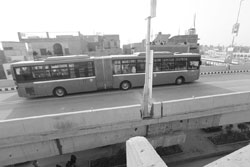
transparency On February 28,
2013, Transparency International Pakistan (TIP) and the Punjab government
signed a memorandum of understanding (MoU) to expose corruption, if any, in
three of its mega projects — the Metro bus project, the Laptop scheme and
Ujala programme. The Chief Minister Punjab who was present on the occasion,
in a brave move, promised that the report would be finalised before the end
of tenure of his government and made public. The TIP looked into all
three mega projects and, within two weeks, gave a clean chit to Punjab
government in all of them. Or almost. No corrupt practices were
found in the Laptop and Ujala schemes while it cleared 25 out of 27 contracts
of the metro bus project. “Based on the information given by the Lahore
Development Authority, prima facie it appears that the Punjab Procurement
Rules 2009 have been followed in the procurement contract of Rs.2.9078
billion to 25 contractors and 2 contracts for Metro Bus Supply &
Operation and Security at annual cost of Rs1.2018 billion. However, TIP feels
that the two unsolicited contracts awarded to M/s NLC, as stated above, shall
have been processed on the basis of competitive bidding as per Punjab
Procurement Rules 2009,” reads the TIP report on the project. On the other hand,
according to a news item published in The News on March 15, 2013, the TIP
advisor Syed Adil Gilani said that last five years period in Pakistan’s
short history of 65 years had been the worst in governance and corruption.”
The ranking of Pakistan in TI Corruption Perception Index dropped from 47th
most corrupt country in 2008 to 35th most corrupt country in 2012,” he
reportedly said pointing towards the PPP-led federal government’s tenure. Shahbaz Sharif-led Punjab
government has been advertising its performance indicators, now with the TIP
certification. “Transparency International has confirmed that all projects
executed by Punjab government are corruption free,” says Senator Mushahid
Ullah Khan, secretary information PML-N. This is an interesting
situation. Critics say there is a possibility that the TI did not find
embezzlement of funds but it could not detect any violation of rules and
regulations in these projects. They say the Metro Bus Project was never
discussed in the last budget nor was it approved by the Punjab Assembly. The PPP-led former federal
government had long been criticising the TIP for leaning towards the PML-N.
In fact, in 2011, the federal government stopped the various departments from
cooperating with the TIP. That was the reason the TIP had not been able to
produce its annual reports after 2011. Interestingly, the TIP has also termed
the Punjab government as the least corrupt government in the country in 2010. “The timing of these
reports, right before the elections, is critical. It is also interesting that
the TIP had evaluated three projects worth billions of rupees in less than
two weeks time,” says Nadeem Afzal Gondal, ex-chairman Public Accounts
Committee (PAC) of the National Assembly. “Transparency has termed the
federal government as the most corrupt in Pakistan on the basis of reports of
auditor general of Pakistan and recoveries made by PAC but it has never
pointed out that in the Punjab Assembly, not a single meeting of PAC was held
in the last two years,” he says. The TIP has no
infrastructure to evaluate mega projects. “There is work force in hundreds
in the Auditor General’s office and even then it took them months to
evaluate mega projects. It takes weeks after audit reports to find out
embezzlements and corruption.” Economist Dr Kaiser Bengali
says the TIP mostly does its work on the basis of perception surveys with a
very biased sampling. “They do not even rank countries on the basis of hard
data on corruption index. They conduct surveys with traders and businessmen
to rank the countries. Their data is flawed. I have never ever given credit
to TI’s ranking.” He says the TIP does not
have infrastructure to evaluate mega projects like Metro Bus Service in two
weeks. “It takes months to conceive and execute such projects and one needs
capacity and certain skills to evaluate them. I do not think the TIP has the
capacity and skills for that,” he says. “The TIP has evaluated projects
under public procurement rules, but they need auditors to do so.” Syed Adil Gilani, advisor
of TIP, says his organisation has nothing to do with politics. “We signed
an MoU with the Punjab government as we have already signed with several
departments of federal government. We investigate projects on the basis of
information provided to us by the government on the basis of the NAB Contract
Evaluation Forms. We have not given a clean chit to Punjab government in
Metro Bus Project. We had objected to two out of 27 contracts worth Rs2
billion,” he says. “It is up to the NAB to investigate whether
information provided to us is correct or not as we and all government
departments share that information with NAB.” “TIP is a trust with nine
trustees. It has volunteer members all over the country. None of its trustees
or members can be government official or office bearer of some political
party,” he says. “We evaluate the work of different public sector
departments on the basis of information provided to us by those departments
and then make it public. It is NAB’s duty to find out whether the
information and documentation provided to us is real or not.” Dr Ayesha Siddiqa, a
trustee of the organisation according to its website, says that “TIP is
very centralised. It is trying to create political space for itself. I
personally think that TIP needs more accountability than anybody else.” “It is not only a
question of capacity; TIP is politically very ambitious. It takes a lot of
time and infrastructure to evaluate such mega-projects; these are not simple
money transfers,” she says. Yasmin Lari, another
trustee of TIP, says that it is a civil society organisation and depends on
funding from different sources to carry on its work. “We do not accept
donations from governments,” she says, adding that TIP has no political
ambitions but “it is true the Punjab government has been using our report
in its favour. We will review the situation in the next meeting of trustees
|
|